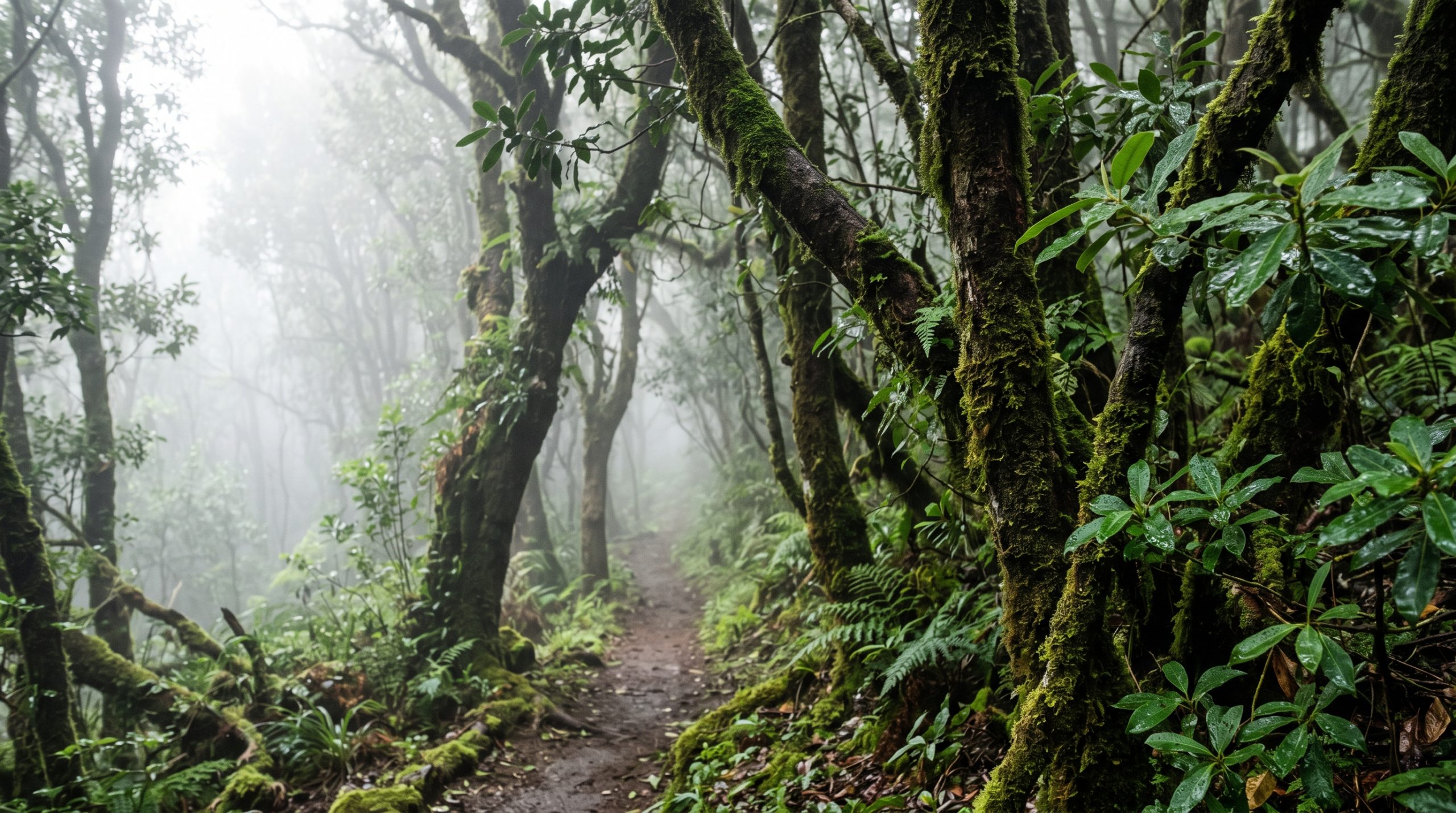
Drive up from the port at San Sebastián on a bright morning and somewhere around 800 meters the windshield turns gray. It looks like the day is over before it has started. It has not. That gray is the entire reason Garajonay exists: the trade winds push damp Atlantic air into the middle of La Gomera, the mountains wring it out as mist, and the result is a laurel forest that covers roughly 70% of the national park and stays wrapped in cloud for much of the year.
This is the sort of forest that grew across southern Europe in the Tertiary, before the ice ages edited the continent, and it survives here in about 40 square kilometers of ridges and ravines. UNESCO listed it in 1986. The park reaches into all six of the island’s municipalities, so you are never far from a village, a coast, or a completely different climate.
What follows is the practical version. The ferry, the road, the walk in wedding clothes, the paperwork, and the one thing that decides your ceremony hour here: where the cloud is sitting relative to your feet.
The forest is the venue and the cloud is the timetable
A private ceremony in the laurel forest needs no venue booking and no hire fee, because you are two people on a public trail. What it does need is planning. Non-resident couples handle the legal marriage at home, professional filming goes through the island’s film commission, and the trade wind cloud rather than the sun sets your hour.
Fifty minutes of Atlantic, then the GM-2
Almost everyone arrives by sea. The crossing from Los Cristianos on Tenerife to San Sebastián de La Gomera takes about 50 minutes, runs all year, and is worked by Fred Olsen Express and Naviera Armas, with roughly three sailings a day each and more through the summer. The first boat out of Los Cristianos leaves around 08:45 and the last one back from San Sebastián goes at about 20:30. One-way fares currently start near 44 euros.
From the harbor, the GM-2 climbs across the island’s spine in switchbacks that take longer than the map suggests. Laguna Grande, at the kilometer 26 to 27 mark and around 1,250 meters up, is the one place inside the park with proper facilities: parking, restrooms, an information point, picnic tables with benches, and a restaurant. It is also where the tour coaches stop, and when the parking area fills they wait along the roadway. Several other trailheads are signed with a P that turns out to mean a widened shoulder, which is worth knowing before you plan to arrive in a dress with nowhere to pull in.
Without a car it still works. The guagua on Line 1 runs up from San Sebastián and stops at Pajarito and Cruce de Garajonay. Outside the boundary, the Juego de Bolas visitor center sits at La Palmita in Agulo, 3 km from the park, currently open 9:30 to 16:30 daily and closed only on 25 December and 1 January. Nobody sleeps inside the park itself. Couples base themselves in Hermigua or Agulo on the wet green north side, or down in Valle Gran Rey and Playa de Santiago where the sun is reliable.
Mist is the light, not the weather problem
Nearly every location guide tells you to book the hour after sunrise or the hour before sunset. Inside this forest that advice is close to useless. Under a cloud ceiling the laurisilva sits in flat, shadowless light that hardly shifts between mid-morning and mid-afternoon, which means vows at eleven look like vows at six. The hard day here is the cloudless one, when direct sun punches through the canopy and the forest floor breaks into white blotches that no exposure holds together.
Height is where the sun becomes useful again. Alto de Garajonay, 1,487 meters and the highest point on the island, frequently stands above the cloud layer while the plateau below it, between 790 and 1,400 meters, stays inside it. On those mornings you get Teide across the water, La Palma and El Hierro on the horizon, and the Fortaleza de Chipude rising out of white. On a uniformly gray day, by contrast, the roadside viewpoints along the GM-2 give you a wall of nothing, and we say so rather than driving you to three of them in turn.
The two things this place gives a camera are completely different from each other. Photographs go quiet and green and very close: epiphytes, ferns, water beading on a laurel leaf, a figure half-dissolved in vapor ten meters up the path. Film does the opposite, because mist actually moves, and a slow drift of cloud through the canopy carries a scene in a way a still frame cannot. Our published galleries and films are the fastest way to see which of the two you respond to, and plenty of couples decide they want both after looking.
Working two cameras in here is a matter of lanes. Most of these paths are single file between trunks, so the photographer and the filmmaker agree in advance who takes the uphill side and who drops back, which keeps each of them out of the other’s frame. The canopy also does something useful: it stops the wind almost completely, so spoken vows in the forest record cleanly, with dripping condensation and pigeons overhead as the only bed. The Expedition puts professional audio on those vows where conditions allow. With eight of us on the team there is always a second camera on the ground and a colleague in reserve.
The Pajarito path in a dress
From the Pajarito trailhead on the GM-2, the way to the summit follows the GR-131 and then the El Contadero to Alto de Garajonay path: a little over a kilometer each way, roughly 120 meters of climb, 30 to 45 minutes up at a talking pace. The first stretch is wide and paved. After that it turns to packed earth with built-in steps and uneven ground, and the steps are the part that matters in wedding clothes, not the distance.
Condensation keeps dripping off the canopy long after any rain has stopped, so stone stays slick and leaf litter stays damp. A long hem takes on dark wet marks in the first hundred meters and a train will drag through everything. What we do instead is walk up in trail shoes with the dress carried, change at the top, keep a veil short or leave it in the car, and accept that this humidity has firm opinions about hair. Done at seven in the morning with the right footwear it is one of the better walks in the Canaries. Attempted in heels it is a bad half hour.
There is more here for couples who want the walking to be the day itself. The Pajarito loop runs about 4.6 km and takes an hour and twenty minutes. The full crossing from Pajarito over the summit and down through Igualero and Alajeró to Playa de Santiago is roughly 18.5 km and six and a half hours, leaving the laurel forest for the dry south, with the Line 3 bus back to San Sebastián at the end of it.
The day-trip ferry sets the crowd clock
Around 450,000 people visit the park each year, and a large share of them are day-trippers who land on a morning boat from Tenerife and leave on an afternoon one. That hands you an unusually honest rhythm: the interior fills from about 10:30 and empties again after four, and nobody can beat you to it before their ferry has docked. Ten minutes of walking from any trailhead removes most of the rest. The catch is small and worth naming. At seven in the morning the cloud has sometimes not formed yet, and the visitor center is shut until 9:30, so an early start is about solitude rather than services.
Permission, and the residency rule nobody mentions
Garajonay was created as a national park by Spanish Law 3/81 and has been managed by the Canary Islands government since responsibility was transferred in 2009. For a couple standing on a public trail speaking vows to each other, that changes nothing practical. There is no venue to book, no hire fee, no permission to request. Most pages hedge this, and it deserves saying plainly.
Professional work is a separate question. Filming and photography permits for the island run through the La Gomera Film Commission, which publishes its own application form and a second, specific form for shooting inside Garajonay National Park, submitted by email. Researching that, filling it in and lodging it in time is our job. Government, venue and landowner fees, where any apply, sit with you, alongside accommodation, your celebrant and anything unusual you want to travel in.
The legal marriage is the part that surprises American couples. A Spanish civil wedding expects one partner to have been legally resident, and the residency is counted in years rather than weeks, with two continuous years the figure that comes up. So the workable shape is the one most couples use anyway: sign the paperwork at home, and let the forest carry the vows that matter. If that sequence is new to you, our guide to planning an elopement walks through the order of operations.
Aerials need the same clear thinking. Spain’s national parks are closed to drone flying without special authorization, so we do not build a film around footage from inside the boundary. Where a story wants air, we look for legal ground outside the park and confirm the airspace before it becomes part of the plan. Full-day coverage here starts at $4,900 with one dedicated photographer or one dedicated filmmaker, and $7,900 for a photographer and filmmaker working the day together, with the team’s flights and accommodation to the island included; the coverage and pricing page sets out what each one covers.
Forty minutes from cloud to sunlight
The backup plan on La Gomera is not a different date. It is a different altitude. The center and the north sit under the trade wind cloud and take more than 800 millimeters of rain a year, most of it in the cooler months, while the south and west around Playa de Santiago and Valle Gran Rey stay dry and sunny. If the forest is streaming water at noon, we do not cancel anything; we move down and out, and the last hour of the day happens in hard coastal light instead. Calima days, when warm Saharan dust hangs over the archipelago for anything from a couple of days to a week, work the other way around: distance views go flat and hazy, so we spend the time inside the forest where haze cannot be seen at all.
Two smaller things shape the day. At 1,250 meters, Laguna Grande is not coastal weather, and couples who pack only for a Canary Islands beach feel it within ten minutes of stepping out of the car. And the forest suits a particular temperament. It is green, dripping, enclosed and strange, and it rewards people who find that beautiful rather than gloomy. If your picture of these islands is warm rock and a slip dress at sunset, the day should be built the other way around, weighted to the coast with a short forest hour early on, and there are other islands in our destination elopement guides that may fit you better. Tell us which version you actually want and we will shape the day around it, or say honestly which month or which coast serves it better.
Common questions
Do we need a permit to say our vows in Garajonay National Park?
Not for the ceremony itself. Two people exchanging vows on a public trail need no permission and pay no venue fee. The permit question applies to professional filming and photography, which is handled through the La Gomera Film Commission using a form specific to the national park, and that part is ours to research and submit.
Can Americans legally get married on La Gomera?
A Spanish civil marriage expects one partner to have been legally resident, counted in years rather than weeks. In practice couples from the United States complete the legal marriage at home and hold the ceremony that matters in the forest, which removes the paperwork problem entirely and leaves the day free to be about the vows.
What happens if the ferry from Tenerife is delayed on the morning of the ceremony?
We do not put a same-day crossing in front of your ceremony hour. The team travels over the day before, and we suggest you do the same. The Los Cristianos to San Sebastián route takes about 50 minutes and runs several times a day, so a shifted sailing becomes an inconvenience rather than a problem.
Is there anywhere to change out of hiking boots up there?
Laguna Grande has restrooms, a restaurant and parking, and it is the only place inside the park with facilities of that kind. Everywhere else, the car is the changing room. We plan the timeline around that honestly, with the walk in trail shoes and the change happening where you can actually stand up straight.
Is the laurel forest too dark to photograph and film?
No, though it is darker than it looks to the eye. Under cloud the light is flat and even rather than dim, which suits both cameras and holds steady for hours instead of minutes. The genuinely difficult condition is bright sun through the canopy, and that is what we plan around.
Can you fly a drone over the laurel forest?
Not inside the national park. Spain’s national parks are closed to drone flying without special authorization, so we plan aerials for legal ground outside the boundary and confirm the airspace first. Given how much of Garajonay’s character is under the canopy rather than above it, that costs the film less than you would expect.
Where the vows actually happen
A day here usually goes like this. You sleep on the island, not on Tenerife. We leave the coast in the dark, walk up from Pajarito as the light arrives and, if the cloud is behaving, stand above it at 1,487 meters with three islands on the horizon. Then down into the trees for the ceremony itself, somewhere off a trail with the sound of water in it, before the road drops you into sunlight on the south coast for the end of the day.
We currently have Canary Islands elopement dates available through 2027–2029, and the whole planning trail stays written and easy to revisit, which suits time zones better than anything else. Send us your dates and we will reply with a first brochure inside 24 hours, then a proposal built for this island; a signed contract and a 30% retainer start the planning. Highlights reach you within 5 days of the day itself, and the full gallery or film within 3 weeks. Check Your Date and tell us what you want the forest to sound like.