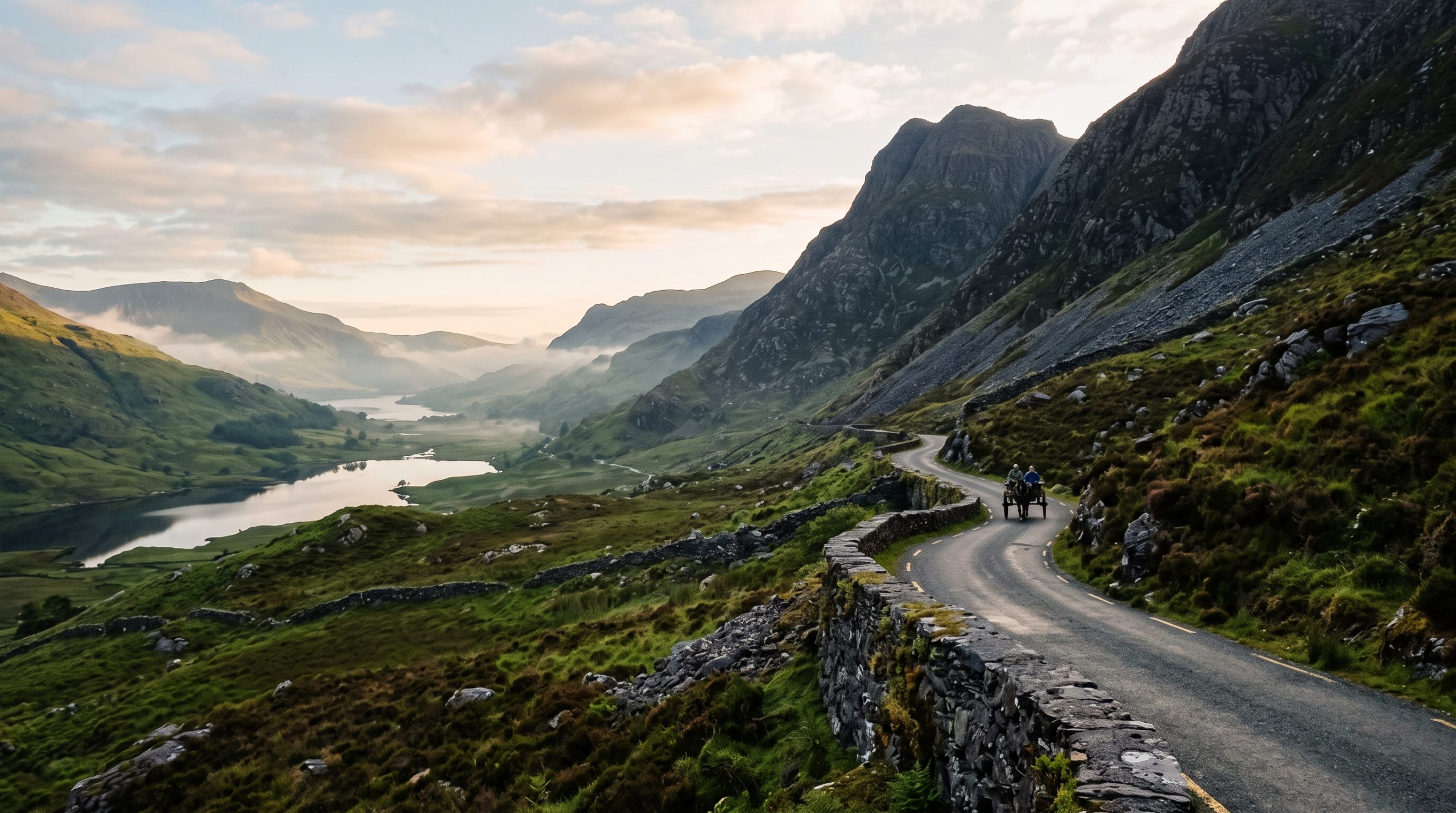
The Killarney day tours leave town at ten in the morning. It is 14 km from the Muckross Road out to Kate Kearney’s Cottage, so the first coach reaches the car park at the mouth of the Gap of Dunloe at around twenty past, and the jarveys are hitched and pulling up the road at much the same hour. Every decision about a wedding morning in this pass comes back to that piece of arithmetic.
Be on the road before it and the Gap is one of the quietest places in Kerry. Eleven kilometres of sealed single lane threaded between MacGillycuddy’s Reeks and Purple Mountain, five small lakes strung along the River Loe, an old arch bridge near the start that everyone calls the Wishing Bridge. Arrive at half ten instead and you are in a slow procession of walkers, cyclists, ponies and rental cars backing into gateways for one another.
None of that is a reason to go elsewhere. It is the shape of the place, and once you know it the pass gives you a morning very few couples in Killarney ever see.
What a wedding in the pass actually requires
The Gap of Dunloe is a public road, and every marriage in Ireland must take place somewhere open to the public, so a ceremony here works legally with a registered solemniser. You give the HSE three months’ notice, collect your marriage registration form, and plan around 11 km of single lane that fills from ten.
The road belongs to the horses from ten until four
Kate Kearney’s Cottage sits 12 km west of Killarney, about a fifteen-minute drive, and it is the only realistic place to leave a car at this end. There is no public bus out here. In July the car park is filling by mid-morning, and from then until the middle of the afternoon the road above it is a working thoroughfare rather than a mountain pass.
A jaunting car takes roughly ninety minutes to two hours to cover the 11 km through to Lord Brandon’s Cottage. The jarveys are self-employed, they work independently of the coach companies, and they are paid directly on the day, in cash, which is worth knowing before you drive out with a card in your pocket and nothing else. A car carries four people.
It is a public road and you are entitled to drive it. We would rather you did not, at least not between mid-morning and late afternoon, because the drive becomes a sequence of reverses into passing places. Honest version: at eleven on an August morning, the middle of the Gap photographs like a queue. The rock is still magnificent. The road in front of it is full.
So we work the ends of the day. In midsummer that means walking up from the car park at around half five or six, with the whole pass empty and the first jarveys still an hour and a half away. In late September and October the arithmetic gets kinder, because sunrise has slipped to around twenty past seven and you can have both the light and an unhurried breakfast. Couples who genuinely dislike early starts do better with a late afternoon into evening plan, and that works here too. Tell us which of those two people you are and we will build the day around it rather than talking you into the other one.
Why first light lands on the crest and not on the lakes
This is the part almost every page about the Gap gets wrong, and it is pure geometry. The pass was cut by glacial ice between two ranges: MacGillycuddy’s Reeks on the west side, Purple Mountain on the east. Both walls rise several hundred metres within a kilometre or so of the tarmac. That means the valley floor beside the lakes is lit by open sky long before it is lit by the sun, and in the evening the sun disappears behind the Reeks well ahead of the sunset printed in any app.
The practical consequence is that height matters more than the clock. The crest at the Head of the Gap, a little over 5 km up from the car park, catches sun first and holds it last. The lower road and the water sit in soft, cool, indirect light for long stretches either side of that. So we tend to put the ceremony high and the walking low, in that order, and let the light come down the eastern wall towards you while you make your way back.
Real numbers to plan against, all local time. On 21 June the sun is up at about 05:18 and does not set until roughly 22:02. By 20 September it is 07:20 and 19:42. By 20 October, 08:11 and 18:34, which is why late autumn is quietly the strongest month here for couples who want first light without a middle-of-the-night alarm.
Grey weather is not the enemy in the Gap. Flat cloud sitting on the ridgelines makes the rock read darker and heavier, the wet tarmac turns into a mirror running away between the walls, and the lakes go the colour of slate. Some of the work we are proudest of in Kerry was made in conditions a forecast would have called a write-off. You can see how places like this actually photograph and how the films move in our stories from real elopements. Highlights reach you within five days and the full gallery or film within three weeks, so the Gap is still fresh in your legs when it lands.
Five kilometres of tarmac in the wrong shoes
The road through the Gap is sealed the whole way, and hiking boots are genuinely not needed. Comfortable shoes are, though. The pull from Kate Kearney’s to the crest is steady rather than steep, a little over 5 km, and up and back at an unhurried pace with stops is a three-and-a-half-hour morning. The full through-route to Lord Brandon’s Cottage is 11 km and takes most walkers two to two and a half hours one way.
In wedding clothes, here is the truth of it. On a dry morning the tarmac is kind and a long hem survives easily. After rain, the edges of the road carry running water and loose grit, and a train picks both up within a hundred metres. Sheep have the run of the whole pass and they use the road as much as the grass. There is no shelter anywhere between the car park and the crest, no building, no trees worth the name.
So we plan it the way locals would. Walk up in trainers or boots with the dress in a bag, change at the crest or at whichever lake we have chosen, and let the last five hundred metres of approach be the part that gets photographed. If walking is not the plan at all, a jaunting car will take you the whole way through, though it is worth knowing that a horse-drawn car on an uneven mountain road is a firm, jolting ride rather than a glide. The wind funnels straight through the narrowest part of the pass, so a veil is a decision, not an accessory.
Who says yes: the registrar, the park and the landowner
Start with the paperwork, because it has the longest lead time. Every marriage in Ireland needs a marriage registration form, sometimes called a marriage licence, and it covers civil, religious and secular ceremonies alike. You get it by giving your local HSE Civil Registration Service at least three months’ notice of your intention to marry, at a marriage notification appointment. Waiting times for that appointment vary by office, so it is the first thing we put in your timeline rather than the last. The sequence, in order, is set out in our guide to planning an elopement.
Then the venue question, which is where the Gap gets interesting. All marriages in Ireland, whatever the type, must happen at a venue that is open to the public. A civil ceremony conducted by an HSE registrar carries an extra condition: it has to be at a registry office or at a venue the registry office has approved, the registrar may need to inspect it, and the official guidance on outdoor ground describes a yard, garden, field or piece of ground attached to a building that is open to the public. Civil ceremonies also run Monday to Friday only, never weekends or bank holidays. Halfway up a mountain pass does not meet that description, which is why couples marrying in the Gap itself work with a solemniser registered through a religious or secular body from the State’s Register of Solemnisers. Nothing about that is a workaround. It is simply the right door.
The road surface itself is public, and a small private ceremony standing on it needs no ticket and no permission. Step off it and ownership changes quickly. The land either side of the pass is farmed and walled, and the car park at the cottage is private ground, so both are matters of asking rather than assuming. Push east into Killarney National Park, which covers more than 26,000 acres of lake, woodland and mountain, and you are on National Parks and Wildlife Service ground, where permits are required for all commercial and organised activities and events, with queries going to the park’s Regional Manager.
Two specifics are worth having in writing. Recreational drone flying is not permitted within Killarney National Park at all, because of the effect on wildlife and nesting birds in particular, so any aerial work inside the park boundary runs on NPWS permission rather than optimism. And the park currently issues no private boating permits, which means the beautiful lake leg from Lord Brandon’s Cottage down through the lakes to Ross Castle happens with the established boatmen or not at all. We do the permit research and the asking as part of planning. Where a government, park or landowner fee applies, you pay it, and we tell you the number before you commit.
When the cloud sits on the Reeks all morning
The Gap has a useful property: its best material is spread along 11 km rather than concentrated at one viewpoint. When the tops are buried and the crest is inside the cloud, we move down instead of cancelling. The five lakes and the Wishing Bridge sit in the first two kilometres, close to the car and to the only indoor space at that end, and they hold up beautifully in low grey light.
If the whole pass is socked in, the day moves sideways. Killarney National Park’s lakeshore and woods are minutes from town on the N71, and the road south from the crest drops into the Black Valley and on towards Moll’s Gap. Building a first and a second version of the same day is standard for us in Kerry, not an emergency measure, and it is the same habit that runs through our destination elopement guides.
Two cameras on a road one car wide
The Gap is a hard place to hide a colleague, which is exactly why it suits the way we work. The road is one vehicle wide with stone walls close on both sides, so a filmmaker with a long lens sits eighty or a hundred metres up the tarmac and shoots straight back down the pass while the photographer works close, and neither appears in the other’s frame because the road itself provides the sightline. The wind is the real problem, not the sightlines. It accelerates through the narrows and flattens any voice pointed into it, so vows go on the sheltered side of a boulder or a wall, with the professional audio that comes with The Expedition. Coverage runs from one dedicated photographer or filmmaker on The Adventure, from $4,900, to a photographer and filmmaker together on The Expedition, from $7,900, with the assigned team’s travel to Kerry included, and the rest is on our pricing page.
Common questions
Do we need a permit to hold our ceremony on the Gap of Dunloe road?
For a small private ceremony standing on the public road, no permit is needed for the ground itself. Permission becomes a question the moment you step into the fields either side, use the private car park at the cottage for anything beyond parking, or move east into Killarney National Park, where permits are required for commercial and organised activity.
Can our HSE registrar marry us at the top of the Gap?
Realistically, no. A civil ceremony has to take place at a registry office or a venue the registry office approves, the guidance ties outdoor ground to a building open to the public, and civil ceremonies happen Monday to Friday only. Couples marrying in the pass itself use a solemniser registered through a religious or secular body, which is a legally recognised route and gives you the location and the day of the week you want.
Can we take a jaunting car up in a wedding dress?
Yes, and plenty do. The car seats four, the jarvey is paid directly on the day in cash, and the journey through to Lord Brandon’s Cottage takes about ninety minutes to two hours. Expect a firm ride rather than a smooth one, and plan for wind at the highest point of the road.
Is there anywhere at the Gap to change and get warm?
Kate Kearney’s Cottage at the mouth of the pass is a long-established family-run bar and restaurant and the only indoor space at that end. Beyond it there is nothing at all for 11 km. In practice the car is the changing room, which is why we time the walk so you are only in wedding clothes for the stretch that matters.
Can we fly a drone in the Gap of Dunloe?
Recreational drone flying is not permitted inside Killarney National Park, and any aerial work within the park runs on NPWS permission. We confirm what is possible for your specific date and location before we plan any part of the film around aerials, and we build the film so it works completely without them.
How the morning runs, crest to car park
A midsummer Gap day starts in the dark at the car park, walks up with head torches and boots, and reaches the crest as the eastern wall begins to lighten. Vows at the top with the pass empty below you. Then a slow descent, changing pace at the lakes and the Wishing Bridge, the sun working its way down the rock as you go. Breakfast at the cottage by the time the first coach arrives, and the rest of the day is yours.
Our current Ireland availability runs across 2027–2029. We handle the planning in writing so nothing depends on matching time zones: send the inquiry form, and a reply with our initial brochure comes back within 24 hours, followed by a proposal built around your dates, the light in the pass and the hour the road fills. Check Your Date and tell us what you want the morning to feel like.