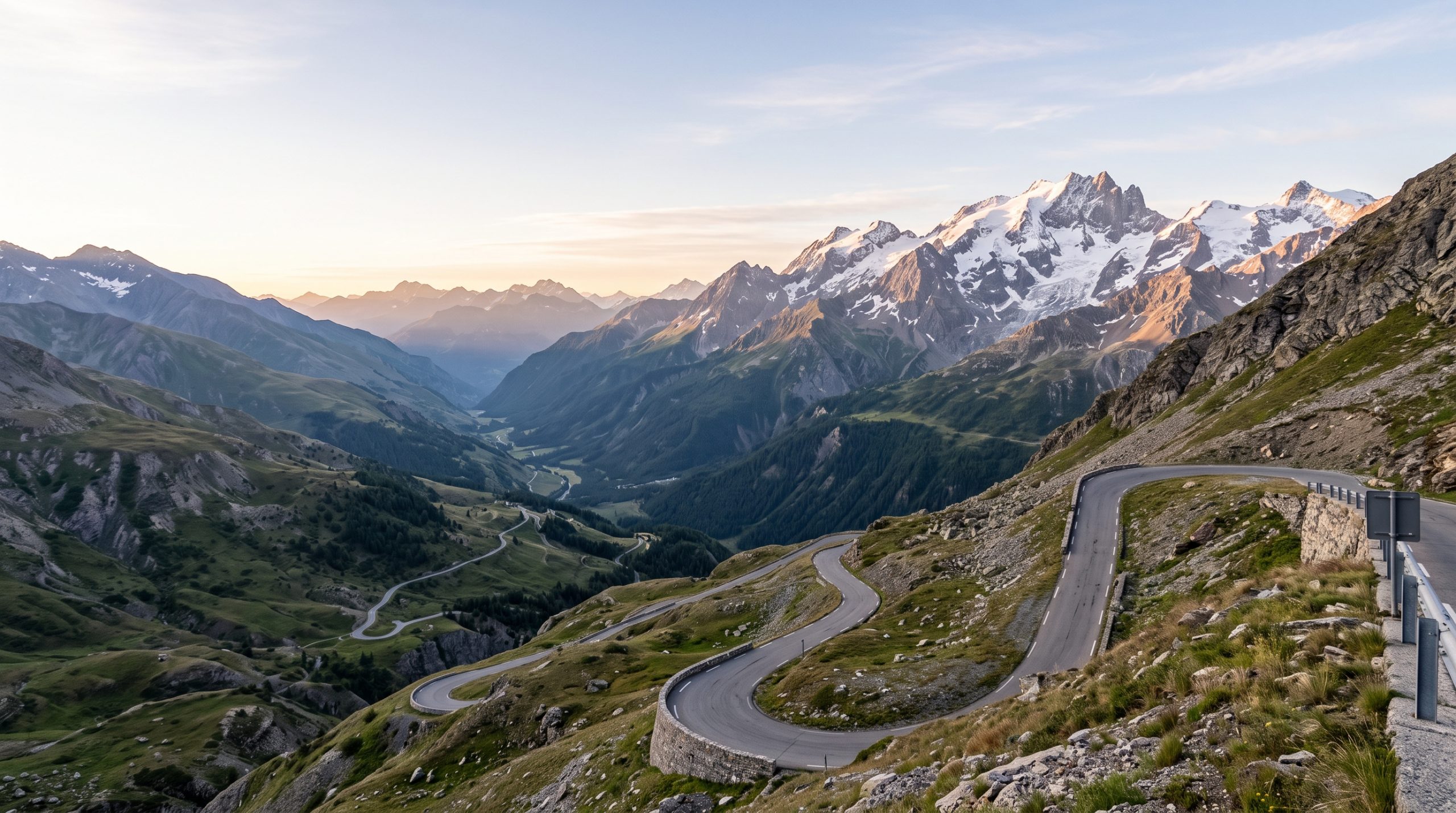
Chamonix sits at 1,035 metres. The Aiguille du Midi station hangs at 3,842 metres above the same street, and in late June the sun is up before 5:45am while the first cabin to the top does not leave until around 6:10am. The gondola at La Flégère, on the opposite wall of the valley, starts later still. The best light in the Mont Blanc valley happens before the mountain opens for business.
That single mismatch decides almost everything about an elopement day here. Lac Blanc, at 2,352 metres, is the frame most couples already have in their heads: the whole Mont Blanc massif laid out across the water, the Drus and the Grandes Jorasses off to one side. It sits inside the Aiguilles Rouges nature reserve, roughly 1,300 metres of climbing above the road at Les Praz. Arrive by lift and chairlift and you get there mid-morning with everybody else. Walk up in the dark and the place is yours for an hour.
Mont Blanc catches light long before anything at valley level does. In a trench this deep, official sunrise and the minute the sun actually reaches you are two different times, and the gap is what we plan against rather than the number printed on a weather app.
What our French Alps coverage actually is
We photograph, film and plan elopements across the French Alps, most often in the Chamonix valley and the Aiguilles Rouges. One team of eight handles location design, the timeline, permit research and both cameras. The Adventure, a full day with one dedicated photographer or filmmaker, starts at $4,900, and team travel to France is included.
The day, built around a lift that opens two hours after sunrise
Every access point into height in this valley has an opening time, and none of them opens at dawn. That is the whole planning problem, and it is the reason we build the day from the light backwards instead of from the timetable forwards.
| Way up | Height reached | Earliest movement | What that means for the day |
|---|---|---|---|
| On foot from Les Praz to Lac Blanc | 2,352 m | Whenever you start walking | The only way to stand at the lake before the sun does |
| Flégère gondola, then the Index chairlift | 2,595 m | Index departures from about 8:35am in early summer | You arrive two to three hours after first light, with company |
| Montenvers cog railway to the Mer de Glace | 1,913 m | First train 8:30am, 20 minutes from town | Height without a walk, ideal as a mid-morning second location |
| Aiguille du Midi cable car | 3,842 m | First cabin around 6:10am in the peak July and August weeks | The big set piece, but the round trip runs two to three hours and doubles when the queue is long |
Here is a late-June Expedition day as we would actually shape it. We leave the car park at Les Praz somewhere around 2:30am, on headlamps, in silence, with the photographer carrying dresses and the filmmaker carrying sound. The climb is long rather than difficult. By 5am you are at the lake with time to change, breathe and stop shaking out your legs before anything is asked of you.
The summits go pink first. Sunrise is at 5:42am on the solstice, but the light that matters lands on the massif across the valley several minutes before it touches the ridge you are standing on, and we want you looking at it when it happens. Vows go in the lee of the boulders on the north side of the lake, where the sound is clean. Portraits go on the exposed lip afterwards, where the wind does something useful to a veil.
By 7:30am the reserve is waking up. Lac Blanc and the Lacs des Chéserys are protected water, so there is no swimming here by prefectoral decree and no dogs anywhere in the reserve, which is worth knowing before you plan a ring-bearing labrador into your morning. We walk down towards Flégère as the first lift-borne walkers come the other way, and by then we already have the hour that everybody else came for.
Mid-morning belongs to the valley floor. Breakfast in town, a change of clothes, and then the 8:30am cog railway is long since running towards Montenvers, twenty minutes and 878 metres of climbing from a station in the middle of Chamonix, for the glacier and the granite spires above it. Afternoons in July and August build cloud, so we rest through the middle of the day rather than fight it, and we hold the Aiguille du Midi as an option rather than a fixture, because a queue is not a location.
Then the day reopens. From about 5pm the light comes back low across the pastures at Le Tour and along the Balcon Nord under Plan de l’Aiguille at 2,310 metres, and in late June it keeps going until sunset just before 9:30pm. That is a genuinely long second half. In December it is a different animal altogether: the shortest day here runs 8 hours 42 minutes against 15 hours 48 minutes at midsummer, and the earliest sunset falls on 10 December at 4:49pm, so a winter day becomes one continuous arc rather than two ends with a gap in the middle.
Tell us the month you are looking at and we will tell you what the light is doing then, and what it means for where you stand at 5am. Check Your Date.
Two cameras, one plan, and twenty minutes of good light
This is the part of the page that matters most, because in this valley the difference between one team and two hired teams is measurable in minutes.
First light at 2,352 metres lasts about twenty minutes and cannot be repeated. A photographer wants you turned into it, hair going sideways, standing on the edge where the ground falls away. A filmmaker recording vows wants shelter, a stable frame and air that is not roaring across a microphone. Those two requests conflict, and on a ridge at 5am they conflict loudly. When the photographer and the filmmaker are on the same team and worked on the same timeline weeks earlier, the conflict has already been solved on paper: vows in the lee, portraits on the lip, the walk-in filmed on the way up in the dark rather than staged again afterwards when the light has gone hard. When they meet for the first time in a car park at 2am, the negotiation happens live, and it costs you the only twenty minutes you had.
The film here also cannot lean on the shots couples imagine when they picture the Alps. Drones do not fly in the Aiguilles Rouges nature reserve at all, at any time of year, and flight over the Mont Blanc massif is closed from 1 July to 31 August. So the aerial that everyone pictures rising over Lac Blanc is simply not available, and any film that depends on it was planned badly. What works instead is scale done with a long lens from across the valley, movement on foot, and sound: boots on scree, the cog train whistle two thousand metres below, wind arriving in pulses. The Expedition adds professional audio for vows where conditions allow, and where aerials are legal and appropriate we build them in on a permit and a time window that we confirm before the timeline is written.
Eight of us do this, which is the other half of it. There is always a second camera on the ground and a colleague in reserve, and if a plan changes at 4am nobody has to ask a stranger to improvise. If you want to see how this valley and other alpine light actually resolve in the finished work, our galleries and films are the honest answer to what a morning like this gives you.
The mairie question: marry at home, elope here
This is the one thing couples write to us worried about, so here it is plainly. French law expects at least one of you to have lived continuously in the commune for about thirty days before a civil marriage takes place at that town hall. For a couple flying in from Denver for six nights, that puts a mairie ceremony out of reach, and no photographer or planner can shortcut it.
What almost every couple does instead is sign the legal paperwork at home, before or after the trip, and hold the ceremony that actually means something at 2,352 metres with a celebrant, or with nobody but the two of us and the two of you. The practical effect is freeing. There is no transfer to a town hall in the middle of the morning, no appointment slot dictating when you stand where, and no outfit change squeezed between two ceremonies. The day answers only to the light. Our planning covers the permit research and the logistics for wherever you choose to stand, and the fees themselves are yours to pay. If you would like the legal side explained in order rather than in pieces, our guide to how to plan an elopement sets out the sequence.
What is in every Alps experience, and where coverage starts
Everything below is included in every experience we run, in France and anywhere else:
- Destination and location design, and planning from the first email to the morning itself
- A custom timeline built around light and real travel time, including lift opening hours and the walk-in
- Permit research and logistics guidance
- Weather alternatives and backup planning, which in this valley means a low-level version of every high plan
- Drone footage where it is legal, safe and appropriate
- Team travel worldwide: flights, accommodation and ordinary travel for the assigned team, with no European or long-haul distinction
- Highlights in 5 days, and the full gallery or film in 3 weeks
The Expedition, with a dedicated photographer and a dedicated filmmaker working the same day together, starts at $7,900 and adds professional audio for vows and other moments where conditions allow. The Odyssey runs two to seven days across one valley or several and is quoted as a custom proposal. Every figure and what sits behind it is on our pricing page. The fee does not move with your guest count: guests change access, permits, transport and timeline, not the price.
What the mountain charges is separate, and in Chamonix it is not hidden. A round trip on the Montenvers railway currently runs a little over €31 per person. If your day includes glacier ground, a private mountain guide from the Chamonix company starts around €390 for two people on a Vallée Blanche day. Add accommodation, your celebrant, any government or landowner permit fees, and unusual transport such as a helicopter, a private boat lower down the lakes or a 4×4 charter. We tell you which of these your plan needs before you commit to the plan.
How a French Alps package becomes a held date
- Send the inquiry form with your dates, or the month you are circling, and what you picture.
- We reply within 24 hours with an initial brochure.
- We put together a tailored proposal: the shape of the day, the team assigned, the locations that fit your date.
- You sign the contract and pay a 30% retainer, and the date is yours.
- Planning begins in earnest: locations, timeline, permits, alternatives.
- We shoot the day, highlights reach you in 5 days, and the full gallery or film in 3 weeks.
The rest of the payment plan is written into the proposal, so you see all of it before you sign anything.
Who the valley fits, and which month fits you
Chamonix rewards couples who are willing to be walking at 2:30am and are steady on rough ground for a couple of hours. If that sounds like the best morning of your life, this is your place and Lac Blanc is your ceremony.
If uneven ground is not for you, say so early and it changes very little about the day. The Index approach to the lake crosses loose scree and we would drop it. The Montenvers railway gains 878 metres without a step. Plan de l’Aiguille, the pastures above Le Tour, the larches at Les Praz and the water meadows on the valley floor all photograph beautifully in low light and ask nothing of your knees.
Timing is the other lever. Most valley lifts open in the first half of June and stop in the second half of September, with a short autumn reopening at Flégère around mid-October before the winter season begins in December. May, late October and November are on-foot months here, and they are quiet and beautiful if you plan low. The valley also fills twice a year, for the Mont Blanc Marathon in late June and for UTMB week at the end of August, and we would rather move your date by five days than share your ridge with a race village.
If one valley is not enough
An Odyssey across two to seven days lets the Alps stop being one postcard. Chamonix to the Vanoise is the classic run, over the Col de l’Iseran at 2,764 metres, the highest paved pass in the Alps and the high point of the Route des Grandes Alpes. Crews clear it over several weeks in May and it generally opens in the first half of June, staying open until the snow returns in mid-autumn, which makes it a July to September proposition rather than a June one. Drone flight inside the Vanoise national park needs specific permission, so we plan those films on the ground and pick our aerial locations outside the park boundary. Our destination guides are the place to start if you are still choosing between regions.
Common questions
Can we legally get married in Chamonix as Americans?
Not on a short trip. French law expects at least one of you to have lived in the commune for around thirty days before a civil marriage there. Couples sign the legal paperwork at home and hold the real ceremony in the mountains, with a celebrant or entirely privately. It changes the paperwork, not the day.
Can you fly a drone over Lac Blanc or Mont Blanc?
No. The Aiguilles Rouges nature reserve, which contains Lac Blanc, is closed to drone flight all year, and the Mont Blanc massif is closed from 1 July to 31 August. We plan aerials only where they are permitted, on a confirmed window, and we build the film around ground craft and sound instead.
What happens if the summits are in cloud on our date?
We plan for it from the start. Every high plan has a low-level twin at a similar walking distance, and cloud on the massif often means better conditions in the larches and pastures below 1,600 metres. We watch the forecast in the days before and decide together, in writing, the evening before.
Do we need a mountain guide?
Only if your day touches glacier terrain, the Vallée Blanche or anything roped. Lac Blanc, Plan de l’Aiguille, Montenvers and the valley locations do not need one. Where a guide is required, private rates start around €390 for two on a full Vallée Blanche day and that cost sits with you, arranged with our help.
Can we elope in the Alps in May or November?
Yes, on foot. Most Chamonix lifts are not turning in May, or between late September and December apart from a short Flégère reopening in mid-October. Those months give you an empty valley and low green ground, so we build the day around pastures, forest and water instead of high ridges. Tell us the month and we will tell you honestly what it can hold.
How many people can come with us?
As many as you want, and it does not change our fee. It changes logistics: lift capacity, transport, permits and how long the group takes to reach 2,352 metres. Above roughly a dozen people we would usually move the ceremony to ground reachable by railway or road and keep the ridge for the two of you.
How soon do we see the photographs and the film?
Highlights arrive within 5 days, which for most couples is while they are still in Europe. The full gallery or the finished film follows within 3 weeks.
Can you cover more than one valley on the same trip?
That is what the Odyssey is for: two to seven days, photography and film, one or several destinations. Chamonix plus the Vanoise over the Col de l’Iseran works from roughly July to September, once the 2,764 metre pass is reliably clear. We quote it as a custom proposal after we know the route.
Booking 2027, 2028 and 2029
We are taking dates through 2028, and every part of working with us happens in writing, which suits couples doing this across a nine-hour time difference. Send your dates and what you picture, and you will have a reply and a brochure within 24 hours. If you already know you want to be standing at 2,352 metres before the sun is, say that too. Tell Us Your Story.