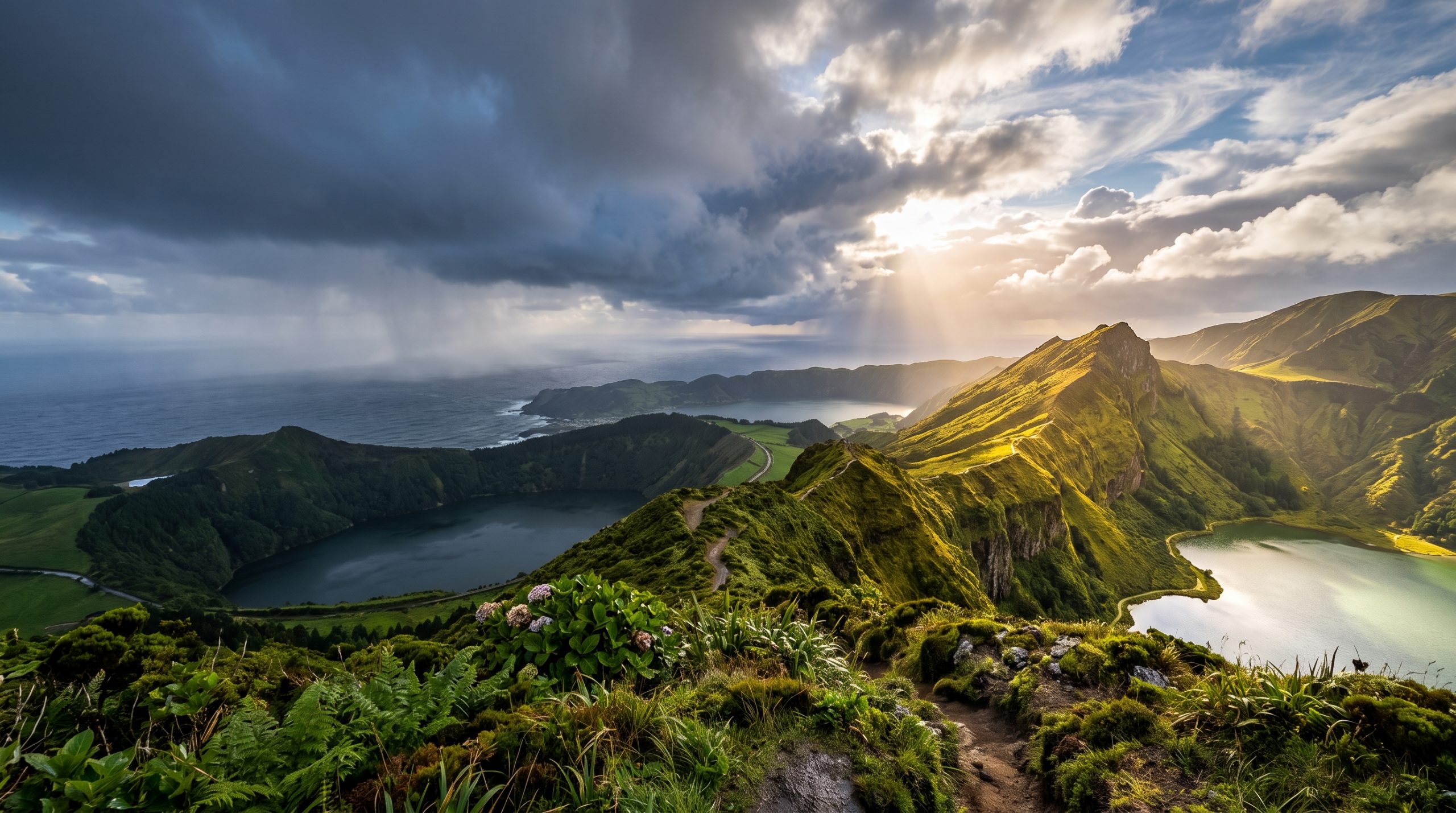
The Sete Cidades rim at twenty past six on a mid-June morning is often nothing at all. Gray wool, no lakes, no far wall, rain moving sideways for ten minutes and then stopping. By half past eight the crater is a green bowl with two lakes sitting in it, the light is clean, and the two people who waited it out have the viewpoint to themselves.
That is São Miguel working normally. The Azores sit alone in the middle of the Atlantic, and the air that reaches them has crossed thousands of miles of open water before it meets ground that climbs from the harbor wall to 1,103 meters at Pico da Vara. On Pico island it goes to 2,351 meters, the highest point in Portugal. Weather that has to lift over that breaks into pockets, and the pockets last about twenty minutes each.
So we are not going to sell you a settled month. What follows is the month-by-month data we plan from, the two windows that are genuinely narrow, the stretch of the year we would move a date out of, and the written plan we build before anyone gets on a plane.
Why we push most couples toward early September
If your date is open, take the first ten days of September. July through September is the driest run of the Azorean year, the ocean is at its warmest near 24°C, the July crowd has thinned, and you still get roughly twelve and a half hours of daylight. Nothing removes the volatility. September shortens the odds.
Month by month on São Miguel, with the numbers
The climate figures here come from the 1991 to 2020 normals for the Ponta Delgada observatory, recorded by the Portuguese Institute for Sea and Atmosphere at sea level on the south coast. Read them as the mildest version of your day. A few hundred meters higher the same afternoon is cooler, wetter and often inside cloud, which is why our timelines move between the coast and the crater rims instead of committing to one altitude. Our destination guides go island by island in more detail.
| Month | Conditions | Daylight | Crowds | Our verdict |
|---|---|---|---|---|
| January | Highs near 17°C, about 110 mm over 13 days, three hours of sun a day | 9h 50m | Quietest of the year | Coast, forest and Furnas only |
| February | Coolest month, highs still around 17°C | 10h 45m | Empty | Greenest island, lowest ground |
| March | Ocean at its coldest, roughly 16°C | 11h 50m | Empty | Big skies, cool feet |
| April | Migratory whales arriving from mid-month | 13h 05m | Building | Best month at sea |
| May | First hydrangeas open on the coast road | 14h 10m | Moderate | Strong, underrated |
| June | Longest days of the year, humidity climbing | 14h 45m | Busy, not yet peak | Longest evening window |
| July | Driest month: 26 mm across about 5 rainy days | 14h 30m | Peak, over 638,000 overnight stays | Hydrangeas at full strength |
| August | Warmest month, highs around 26°C | 13h 35m | Peak | Sunrise starts, nothing later |
| September | Dry run holds, sea near its 24°C maximum | 12h 20m | Drops after week one | Our first choice |
| October | Rain returns, ocean still warm | 11h 10m | Quiet | Rims to yourselves |
| November | Wet, windy, fast-moving | 10h 05m | Very quiet | Coastal and laurel forest |
| December | Wettest month: about 153 mm over 15 days | 9h 35m | Empty | Short day, all of it soft |
Two lines in that table matter more than the rest. July is the driest month by a wide margin and also the most crowded, which is a trade rather than a rule. And the daylight swing is large for this latitude: five hours and thirteen minutes separate the longest day from the shortest, so a June afternoon has almost nothing in common with a December one.
The windows that are actually narrow
Most of the Azorean calendar is broad. Two parts of it are not.
The hydrangeas are the reason a lot of couples write to us in the first place. The roadside hedges begin to turn in early June, run at full strength through July and August, and are still worth photographing into September. Elevation shifts the schedule: the coast opens first and the interior and the higher western islands follow, sometimes by a couple of weeks. Warm springs pull the whole thing forward, cool ones push it back, so if the flowers are the point we aim at the middle of the window rather than its edge.
The whales are narrower still. Resident sperm whales, Risso’s dolphins, bottlenose and common dolphins are around all year, but the giants are only passing through. Blue, fin and sei whales cross on migration, and the licensed operators in Ponta Delgada and Horta name April and May as their strongest months, with sightings concentrated in roughly the last two weeks of April and the first two of May. Nobody can promise you an animal. If a boat morning matters, we put it early in the week with a spare day behind it, and build the day so it is complete whether or not anything surfaces.
Water temperature is the third clock, and it runs late. The sea is coldest in March at about 16°C and warmest from late August into early September at roughly 24°C. If you want to step into the tidal pools at Ferraria in the last hour of light rather than just look at them, September is the month that makes it comfortable.
The stretch we would move a date out of, and how we work it if you cannot
Late January into February. Not because it is unpleasant, and not because we would rather be elsewhere, but because the numbers narrow your options. Highs sit near 17°C, it is inside the wettest run of the year, the day is under eleven hours, and January averages about three hours of sunshine a day. High ground spends a lot of that inside cloud, so the crater viewpoints stop being reliable and become bonuses.
If the date can move, our answer is the first half of June or the first ten days of September, and we will say so plainly.
If it cannot, February is still a real elopement and we simply build it differently. The island is at its greenest, the waterfalls in the Nordeste run hard, the laurel forest above Faial da Terra holds light beautifully in flat weather, and Furnas gives you steam, hot pools and gardens that do not care what the sky is doing. Low ground, short drives, and a ceremony hour we can move by three hours at short notice. Tell us the date you already have and we will tell you which week of that month works hardest, and where on the island we would put you.
Where the sun sets, and how long the warm light lasts
This is the part that changes the photographs and the film more than rainfall does.
In late June the sun clears the horizon before half past six in the morning, sits about 76 degrees above you at midday, and at the latest point of the year does not set until 9:10 in the evening. Two long, generous edges and a hard, flat middle. We use it by putting the ceremony late, often after seven, and treating the afternoon as travel, food and the drive west. It also means a couple can be at Lagoa do Fogo at sunrise and on the Mosteiros shoreline at sunset without rushing either one.
December inverts it. The shortest day runs nine hours and thirty-five minutes, the earliest sunset falls at 5:25 in the afternoon, and the midday sun never climbs past about 29 degrees. Everything you shoot is low-angle. A ceremony at eleven in the morning looks like six in the evening anywhere else in our calendar, which is a real gift, and the whole usable day fits inside one drive.
The direction moves too. At the June solstice the sun goes down about thirty degrees north of west, which is why the sea stacks at Mosteiros are lit from behind in summer. By the December solstice it sets thirty degrees south of west, the same coast is side-lit, and west-facing crater walls that glowed in June sit in shadow. Designing a location list is choosing compass bearings for a specific week rather than landmarks in general, and you can see how that reads in the galleries and films we have published from days that ran in very different light.
December is also where having a photographer and a filmmaker from the same team stops being a nicety. When the good light is a ninety-minute band rather than a four-hour one, one person alone has to choose between the frame and the shot. Two of ours work the same moment at once, from different distances, and nothing gets traded away. In June the opposite applies: the evening is so long that we can work slowly, walk further, and let a scene develop twice.
Ferries, the mountain and the things that only run in summer
Access is seasonal here in a way that catches planners out more than the rain does.
- Inter-island ferries. Atlânticoline is the only operator. Its full network, linking all nine islands, is a spring and summer operation; outside that only certain routes sail. The one dependable year-round crossing is Horta to Madalena between Faial and Pico, about thirty minutes each way, several times a day.
- The eastern group. There is no practical passenger ferry to São Miguel or Santa Maria. If your plan involves either of them plus another island, it involves a flight, and that flight is a weather variable of its own.
- Pico mountain. Every ascent is booked through the natural park authority’s own reservation system, numbers per day are capped, and the reserve’s regulation allows the park to close access while a meteorological warning is in force. The trail starts at the mountain house at about 1,200 meters, twenty-five minutes from Madalena and forty-five from Lajes do Pico, and the house keeps its longest hours through the summer.
- High viewpoints in winter. Nothing formally shuts, but cloud base does the shutting for you. From November to March we plan the high crater work as an opportunistic add-on with a coastal or forest alternative already timed into the day.
None of this is a reason to avoid a season. It is a reason to have permits, reservations and crossing times settled months out, which is our work rather than yours. If you have a week in mind, Check Your Date with us and we will tell you what is running then.
How we build an Azorean day that can change seasons
Every day we build for the Azores carries three location sets, not one, chosen by wind direction rather than by preference. A south-westerly puts us on the north coast at Santa Iria and Mosteiros. A northerly moves the whole day to the sheltered south and to Furnas, where the crater holds still air. Rain over the interior sends us to the coast, where showers pass in minutes; hard sun over the coast sends us up into the laurel forest, where flat overhead light behaves.
The ceremony hour is written as movable from the start. Your celebrant knows it, your witnesses know it, and we confirm the final version the evening before, once we can read the pattern rather than a forecast icon. We would rather move the vows by two hours than hold them in the wrong hour.
Practically, that means location design, a timeline built around light and real travel time, permit research for whatever your date requires, written weather alternatives, and aerial coverage where it is legal and conditions allow. Team travel to the islands is included, whichever island you choose. Highlights reach you within five days and the full gallery or film within three weeks. The coverage options and what each includes sit on one page, and our guide to planning an elopement covers the paperwork.
Common questions
Will it rain on our Azores elopement day?
Probably at some point, and it usually does not matter. July averages 26 mm across about five rainy days in Ponta Delgada, December about 153 mm across fifteen. Azorean rain tends to arrive in short bands rather than settle in, so we plan the hour after a shower rather than trying to dodge the whole day.
Can we count on seeing the Sete Cidades lakes from the rim?
Not on demand. Cloud sits on the crater walls regularly in every month, and the odds are best in the first hours after sunrise and in the September dry run. We build the rim as an early stop with time banked around it, so if it is closed in at 7am we can come back at 10am.
Is October still worth it, or has the weather gone?
It is worth it. The ocean is still near its warmest, the viewpoints are quiet, and daylight is a shade over eleven hours. Rainfall does start climbing back toward the winter pattern, so October days are built with more indoor and low-level fallback than September days.
How far ahead should we book if we want the hydrangeas?
Early. We are currently booking 2027, 2028 and 2029, and the June to August window is the busiest part of the Azorean year for us. Booking twelve to eighteen months out gives you the choice of week inside the bloom rather than whatever is left.
Do we need to plan around the ferries if we want two islands?
Yes, and it shapes the date. Faial and Pico work all year on the thirty-minute Horta to Madalena crossing. Any wider island-hopping plan leans on the seasonal spring and summer network or on inter-island flights, which is a strong argument for June to September if two islands are the goal.
What happens if Pico mountain is closed on our date?
The film still works, because the mountain is never the only plan. The Criação Velha vineyard walls, the Lajido lava fields and the Faial caldera are all within an hour and photograph in weather that keeps people off the summit. We confirm the ascent the day before and switch cleanly if the park has closed access.
Can you actually film in fog?
Yes, and some of our favorite Azorean footage comes out of it. Fog removes distance and gives you a couple, a ridge line and nothing else, which is often stronger than a clear panorama. What fog does rule out is aerial work, so on those days the film leans on ground movement and audio instead.
What time will our ceremony be?
It depends on the month, and we set it once we know the date. A late June ceremony often sits between seven and eight in the evening with sunset after nine. A December ceremony can start at eleven in the morning, because the sun stays low all day and the whole nine and a half hour window is usable.
Picking your week
Give us a month and we will name the week inside it we would choose, and why. September if the date is free, June if the hydrangeas are the point, April if you want the big whales, February if February is what you have. We keep every planning decision in writing, so you get a straight answer without any hoop to jump through first.
Tell us the date you are circling, the island you keep returning to, and how early you are willing to be awake. Tell Us Your Story and we will come back within a day with a plan shaped around your week.