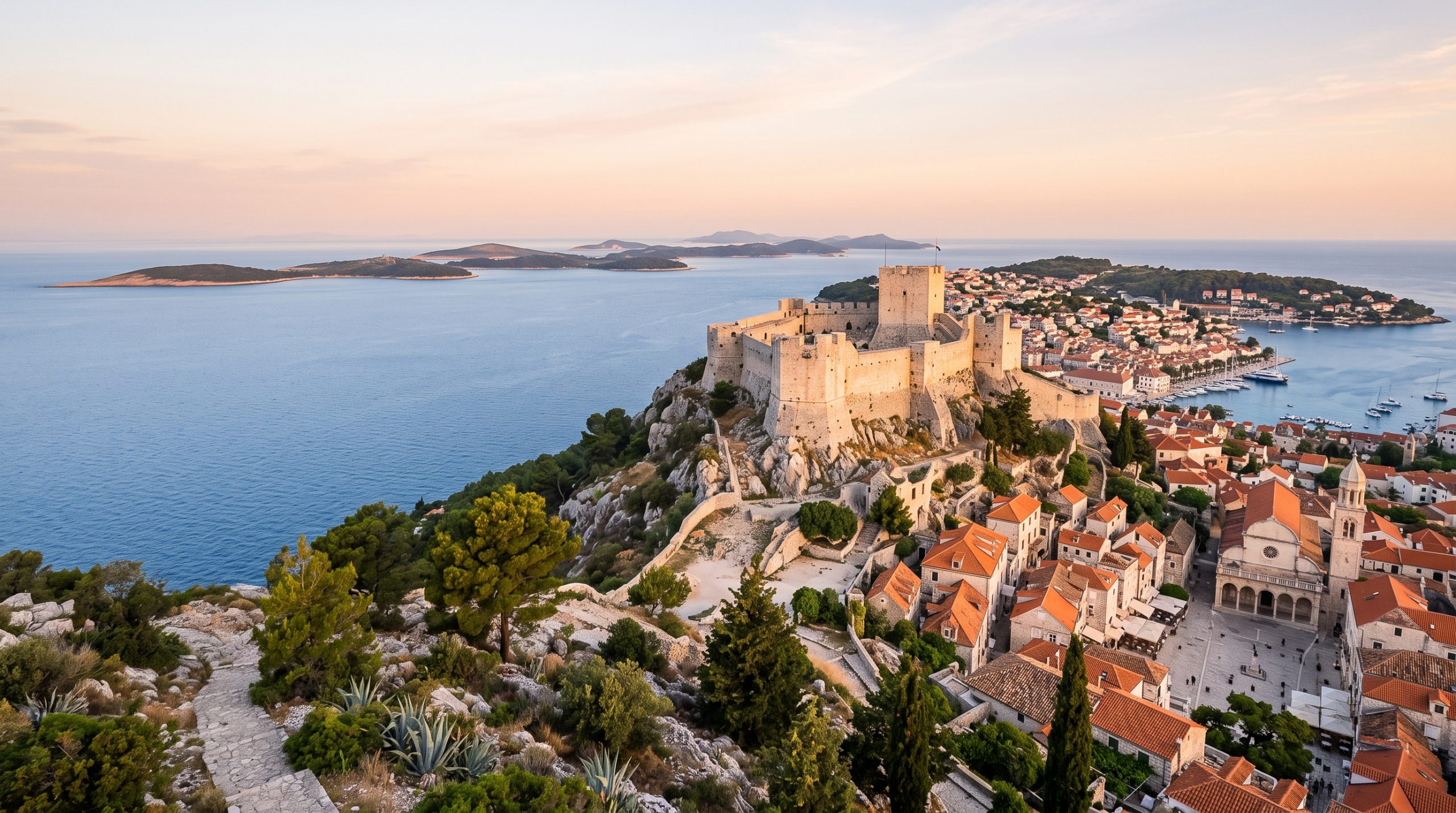
The public institution that runs Fortica publishes a short list of rules for visitors, and one of them is about clothes. No swimwear. Dress in keeping with the dignity of a historic site. It is aimed at people who wander up from the beach in a wet bikini, but read it as a couple planning a ceremony and it lands differently. A wedding dress on those ramparts is one of the very few outfits on Hvar that meets the brief completely.
That single rule tells you most of what you need to know about eloping here. Fortica is not a venue with a wedding coordinator and a sales deck. It is the city fortress on the hill above Hvar’s old town, run by Javna ustanova u kulturi HVAR 1612, the City of Hvar’s public cultural institution, which also holds the theatre and the Arsenal on the main square. The institution’s own visitor page calls the fortress a cultural monument of exceptional significance and a space of particular sensitivity. There is a gate. There is a ticket. There are hours, and they change with the season, and in winter the gate does not open at all.
Work with that instead of against it and Hvar gives you a day almost nowhere else can: vows on a fortress wall above a Venetian harbour, then fifteen minutes of open water to a pine cove where nobody is wearing shoes.
Who says yes to a fortress ceremony above Hvar
Fortica is city property, run as a monument by the public institution HVAR 1612. Two people saying words on a terrace inside visiting hours are ticketed visitors. Chairs, a celebrant, guests or exclusive use of a terrace make it a booking, and that booking is made with the institution, which hires out its spaces.
Up from Pjaca in shoes you did not choose for steps
The walk starts on Trg svetog Stjepana, the long stone square everyone calls Pjaca, with the Arsenal and the Hvar Theatre, which the city calls the oldest public theatre in Europe, at the harbour end of it. From there you climb out of the old town on steps between houses, then join a path that switchbacks up through pine and scrub to the fortress entrance at the top of the rise.
Twenty minutes if you are in trainers and moving. Closer to half an hour at the pace of someone carrying a dress off the ground with both hands, and that is the pace we build the timeline around. The steps are uneven limestone, worn smooth in the middle and gritty at the edges, and the grit is what gets into a hem. Shade is patchy rather than continuous. In July, this climb at two in the afternoon in full clothes is nobody’s idea of a good time, which is one of several reasons our Hvar timelines put the fortress at either end of the day and never in the middle of it.
What actually works: walk up in flat shoes with the dress carried or bagged, and change at the top. The fortress has a designated catering area, and it is the only place inside the walls where food and drink are allowed at all, so a bottle of anything opened on the ramparts is not part of the plan. Bring the shoes you want in the photographs in a bag, and let one of us take the bag once you are up.
Veils are the other thing worth thinking about. The afternoon breeze arrives off the water and funnels along the walls, and a long veil up there is either the best frame of the day or twenty minutes of somebody’s hand in the shot. We would rather know which one you want before we place the ceremony.
The other approach is worth asking about rather than assuming. Guests who cannot manage steps in heat should not be walked up as a test of loyalty, and we plan transport and timing for that separately once we know who is coming.
Where the sun goes over the Pakleni channel
This is the part almost every page about Hvar gets vague about, and it decides your ceremony hour.
Fortica sits above the town on its north side and looks out over the harbour, the channel and the Pakleni islands strung out to the west. The sun therefore sets in front of you rather than behind you, which is the whole reason the terrace is worth the climb. But it does not set in the same place all season. In the third week of June the sun goes down at a bearing of around 304 degrees, well round to the north-west, off the far end of the island chain, at about 8:35pm. By the third week of September it has swung to almost due west and drops at roughly 6:55pm, straight down the channel between the fortress and the islands. Mid-October takes it further south again and closer to 6:20pm.
Two practical consequences. First, a late-June ceremony that ends at 8pm still has half an hour of high, hard light before anything turns gold, so we set the vows later than couples expect. Second, in September and October the sun lines up with the gap between the islands, and the light comes at you low and level across the water rather than down from above. That second version is the one we would choose if the date were ours.
Now the constraint that catches people. The gate has closing times, and they move. The institution’s shoulder-season schedule has the fortress open 9am to 7pm; in the middle of summer the town’s own listings run it into the evening. In April, sunset here is around 7:30pm, which means the published closing time can land before the best light of the day. So we confirm the current opening and closing hours for your specific week before we put a ceremony time in your timeline, and where the two do not line up, the evening hour is something to arrange with the institution rather than hope for. You can see how stone and low water light behave together in our published stories and films, which is the honest way to judge whether this hour is the one you want.
Mornings are the underrated option. Fortica is the highest thing in Hvar Town, so it is the first place lit and the last to lose the sun. The gate opens at 9am on the current schedule, and the hour after that is a different fortress from the one at sunset: cool stone, the harbour still half in shadow, and the day boats not yet loaded.
The sunset ticket is the busiest hour of the day
Arrive early is not useful advice here, because the crowd is not a morning crowd. It is an evening one. The fortress fills through the afternoon and peaks in the last ninety minutes before sunset, when a large share of everyone staying in town has had the same good idea, and the terraces with the best view are exactly where they all stand. It is a fine place to be one of a crowd. It is not where you want to be reading vows out loud.
So the choice is real: take the first hour after opening and have the walls close to empty, take the shoulder-season sunset when the town is quieter, or book the space through the institution so the hour is yours. Tell us which of those matters more and we will build the day around it.
Fifteen minutes of water: Jerolim, Ždrilca, Palmižana
The Pakleni islands are the second half of a Hvar day and the reason the day never feels like a single location. Taxi boats leave from the Riva in Hvar Town, run roughly every thirty to sixty minutes in season, and cross in ten to fifteen minutes to the main landings: Jerolim and Stipanska closest, Mlini and Ždrilca in the middle of the chain, Palmižana furthest out at the western end.
What that gives you is a full change of scene without a travel day. Fortress stone in the morning, a pine-shaded cove and clear water by lunch, or the reverse. Ždrilca is the narrow passage between two islands and the water there goes an almost implausible pale green over sand. Palmižana costs you more crossing time and rewards it with a proper harbour and shade.
The variable is wind, not rain. The channel picks up an afternoon breeze most summer days, and when it is up, the smaller open bays get choppy and the boats favour the sheltered side of the chain. That is not a problem so much as a decision made at breakfast, and it is why our Hvar plans always carry a second cove. If the water is flat, we go where the light is best. If it is not, we go where the shelter is, and there are usually two options within a few minutes of each other. More of how we sequence island days sits in our destination elopement guides.
Two cameras on a walled terrace
The fortress is generous in one direction and tight in the other. The long rampart terraces give a filmmaker somewhere to move laterally while a photographer works from the corner, which means two of us can cover the same vows from different angles without appearing in each other’s frames. Sound is the harder problem. Wind coming off the channel hits the top of the walls and turns a beautiful open terrace into a noisy one, so we scout the two or three pockets where the stone breaks the airflow and place the ceremony inside one of them. On our Expedition coverage, where a dedicated photographer and filmmaker work as a pair, that also means proper audio on your vows instead of a wall of moving air. Aerials are a separate question, because a protected monument above a working harbour is exactly the sort of airspace that needs confirming rather than assuming, and we do that in planning rather than on the morning.
The registry office in Hvar Town, and the window it needs
The legal side of a Croatian wedding is administrative rather than difficult, and it runs on a clock you have to respect.
The registry office covering the island is in Hvar Town. For a civil marriage, notice must be given in person by both of you, and that happens between 30 and 45 days before your chosen date. If neither of you speaks Croatian, an official court interpreter is required at the ceremony itself. Ceremonies held away from the registrar’s own premises carry an additional charge set by the office, which depends on where, when and what date you have asked for.
The practical reading of all this: a legally binding ceremony on Hvar means a trip to the island in advance, or a legal marriage at home and a ceremony here that is about the words rather than the signatures. Both are completely normal, and plenty of couples we work with choose the second. We handle the permit research and the logistics either way, and the government or venue fees themselves are paid by you. If you are at the stage of working out which route suits you, our guide to planning an elopement is the place to start.
One more piece of the calendar. HVAR 1612 also programmes the town’s summer festival, a series now past its sixtieth edition, which books these same monuments for concerts and theatre through July and August. It is a good reason to be in Hvar in August and a reason to confirm dates early if the fortress is central to your plan.
Common questions
Does everyone in our group need a ticket to come up to Fortica?
Yes. Entry to the fortress is ticketed per person, with reduced rates for students, seniors and school-age visitors, and a combined ticket, currently 15 euros, covering the fortress along with the theatre and Arsenal on the main square. Guest numbers change your ticket total and your transport, never our fee.
Is the fortress open in March or early April?
Not through the winter. HVAR 1612 closes the fortress and the theatre out of season and announces a reopening date each spring, which for 2028 is 30 March. For a February or early March date we build the day in the old town, on the harbour and out on the water instead, and it is a quieter, softer version of Hvar.
Can we get married at the fortress and still swim in the Pakleni islands the same day?
Easily. The crossing from the Riva is ten to fifteen minutes, so a morning ceremony on the ramparts, a boat out to a cove, lunch in the shade and a return for evening light in town is a comfortable single day rather than a rushed one.
What happens to our vows if the wind picks up on the ramparts?
We move you, not the schedule. There are sheltered pockets along the walls where the stone breaks the wind, and we pick one before the ceremony hour rather than during it. Expedition coverage adds recorded audio for the vows where conditions allow, which is exactly the situation it exists for.
Can we bring a bottle of champagne up to the fortress?
Not onto the walls. The institution does not permit visitors’ own food and drink inside the fortress except in the designated catering area, so the toast either happens there or waits for the terrace of wherever you are staying. Worth knowing before someone carries a bottle up the hill.
Do we need an interpreter for a legal ceremony on Hvar?
If neither of you speaks Croatian, yes: an official court interpreter is required at a civil ceremony. It is a standard arrangement, and it sits alongside the notice you give in person at the registry office 30 to 45 days ahead.
A day that begins before the gate opens
The version we would build for you starts early, with light on the old town and nobody on Pjaca. Up the steps in flat shoes by nine, into the fortress with the stone still cool, vows on a rampart with the harbour below and the islands laid out west. Down for a boat by late morning, a cove for the middle of the day, and back for the last of the light on the water. One full day, one photographer and one filmmaker who have worked together before, and no one meeting for the first time on your morning. Our highlights reach you in five days and the full gallery or film in three weeks. Coverage shapes run from a single full day to a longer multi-day route across the Dalmatian islands, and the figures are on our pricing page.
We currently have Croatia elopement dates available through 2027–2029. Everything from here happens in writing, so send us your dates and the version of Hvar you have in your head, including the parts you are unsure about, and we will tell you honestly which week and which hour on that hill will give it to you. Tell Us Your Story.