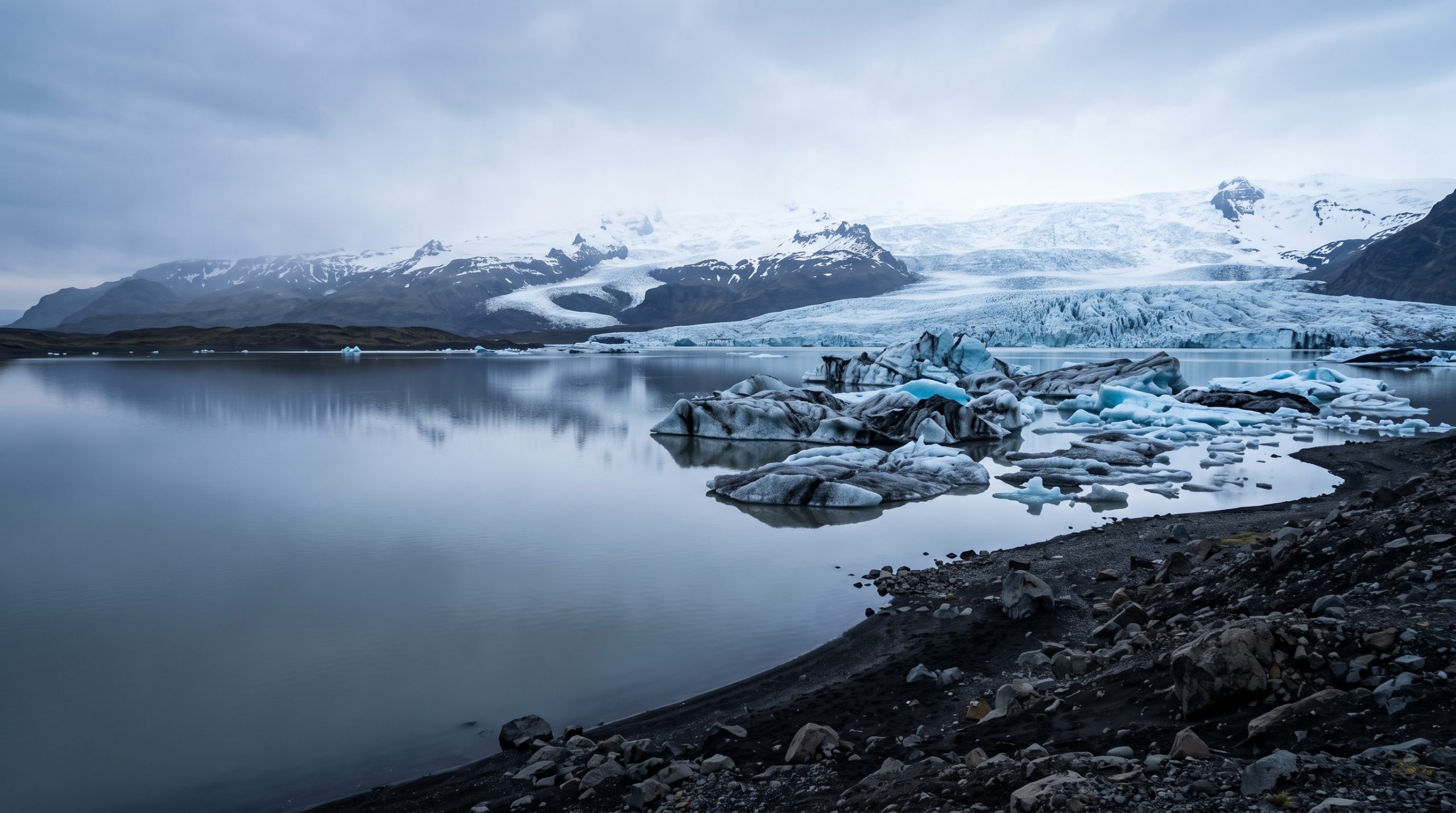
A film crew came here in 2022 and used Fjallsárlón as the Arctic coast of Greenland. They did not need to dress it or hide anything. They chose it because the ice looked untouched and because the place felt like nobody had arrived yet.
That is still broadly true, and the reason is dull and practical. Fjallsárlón sits about ten kilometres west of Jökulsárlón. Ten kilometres is nothing in a car and everything to a coach itinerary. The south coast bus stops at the famous lagoon. The groups stop at the famous lagoon. Fjallsárlón needs its own turn off Route 1, down a short spur, and most of the traffic on that road never takes it.
So you get a glacier front, a lagoon full of moving ice, and a shoreline you reach in minutes from the car. You also get a light situation almost nobody writes about, and it is the one thing that should decide what hour you stand there.
Why the coaches stop ten kilometres east
Fjallsárlón is a glacier lagoon inside Vatnajökull National Park, ten kilometres west of Jökulsárlón on Iceland’s south coast. The public bus network serves the famous one; this one needs a car and a short spur off Route 1. Parking sits close to the water, and the walk to the shoreline takes minutes.
Four and a half hours from Reykjavík, then a gravel spur
Reykjavík to Fjallsárlón is around four and a half hours of driving, which means nobody sensible does it on the morning of their ceremony. Couples we work with here sleep in the Skaftafell area, about 47 km and forty minutes west, or in Höfn, about 70 km and an hour east. Forty minutes is the number that matters. It is short enough that a 4am call time is a real option rather than a heroic one.
The turn off Route 1 is brief and the parking sits beside the service building and restaurant, close enough to the water that you can see the lagoon while you are still pulling on a coat. Any rental car manages it. There is no washboard track, no river crossing, no reason to pay for a 4×4 on account of this stop alone.
The walk in wedding clothes is the part worth being specific about. The ground between the buildings and the water is gravel path and low moss, with a gentle rise and nothing to scramble. A dress hem will pick up dust rather than mud if you keep to the path, and grit if you cut across the moss. We move people in boots and change at the water, because the wind coming off the ice makes the last fifty steps colder than the car park suggested. A veil is a decision, not an accessory, on this shoreline.
The ice faces north, so the good light is at four in the morning
Iceland runs on GMT all year, and Fjallsárlón sits at roughly 16.4 degrees west. Solar noon here lands just after one in the afternoon rather than at twelve. That single offset shifts every assumption a couple brings from home, and it is only the beginning of it.
Fjallsjökull, the outlet glacier that feeds the lagoon, sits to the north. You stand on the south shore looking north at it. Which means the glacier wall receives clean frontal light for exactly one part of the day: the middle of it, when the sun swings around to due south and, in late June, climbs to nearly fifty degrees. That is the flattest, hardest light the place produces. It is also, precisely, when the boat departures cluster and the car park fills.
The hour that actually suits this lagoon is absurdly early. In late June the sun clears the horizon around three in the morning in the north-east, at almost no altitude at all, and by five it has only reached about eight degrees. Coming from that direction, it rakes straight across the bergs instead of hitting them flat. Small ice goes translucent. The edges catch and the interiors glow blue. Standing on the south shore, you have the light behind your right shoulder and the glacier in front of you, which is the one geometry that makes a wall of ice read as depth rather than as a grey backdrop. Our published galleries and films are the fastest way to see what that difference looks like before you commit an alarm clock to it.
Now the part that catches people out. Couples arrive in June assuming a near-midnight sunset means near-midnight light, and book the evening. The western skyline here is not sea level. Öræfajökull, which carries the highest ground in Iceland, rises immediately to the west, and its eastern flank continues around to the north-west. By around nine in the evening in late June the sun is under ten degrees and sitting in the north-west, which is exactly where that ice cap is. The sky stays bright for hours. The lagoon itself goes into shade. It is a lovely place to be at eleven at night and a poor place to be photographed at eleven at night, and those are not the same sentence.
Late September behaves better than either. At the equinox the sun tops out around twenty-seven degrees, so there is no harsh hour anywhere in the day. Everything rakes. The trade is that the light leaves the lagoon by roughly half past five in the evening, well before the clock sunset, so the day has to be built forward rather than back.
The pulse of the place is a boat departure
Fjallsárlón is quiet in a specific, rhythmic way. The zodiac operation runs a spring-to-autumn season and departures bunch through the middle of the day, selling out on the busiest days of July and August. Between departures the shoreline genuinely empties. That is unusual on this coast, and it means the standard advice to arrive early is not a coping strategy here. It just works.
One office, not three landowners
This is the administratively easy part of the south-east coast, and it is worth knowing before you compare locations. Fjallsárlón lies inside Vatnajökull National Park, so the questions about professional film work, organised activity and aerials go to the park authority. There is no farm gate to negotiate and no chain of private owners each holding a different answer. One authority governs the shoreline.
Aerials run on a permit and a time window inside a national park, so we confirm both before we build any part of the film around them. Permit research and the logistics that follow it are ours to do, in every one of our destination guides and every day we shoot. The fees themselves, along with your celebrant and accommodation, sit on your side of the ledger.
If you want vows or portraits out among the ice rather than beside it, that is the local operator’s zodiac, and it is a separate booking. The trip runs 75 to 90 minutes with about 45 of those on the water, in a small inflatable, in a flotation jacket over whatever you are wearing. Some couples love that idea and some go quiet when they hear the words flotation jacket. Both reactions are useful, and we would rather hear yours early. The planning fundamentals we work through cover which of these decisions has to be made months out and which can wait.
Room to stand on an open gravel bank
The shoreline here is long and unobstructed, which changes what two people with cameras can do. A filmmaker can work well down the bank, low, with the glacier as a background, while a photographer holds a tighter frame from the other side, and neither appears in the other’s shot. That stops being true at the boat dock, where the ground funnels and two of us in the same few metres would show. So we split there by design rather than by improvisation. Wind is the other factor: it comes off the ice and down the valley, and it does not care about your vows. The Expedition pairing adds professional audio for that reason, and we choose the ceremony spot partly for what it does to sound.
When the ice rearranges overnight
Bergs move. A bay that was open and photogenic at dusk can be packed solid by morning, or the reverse, and no forecast tells you which. We treat the exact ceremony spot on this lagoon as a decision made on the day, within a shape agreed months earlier. Wind direction decides which shore is sheltered. If the boats are not running, the land side loses nothing important.
If the whole day turns, the alternatives are close and genuinely different rather than consolation prizes. Skaftafell is forty minutes west with low ground, birch and shelter when the open lagoon is unworkable. Jökulsárlón and its black beach are ten kilometres east, busy but useful in flat light. Holding both in reserve is ordinary practice for us here, not a contingency you have to ask for.
On fit: this lagoon rewards couples willing to be at the water before four in the morning in summer, and it is honest to say that a mid-morning ceremony here gets a much less interesting version of the same view. If a 4am start is not your idea of a good morning, tell us, and we will either build the day around late September, when there is no harsh hour to avoid, or say plainly which stretch of this coast suits a later start better. A full day here with one photographer or one filmmaker starts at $4,900, the pairing at $7,900, and what that covers is set out on our pricing page.
Common questions
Can we reach the shoreline at Fjallsárlón without booking a boat tour?
Yes. The walk from the parking area to the water takes minutes on a gravel path, and it brings you closer to the glacier front than any roadside stop on this stretch of coast. The zodiac is an addition, not the way in.
Is the turn-off to Fjallsárlón suitable for a normal rental car?
It is. The spur off Route 1 is short and the parking beside the service building takes any vehicle. You do not need a 4×4 for this lagoon, though you may want one for other things you are planning on the same trip.
Does the light really last until midnight at Fjallsárlón in June?
The sky does. The direct light on the lagoon does not, because Öræfajökull sits to the west and the sun drops behind that high ground while it is still technically up. Plan the ceremony for the early morning instead, when the sun comes low out of the north-east.
Can we include Jökulsárlón on the same day?
Easily. The two lagoons are about ten kilometres apart on Route 1. The usual order is Fjallsárlón first, in the quiet early hours, then Jökulsárlón or the black beach later, accepting that the second stop will have company.
Is there anywhere to change out of hiking boots at the lagoon?
There is a service building with a restaurant at the parking area, and in practice most people change at the car rather than inside. We plan for boots on the gravel and a change at the water, with a bag carried down for whatever comes off.
The day we would build here
A 3:30am departure from the Skaftafell area. Forty minutes east on an empty Route 1. Boots on the gravel, a change at the water, and vows on the south shore somewhere between four and six, with the sun coming low out of the north-east and the glacier lit from the side. Coffee when the service building opens. Jökulsárlón after that if you want it, or back to bed, which is a more common choice than couples expect. Dates are currently open across our 2027, 2028 and 2029 Iceland seasons, and the planning from the first message onward stays in writing, so you can read it twice and think about it. Send us the dates you are holding and the shape of morning you actually want, and we will tell you which week of the year suits it. Start Your Story.