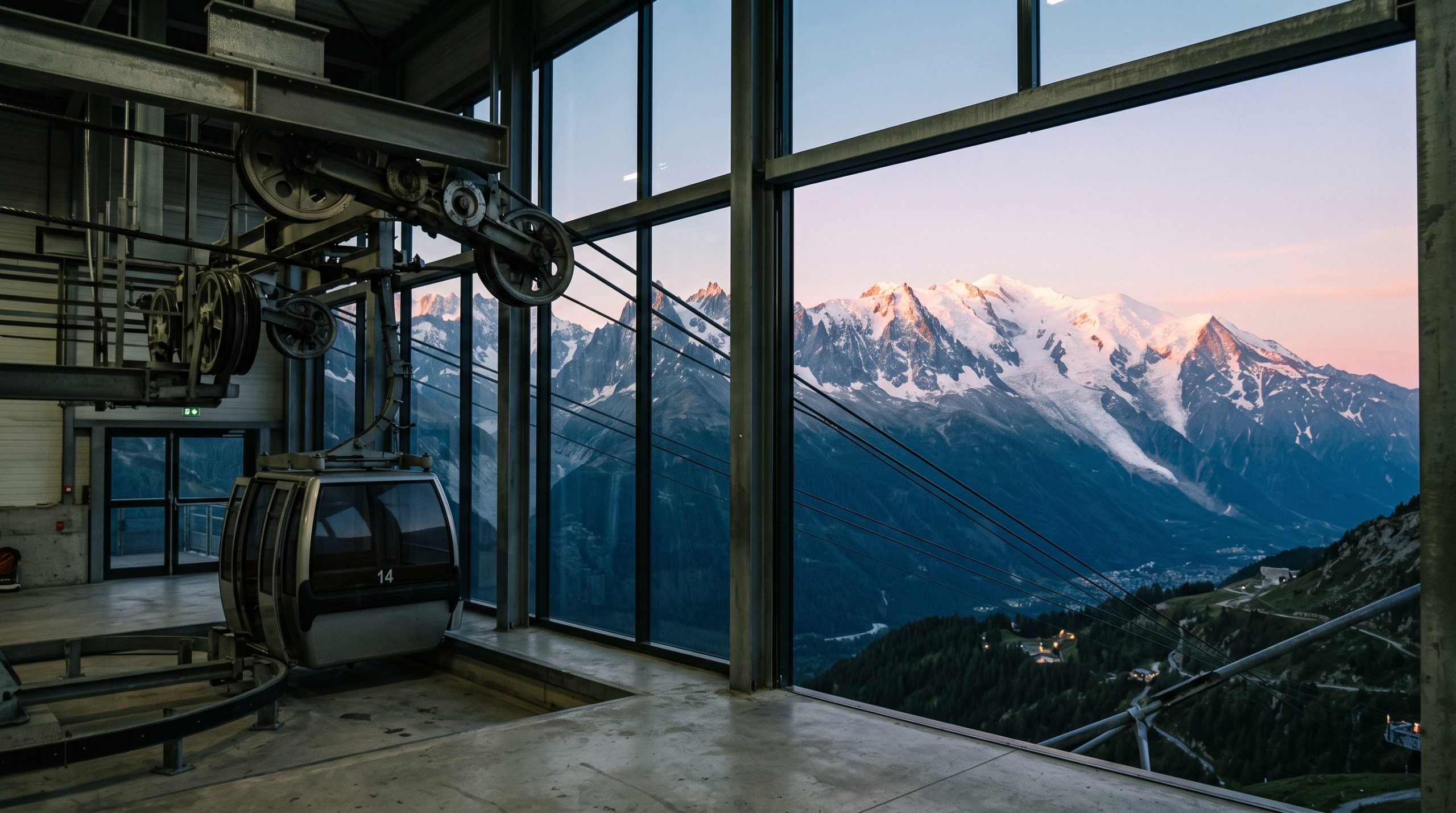
The first cabin of the day out of Chamonix Sud leaves at 6:10 am in high summer, and there is almost nobody in it. Twenty minutes later you are standing at 3842 metres on the Aiguille du Midi with the valley floor 2800 metres below you still sitting in shadow, while the granite around you has already come up warm.
By ten in the morning the same cable car is a queue. The Chamonix tourist office puts an average visit at two to three hours including travel, and says plainly that the time can double depending on how many people are in the building. Almost nothing about a wedding day here is decided by a venue. It is decided by two clock times printed on a lift timetable.
So this is that timetable read the way we read it when we build a Chamonix schedule: forwards from the first departure, and backwards from the last one that still brings you home.
The two times that decide a Chamonix day
Between 1 July and 23 August the Aiguille du Midi cable car runs from 6:10 am, and the last round-trip departure is 4:30 pm even though the machine keeps turning until 6 pm. From 31 August it starts at 8:10 am and the last round trip pulls back to 4 pm. Everything else fits between those two numbers.
The published clock, and why the last round trip is not the last lift
Two different numbers get called the last lift, and confusing them is how couples end up with a ceremony hour that cannot breathe. The last round-trip departure is the final moment you are allowed to start going up. The end of service is the final moment a cabin comes down. In high summer those two numbers are ninety minutes apart.
That gap is the most useful ninety minutes in the valley. It means a 3 pm ceremony on the terraces is not a race, because the down cabins keep running long after the ticket desk has stopped selling ascents. It also means that if your morning slips by an hour, the day does not collapse; it just moves later into a mountain that is emptying rather than filling.
| Aiguille du Midi timetable block | First departure | Last round trip up | Cabins stop |
|---|---|---|---|
| 1 July to 23 August | 6:10 am | 4:30 pm | 6 pm |
| 31 August to 13 September | 8:10 am | 4 pm | 5:30 pm |
The step down happens earlier than most planners expect. From 24 August the last round trip is already 4 pm, a week before the morning start moves back to 8:10 am. And the timetable itself carries the phrase subject to favourable weather, which is the operator being honest rather than cautious. Every high-mountain hour we schedule in Chamonix has a valley-floor twin held in reserve, at a location we have already walked, so a change in conditions costs you a drive and not a plan.
Where the twenty-minute ride costs you three hours
The ascent is twenty minutes. That is the number every guide prints, and it is true, and it is not the number to plan on. The tourist office’s own estimate for a visit is two to three hours including travel, and it adds that this may double depending on visitor numbers. In the second week of August, plan on the doubled figure.
The reason is that the journey is not one ride. It is a sequence of transfers, each with a line behind it. Chamonix Sud to Plan de l’Aiguille at 2317 metres, change of cabin, second stage to the top station, then a lift inside the rock that climbs the final forty-two metres to the terrace at 3842 metres. Departures run every fifteen or thirty minutes depending on ridership, so the interval you queue in is not fixed either. Step into the Void has its own separate line once you are up there, and on a wedding morning it is rarely worth standing in it.
Two things nobody mentions. The summit cafeteria does not open with the first cabin, so coffee happens on the way down; bring a flask. And the Panoramic Mont-Blanc cable car onward to Pointe Helbronner in Italy is an extraordinary ride that will eat the middle of your day. Do it the day before or after, not on the day itself.
Getting to the base station at six in the morning is simpler than it looks. The closest bus stop is Chamonix Sud, the closest railway stop is Aiguille du Midi station, and the closest car parks are Grépon and Courmayeur. If you are staying anywhere central, walk. Our notes for every Chamonix couple say which door to stand at and when, which is the whole point of the planning groundwork we do before a date is confirmed.
September dates and the order the lifts shut down
Chamonix does not close in one go. The lift company publishes the coming season’s dates each spring and the sequence rarely shifts by more than a few days, which makes September the month where a single week changes which viewpoints you actually have. Here is how the pattern sat for the 2028 summer season.
| Lift | Season end | What that means for your date |
|---|---|---|
| Prarion gondola, Les Houches | End of August | The gentlest lift-served ground goes first |
| Brévent cable car | Evening of 13 September | The classic Mont Blanc face-on viewpoint |
| Flégère gondola | Evening of 13 September | Aiguilles Rouges access from Les Praz |
| Glacier des Bossons chairlift | Evening of 13 September | Low, quiet, and easy to reach on foot afterwards |
| Planpraz gondola | Evening of 20 September | Brévent’s mid-station outlives the summit lift by a week |
| Charamillon gondola, Le Tour | Evening of 20 September | The head of the valley, and the last of the meadows |
| Tramway du Mont-Blanc | Late September | The final high-mountain option of the season |
Two consequences worth knowing early. The Aiguille du Midi does not appear on that list because it changes timetable rather than closing, so a late-September date keeps the highest ground and loses several of the mid-mountain ones. And the Plan Joran gondola in the Argentière sector was out for the 2028 summer season and is not open to walkers in winter, which means the Grands Montets side of the valley is currently a walk-up rather than a ride-up. If that skyline is on your mood board, tell us early and we will either plan the walk properly or point you at the ridge that gives the same view for far less effort.
A day built forwards from 6:10 am
This is the shape we keep coming back to in July and August, and it works because it spends the quietest ninety minutes of the day in the most crowded place in the valley.
- 5:20 am We meet you at the apartment. Nothing is open. Coffee comes from the kitchen, in a flask.
- 5:50 am At the barriers at Chamonix Sud. Warm layers on over everything, because it sits well below freezing at 3842 metres even in July. The tourist office’s own summit list is warm clothing, sunglasses and sun cream, and all three earn their place.
- 6:10 am First departure. Twenty minutes, one change of cabin at Plan de l’Aiguille.
- 6:35 am The lift through the rock, then the terrace. This is the part people do not believe until they are standing in it.
- 6:40 to 7:40 am Vows and the ridge frames, with the massif to yourselves. Layers come off for minutes at a time, not for an hour.
- 7:50 am Down. Every cabin passing you on the way up is full.
- 8:30 am Back in the valley, and properly hungry.
- 9:15 am Breakfast in town, and the first hour of the day where nobody is on a clock.
- Late morning A second location on the Aiguilles Rouges side, which is the side that looks at Mont Blanc rather than standing on it.
- Mid afternoon Rest. Not a euphemism. You were up at five.
- Evening Last light on the massif faces, shot from the west side of the valley where the sun leaves last.
One thing this day cannot contain: both first departures. If you come down off the Aiguille du Midi at 8:30 am, the first Montenvers train has already left at 8:30 from the other side of town, and the 9 am service only runs when numbers justify it. Chasing both is technically possible and practically joyless. Pick the one that matters to you and we will build the morning around it.
If the Mer de Glace is the one, the day inverts cleanly. The cog railway climbs from 1035 metres to Montenvers at 1913 metres in twenty minutes, the first summer train is 8:30 am, and trains then run every twenty to sixty minutes depending on demand. Allow two to three hours for the whole site including the ice cave, and know that the gondola to the cave and the cave itself take maintenance windows in late spring and again from late September, while the train keeps running. Parking is at Les Planards.
Aerials over the massif, and the lines we confirm first
Drone work is part of what we deliver where it is legal, safe and appropriate, and Chamonix is a place where that last clause does real work. Restricted airspace over the massif is published under the designations LF-R30 A and LF-R30 B Mont-Blanc, set by ministerial by-law with official coordinates. The Aiguilles Rouges nature reserve is closed to drones year-round, as are the neighbouring reserves at Passy and Sixt-Fer-à-Cheval. On top of that, the valley carries a great deal of helicopter movement through July and August, and the seasonal restrictions across the massif reflect it.
What that means in practice is a sequence, not a gamble. We identify the exact frames we want from the air, check them against the published zones, confirm the window with the regional civil aviation authority for the area, and only then write those shots into the film. If the answer is no for your date and your location, you never see the difference, because the film was designed to stand up on the ground first. You can see how that balance actually reads in the films and galleries we have published from mountain days, where the aerials are punctuation rather than the point.
Two cameras, one cable car, twenty minutes each way
On a mountain like this, the practical case for a photographer and a filmmaker from the same team stops being a preference and becomes arithmetic. You cannot go back down for a lens. The round trip to fix a forgotten battery is forty minutes and a ticket, and it is forty minutes you spent standing in a queue rather than on a terrace at 3842 metres.
So one of us rides ahead on the first cabin to read the terrace and hold the frame while the other stays with you through the barriers, the cabin change and the lift through the rock. Two bodies, two sets of batteries, spare cards, and eight people on the team so there is always a colleague in reserve. The Adventure covers one full day with one dedicated photographer or one dedicated filmmaker; the Expedition puts both on the mountain together and adds proper audio for vows where conditions allow, and both are set out on our pricing page with team travel to Chamonix already inside the fee. Highlights reach you in five days and the full gallery or film in three weeks.
If you already know which morning you want, or you only know the month, that is enough to start. Tell Us Your Story and we will come back with the timetable your date actually sits on.
Common questions
What time does the first Aiguille du Midi cable car leave in summer?
Between 1 July and 23 August the first departure is 6:10 am, with cabins leaving every fifteen or thirty minutes depending on how many people are waiting. From 31 August to 13 September the first departure moves to 8:10 am. Conditions can change any of it, which is why we always hold a valley-floor alternative.
How long should we block out for a ceremony on the Aiguille du Midi?
The ride is twenty minutes each way, but the tourist office puts a full visit at two to three hours including travel and says that can double when the building is busy. We block four hours in July and August, and we build the rest of the day so that nothing after it depends on being back early.
Can we go up in the afternoon instead, or is 4:30 pm a hard stop?
In high summer the last round-trip departure is 4:30 pm and cabins keep coming down until 6 pm, so you can be up there late; you simply cannot start late. From 24 August the last round trip is 4 pm, and from 31 August service ends at 5:30 pm.
Is the Montenvers train early enough to beat the crowds at the Mer de Glace?
The first summer train is 8:30 am, with a 9 am service added when numbers justify it, and it climbs from 1035 metres to 1913 metres in twenty minutes. That first train is genuinely quiet. Allow two to three hours for the full site, and note that the gondola to the ice cave takes its own maintenance windows in late spring and from late September.
Which Chamonix lifts are still open for a late-September elopement?
Brévent and the Flégère gondola close in mid-September, Planpraz and Charamillon run about a week longer, and the Tramway du Mont-Blanc goes latest of all. The Aiguille du Midi shifts to a shorter timetable rather than closing. A late-September date works well; it simply uses fewer of the mid-mountain viewpoints.
Can you film drone aerials around Mont Blanc for our elopement?
Sometimes, and never on an assumption. Restricted airspace over the massif is published as LF-R30 A and LF-R30 B Mont-Blanc, the Aiguilles Rouges nature reserve is closed to drones year-round, and summer carries additional restriction because of helicopter movement. We confirm the zone and the window with the regional civil aviation authority before any aerial enters the film plan.
Can our parents and our children come up the Aiguille du Midi with us?
Children under three are not admitted and under five is not recommended by the operator. The summit is reachable for wheelchair users with a companion and the passage between the two stages is manageable, but the mid-station café involves a lot of stairs. Guest numbers never change our fee; they change tickets, transfers and how the timeline is built.
Pick the month, and we will build the clock around it
Chamonix rewards couples who are willing to be at a barrier in the dark at 5:50 am. If that is not your idea of a good morning, there is a gentler version of this day built around the Aiguilles Rouges and the evening light instead, and it is worth telling us which one you are. Dates are currently open across 2027–2029, and if you are still choosing between valleys, start with our elopement guides by destination.
Give us the date and we will tell you which lift timetable it actually lands on. The first brochure comes back within a day, a tailored proposal follows, and the detailed planning starts once the contract is signed and the thirty per cent retainer is paid. We keep that process on email so you can answer at your own pace. Check Your Date.