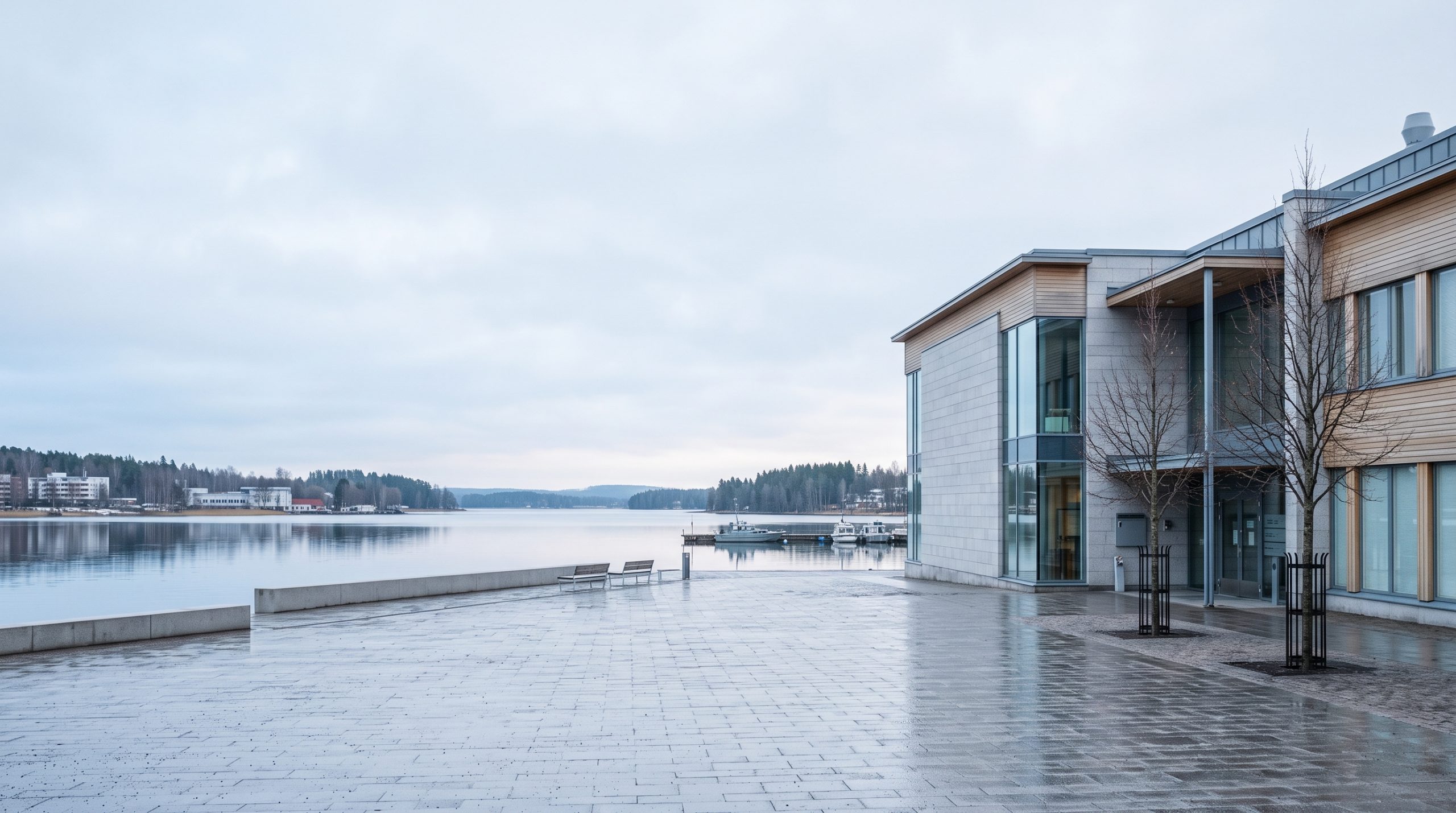
Two numbers decide the shape of a legal Finnish wedding, and neither of them is a fee. You cannot request the examination of impediments to marriage more than four months before your ceremony date. And the office cannot hand you the certificate sooner than the seventh day after you ask for it.
Everything else fits between those two edges: the affidavit, the Apostille, the original documents travelling in an envelope, the officiator’s diary. Once you see it that way, Finland stops looking like a bureaucracy and starts looking like a calendar problem, which is a far easier thing to solve.
We plan elopements across Finland, from frozen lake shores in February to Lakeland evenings in June when the light barely bothers to leave, and the legal question turns up in almost every first message we get. This is the answer we send back: what the Digital and Population Data Services Agency actually needs, in the order you have to get it, with the waiting counted backwards from the day you want to be standing outside.
The four-month window and the seven-day floor
Visiting couples can marry in Finland without living there. The Digital and Population Data Services Agency examines impediments to marriage, and it cannot issue the certificate sooner than the seventh day after you ask. That certificate is then valid for four months, so the entire legal chain lives inside one four-month window that you open yourself.
The paperwork is manageable; Lapland logistics are harder
Call it fiddly. Not hard, not out of reach, but fiddly in one specific place, and that place is not Finland.
The Finnish side is unusually clean. There is no residency requirement, and the Digital and Population Data Services Agency, which everyone shortens to DVV, publishes a route for the case where neither spouse is a Finnish citizen and neither has a place of residence in Finland. The certificate of the examination of impediments is free of charge. A civil ceremony held on DVV or District Court premises during office hours is free as well. Two witnesses, aged 15 or over, and both of you present. That is the whole ceremony requirement.
The friction sits on the American side. No US state government issues a statement of non-impediment, which is the document a registrar would ordinarily want, so Americans use a substitute: an affidavit sworn at the US Embassy in Helsinki confirming that you are not presently married. The Embassy notes that most Finnish registrars accept it. That single item is why the chain for a couple from Denver has one more link in it than the chain for a couple from Stockholm, and it is the link that dictates your travel dates rather than the other way around.
We can build the day around the paperwork, but we do not decide the law. Confirm your exact route with the relevant registry or consulate. What follows is the chain as the offices themselves publish it, and the parts of it we have planned trips around. For the ground beyond the paperwork, our destination elopement guides cover regions, months and light.
Every document, in the order you need to get it
DVV works from the Population Information System. Neither of you is in it, so every fact the agency would normally look up has to arrive as paper instead. One rule sits above all the others: the original document is always required for the examination of impediments. Not a scan, not a photocopy, not a printout of an email attachment.
- Valid passports. The identity half of the file, and the only item on this list you already own.
- Proof of your marital status. DVV needs a certificate showing whether you are unmarried or a previous marriage has ended. Since no US state issues one, the accepted substitute is the affidavit sworn at the US Embassy in Helsinki stating that you are not presently married.
- Certified evidence that any earlier marriage was legally terminated. If either of you has been married before, that evidence attaches to the affidavit. Order certified copies early, because the next step depends on them.
- An official certificate that you have the right to marry in Finland. Where neither spouse is a Finnish citizen, DVV asks for this on top of the marital status proof. The US Embassy’s own advice is to contact the DVV office with jurisdiction over your intended place of marriage and confirm what that office wants to see.
- An Apostille on anything issued outside the EU. A document that is not a public document issued by an EU member state, and is not a certificate issued by a Nordic country, must be legalised with an Apostille. For American paperwork that means the office of the Secretary of State in the state that issued it. Build in generous time. This is the only step run entirely by an office with no interest in your Finnish deadline.
- A translation, only if you actually need one. DVV can process documents in Finnish, Swedish or English, so American paperwork usually arrives ready to read. Anything in another language needs a translation produced by an official translator in an EU member state or an authorised translator in Finland. The translation itself does not have to be legalised.
- The request for the examination of impediments. The online route requires both of you to hold a Finnish personal identity code and Finnish online banking credentials, so visiting couples use the paper or PDF form instead. A single form signed by both of you is enough. It reaches DVV by post or in person at a service location, with Helsinki, Oulu, Jyväskylä, Joensuu, Lahti and Lappeenranta among them.
- The certificate itself. DVV issues it once the examination is complete. It costs nothing and it is valid for four months from the date of issue. If a DVV officiator marries you, there is no need to carry it to the ceremony. If anyone else officiates, hand it over beforehand.
Impediments under Finnish law are narrow and specific: a currently valid marriage or registered partnership, a family relationship that is too close, an age under 18, or one spouse being a child adopted by the other. For almost every couple reading this, the examination is a formality. It is the clock attached to it that needs managing.
Work back from the Finnish ceremony date
The statutory minimum and the workable minimum are not the same number, and the gap between them is where the stress lives.
On paper the Finnish side takes a week. The certificate may not be issued, absent a weighty reason, earlier than the seventh day after the examination is requested. In practice, DVV’s own guidance is to allow several weeks when one spouse is a foreigner, and two foreign spouses do not make that faster. Processing runs longer again if the agency comes back asking for an attachment or a clarification.
| When | What happens | Why it lands there |
|---|---|---|
| Six months out | Order certified copies of any earlier marriage records and send them for an Apostille | Apostille turnaround sits with a US state office, entirely outside Finnish control |
| Four months out | The earliest date DVV will accept a request for the examination of impediments | A hard ceiling written into the process, not a guideline |
| Same period | Swear the affidavit at the US Embassy in Helsinki, or fix the trip on which you will | It has to reach DVV as an original alongside the rest of the file |
| Several weeks | DVV processes the examination | The agency’s own published expectation when a spouse is a foreigner |
| Seven days | The shortest legal gap between the request and the certificate | The statutory floor, and the number people mistake for the whole timeline |
| Four months from issue | The certificate stays valid | After that the impediments have to be examined again before a marriage can be concluded |
| Ceremony day | Both spouses present, two witnesses aged 15 or over | The one part of this that happens in the landscape rather than in an envelope |
The real minimum is seven days from a complete request. The comfortable minimum is a complete file with DVV a clear month before your date, with the American documents apostilled and physically in Finland well ahead of that. We plan to the comfortable one every time, because a February date in Lapland is worth defending and a document in transit is not something anyone can hurry.
Six details that catch visiting couples out
The affidavit is sworn in Helsinki
The US Embassy is in Helsinki. Lapland is a domestic flight north of it. That geography quietly rewrites the trip, because the affidavit has to be sworn in person and then travel to DVV with the rest of the original documents, and the examination takes weeks after that. Couples who want the legal marriage to happen in Finland generally do one of two things: build a Helsinki leg into the front of a longer trip, or make an earlier visit specifically to lodge the file. Both work. Neither works if it is discovered in month three.
Originals travel, scans do not
Every certificate in the chain has to reach DVV as the original document. Plan how it gets there, plan how it comes back, and keep certified duplicates of anything you will need again at home.
Four months is a ceiling, not a target
Organised couples often want the whole legal side finished a year out. Finland does not allow it. You cannot request the examination earlier than four months before the wedding date, so the only work available before that point is the American half: certified copies, Apostilles, and knowing which DVV service location will handle the file.
Several weeks is DVV’s phrase, not ours
The agency says to allow several weeks when a spouse is a foreigner. Read that as the base case rather than the pessimistic one, and add margin for the possibility of a request for further clarification, which restarts your reading of the calendar even though it does not restart the seven days.
Finnish, Swedish or English, and nothing improvised
Those three languages go through as they are. Anything else needs an official translator in an EU member state or an authorised translator in Finland. A bilingual friend, however fluent, is not a route the office recognises.
Office hours decide whether the ceremony is free
A civil ceremony on DVV or District Court premises during office hours costs nothing. Book an officiator to your own venue after office hours and the fee is 250 euros plus the officiator’s travel expenses to you. At the exchange rates of recent years that fee has landed somewhere in the high two hundreds in dollars. For an elopement it is almost always money well spent, because the hour you want is rarely a Tuesday at eleven in a municipal building.
Registry fees and response times are not permanent; verify the current version with the office responsible for your case.
Marrying at home first, then marrying in Finland
A good number of the couples we work with in Finland sign the legal paperwork at a courthouse at home, weeks before they fly. It is not a compromise and we will not present it as one. It is a calendar decision, and for a Lapland or archipelago elopement it is frequently the better one.
Signing at home removes the four-month ceiling, the seven-day floor, the Helsinki affidavit trip, the Apostilles, the originals in the post, and the certificate that has to still be inside its validity window on the morning. What it gives back is the date. You choose the day on light, ice and forecast rather than on an officiator’s diary, and if the weather turns you can move the ceremony hour by three hours without asking anyone’s permission.
What it changes about the day itself is nothing. You still write vows and read them to each other somewhere with no road noise. You still have witnesses if you want them and nobody if you do not. The film is the same film, shot the same way, and our published elopement stories and films are the honest reference for what a Finnish morning looks like when it is finished: highlights reach you within 5 days, the full gallery or film within 3 weeks. If you are still deciding what shape the whole thing takes, our guide to how to elope walks through the fundamentals before any of this paperwork becomes relevant.
Where our planning meets the officiator’s calendar
Every experience we run includes destination and location design, planning, a custom timeline built around light and real travel time, permit research and logistics guidance, and weather alternatives with a backup already chosen. In Finland that translates into something quite specific. We hold your shortlist of dates against officiator availability before anything is locked, and we set the ceremony hour against the sun rather than against the working day.
That matters more here than almost anywhere. A late-January afternoon in Lapland gives you a narrow, low, extraordinary light, and it does not wait for a 9 to 4 diary. The ability to book an officiator to a venue of your choosing after office hours is precisely what makes the best hour of the day available to you at all.
On the Expedition, a dedicated photographer and a dedicated filmmaker work that same hour together, with professional audio on the vows where conditions allow. It is the practical reason we can put a ceremony inside a fifteen-minute band of light rather than stretching it across an afternoon: one of us stays close on the vows while the other holds the wide frame and the sound, and nothing has to be repeated for a second camera.
What stays with you is the paperwork. We are not lawyers, we do not file forms with DVV, and we do not stand between you and the office. What we build is a trip in which the office’s dates and the light’s dates agree with each other, which is a smaller-sounding job than it is. Coverage runs from one full day to a multi-day route across more than one region, and the full breakdown of what each experience includes sits on a single page.
Send us your date range and the part of Finland you have in mind, and we will tell you honestly what the calendar allows and which month suits the day you are describing. Send Us a Message
Common questions
Do we have to live in Finland to get married there?
No. DVV publishes a route for couples where neither spouse is a Finnish citizen and neither has a place of residence in Finland. You will be asked for an official certificate confirming you have the right to enter into the marriage in Finland, in addition to proof of marital status.
How long does the examination of impediments take for two Americans?
Seven days is the legal floor, since the certificate may not be issued earlier than the seventh day after the request. DVV asks you to allow several weeks when a spouse is a foreigner, and longer if it needs an extra attachment or a translation. We plan for a complete file a month before the date.
Our state does not issue a certificate of no impediment. What do we send instead?
No US state government issues one. The US Embassy in Helsinki notes that most Finnish registrars accept an affidavit sworn at the Embassy stating you are not presently married, with certified evidence attached if an earlier marriage was legally terminated. The Embassy also advises contacting the DVV office with jurisdiction over your intended place of marriage first.
Can we get married outdoors in Finland, and what does that cost?
Yes. A marriage ceremony may, by agreement, be performed outside office hours and somewhere other than the courthouse. On DVV or District Court premises during office hours it is free. Booking an officiator to your own venue after office hours costs 250 euros plus the officiator’s travel expenses.
Do we need witnesses if we are eloping just the two of us?
Yes. Both spouses must be present, along with at least two witnesses who have reached the age of 15. Working out who those two people are is one of the first things we settle when the timeline is built, because their travel and the ceremony hour have to agree.
Can same-sex couples marry in Finland on the same terms?
Yes. Finland’s Marriage Act has been gender neutral since 1 March 2017, and the impediments DVV examines make no reference to the gender of either spouse. The document chain, the seven-day floor and the four-month validity window are identical.
Will a Finnish marriage be recognised when we get home?
A marriage performed overseas is generally treated as valid where it took place if it was entered into in accordance with local law, and recognition then depends on the laws of the place where you want it recognised. If a US office asks for a legalised Finnish document, DVV attaches an Apostille, currently 38 euros.
Pick the date, then work backwards
Finland rewards couples who choose the date first and hang everything off it. Four months is the earliest you can file, seven days is the fastest DVV can answer, four months is how long the answer lasts, and the light in the north moves faster than any of those numbers. Get the date right and the rest is sequencing.
From the first message onward, the planning stays in writing rather than depending on calls. You send the inquiry form, we reply within 24 hours with our initial brochure, a tailored proposal follows, and once the contract is signed and the 30% retainer is paid the planning begins properly. We are currently booking 2027, 2028 and 2029, and Finnish winter dates are the ones couples ask about earliest.
Tell us the month you are picturing and whether you want the legal marriage in Finland or at home, and we will build the rest around it. Start Your Story