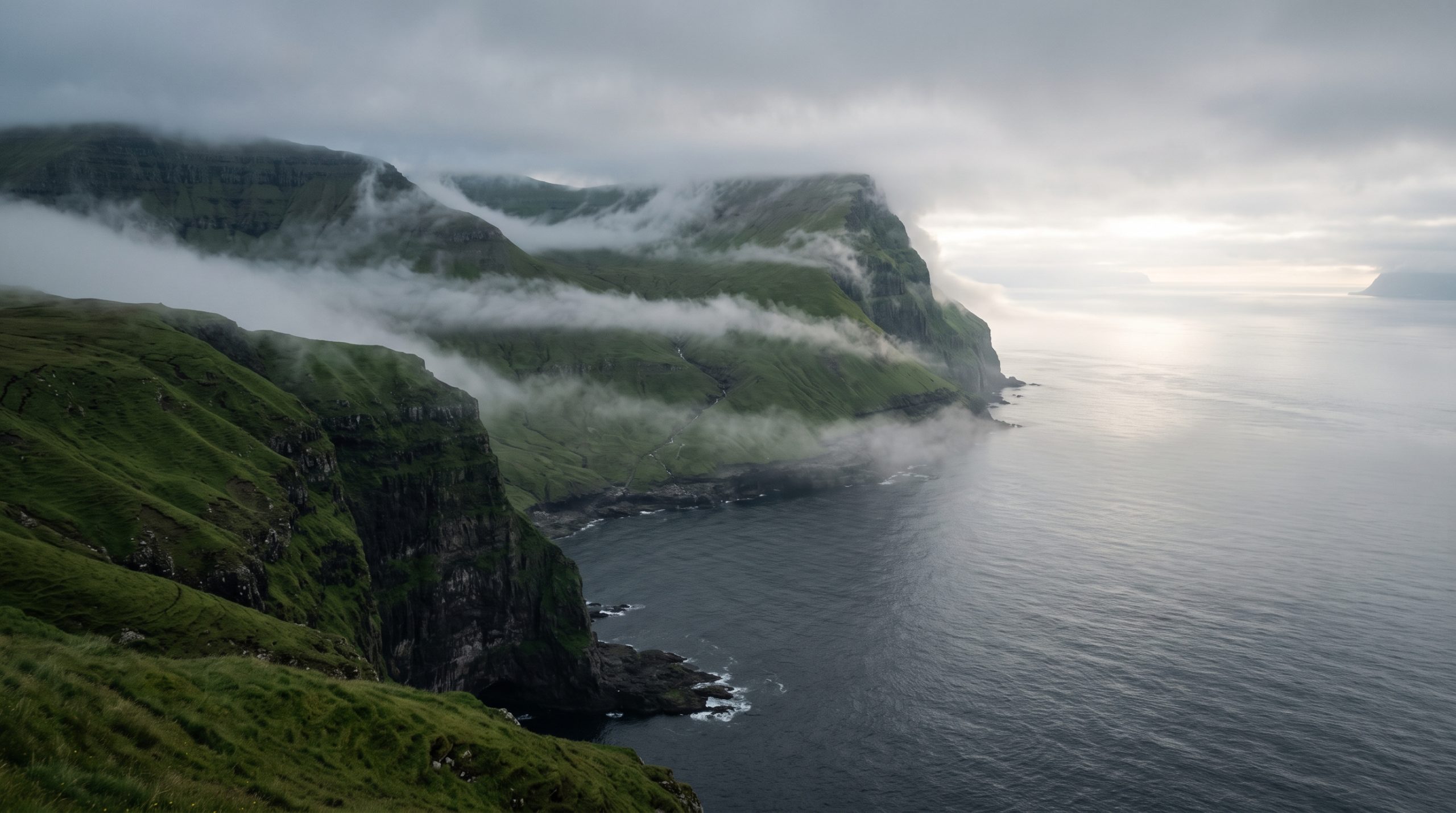
At the June solstice on Vágar the sun comes up at 3:38 in the morning, almost due northeast, and it does not go down again until 23:25. At midnight it sits about four and a half degrees below the horizon, which means the northern sky never turns black. There is no dark hour on these islands in June. There is a long sideways light, and a great deal of weather crossing it.
The other numbers matter just as much. The walk along Sørvágsvatn to Trælanípa crosses private land and costs 200 kroner a person, and the guided departures leave at 9:00, 12:00 and 15:00, which tells you precisely when the path is busy. That cliff also sits about 3.6 kilometres from the runway at Vága Floghavn, inside the five-kilometre distance requirement where flying a drone needs permission from the Danish Civil Aviation and Railway Authority. Múlafossur, out at Gásadalur, is nearly ten kilometres from the same runway and falls outside that ring. Two of the most photographed places in the North Atlantic, twenty-odd minutes apart by road, with entirely different rules in the air.
Then there is the cloud, which is the thing couples ask us about before anything else. Fog here is not a spoiled forecast. It is the reason the ridges read as layers rather than a wall, and on film it is the one thing in the frame that moves on its own.
One team on eighteen islands, and what a day costs
We are eight people, four photographers and four filmmakers, and we plan, photograph and film Faroese elopements as one team. A full day with a dedicated photographer and filmmaker working together starts at $7,900, with team travel to the islands included. Permit research, the timeline and the weather alternatives are all part of it.
One June day on Vágar and Streymoy, 02:00 to midnight
Two in the morning, and the north is already pale. This is the hour that only exists here for about six weeks of the year, and we use it for the places that become impossible later: the pull-in above Múlafossur, the road down into Saksun, the shoulder of hill above the lake. Nobody is awake. The wind is usually at its lowest of the whole day.
Sunrise lands at 3:38 and it happens at 29 degrees, which is to say in the northeast. The sun then climbs so slowly that it stays under six degrees of altitude for roughly ninety minutes. In the Utah desert the same window is under forty minutes and you get one location out of it. Here you can shoot the same low light in three places and the film will cut together as though it were one continuous morning, because it more or less was.
Because the sun rises at 29 degrees and sets at 331, the northern coasts are the ones that catch the low light. Tjørnuvík looking out at the two sea stacks, and the waterfall at Gásadalur pouring off the cliff towards Mykines, are both evening subjects in June rather than morning ones. Stand at Múlafossur at two in the afternoon and you get a flat grey record of a place that deserves better, shoulder to shoulder with a coach party. The pull-in is small, the fence is close to the road, and between roughly 10:00 and 16:00 you are sharing it. That is the honest middle of a Faroese day, and it is why we spend those hours under a roof, on the water, or somewhere that no tour route reaches.
The legal side runs on office hours. Tórshavn City Hall marries couples on weekdays during working hours and not on public holidays, so the signing and the day we photograph are rarely the same clock, and that is a feature rather than a problem. Couples who marry somewhere other than City Hall bring two witnesses to sign the certificate. Foreigners who marry in Tórshavn receive an international marriage certificate in Faroese and English, and the ceremony is conducted in Faroese with English translation. It is a short, oddly moving piece of administration, and it frees the outdoor vows to happen at 4am on a clifftop with nobody there but us.
By 21:50 the sun has dropped back under six degrees and the second long window opens, this time in the northwest. Sunset is at 23:25 at the solstice, and afterwards the glow simply slides along the northern horizon until it starts again. We have finished days at 00:30 on a beach because the light refused to leave. If your idea of a wedding day ends with dinner, say so early and we will build a shape that lands the best hour before the food rather than after it.
| Date on Vágar | Sunrise | Sunset | What that gives you |
|---|---|---|---|
| 21 June | 03:38 | 23:25 | No true night, two ninety-minute low-light windows |
| 20 August | 05:47 | 21:18 | Civilised start, an hour of proper dark for interiors |
| 15 September | 06:55 | 19:53 | Sunrise due east, storm light, empty paths |
| 21 December | 09:54 | 15:01 | Five hours of continuous low sun, never above five degrees |
Tell us the month you are holding and we will send back the shape of that day, hour by hour, before you commit to anything: Check Your Date.
Ninety minutes of low sun, two cameras, one plan
Here is what the pairing actually changes on a Faroese ridge. The weather arrives in minutes. Cloud lifts off a summit, a squall crosses the fjord, sea fog drains through a col and the whole scene is remade twice inside a quarter of an hour. A photographer working alone has to choose which of those minutes to keep as a still and which to keep as motion, and in choosing, loses the other. Two people with one plan keep both.
In practice it sounds like this: the photographer takes the wide frame with the couple small on the terrace of rock, then moves in close for hands and hair and the noise of the wind in a veil, while the filmmaker holds a long, almost static shot of the cloud pulling off the ridge behind them. Neither person is waiting for the other. When the window closes, we have the frame you will print and the twelve seconds that show what it was like to stand there.
Fog is where film wins outright. A still photograph of a ridge in cloud is a study in grey. The same ridge on film has movement through it, and the movement gives the frame its depth. Sound does the rest. On The Expedition we record professional audio for vows and the moments that matter, so the vows sit over the actual noise of the place, which in the Faroes is water, wind and oystercatchers rather than silence. You can see how the two halves read together in our films and galleries, where the same hour appears as both a set of stills and a moving sequence.
Aerials are the third layer, and they run on rules rather than instinct. European drone regulation applies here alongside the Faroese order on drones, and the distance requirements are specific: five kilometres from Vága Floghavn, permission before flying over land that is enclosed by a fence or a wall, and real care around bird cliffs and nesting areas in the breeding season. Because the filmmaker is flying, the photographer never stops shooting, and because we researched the zone before the timeline was written, the aerial either has a legal window or it was never in the plan. Being eight people means there is always a second camera on the ground and a colleague in reserve, which is not an abstraction on an island group where a ferry timetable can rearrange an afternoon.
When the ridge stays in cloud for three days
This is the real objection, and it deserves a straight answer rather than reassurance. Yes, it happens. The tops can sit in cloud for days while the coast below is perfectly clear, because these islands are steep and narrow and the high ground tops out under 900 metres, right where the weather sits.
So we do not plan a route. We plan a set of options, ranked by wind direction and cloud base, and we choose on the morning. If the tops are in, we work low: the lagoon at Saksun with the tide going out and the sand at the far end walkable near low water, the black church at Kirkjubøur, the turf roofs at Tinganes in Tórshavn, Gjógv from the level ground beside the gorge. If one side of the archipelago is being hammered, we drive through the tunnel to the lee side, and if the day needs it we take the roundabout under the fjord to Eysturoy and shoot a completely different coast. Your fee does not change when the plan does.
The couples who love their Faroese films most are almost never the ones who got the clear blue day. Clear and blue is the least Faroese weather there is.
Where coverage starts, and what the islands charge on top
Every experience includes destination and location design, planning, a custom timeline built around light and real travel time, permit research and logistics guidance, weather alternatives and backup planning, and drone footage where it is legal, safe and appropriate. Team travel is included worldwide, so flights, accommodation and ordinary travel for the assigned team are already in the figure. Highlights reach you in 5 days. The full gallery or film follows within 3 weeks.
- The Adventure, from $4,900: one full day with one dedicated photographer or one dedicated filmmaker.
- The Expedition: one full day with a dedicated photographer and filmmaker working together, and professional audio for vows where conditions allow.
- The Odyssey: two to seven days, photography and film, one or several destinations, quoted as a custom proposal.
The current figures for each of those sit on the pricing page, and the fee does not move with your guest count. Guests change access, permits, transport and the timeline, never the price.
What the Faroes add on top is small but real, and it is paid locally. The Trælanípa walk above Sørvágsvatn is 200 kroner a person. The path to the Kallur lighthouse on Kalsoy, where a small red and white light has stood since 1927, is 200 kroner for adults and 100 for ages 13 to 17, with under-13s free and cards taken at the site. Faroese króna run at par with the Danish krone, and at roughly six and a half kroner to the dollar that lighthouse walk is about thirty dollars each. Beyond the land fees, you cover any government, venue or landowner permit fees, your accommodation, your celebrant, and anything unusual on the transport side: a boat charter, a helicopter, a 4×4, a mountain guide. We research and arrange all of it. The invoices are simply not ours to absorb.
How a Faroe film date moves from first message to hold
- You send the inquiry form with your month, or the two months you are choosing between.
- We reply within 24 hours with an initial brochure.
- We write back with questions about the shape of day you want, and which islands matter to you.
- You get a tailored proposal: coverage, timeline logic, the light on your actual dates.
- Contract signed and a 30% retainer paid. The remaining schedule is set out in the proposal.
- Planning begins: locations, permits, the tide and ferry constraints, the alternatives for each hour.
Our current Faroe Islands availability runs across 2027–2029, and the Faroese paperwork wants weeks rather than days, so the notice of marriage and any certified English translations get settled long before you fly.
Who these islands suit at four in the morning
The couples who get the most out of the Faroes are the ones who are genuinely happy to be on a hill at 04:00 in a jacket over the dress, who do not mind uneven, wet, sheep-cropped ground, and who can hear at breakfast that the plan has changed islands without it spoiling anything. If that is you, June gives you light that barely stops.
If a 3:38 alarm sounds like a punishment rather than an adventure, that is worth telling us in your first message, because the answer is not to compromise. Mid-September gets you a 06:55 sunrise, sharper storm light and paths with nobody on them, and it is our favourite month here for film. If long walks are not the plan, there is a whole Faroese day available from the roadside and the harbour, and it is a good one. If your parents are coming and one of them is not going up a hill, we build the vows somewhere a car can reach and take the two of you to the ridge afterwards. Our destination guides are a decent way to work out which month you are actually describing.
Common questions
Can we fly a drone over Sørvágsvatn for our film?
Not on impulse. The Trælanípa cliff is about 3.6 kilometres from the runway at Vága Floghavn, and the Faroese order on drones sets a five-kilometre distance requirement around the airport, with flying closer needing permission from the Danish Civil Aviation and Railway Authority. Gásadalur, at nearly ten kilometres out, sits outside that ring. We decide aerials in planning, with the zone checked first.
Do we have to get legally married in Tórshavn, or can we sign at home?
Both routes work and plenty of couples do the paperwork at home and keep the islands for the vows. If you marry here, Tórshavn City Hall handles it on a weekday inside working hours, foreigners receive an international certificate in Faroese and English, and same-sex couples marry legally in the Faroes. Marrying outside City Hall means bringing two witnesses to sign.
What if it is fogged in for our entire week?
We work low instead of high, move to the lee side through the tunnels, and lean into what fog does for a film rather than waiting for it to clear. The plan is built as ranked options from the start, so switching islands on the morning is a decision rather than a scramble.
Is June or September better for the film?
June gives you a 03:38 sunrise, a 23:25 sunset and two ninety-minute windows of low sun. September gives you a 06:55 start, real darkness for candlelight and interiors, and far fewer people on the paths. Tell us which of those two days you would rather live through and we will tell you honestly which fits.
How many islands can we realistically cover in one day?
Two comfortably, three if the geography cooperates. Vágar and Streymoy pair well because the tunnel does the work. Anything reached by ferry, Kalsoy for instance, becomes the spine of the day rather than an addition to it, because the timetable decides your hours rather than the light.
Who pays the hiking and permit fees?
You do, locally, and they are modest: 200 kroner a person at Trælanípa, 200 for adults at Kallur. The research, the permission requests and the logistics around them are ours, and they are included.
When do we get the film and the photographs?
Highlights land within 5 days, while you are still travelling or just home. The full gallery or the finished film follows within 3 weeks.
Our parents want to come. Does that change what we pay?
No. The fee is the same whether it is the two of you or twelve people. Guests affect access, permits, transport and the timeline, so we plan for them, and if you are marrying outside City Hall two of them can be your witnesses.
Start with a month and an island
Everything we do runs in writing, which works across the time difference and suits couples who would rather think before replying. Send us your dates and the version of the Faroes you keep imagining, whether that is the lake edge at 4am or the harbour in the rain, and we will write back within 24 hours with an initial brochure and a first read on the light. Tell Us Your Story.