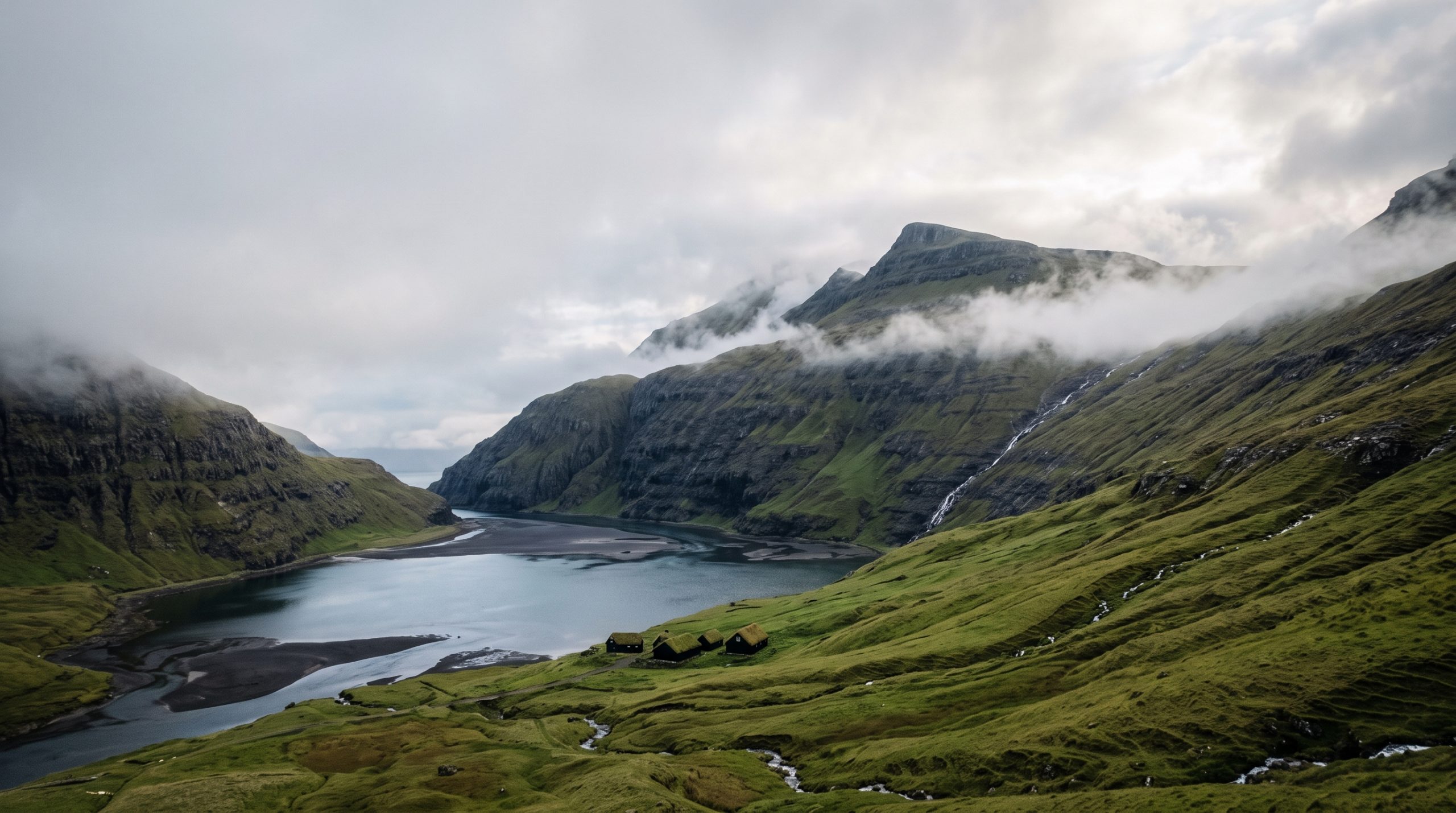
In the third week of June the sun comes up over Streymoy around 03:36 and stays up until 23:21, and from the first days of June to mid-July the sky never gets past twilight. Nineteen and three quarter hours of daylight rearranges an elopement day more than any other fact about these islands.
The rest of the planning is smaller and more stubborn. One airport. Four tolled subsea tunnels and a great deal of one-lane village road. Boats that run in summer only, and only when the sea agrees. Gates on the best-known walks, where a landowner takes 200 króna before you set off.
We are Unmapped Stories, eight photographers and filmmakers who plan and shoot elopements as one job. What follows is the operational version of a Faroes plan: what to book, in what order, and which timetable each day is really built around.
One airport, one tunnel, and the days it really takes
Everyone flies into Vágar Airport. Tórshavn sits one subsea tunnel away, under an hour by road. Plan four nights: one to land and sleep, two working days so the weather always has an alternative, and one held for a boat crossing. The legal paperwork goes through Tórshavn municipality, and several trailheads charge at the gate.
Getting in, and where to put your bags
Four airlines serve Vágar: the Faroese carrier Atlantic Airways, plus Icelandair, SAS and Widerøe. Direct routes come in from Denmark, Scotland, Iceland and Norway, and most of those flights run under two hours. Copenhagen is the year-round spine, with at least two departures a day. Everything else thins or vanishes with the season, so check the month you actually want.
There is no direct flight from North America, so plan on connecting in Copenhagen or Reykjavík, and treat the arrival day as an arrival day. We do not photograph on it. Vágar sits in a valley where cloud collects, and a day of slack between the landing and the ceremony is the most useful thing in the itinerary.
Where you sleep then decides how much of your trip you spend behind a windshield. Beds are limited outside the capital, and that shapes a Faroes plan more than distance does.
| Base | From the airport | Puts you next to | The trade-off |
|---|---|---|---|
| Sørvágur and the Vágar villages | Minutes | Trælanípan, Gásadalur, the Mykines and Drangarnir boats | Very few places to eat; quiet evenings |
| Tórshavn | One subsea tunnel, under an hour | The marriage office, restaurants, most of the accommodation | Every location is a drive |
| Klaksvík | Two subsea tunnels, well over an hour | The Kalsoy ferry and the northern cliffs | A long transfer on arrival day |
| Gjógv and Funningur | The pass road across Eysturoy | The gorge, the north coast, Slættaratindur | Cloud settles on the pass; almost no beds |
| Sandoy | 10.8 km of tunnel since December 2023 | Long sand, sea cliffs, hardly another visitor | Fewer services; older guides still send you to a ferry |
If you are still weighing the Faroes against somewhere else at this latitude, our destination guides set out how the northern islands behave across the year, and which of them suit a short trip.
Where the map lies: ferries, one-lane roads and the Kalsoy problem
On the main artery a route planner is close to honest. The subsea tunnels are signed for 80 km/h, and Vágatunnilin has been carrying airport traffic under Vestmannasund since 2002. Sandoyartunnilin opened on 21 December 2023 and runs 10.8 km beneath the sea to Sandoy. Eysturoyartunnilin holds a roundabout below the fjord. Of the twenty-odd tunnels in the country only those four charge a toll, cameras read the plate, and the rental company passes the charge on afterwards, so there is no booth to stop at and nothing to arrange at the airport.
The map starts lying the moment you leave that artery. The lanes to Saksun and Tjørnuvík are single track with passing places, so a van coming the other way means one of you reverses, and sheep treat the tarmac as theirs. Kalsoy’s single road threads a series of one-lane tunnels between its settlements, though the driving is not the real constraint there. The day is set by the route 56 ferry from Klaksvík to Syðradalur, a small boat with limited room for vehicles, and crossing as foot passengers on the bus that meets the sailing is usually calmer. Add the walk out to Kallur lighthouse and the 200 króna the landowner charges for it, and Kalsoy is a day, not an afternoon.
Two things we would not do. Airport to Klaksvík to Kalsoy and back to Vágar inside one day is technically possible, and it turns the best day of your trip into a transfer. And we never put Mykines on the morning of a ceremony. That crossing depends on the sea state, so it belongs early in the trip, where a change of plan costs a lie-in.
These four run on someone else’s schedule. Everything else here is a road and a pair of boots.
| Place | How you reach it | Fee | What governs the timing |
|---|---|---|---|
| Trælanípan and Lake Sørvágsvatn | Reception hut at the Miðvágur trailhead, then a walk to the 142 m cliff | 200 DKK per adult without a guide | Guided departures at 09:00, 12:00 and 15:00; the hut is staffed, not automatic |
| Mykines | Boat from Sørvágur marina, summer months only | 400 DKK booked online before you arrive, 500 DKK paid on the island, plus the boat ticket | Sea state and a short season; book it for early in your trip |
| Kallur lighthouse, Kalsoy | Route 56 ferry Klaksvík to Syðradalur, then the road north to Trøllanes | 200 DKK adults, 100 DKK ages 13 to 17, under 13 free | The ferry timetable, and how few cars fit on board |
| Drangarnir sea stacks | Guided hike from Sørvágur | 600 DKK per person | Wednesdays, Saturdays and Sundays at 11:00, from 1 April to 1 October |
Light in the Faroes, and a day built on it
Tórshavn sits at 62 degrees north, so the year swings hard. On the June solstice the sun rises around 03:36 and sets around 23:21, and between roughly 2 June and 12 July there is no true darkness at all, only a long blue middle of the night. By mid-September sunrise has moved to about 06:50 and sunset to about 19:55. Ten days later it is 07:16 and 19:22. The December solstice gives about five hours of daylight, sunrise near 09:50 and sunset near 14:59, with the sun so low that the entire day rakes across the hills.
June is the month most couples ask for, and it asks something back: alarms before 03:00, and a sunset so late that a full day has to be shaped rather than filled. Mid-September is our own preference. A sunrise you can wake up to, a sunset before your dinner reservation, and the viewpoints quieter than in July. Múlafossur at Gásadalur shows why the hour matters more than the map pin. It faces west, so it is an evening subject, and at two in the afternoon it is flat, gray and shared with two coaches.
Wind is the other clock. It decides where vows can be spoken and heard, and it turns faster than any forecast. These islands photograph as weather more than as scenery, which is why cloud tearing across a ridge beats a clear sky, and you can see how that reads in our published stories and films.
Here is a real mid-September day, based in Tórshavn, built on that 06:50 sunrise.
- 05:40 Out of Tórshavn with coffee in the car. No other traffic on the road north.
- 06:25 Saksun. Turf-roofed church, tidal lagoon, and twenty-five minutes before the sun reaches the far ridge.
- 08:15 Tjørnuvík. Black sand, and Risin og Kellingin standing out in the sound. Side light, and the village still asleep.
- 09:45 Back through the tunnel to change, eat properly, and dry out.
- 11:30 The ceremony hour, placed in a lee where the wind will let you hear each other. If the municipality is officiating, that slot is theirs and everything else moves around it.
- 13:00 The quiet middle. The coaches are at the famous stops now. We eat, and we drive.
- 15:00 Pay in at the Trælanípan trailhead and walk up to the cliff edge above Lake Sørvágsvatn.
- 18:30 Gásadalur, for the last hour on Múlafossur while the light is finally on it.
- 19:55 Sunset, and a shallow sun angle that keeps the frames alive past 20:00.
- 21:00 Back in town, boots off.
Dress in layers you can lose in ninety seconds. Wool under the dress or the suit, a coat that lives in the car, real boots for the trailhead walks and the ceremony shoes in a bag. The ceremony hour is the one moment worth being cold for, and it should be the only one.
Paperwork, witnesses and the turf church question
Visitor civil marriages are handled by Tórshavn municipality, and the standard visitor ceremony is at City Hall. The municipality asks couples to make the inquiry no later than four weeks before the intended date, while the Notice of Marriage cannot be submitted more than four months ahead. Some weeks and public-holiday dates are unavailable, so the legal ceremony is a fixed booking rather than something we move around the weather. You will also be asked for the required civil-status documentation, and afterwards the municipality issues an international marriage certificate in Faroese and English. A non-resident name change is handled at home.
You need two witnesses on the day and the municipality asks for their names and addresses in advance. If the legal ceremony is part of the trip, we build the photography around the confirmed City Hall slot rather than presenting an outdoor symbolic ceremony as the legal one.
The turf-roofed churches are the question we get most. The national church requires that at least one of a couple is a member, and for foreign couples that one partner is, or has been, a Faroese citizen. That makes those churches a setting rather than a venue, which is less of a loss than it sounds: the ground outside them is where the landscape is. Plenty of couples sign the legal papers at home and treat the Faroese day as the ceremony instead, which lifts every deadline off the trip. Our guide to planning an elopement covers both routes. Tell us which one you want and we build the timeline around it.
Government, venue and landowner fees are paid by you directly, those trailhead fees included. The research, the applications and the sequencing are ours, and they happen before a location enters your timeline.
Aerials: what we confirm before we plan a shot from the air
European drone regulations apply here alongside the Faroese order on unmanned aircraft, with the Danish Civil Aviation and Railway Authority and the Faroese police as the authorities in charge. That means operator registration and liability insurance on our side, a 5 km buffer around Vágar Airport, a 2 km buffer around helicopter landing sites, and specific permission to fly over private property or an environmentally protected area. Much of the landscape is privately held and much of it protected for its birdlife, so permission is the slow part. We confirm what is legal at each location, and in which weeks, before a single aerial sequence goes into the plan for your film.
How we build a Faroes day that survives a change in the weather
Every timeline we write for these islands carries a second version. A north coast morning has a sheltered inland alternative fifteen minutes away, and the ceremony hour is never placed next to a ferry departure or a gate closing. Drive times in your timeline account for passing places and for stopping to look.
Two of us on the ground changes what is possible on a day this spread out. Two vehicles means one of us can be at the next trailhead reading the light and the queue while the other stays with you, so you arrive at a location already scouted. It also means a second full set of bodies and lenses on an island where the nearest camera shop is a flight away, and on the Expedition a filmmaker whose whole attention is the audio when the wind is up. Photography, film and planning come from one team as a single service, and the starting figures are on our pricing page.
Highlights reach you within 5 days of the day itself, and the full gallery or film within 3 weeks, which for most couples lands while they are still traveling. If you already have a month in mind, Check Your Date and tell us what you want the day to feel like.
Common questions
How many days do we need in the Faroe Islands for an elopement?
Four nights is the sensible minimum: an arrival day, two days for the elopement and its weather alternative, and one held for a boat. Adding Mykines, Kalsoy and a southern island makes it a multi-day plan across two to seven days, which is what our Odyssey is for.
Can Americans legally get married in the Faroe Islands?
Yes. Tórshavn municipality conducts civil marriages for visitors at City Hall and issues an international marriage certificate in Faroese and English. Contact the municipality no later than four weeks before the intended date, submit the Notice of Marriage within its four-month window, provide the requested documents and bring two witnesses on the day.
Is September better than June for a Faroes elopement?
For most couples, yes. June gives about nineteen and three quarter hours of daylight and a sunrise around 03:36, which is thrilling and demanding in equal measure. Mid-September gives a 06:50 sunrise, a 19:55 sunset, autumn color on the slopes and noticeably fewer people at the famous stops.
Do we need a rental car, or can we manage on buses?
Take the car. The public network is genuinely good for a country this size, but an elopement day runs on being at a specific place at 06:25, and no timetable does that. Tolls on the four subsea tunnels are read from the plate and settled through the rental agreement.
How far ahead should we book the Mykines boat?
As soon as the season’s sailings open, because capacity is small and the crossing runs in the summer months only. Book the hiking fee online at 400 DKK rather than 500 DKK on the island, and keep a spare day so a change in the sea state is only an inconvenience.
What happens to our plan if the weather turns on the day?
We move it, usually by hours rather than days. Each location in your timeline has a sheltered alternative attached to it, the light windows are wide at this latitude, and we watch the wind direction from the evening before. In four days on these islands, something always opens up.
Booking a 2027 date in the Faroes
We are booking 2027, 2028 and 2029. Send the inquiry form and you will have a reply and our initial brochure within 24 hours, then a tailored proposal, and planning begins once the contract is signed and the 30% retainer is paid. All of it happens in writing, on your own schedule, whatever time zones sit between us. Tell us the month you are considering and what you want the morning to feel like, and we will tell you what the light and the boats will do with it. Tell Us Your Story.