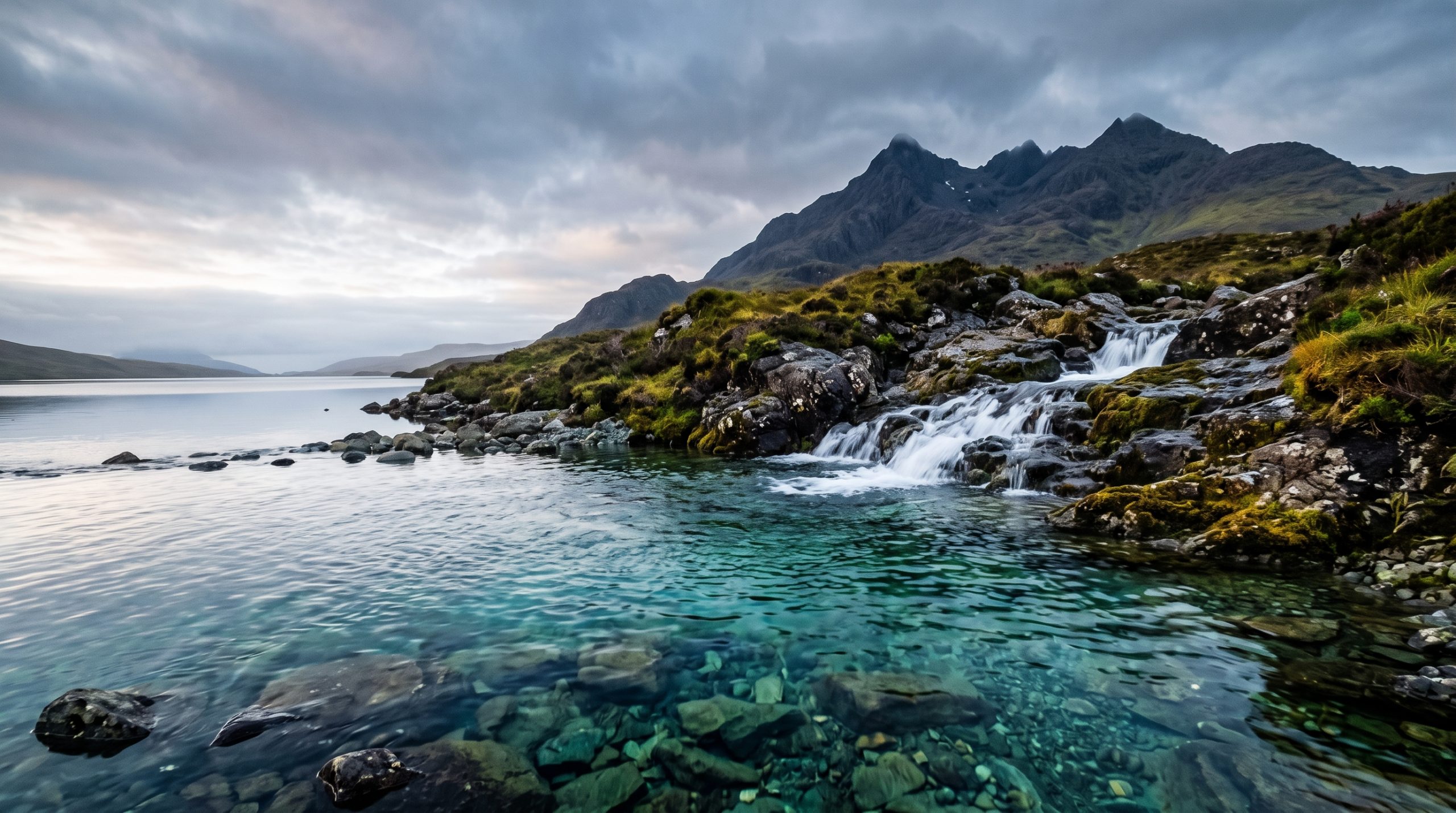
The path out of the Fairy Pools car park points southeast, straight at the pinnacle of Sgùrr an Fheadain and the long gash of Waterpipe Gully, which the Victorians attempted for years before it was finally climbed in 1895. That direction is the most useful thing on this page, and almost nobody writes it down. The high ground stands between the pools and the sunrise. At seven on a June morning the ridge is lit and the water is not.
While the water waits for the sun, the car park fills. The site is run by the Outdoor Access Trust for Scotland, which now sizes the facilities here around roughly 240,000 visitors a year. Local guidance names late morning, about 11am to 1pm, as the busiest stretch in summer. In July the arrivals are steady well before nine, and the last five miles into Glen Brittle are single track with passing places, so the queue forms on the road before it forms on the path.
None of that rules out a ceremony beside the burn. It rules out the middle of the morning. Scots law is unusually relaxed about where a wedding can happen, the glen costs nothing to walk into, and the good light arrives at the far end of the day. Those three facts, together, are the whole plan.
The nine o’clock problem, and the hour we book instead
The Fairy Pools car park fills from mid-morning in season, and the pools sit in the shade of the Cuillin at first light. So we place the ceremony early, before the road fills, or late, when the sun swings northwest down Glen Brittle and the visitors have gone. A belief celebrant can legally marry you there at either hour.
Five miles of single track off the Carbost road
From Portree it is 20.5 miles and about half an hour of driving. You come through Carbost, home of the Talisker distillery, then turn off the B8009 and onto the Glenbrittle road, which runs single track with passing places for the last five miles or so. Buses cannot use it. Minibuses do, and a tour vehicle coming the other way on a blind rise will cost you five minutes you had not planned for, which is why our timelines treat that road as a variable rather than a fixed number.
The car park itself was finished in 2020, built by the Minginish Community Hall Association and leased to the Outdoor Access Trust for Scotland, who set and collect the charges. Pay and display sits on the left as you drive in, just before the toilet block, and takes cards as well as coins. Charges have risen more than once since the car park opened: a car is currently £8 for the day, and a campervan or motorhome £10, directed into the lower car park. There is no overnight parking. The toilet block is off grid and has an accessible cubicle, which makes it more useful than most trailheads on Skye and still nothing like a dressing room.
Twenty minutes on gravel, in wedding clothes
The walk to the main falls and back is about 2.4km. Twenty minutes gets you to the first big pool at a normal pace, forty covers the round trip if you do not stop, and nobody does not stop. The path is well made and undulating with short boggy sections, and two steel and timber bridges were airlifted in and installed over the burns as part of the Skye Iconic Sites Project, along with rebuilt viewpoints and repaired path surfaces. Past the main pools the ground turns stonier and wetter. If you want the whole corrie rather than the famous 200 metres of it, the full round into Coire na Creiche is around 8km with up to 360m of ascent, and it is a different day entirely.
Here is the part other pages leave out. In dry weather the path is fine pale grit, and a long hem collects a grey tideline within the first few hundred metres. After rain the same grit turns dark and the grass either side holds water for hours, so the wet arrives from the sides, not from above. The distance is not the problem: twenty minutes is nothing. The fix is order of operations. Dress at the accommodation, walk up in boots with the hem carried or lifted, and change on the flat rock by the upper bridge, where there is room to stand and something dry to sit on. Rings, schedule and shoes go in one bag with one person carrying it, because the one thing you do not want at the top of that path is a discussion about who has the ring box.
Why the water sits in shade while the ridge is lit
Coire na Creiche opens to the northwest. The pools drain down that way, on the Allt Coir’ a’ Mhadaidh, into the River Brittle, and the high ground of the Cuillin stands round to the south and east. That geometry decides your ceremony hour more than the crowds do.
In the morning, the sun comes up behind the ridge. First light lands on Sgùrr an Fheadain and Bidein Druim nan Ràmh while the water below is flat and blue grey, which is why so many early frames from here look grand on the skyline and dull at your feet. It is a real trade, and worth knowing before you set an alarm. In the evening the sun swings around into the open end of the glen and comes back up the burn at you, low, from the northwest, and the pools go from grey to gold in about twenty minutes. In this part of Skye midsummer gives you sunrise around 4:26am and sunset around 10:26pm, with the earliest sunrise of the year falling around 18 June, so an evening ceremony in late June is genuinely late. In late December there are only about six and a half hours of daylight in total, which turns the whole question into one short window and makes the drive in, rather than the light, the thing we plan around.
One more piece of honesty about how this place records. Bright overcast suits the pools better than hard sun. The colour in that water comes from clarity, not from sunlight, and full sun blows the white of the falls while the rock beside them goes to contrast. A soft grey sky with a bit of wind in the surface is not a compromise here, it is the better card. You can see how the Cuillin and Skye’s west coast come out in our published films and galleries, including the greyer days, which are the ones couples worry about and later like best.
Who owns the glen, and what the registrar needs
Glenbrittle is part of the MacLeod Estate, and the estate’s own position is straightforward: the Fairy Pools are free to visit at any time. Nobody sells tickets. Nobody books slots. The only money that changes hands on the ground is the parking charge.
Access itself runs on the Land Reform (Scotland) Act 2003 and the Scottish Outdoor Access Code, which is worth reading once because it is more generous than visitors expect. The Code lists photography among the recreational activities access rights cover, and it extends those rights to activities carried out commercially where the same activity could also be done non commercially. Its own worked example is a photographer photographing the natural heritage. So a small ceremony at the pools with a celebrant, two of you, and a team carrying cameras on their backs needs no permit and no permission. That is a clean answer, and most pages hedge it into mush.
The paperwork is where Scotland asks for your attention instead. Both of you complete a marriage notice, form M10, and lodge it with the Highland Council registrar covering Skye no fewer than 29 clear days and no more than three months before the date. There are registration offices at Portree and at Broadford. Belief celebrants, including the permanently authorised celebrants of the Humanist Society Scotland, can conduct a legal wedding anywhere in the country, indoors or out, with no venue approval required, which is the reason a corrie in the Cuillin is legally no harder than a hotel ballroom. Your marriage schedule is collected from the register office before the day and signed at the ceremony itself, so it travels up the path with us: flat, dry, and produced only once we have found a spot out of the funnel of wind coming down the corrie. If the sequence of notice, schedule and celebrant is new to you, our guide to planning an elopement sets out the order things happen in.
Standing room for two cameras beside a loud burn
The ledges around the main falls are not big. There are two or three places where the whole cascade sits behind you, and they are close enough together that a photographer and a filmmaker who have not agreed sightlines will spend the ceremony in each other’s frames. Because our photographers and filmmakers work in the same team rather than meeting for the first time in the car park, that gets settled the day before: who takes the low ledge, who works long from the far bank, who moves and when. The burn is the other half of it. Falling water at that volume swallows a vow spoken at normal strength, and the wind funnels straight down the corrie, so on an Expedition the audio kit goes close and the ceremony sits a little downstream of the loudest fall, where the sound is atmosphere rather than a wall.
Practically, that is the difference between our two full day experiences. The Adventure brings one dedicated photographer or one dedicated filmmaker for a full day, from $4,900. The Expedition brings both, working together, from $7,900, and adds professional audio for the vows where conditions allow. The Odyssey runs across two to seven days and as many destinations as the trip needs, quoted as a custom proposal. Every one of them includes the planning, the location design, the timeline built around real light and real drive times, the permit research, the weather alternatives, and team travel to Skye, with highlights back to you in five days and the full gallery or film in three weeks. What each experience covers is laid out in full on our experiences and pricing page.
If you already know you want the burn, the ridge and no audience, tell us your story and we will start with the hour rather than the venue.
If the burn is up, the glen has other rooms
Heavy rain does two things here. It makes the falls magnificent, the best they ever get, and it slows the ground down. The bridges handle the crossings, but the stonier sections above the main pools take longer in nice shoes, so a wet forecast usually means we shorten the distance rather than move the day. There is a great deal of Glen Brittle below the pools that photographs well and asks less of your footwear: the River Brittle itself, the open floor of the glen with the whole ridge behind it, and the road’s end at Loch Brittle, where the beach and the campsite cafe sit about ten minutes further on and the cafe runs through the season from spring to mid October. Carbost and the distillery are ten minutes back the other way for the end of the evening.
This place suits couples who like the idea of being on a path at half past four in the morning, or still standing in a corrie at ten at night in June. It suits people who want water, rock and sound rather than a wide view, and who would rather have twenty quiet minutes of ceremony than a production. If neither of those hours appeals, say so in your first message. There is a version of this day that starts at a civilised hour and uses the low glen and the coast, and there are corners of Skye and the wider Hebrides that are quiet at noon, which is a different conversation and one we would rather have honestly. Our destination guides are a reasonable place to start comparing.
Common questions
Do we need a permit to have our ceremony at the Fairy Pools?
No. Glenbrittle is part of the MacLeod Estate and the pools are free to visit at any time, and Scottish access rights cover walking in, holding a small private ceremony, and photographing it. The charge you will pay is parking, currently £8 for a car for the day.
Is there anywhere to change at the Fairy Pools car park?
There is an off grid toilet block at the car park with an accessible cubicle, and that is the extent of the facilities. In practice couples dress at their accommodation in Carbost or Glenbrittle, walk up in boots, and swap shoes and lift the hem on the flat ground by the upper bridge.
Can a celebrant marry us at the pools, or do we have to do the legal part indoors?
At the pools. Belief celebrants in Scotland, including Humanist Society Scotland celebrants, are authorised to conduct legally binding weddings anywhere in the country with no venue approval. Both of you lodge an M10 marriage notice with the Highland Council registrar between three months and 29 clear days beforehand, and collect the marriage schedule before the day.
How early is early enough in July?
Earlier than most guides suggest, because the bottleneck is the single track road rather than the path. Arrivals are steady well before nine, and the busiest stretch in summer runs from roughly 11am to 1pm. For a July ceremony we will usually recommend the evening instead, which puts the sun in the right part of the sky as well as the people back in their cars.
What happens to our plan if the burn is running high?
The falls get better and the walking gets slower. Two installed bridges take care of the burn crossings, so we keep the ceremony lower on the path, build in longer walking times, and hold the open floor of Glen Brittle and the coast at Loch Brittle as alternatives that are minutes away rather than a redrawn day.
Picking your hour in Glen Brittle
An elopement here is really one decision made well: which end of the day you want, and then everything else built backwards from it. Once that is set, the rest falls into place quickly, because the walk is short, the permission question is already answered, and the paperwork runs on a 29 day clock you can start from home. Our current Scotland availability runs across 2027–2029. the planning stays in one written thread, at whatever hour suits you: send the inquiry form and you will have a reply and our initial brochure within 24 hours, then a tailored proposal, and planning begins once the contract is signed and the 30% retainer is paid. Tell us the date you are circling and we will tell you what the light is doing in Glen Brittle that week: check your date.