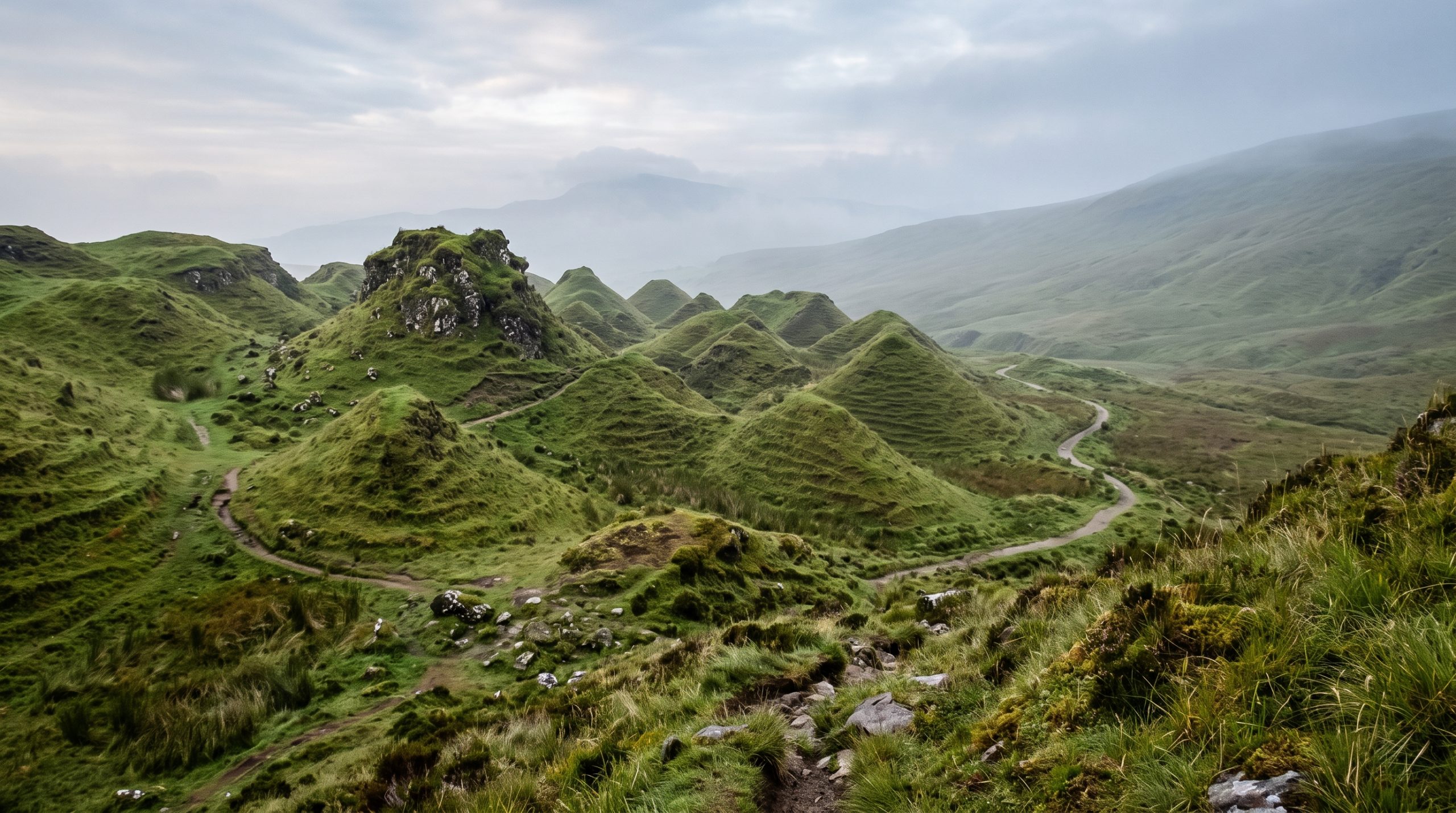
The whole of the Fairy Glen fits inside a mile. The circuit from the parking meter is about 1.5 kilometres with roughly 32 metres of climb, and a walker who stops for nothing is back at the car in half an hour. Almost everything that matters about getting married here follows from that one number.
This is not the Quiraing, where you can walk twenty minutes and leave everybody behind. The Fairy Glen is a scale model: a cluster of grass cones, a few lochans and a basalt tower called Castle Ewen, sitting in the hills above Uig at a place Gaelic names Baile nan Cnoc, the village of the hills. A landslip built it, nothing smaller or more mischievous, and it is compact enough that a ceremony here is a question of timing rather than distance.
The timing is knowable to the quarter hour, which is the good news. We have stood at the top of that road watching the last minibus of the day turn around while the sun finally came onto the front of the cones, and the gap between those two things is where a Fairy Glen ceremony belongs.
Married among the cones: what Scottish law allows here
You can legally marry in the Fairy Glen. Scotland lets a celebrant on the National Records of Scotland register conduct a binding ceremony outdoors, with no approved-venue list to work from. Marriage notice forms go to the registrar for the district at least 29 days ahead, and the glen itself needs no booking at all.
The turn between the Uig Hotel and Captain Fraser’s tower
From Portree it is roughly 16 miles north on the A87, about 25 minutes if nothing agricultural is in front of you. The turn comes just before the Uig Hotel, signposted for Sheader and Bail nan Cnoc, with Captain Fraser’s tower on the other side of the road. Coming up from Uig harbour instead, it is 2.9 miles back along the A87 to the same junction, taken from the other direction.
After that it is 1.5 miles of narrow, climbing, twisting single track with passing places. That mile and a half is the part couples underestimate. It is slow, it is blind over the crests, and it carries everything from cyclists to tour minibuses, so the drive up is a fifteen-minute job rather than a five-minute one.
The car park is pay and display, currently £2 for two hours and £3 for four, and the machine takes cards as well as coins. Spaces are limited, with a marked overspill lane along the roadside for when it fills. Public transport is not a plan here: the nearest bus stop is 1.5 km away on the A87 by the Uig Hotel, and the services that call there are infrequent. There are no toilets at the glen, and the nearest are down in Uig.
Ten minutes from the parking meter, in a dress
From the meter the path slopes uphill, and the main cluster of cones is five to ten minutes away on foot. Short enough that couples assume it is nothing. Long enough to matter in the wrong shoes.
Here is what that walk is actually like in wedding clothes. The path is good by Skye standards, but the ground between the cones and around the lochans is grass over peat, and it holds water for days after rain. Through winter and early spring it is properly wet. A long hem picks up a dark tideline in the first hundred metres, and a narrow heel finds every soft patch of it. So we walk in from the car park in boots, change at the cones, and carry the boots from there, because the far side of the loop is the half worth walking and it is the half nobody bothers with.
The climb up Castle Ewen is the one piece we leave alone. It is narrow and stony and finishes in a gap between two rocks, which is a fine scramble in walking shoes and the wrong idea in a long dress. The circular route passes underneath it, and the tower photographs better from below in any case, with the couple small at its foot and the basalt running up out of the frame.
The glen faces northwest, and that decides your ceremony hour
Walk down to the turning area at the bottom and the view opens across Glen Conon towards Kilmuir. That open side, the northwest, is the entire light story. Behind you the ground climbs east towards the Trotternish ridge, and the ridge is high enough and near enough that the sun does not arrive in the glen at the moment the tables say sunrise. First light touches the tops of the cones a good while later, and the hollows between them stay flat and cold for longer still.
Evening does the opposite. Around midsummer the sun sets at about 320 degrees, almost exactly down the open side of the glen, so the last two hours of light come in low over Glen Conon and rake sideways across the mounds. That is when the place stops being a lumpy green field and becomes the landscape people travel for: every cone with a lit face and a shadowed one, the lochans holding the sky, one edge of Castle Ewen going warm. Our galleries and films are the quickest way to see the difference, and it is worth noticing how much of it is the hour rather than the lens.
| Time of year | Sun sets around | What the ceremony hour is like |
|---|---|---|
| Mid-April | 8:30pm | Ground still soft, long clean light, car park emptying by seven |
| Late June | 10:25pm | Eighteen hours of daylight, warm side light from nine, calm air brings midges |
| Mid-September | 7:45pm | Sunset swings back to due west, first colour in the grass, loop clears earlier |
| Late December | 3:40pm | About six and a half hours of daylight, sun never higher than nine degrees |
That last row is the one most people misread. In the days around the winter solstice the sun never climbs more than about nine degrees above the horizon at this latitude, so the whole short day carries the sort of light we would otherwise wait until evening for. It also sets in the southwest, behind higher ground, which means the glen loses direct sun before the clock says sunset. A December ceremony in the Fairy Glen works well, and it works at one in the afternoon.
June sets the opposite trap. Nine in the evening is a working hour here, not a late one, and the still air after the breeze drops is when the midges find you. We put the vows on the side of a cone that keeps some moving air.
The spiral at Castle Ewen’s foot, and the honest crowd picture
On the flat ground at the base of the tower there is a large spiral marked into the grass, usually filled in with stones. Visitors made that, not fairies. It is not a tradition anybody local wants continued, because the stone gathering strips material off the slopes and speeds up erosion, signs ask people to stop, and volunteers clear the stones again and again. We build nothing, move nothing and leave nothing, and we place the ceremony beside the spiral rather than in it. Some corners of the glen are roped off to let the ground recover, and they stay roped off for us too.
Now the crowds, told straight. The glen is a stop on the 80 km Trotternish loop, which makes it a twenty-minute pull-in for a great many vehicles between roughly ten in the morning and six in the evening. From June to August the car park fills. Arriving early genuinely helps, and it is also not enough on its own, because a 1.5 km loop with one famous tower on it has no back side to retreat to. What works is the top and the tail of the day: the first hour of light, when the ground is empty and the sun is still working over the ridge, or the last two hours before sunset, once the day visitors have driven back to Portree for dinner. In June those windows sit seventeen hours apart, so we pick one and build the whole day around it.
Standing room is the other honest limit, and it makes the practical case for a photographer and filmmaker who already work together rather than two people introduced in the car park. The flat at the tower’s foot takes a couple, a celebrant and a handful of others. The frames worth having come from separating on the vertical: one of us low and close on the flat, the other thirty or forty metres out on the shoulder of a cone with the whole model landscape stacked up behind you. Without a plan, each camera spends the evening in the other one’s shot. Wind is the third factor, because it funnels between the mounds and finds a lapel microphone from any angle, so on an Expedition day we set the ceremony to put the vows in the lee of a cone, and if the wind swings round we move ninety degrees and lose nothing.
Who owns the ground, and what nobody has to book
The glen is private land with no gate, no ticket office, no visitor centre and no booking system. Entry is free, the parking meter is the only thing anyone pays on site, and for a small private ceremony that means exactly what it sounds like. Nobody issues a Fairy Glen wedding permit, because no such document exists.
What does exist is a short list of things we settle before a date is confirmed. We approach the landowner for permission rather than assume that a right of access covers a ceremony, which is straightforward to do and part of why we are welcome back. We confirm what is legal and sensible in the air before any part of the film leans on a drone. And we work the paperwork backwards from your date: notice forms to the district registrar at least 29 days out, the marriage schedule collected before the ceremony and returned after it. Couples travelling from the United States are often asked for extra documents about their status, so we open that thread early. Our guide to how an elopement actually comes together walks through the whole sequence.
One full day here fits either The Adventure, from $4,900, with a dedicated photographer or a dedicated filmmaker, or The Expedition, which puts both on the ground together, and the pricing page sets out what each one covers.
When 1.5 km of path is not a whole day
The glen suits couples who want one concentrated hour in a small, strange, beautiful place, with the rest of the day built somewhere else. It does not suit a long slow afternoon, because you will have walked everything twice by four o’clock. It also does not suit a party arriving in six cars, since parking is the real ceiling on numbers here and nothing else is. Our fee stays the same whatever your guest count; guests change access, transport and the timeline.
If you want more room and a longer horizon, the same peninsula hands it to you within a few miles. Uig Bay and the harbour sit about four miles back down the hill, the Quiraing is further round the loop, and Kilmuir and Duntulm finish the north end. The best Trotternish days we plan use the glen as one act rather than the whole play, usually the evening act, with coast and cliff earlier. Tell us the kind of morning you actually want and we will tell you honestly whether the glen belongs at the start of your day or the end of it, and which month gives you both. Our destination guides show how we put a Skye day together.
Common questions
Do we need a permit to get married in the Fairy Glen?
There is no permit for the glen and no venue to book. The requirements are national rather than local: a celebrant on the National Records of Scotland register, marriage notice forms lodged with the district registrar at least 29 days before your date, and the marriage schedule signed on the day. Because the ground is private, we ask the landowner’s permission as a matter of course.
Is there anywhere to change out of walking boots at the Fairy Glen?
Not on site. The glen has no toilets and no shelter, and the nearest facilities are in Uig. In practice couples get dressed at their accommodation, drive up in boots, and change footwear at the cones five to ten minutes in. We write a fifteen-minute buffer at the car park into the timeline for precisely that.
How many guests can the Fairy Glen take?
Count cars rather than people. The car park is small with a marked overspill lane on the road, so a group arriving in two or three vehicles is comfortable, while six cars becomes everybody else’s problem on 1.5 miles of single track. The flat at Castle Ewen’s foot holds a couple, a celebrant, two witnesses and a few more. Our fee does not move with the number.
Is the Fairy Glen the same place as the Fairy Pools?
No, and confusing the two costs you most of a day in the car. The Fairy Pools are at Glenbrittle in the southwest of Skye under the Cuillin, with a 140-space car park that opened in 2021. The Fairy Glen is in the far north above Uig, with a small pay-and-display and no facilities of any kind.
Can we get up Castle Ewen for photographs in a wedding dress?
We do not plan on it. The way up is narrow and stony and ends in a gap between two rocks, which is a poor exchange in long clothes on wet basalt. The loop path runs below the tower, and that is the better view of it anyway. If you want height, the shoulders of the surrounding cones lay the whole glen out beneath you after a few minutes of easy walking.
How wet is the ground in the Fairy Glen in April?
Wet. The hollows and the ground around the lochans hold water, the winter months are the worst of it, and April can still be soft underfoot for days after rain. That is a footwear and route question rather than a reason to move your date, and we pick the exact line we walk on the day itself, once we have seen the ground.
One evening in the glen, from the meter to the last light
Here is the shape we would give a June date. Leave Portree at half past seven in the evening and park around eight, walk in while the last minibus is turning around, marry at the foot of Castle Ewen near nine with the sun swung fully to the northwest, then spend an hour on the far side of the loop where almost nobody walks, the light going low and gold over Glen Conon until half past ten. Highlights reach you five days later, the full gallery or film inside three weeks.
All of the planning between now and then happens in writing, at whatever hour suits you: you send us the date and the shape you have in mind, we reply within 24 hours with a first brochure, and a tailored proposal follows. We are currently taking Scotland dates for 2027, 2028 and 2029. Check Your Date and tell us what you are picturing.