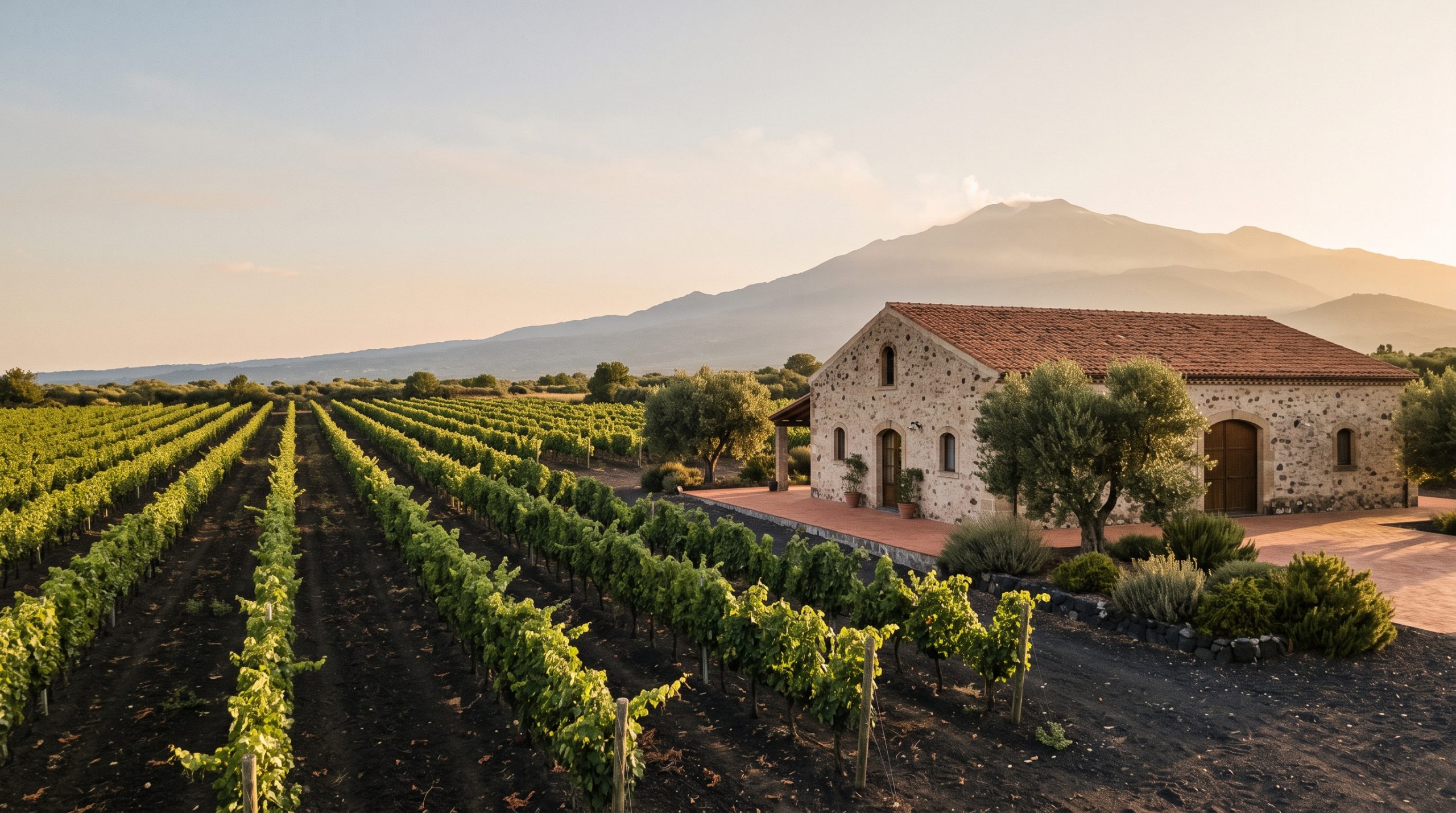
On the north flank above Passopisciaro, Planeta took a set of old terraces above 800 metres and rebuilt them into an open-air theatre in the middle of the Sciaranuova vineyard, then filled it with an audience every summer. That is the scale these Etna estates already operate at on their own land, and it is the reason almost none of them treat a ceremony for two people as a product with a price on a page.
So the honest answer to what Etna wineries charge is that they quote, and the quote is assembled from things you can predict before you write to anyone: whether the terrace closes to other visitors, what the kitchen and the cellar put in front of you, how many staff hours the afternoon takes, and which week of the year you have asked for. If you want the marriage to be legal in Italy rather than symbolic, a second and entirely separate bill arrives from the comune.
What follows is which estates say yes and who to write to, what the money is actually made of, which slope suits the hour you want to be standing there, and why an estate that says yes for May will say no for the third week of October.
Who says yes on Etna, and how the two bills split
Resort-estates that run their own events office, like Monaci delle Terre Nere above Zafferana Etnea, host ceremonies as a matter of course and quote privately. Working family cellars host small symbolic ones by arrangement. Expect two separate costs: the estate’s, built on exclusive use and hospitality, and the comune’s tariff if the marriage is legal rather than symbolic.
Zafferana’s sea terraces and the Passopisciaro contrade
Etna is not one venue with one view. The east flank, above Zafferana Etnea, drops toward the Ionian, so the sea is your background and the mountain stands behind you. Monaci delle Terre Nere sits up there across 25 hectares of vineyard, with lava-stone suites, gardens and terraces that open toward the water, and it keeps a dedicated events and weddings office. It takes on everything from a small ceremony to a full estate buyout. If you want one address you can write to and get a real answer from, this is the clearest on the mountain.
The north flank is a different country. Above Passopisciaro the land is cut into contrade, single named parcels of lava, and the estates there were built around wine rather than hospitality. Planeta planted vines here from 2008 and established its Feudo di Mezzo winery in 2012, with holdings north and south of the village and carefully restored buildings standing in the middle of the Sciaranuova vineyard above 800 metres. What the north slope teaches you is worth knowing: hospitality up here is organized around the tasting, the harvest and the cellar, so a ceremony is a conversation with a family rather than a form on a website.
In between, along the lanes that link one contrada to the next, are family cellars with no events page at all. Plenty of them will hold a short symbolic ceremony on a terrace as an extension of a private tasting, because that sits close to what they already do every week. What you will not get from them is a package, a pricing document or a fast reply in English, and that is the part we take over.
What an estate is actually pricing when it quotes you
Almost nobody on Etna publishes a ceremony price, and a rate card would mislead you anyway, because the cost of two people standing on a terrace has very little to do with headcount. What an estate is really selling is an afternoon in which nobody else is tasting on that terrace. Exclusive use is the first line of the quote and usually the largest one.
The rest is predictable. Food and wine come per head against a floor, because a kitchen and a service team cost the same to open for four guests as for forty. Staff hours, table and glass hire, and setting up and clearing an outdoor space are counted separately. Estates with rooms often tie a celebration to a number of room nights, or to taking the whole property, which is where a small wedding stops looking small on paper. The day of the week moves the number, and so does the week of the year.
Four facts get a real quote out of any of them: your date, your headcount including the two of you, the hour you want to be standing in the vineyard, and whether the ceremony is legal or symbolic. Send those and numbers come back. Send a note about thinking of Sicily next year and you get a brochure.
Location design, the approach to the estates, permit research and the timeline are part of every experience we run, so this correspondence is ours rather than yours. Our own figures are published and plain: The Adventure covers one full day with a dedicated photographer or filmmaker from $4,900, The Expedition puts a photographer and a filmmaker on the ground together from $7,900, and team travel to Sicily is included either way. The pricing page sets out what sits inside each one.
The comune’s tariff arrives on a separate line
A legally binding civil marriage in Italy belongs to the comune, not to the venue. The ceremony has to take place somewhere the council has formally designated for marriages, which means the town hall unless the council has extended that status to a specific building outside it. Some estates hold that designation and many do not, and it is the first thing we check when a couple wants the legal act itself to happen in the vineyard.
Italian councils publish their own tariffs for this, and the pattern is consistent across the country. Non-residents pay more than residents. A venue outside the town hall costs more than the council chamber. A Saturday, or any hour outside normal office hours, costs more again, and moving the date late usually means the fee stays paid. These are council decisions reset by resolution rather than fixed forever, so we confirm the current tariff with the comune that governs your estate before a timeline is built around it.
Paperwork for American couples runs through the US consular network in Italy and then through the comune, and it takes weeks rather than days. The research and the sequencing are ours; the fees themselves are yours. Most couples we take to Etna choose the other route: a symbolic ceremony with a celebrant on the estate’s own terrace, with the legal signing done at home before or after. On private land a symbolic ceremony needs no council permission at all. The estate’s yes is the only yes you need, and that single fact removes most of what makes people uneasy about marrying abroad. Our guide to planning an elopement walks through the order of operations.
Harvest runs the calendar, not the wedding season
Etna picks late. On the north slope the Nerello Mascalese often comes in through October, and at altitude the last parcels can run later still. Through those weeks the courtyard holds crates, the press is working, and the terrace outside the tasting room is a working floor rather than a place to stand quietly for twenty minutes. An estate that says yes for a Tuesday in May will say no for the same Tuesday in harvest.
It is also, inconveniently, the moment the mountain looks best. The Nerello leaves turn, the light drops lower, and the whole slope smells of fruit. If that is the month you want, ask early, stay flexible about the day, and let us find the estates whose picking window falls either side of your date. Spring offers the opposite trade: green terraces, a quiet cellar, snow still sitting on the summit, and a cool wind by the time the sun goes. If Sicily is one of two or three places you are weighing, the rest of our destination elopement guides are built to be read the same way.
Etna takes the sun long before the app says sunset
This is the part most plans get wrong. On the east flank the sun comes up out of the Ionian, so first light arrives early, clean and low, straight down the rows. By late afternoon the mountain itself is between you and the sun. The sky above Zafferana stays bright while the terraces slide into shade, so the sunset time on your phone is not the hour your light ends. We work back from the shade line instead.
The north slope behaves the other way around. From above Passopisciaro the western horizon runs open across the Alcantara valley to the Nebrodi, so the evening lasts, and the summit standing away to the south takes warm light on its flank while you are still lit. Above 800 metres the air is thinner and cleaner than anything on the coast, which is why frames from up there hold their contrast at an hour when sea-level light has gone flat and hazy.
Black lava ground changes exposure more than couples expect. Sciara absorbs light rather than bouncing it back, so shadows under the vines stay deep and a white dress reads very bright against the earth. It rewards exposing for the fabric and letting the ground go dark, and it is worth seeing how that renders rather than taking our word for it: our galleries and films show what volcanic ground does to a frame at both ends of the day.
The terracing helps us more than it helps anyone walking. Because the vineyard is stepped, a filmmaker can drop a level below the photographer and hold the same vows from another angle without appearing in a single frame, and the cellar door and the terrace can be covered at the same time rather than one after the other. Wind is the real variable on the Etna terraces. It builds through the morning and often again once the sun has gone off the slope, so for vows we set you with a dry-stone wall at your back and the microphone out of the airflow, which is the difference between audio you keep and audio you delete.
Black grit, stone risers and a hem you can still wear to dinner
The last stretch to most contrada estates is an unpaved lane, and the parking is a yard rather than a car park. None of it is difficult, but it is not a hotel forecourt either, and heels are the wrong choice for the walk in from the car.
Inside the vineyard you step rather than walk. Terraces are held by dry-stone walls with risers of uneven height, a long hem catches on them, and we move you between levels with a hand rather than a camera. Lava grit is the other thing to know about. It is black, as fine as coarse sugar, and it works into shoes and along a hem within minutes. That is a sequencing question rather than a problem: we take the open rows first while everything is clean, then keep the courtyard, the cellar and the tasting room for later, once the hem has stopped being pristine and nobody minds. Flat shoes for moving between terraces, one warm layer for after the sun goes, and a room to change in, which on request is nearly always offered.
Common questions
Can we legally get married at an Etna winery, or does it have to be symbolic?
Legally, only if the comune that governs that estate has formally designated the venue for marriages, and most vineyard terraces are not designated. The usual shape on Etna is a symbolic ceremony on the estate with the legal act completed at home. We check the designation and the current council tariff for that specific comune before you settle on a date.
Do we have to book the whole estate if there are only two of us?
Sometimes, because a private terrace for an afternoon is the thing you are really paying for, and some estates price that as exclusive use whatever the numbers. Estates with rooms may attach a room-night minimum instead. We ask the question with your date and headcount attached, since that is the only way a real figure comes back.
Is there anywhere at the winery to change out of walking shoes and into a dress?
Usually yes. Tasting rooms and cellar offices become changing rooms readily when the request goes in weeks ahead rather than on the morning, and on estates with accommodation you simply take a room. We ask for a specific space with a mirror and somewhere to set a bag down as part of building the timeline.
Can you fly a drone over the vineyard for our film?
Where it is permitted. Much of the mountain above the vineyard belt sits inside a protected park, and estates hold their own views about aerials over the rows, so both get confirmed before the film is planned around them. Drone footage is part of every experience we run wherever it is legal, safe and appropriate.
What happens if ash falls on our date?
Estates sweep their terraces as routine, and the light on an ash day often turns gold. Ash can also delay flights into Catania, which is the practical reason we ask you to arrive with a spare day before the ceremony rather than a spare hour, and why every timeline we build carries an alternative location.
Which slope should we choose if we only have one full day?
The east flank above Zafferana Etnea if you want the sea behind you and are happy to be up for first light, since the mountain takes the afternoon sun there. The north slope above Passopisciaro if you would rather be in the rows late with the western horizon open. Tell us which of those two days sounds like yours.
Before you write to an estate, tell us the hour you want
A day here has a natural shape. First light on the terraces, the celebrant or the paperwork mid-morning, a long lunch in the cellar’s shade, a couple of hours off while the wind builds, then back into the rows for the last light and a bottle of Carricante opened on a wall. Two to seven days across several contrade is its own kind of trip, and we build those as one continuous story rather than repeated days.
We keep every planning decision in writing, at whatever pace suits you. Send your dates and a brochure comes back within 24 hours, then a tailored proposal, then a contract and a 30% retainer, and planning begins. Highlights reach you 5 days after the day itself, with the full gallery or film inside 3 weeks. We are currently taking Sicily elopement bookings for 2027 through 2029, and we will tell you plainly which month on which slope fits what you have described. Start Your Story and tell us the hour you want to be standing in the vineyard.