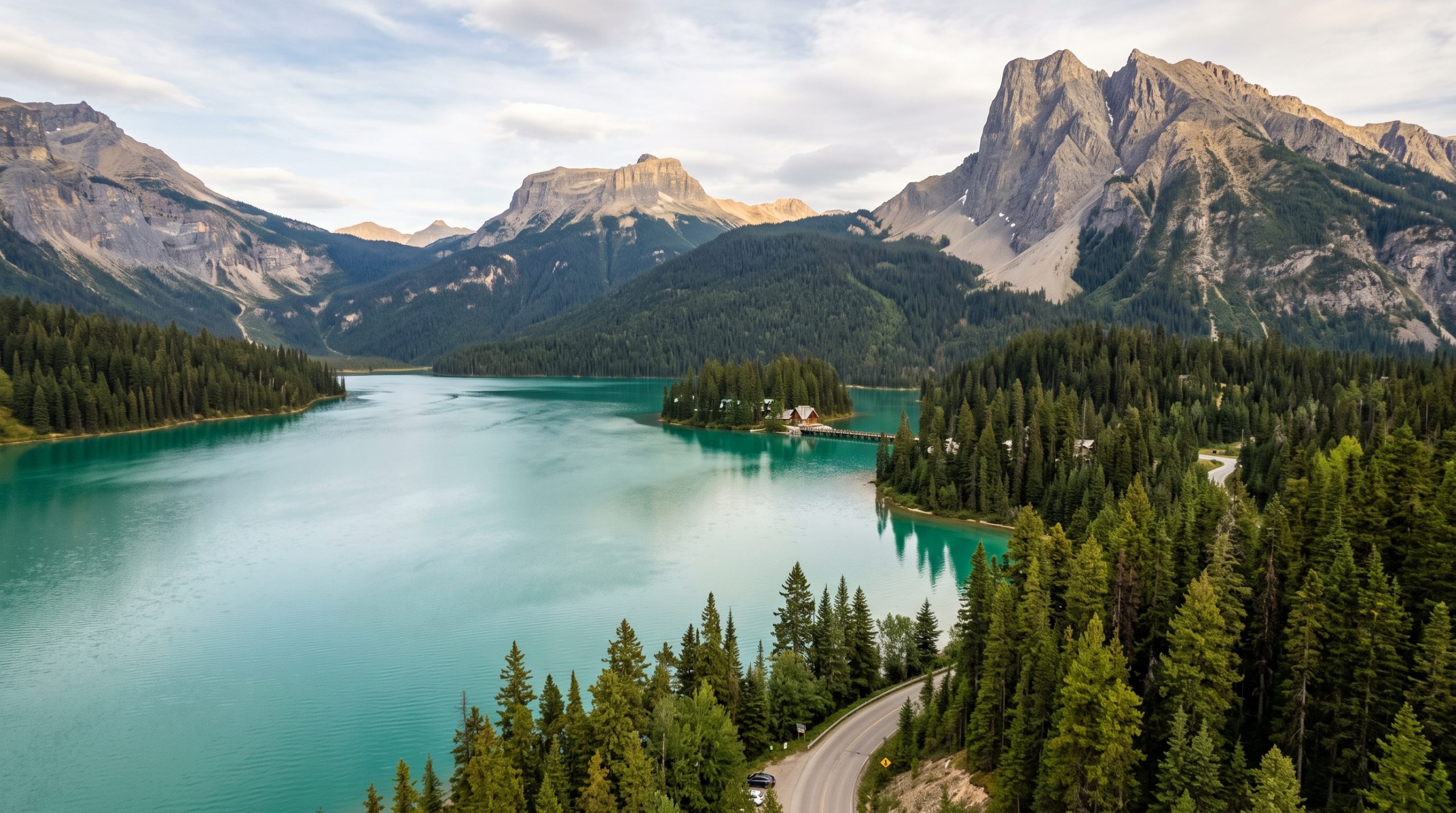
Most couples find Emerald Lake while planning a Banff trip. It turns up in the same search results as Moraine Lake and Lake Louise, roughly half an hour west along the Trans-Canada, and it reads like one more Alberta lake with a good footbridge. It is not. The provincial boundary sits between Lake Louise and the village of Field, and Emerald Lake is on the British Columbia side of it.
That one fact reorganizes the legal half of the day. An Alberta marriage licence does not work here, and neither does an Alberta officiant. What works is a British Columbia licence and someone registered in that province to marry you, and the nearest counter selling licences in person is the Service BC office on 9th Street South in Golden, about 65 km west of the lake. Every figure on this page is in Canadian dollars.
The rest of it is gentler than the paperwork suggests. Nine kilometres of paved road, one small lot, a footbridge, and a shoreline path that runs flat the whole way around. We currently have Rockies elopement dates available through 2027–2029 here, and the questions couples send us about this lake are almost always the same three: whose licence, whose permission, and what hour the sun actually reaches the water.
What changes when the ceremony is in British Columbia
Emerald Lake sits in Yoho National Park, in British Columbia, so the marriage runs on British Columbia rules: a provincial licence, currently $100, bought in person and valid three months, an officiant registered in that province, and two witnesses over 19. A ceremony on the public shoreline also needs a Parks Canada wedding registration.
The licence is British Columbian, the registration goes back to Alberta
Buying the licence
One of you buys it, in person, carrying primary identification for both of you. There is no waiting period in the province. You can collect the licence in the morning and marry that same afternoon, and it stays valid for three months, so most couples pick it up on the way in rather than trying to line it up with a flight. The fee is nonrefundable and it covers your first marriage certificate, which is mailed out once the marriage is registered.
Any issuer in British Columbia works, wherever in the province you marry: Service BC offices, some notaries public, and a long list of insurance agents, including counters inside some London Drugs stores. Land in Vancouver first and it is an errand on your first afternoon. Fly into Calgary, as most couples heading for Yoho do, and the licence has to happen after you cross the boundary, which is why we usually build the Golden stop into the day before the ceremony rather than the morning of it.
The ceremony itself has to be performed by a British Columbia marriage commissioner or a religious official registered in the province. Commissioners charge on a scale the province sets, currently $75 plus tax for a basic ceremony, with hourly and mileage additions for travel, which for someone driving out from Golden is a real part of the number. You also need two witnesses, both over 19. If it is only the two of you and us, ask your commissioner early how they prefer to handle the signatures, because the answer varies from one commissioner to the next.
Parks Canada’s half of it
The shoreline, the bridge approach and the loop trail are all national park land. Parks Canada handles weddings in Yoho through a registration form for the Lake Louise, Yoho and Kootenay field unit, which produces the small oddity at the heart of this plan: a British Columbia ceremony gets filed to a post box in Lake Louise, Alberta, or handed in at the visitor centre on Village Road. The form reserves nothing: the park is a public place and exclusive use of an area is not permitted, so someone in a rain shell will walk past at some point, and we position for that rather than pretend otherwise.
Parks Canada asks organizers to keep the group to around 20 people and to carpool in. Acoustic instruments are welcome at a conversational volume, while generators and PA systems are not. Guest numbers shape access, transport and the timeline here, not our fee, which does not move with the head count. Permit research and the forms are our work; the fees the park, the province or a private venue charge are yours. Our guide to planning an elopement covers how a legal ceremony sits inside the rest of the day. Book Emerald Lake Lodge and you are inside a private venue on its own terms; step off its island onto the public shore and you are back under park conditions. Photography and film work for sale in the mountain parks runs under a Parks Canada business licence, and that piece of paper is ours to hold, not yours to chase.
Nine kilometres of pavement and one small lot
The turnoff sits about a kilometre west of Field on the Trans-Canada. From there Emerald Lake Road runs roughly 9 km of narrow, winding pavement, past the Natural Bridge where the Kicking Horse River has cut straight through a rock slab, and ends at the lake. There is no bus. Lake Louise is around 40 km east, call it thirty minutes; Banff is a little over an hour; Golden is that hour in the other direction.
You need a national park entry pass to stop anywhere in Yoho, and that includes driving Emerald Lake Road. A daily adult pass currently runs a little over $12, a family or group pass covers up to seven people arriving in one vehicle, and a daily pass holds good until 4 p.m. the following day, which is quietly useful when the plan starts before dawn. Everyone coming needs one, guests included.
Parking is the constraint that actually moves the plan. The public lot at the lake is small. Through July and August it fills by mid-morning, and the overflow becomes a line of cars parked back along the last stretch of road, which hands you a walk you did not plan for in shoes you chose for photographs. Emerald Lake Lodge keeps its own lot about a kilometre short of the water and shuttles guests in, with no private vehicles crossing onto the lodge island. Staying there solves parking, changing and the first hour of light in one booking.
The walk to the water in wedding clothes
From the lot it is a few flat minutes to the bridge, and the loop around the lake is a little over 5 km with almost no climbing in it. That makes this one of the kindest lakes in the Rockies to reach in a dress. The surface is gravel and packed dirt, damp on the inland side through late June and dusty by August, so a long train is a two-person job and a hem will show the walk. Boots on for the road in, changed at the trailhead or back in Field, fifteen minutes away. The far shore is a half-hour walk at a ceremony pace, and that half hour is worth more than any hour of the clock.
A basin that takes the light late and gives it up early
The lake sits just over 1,300 m, low for a Rockies lake, in a bowl ringed by walls more than a kilometre higher: Wapta Mountain to the east and northeast, Mount Burgess to the south, the President Range and Michael Peak closing the north and west. That geometry, not the sunrise table, decides your ceremony hour.
Sunrise here happens twice. The sky over the basin goes pale and then warm long before any direct sun clears the eastern wall, and during that gap the water is usually glass. It is the best reflection and the coldest air of the day, and the reason we are on the shore in the dark. Direct light lands on the water and on faces considerably later than official sunrise. If you want sun on you at the lake edge, that is a mid-morning ceremony, and mid-morning is also when the lot is filling and the first canoes go out.
Evenings invert it. The sun drops behind the President Range and the shoreline goes into shadow while there is still plenty of daylight overhead, and the last warm light of the day sits high on the face of Mount Burgess above a lake already in shade. That can be a beautiful frame. It is not golden hour on your faces, and any plan that promises both at once is not describing this basin. The colour is a light effect too: strong sun through summer meltwater gives you the green the lake is named for, an overcast morning gives you slate, and by September the silt has settled and the green cools toward blue. You can see how the basin actually renders in the galleries and films we publish, dawn frames and grey-day frames both.
Aerials are the one tool we leave in the case here, since drones do not take off or land inside a national park without a permit, so height in a Yoho film comes from the Emerald Basin trail where it branches off the loop and climbs. What we gain instead is room for two people to work. The east shore is a corridor with water on one side and spruce on the other, wide enough that a photographer and a filmmaker who plan their angles never appear in each other’s frames, and narrow enough that two strangers who met that morning would. Vows are spoken at conversational volume because nothing is amplified, and open water carries a breeze straight into a microphone, so on the Expedition the audio is rigged for wind before anyone says anything that matters.
Ice out, silt in: choosing the month
The lake carries ice from about November into early June. Because it sits lower than Lake Louise, it opens earlier, usually somewhere between the last week of May and the middle of June, and a first week of June date is genuinely a toss-up between white and green. A frozen Emerald Lake with the bridge, the lodge lights and the spruce loaded with snow is a strong day in its own right, just a different one, and the lot is empty.
Peak colour runs while the melt is still feeding the lake, roughly late June through August, which is also the busiest stretch on the shoreline. Arriving early works better here than it does at Lake Louise, but the real answer to crowds at Emerald Lake is distance rather than time: twenty-five minutes of walking puts the bridge, the canoes and almost everyone else behind you. September and early October trade some of the green for larch gold, cold mornings and a lot more space.
When the basin socks in with cloud, and it does, the alternative is close. The Natural Bridge and the Kicking Horse River sit part-way back down Emerald Lake Road, the forest along that road holds shape in flat light, and Field is fifteen minutes from the water. Weather alternatives are built into the timeline before you arrive, not improvised at 6 a.m. If you are weighing Yoho against the Alberta lakes or somewhere else entirely, our destination guides are the place to compare, and if you tell us the shape of morning you actually want we will tell you honestly which month and which side of the boundary fits it.
Common questions
Do we need an Alberta or a British Columbia marriage licence if we are staying in Lake Louise?
British Columbia. The lake is over the boundary, so the licence has to be a provincial one from British Columbia, bought in person by one of you with identification for both. It is valid for three months and works anywhere in the province. The nearest in-person counter to the lake is the Service BC office in Golden, an hour west.
Can the officiant who married our friends in Banff marry us at Emerald Lake?
Only if they are also registered in British Columbia. An Alberta officiant cannot solemnize a marriage on the Yoho side. What you need is a British Columbia marriage commissioner or a religious official registered there, plus two witnesses over 19, and commissioner fees are set by the province with travel added on top.
Will the parking lot be full if we get to Emerald Lake at nine in the morning in July?
Assume it is close. The lot is small and mid-morning is the turning point in high summer, with the overflow strung back along the road. Our July and August timelines here start well before that, which also buys the still water. Lodge guests park at the private lot a kilometre out and ride the shuttle in.
Is Emerald Lake still frozen in early June?
Sometimes. Ice usually clears between the last week of May and mid-June, earlier than Lake Louise because the lake sits lower, so a June 5th date can go either way. We plan both versions of that day, and the frozen one is not a consolation prize.
Is there anywhere at the lake to change out of hiking boots?
Not publicly, beyond the lodge’s lakeside restaurant in the summer months. In practice you change at the trailhead with the car doors open, in your room if you are staying at the lodge, or back in Field fifteen minutes down the road. We build that stop into the timeline instead of leaving it to chance.
Can you fly a drone over Emerald Lake for our film?
No, and no one else can either without a Parks Canada permit, because Yoho is a national park. Aerials are part of what we do where they are legal and appropriate, and here they simply are not. Height comes from the Emerald Basin trail climbing away from the loop instead.
Putting a date on the British Columbia side
A day here has a simple shape. Licence in hand from the day before, out along Emerald Lake Road before the sky has colour, the first hour on glass water with the bridge to ourselves, vows once the light has climbed the wall and reached the shore, then the walk around to the far side where the noise ends. One full day with a dedicated photographer or filmmaker starts at $4,900 and a photographer and filmmaker working together at $7,900, both with team travel to Yoho included, and everything else sits on our pricing page.
The process stays written, so you can read and reply on your own schedule, which suits a plan with this much paperwork in it: send us your dates and we reply with our brochure inside 24 hours, then a tailored proposal, then a 30% retainer and the planning starts. Highlights reach you five days after the day itself, the full gallery or film three weeks from it. Start Your Story and tell us which month you are circling, and we will tell you what the lake is likely doing then.