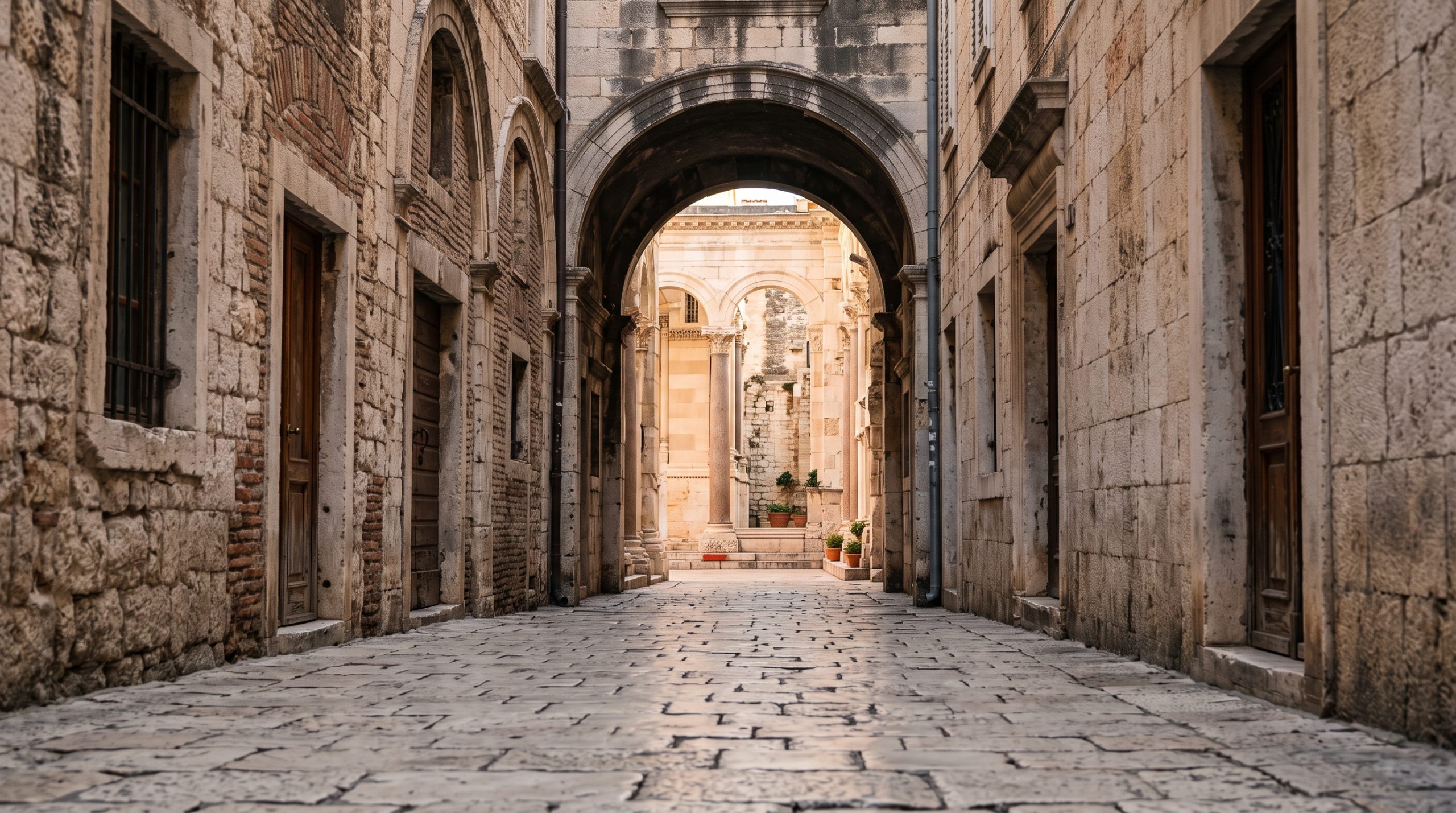
Two men in Roman legionary costume work the Peristyle most of the day, posing for photographs with anyone who asks. A cafe puts cushions out along the steps and sells wine to people who sit and watch the court fill and empty. A few meters south, under a dome with its top open to the sky, a group of singers holds a note until it comes back off the brickwork, then sells recordings between songs.
This is the ceremonial courtyard of a fourth-century imperial palace, and it is also a working square in a lived-in town. You can be married on stone that was laid for Diocletian, with the wall of his mausoleum on one side and a colonnade on the other, and nobody is going to clear the square for you.
Which is fine, because both of the things that decide whether a morning here works are knowable months ahead. Cruise arrivals for Split are published years in advance. The geometry of the court has not moved in seventeen centuries.
The ceremony the city can actually give you
You can be married inside the palace walls in a civil ceremony. A Croatian registrar will travel outside the office when you request it, and the Peristyle itself is a public square with no gate and no ticket. Administrative fees come to 27.87 euros, and marrying away from the office carries its own additional fee.
Thirty to forty-five days, and a registrar who travels
The Croatian timetable for this is fixed, and knowing it early changes how you plan. Once the notice of intent is filed, the registrar sets the wedding day between the thirtieth and the forty-fifth day from that filing. With good reason it can be brought forward, and it cannot fall later than the ninetieth day. That is the frame everything else hangs on, which is why we work backwards from a date rather than forwards from an idea.
A request to marry somewhere other than the registry office goes to the office that covers the place you intend to marry in, so for the Peristyle that means Split. The extra fee for it is set by a national formula rather than by the town, and it moves with things like how far the location sits from the office. The two administrative charges, for the record of intent and for the act of marriage itself, are the flat part.
Documents are the slow part rather than the hard part. The registrar works from your birth record and evidence that you are both free to marry, and identity documents are shown in person. Permit research and logistics guidance sit inside every experience we run, so finding out what your date and your chosen corner of the palace actually require is our job, while the government, venue and landowner fees themselves are yours. If you are working out the order of operations, our guide to how an elopement comes together is the place to start.
One more thing about permission, because most pages hedge it. The court is public and ungated, so a small group standing together for twenty minutes is one situation. Chairs, an arch, a table, amplified sound and a tripod planted in the middle of a working square inside a protected monument is a different one, and that is where the rules for public space and for the palace as a monument arrive. We ask those questions before a timeline exists, not after.
Before the ships land, and after they leave
Split’s cruise berths sit a short walk from the palace, and the quickest route from the quay into the middle of it runs along the Riva, in through the Bronze Gate, up through the Roman substructure passage and out into the Peristyle. You cannot plan around that by picking a different street. It is the shape of the town.
The ships arrive early, often around eight in the morning, and pull out through the late afternoon and evening, mostly between five and seven. The vessels calling here are large. Plenty of them carry somewhere between 2,300 and 2,900 passengers, and some days bring more than one. That single fact rewrites the advice you will read elsewhere. Arrive early does not mean nine or ten. It means the court is genuinely quiet from about six until half past seven, and after that you are sharing it.
The useful part is that the calendar is public. Arrivals are already listed through 2028 and 2029, so before we fix a ceremony hour we read your date against the port schedule. A light day can hold a mid-morning ceremony on the flagstones. A heavy one moves us to first light, or to the far end of the evening once the last ship has gone and the court has turned into a dinner square with live music in it instead of a queue.
High summer is the honest exception. In July and August the palace does not empty, it only thins, and if you want the courtyard close to yourselves in August you are marrying at sunrise. We would rather tell you that than sell you ten o’clock. The published schedule for March and April is a different town altogether, single ships and smaller ones, and if your dates can move at all it is worth telling us so.
Why the court is in shade when you expect gold
The Peristyle is a long rectangle running north to south, sunk below the level of the lanes around it, with colonnades down both flanks. On the east side stands the emperor’s mausoleum, now the cathedral of St Domnius, with the bell tower rising beside its front. On the west there are columns, and behind them the old Temple of Jupiter. What that adds up to is a deep box of pale stone.
At sunrise no direct sun reaches the floor of the court at all. The first light of the day lands high up, on the campanile, on the upper columns and cornice of the west side, on the roofline above the arches. Where you are standing it is open shade, even and soft, bouncing off limestone on every side. Around the middle of a summer day the sun climbs high enough to drop straight in, and for a couple of hours the court goes white and hard. Then the west wall takes it back.
Golden hour, the way couples picture it, does not really happen between these walls. Low sun cannot get in. That is not a problem to solve, it is the reason the place photographs the way it does: kind light on faces, deep shade under the colonnade, and the warm hour visible above you on the tower while you stand in the cool. You can see how that reads in finished work in our galleries and films.
The one place where light and shade meet on your level is the protiron, the arched platform at the south end where the emperor once appeared to the court. Sun crosses that gap earlier and leaves it later than it crosses the floor. It is a small piece of geography, and it is most of what we build the ceremony hour around.
The last stretch in a dress, on stone worn smooth
Nothing drives into the old town, so however you arrive in Split, the final part is on foot through the lanes. From the waterfront it is short, though the Bronze Gate route takes you up through the vaulted substructure passage and its stalls, which is narrow and full of feet and has a floor that a long train will sweep clean for you. The Golden Gate on the north side is a gentler way in and quieter at that hour.
The stone is what nobody mentions. Centuries of feet have polished the limestone glossy, and it is slick first thing in the morning when the lanes have been washed down, and after rain. So we route the walk and time it: flat shoes to the edge of the court, heels carried, a hand under the elbow on the protiron steps, which are shallow, worn and not quite level. Most couples we work with here take an apartment inside the palace walls, which puts a door two minutes from the ceremony and makes changing, pinning and fixing hair a non-event.
The domed room, the cellars and the doors that need a ticket
The palace is not one space, and the difference between its rooms is what turns twenty minutes in a courtyard into a whole morning.
Up the steps at the south end of the Peristyle is the Vestibule, the round entrance hall to the imperial apartments. Its dome is open at the top now, so you stand in a brick drum with a circle of sky above you. It is free to walk through, and for much of the day singers are working it, because the acoustics are remarkable and they know it. That cuts both ways for vows. The room makes an ordinary voice sound like it is arriving from everywhere, and it does exactly the same for every other voice in there.
Underneath the imperial apartments are the substructures, vaulted halls whose floor plan copies the rooms that once stood above them. The ticketed halls keep museum hours. They are dim, so film work down there is lit rather than found, and they are the reason weather is not much of a threat to a palace morning. Your rain plan is one minute away under a Roman vault, not a drive across town.
Then there are the doors that belong to the church. The cathedral, its crypt, the treasury, the baptistery in the old Temple of Jupiter and the bell tower are covered by one combined ticket. Anything inside them runs on the parish’s terms and its service times, and the cathedral is an active church rather than a monument with a ceremony slot in it. The bell tower stair is narrow and open to the drop, which makes it a fine climb in walking shoes and a poor one in a train.
| Space | Overhead | Access | What it gives a ceremony |
|---|---|---|---|
| Peristyle | Open sky, in shade most of the day | Public square, no ticket | Standing room for a small group between the columns |
| Vestibule | Brick dome, open circle at the top | Public passage, no ticket | Sound. Your vows carry, and so does everyone else’s |
| Substructures | Roman vaults, fully roofed | Ticketed, currently around 8 euros, museum hours | The weather alternative, one minute from the court |
| Cathedral and Temple of Jupiter | Roofed interiors | Combined church ticket, currently around 15 euros | Interiors, on the parish’s timetable |
Standing room for two cameras between the columns
Colonnades down both flanks give two people somewhere to be that is not the middle of the floor. One of us can work close and low while the other is up on the plinth behind a column or in the mouth of the Vestibule, and neither ends up in the other’s frame. Sound is the harder problem here, because a stone box returns everything, from wheeled cases on the flagstones to the singers up the steps. Vow audio gets taken close, at the quiet hour, by two people who planned the hour together rather than met that morning. The Adventure covers one full day with a dedicated photographer or a dedicated filmmaker, from $4,900. The Expedition puts both on the ground, from $7,900, and adds professional audio for vows where conditions allow. Team travel is included, wherever the day happens.
Common questions
Do we need a permit for a small ceremony in the Peristyle?
The square is public and there is no gate or ticket, so a short ceremony with a handful of people sits in a different category from chairs, an arch or amplified sound set up inside a protected monument. The registrar’s request to marry outside the office is a separate step with its own fee. We research what your date and your spot require before the timeline is built, and any government or venue fees are paid by you.
How early do we have to be up to have the courtyard to ourselves?
Before eight. Ships tend to dock around eight in the morning and their passengers walk in through the Bronze Gate, so the honest window is roughly six until half past seven. Sunrise itself is the quietest the palace gets, and in July and August it is the only hour that comes close to empty.
Where can we get dressed near the Peristyle?
Inside the walls. The palace is full of apartments, and taking one puts your door a two minute walk from the court, which removes the whole problem of arriving somewhere in a dress with nowhere to stand. Walk over in flat shoes with the heels in a bag, because the lanes are washed early and the limestone is slick.
What happens if it rains on the morning of our ceremony?
The palace answers that itself. The vaulted substructures are directly below the courtyard and fully roofed, the Vestibule is a covered drum with a circle of open sky, and the colonnade gives shelter along both flanks. The plan moves without leaving the walls, which is not something most locations can offer.
Can we fly a drone over Diocletian’s Palace?
Not over the courtyard. A sunken stone square ringed by roofs, towers and people in the middle of a dense old town is not drone ground in any city. We plan aerials for open coast or high ground outside the centre, on a confirmed permission and a confirmed time window, and build that part of the film around them.
The morning the palace asks for
This suits couples who like the thought of being married inside a town that is waking up around them. A cafe setting out cushions, a delivery trolley squeaking over the flagstones, the fish market going two streets west, somebody singing under a broken dome. It asks for one thing back, which is an early alarm.
If six in the morning is not your idea of a good start, say so. There is another version of this day that leans on the open shade the court holds all afternoon and takes the last hour of light out to the water, and there are months when the palace is a calmer place to stand. Tell us which one you actually want and we will build the hour around it, or tell you honestly which weeks suit it better.
We keep the planning in one written thread, at whatever hour suits you. The inquiry form gets a reply and an initial brochure within 24 hours, then a tailored proposal, and planning begins once the contract is signed and the 30% retainer is paid. We are currently taking Croatia elopement bookings for 2027 through 2029, and what each experience includes is set out on our coverage and pricing page. If Croatia is still one option among several, our destination elopement guides are the place to compare. When you are ready, Tell Us Your Story and we will tell you which hour in the Peristyle is yours.