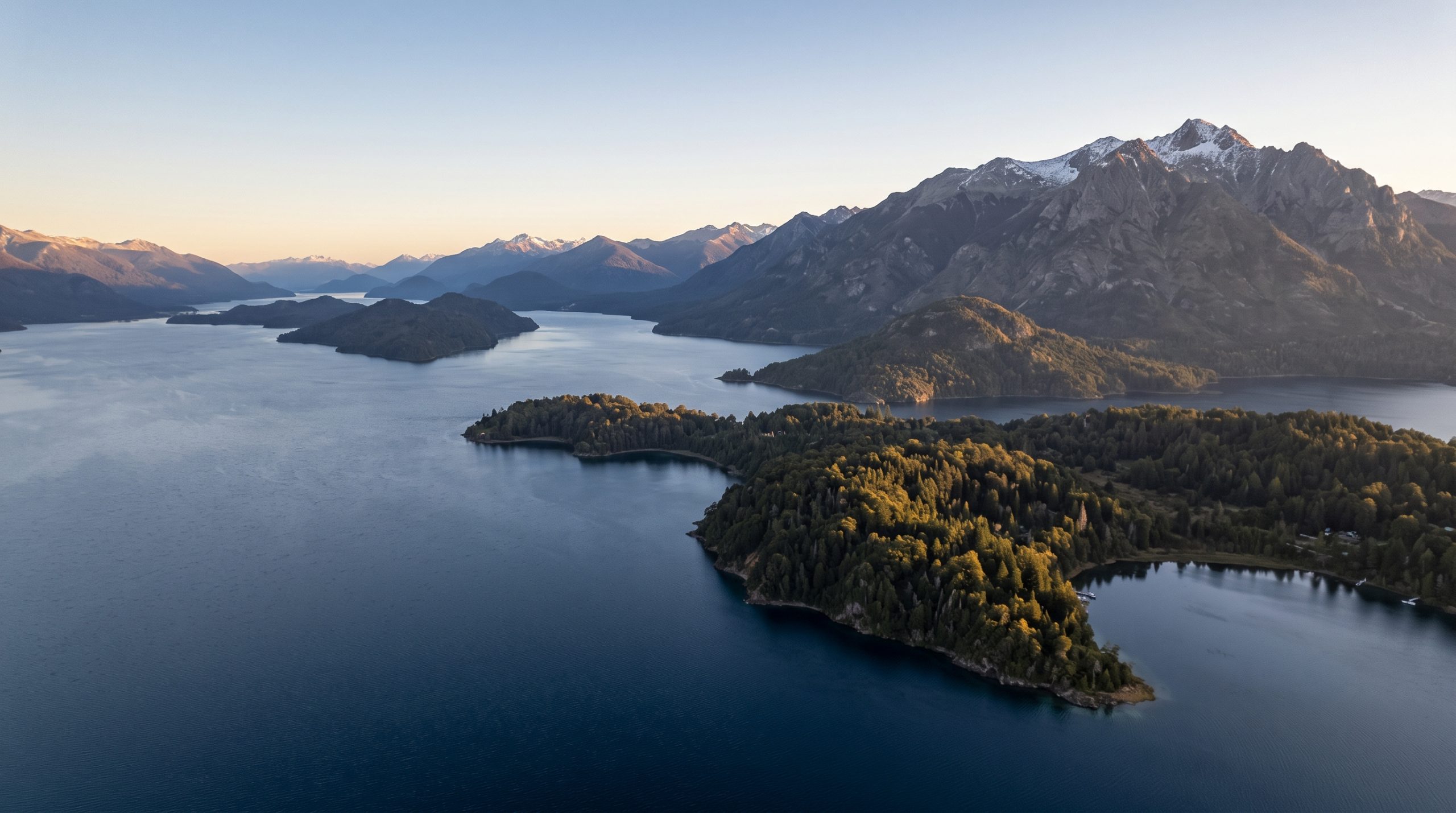
Between 2 p.m. and 4 p.m. nobody drives into or out of the Tronador valley. The gravel road that reaches it runs one direction at a time and the national park publishes the hours. Uphill traffic only, 10:30 a.m. to 2 p.m. Downhill only, 4 p.m. to 6 p.m. Both directions together for one stretch of the day, 7:30 p.m. until 9 a.m.
That single rule decides more about a Bariloche elopement than the weather does. It sets the hour you exchange vows, whether you have the valley to yourselves, and whether you eat lunch on a gravel flat below a glacier because you cannot legally drive out yet.
San Carlos de Bariloche sits at the eastern edge of Nahuel Huapi National Park, more than 700,000 hectares of it across the provinces of Río Negro and Neuquén. Head west and the forest thickens to the Chilean border. Head east past the airport and it thins into open steppe. What follows is what that geography does to a wedding day, and which months are worth the flights.
Lakes, a gravel road, and a rule that changed in 2027
Bariloche suits couples who want Andean scale without a multi-day approach on foot: lake arms, glacial rock and beech forest, all reachable by vehicle. Río Negro’s civil registry now marries couples regardless of where they live, under a disposition issued in August 2027. The complications are timing ones, because the best ground runs on published one-way hours.
Why the road to Tronador sets your ceremony hour
The park lays the route out plainly. From Bariloche you take Ruta Nacional 40 south toward El Bolsón for about 36 km, then turn off into the Mascardi area, where an information office collects the protected-area access and holds the last restrooms you will see for a while. The gravel starts there. Nine kilometers on, a right turn crosses a bridge over the río Manso, and from that bridge it is another 31 km of mountain gravel to Pampa Linda. One more kilometer toward the Ventisquero and you are under the black glacier on Tronador itself.
Roughly 40 km of gravel, then, on a road that only ever flows one way. The hours the park publishes leave exactly two sensible shapes for a ceremony up there, and they are nothing alike.
The first is a mid-day day. You clear the 10:30 a.m. gate with the rest of the traffic, and you are then committed to the valley until the 4 p.m. downhill window opens. Couples hear that and flinch, but it is the easier version to plan, because no rush is built into it anywhere. Vows late morning while the ice still holds shadow, a slow afternoon on the flats, and you roll out with the light going long behind you.
The second is the one we push for. The road is two-way overnight, from 7:30 p.m. to 9 a.m., which means you can drive in before dawn without waiting for any gate at all. Leave Bariloche in the dark, be standing on gravel when the first light hits the ice, and be back down the valley and out before nine, while the day-trip vans are still forming a queue for 10:30. Nobody else is up there. The whole massif is yours for about ninety minutes, and then you have an entire afternoon left for the lake shores nearer town.
One more thing about that gravel: the park posts vehicle restrictions on it, and has at points limited the section to high-clearance vehicles only. We check the current notice before committing to transport, because a 4×4 charter is something a couple pays for separately and nobody wants that decided on the morning.
High walls to the west, open steppe to the east
Bariloche sits at roughly 41 degrees south, in a basin with a lopsided horizon, and almost nobody writing about elopements here accounts for it.
Sunrise comes in over the steppe. Nothing tall stands in the way, so first light arrives early, arrives clean, and lands on the western walls first: the ice on Tronador, the rock faces above Catedral. You get color on the high ground while the water is still gray.
Sunset does not work in reverse, and this is where plans go wrong. The Andes stand between you and the western horizon, so on the lake shores the sun is behind a mountain long before the hour printed on your weather app. Plan vows for “sunset” on a west-facing beach and you hold them in shade. The fix is to turn around. In the last hour we work facing east and north-east, where the peaks keep color after the shore has gone flat, and the light comes toward the camera off snow rather than dying behind it.
How this photographs is different from how the postcards look. The postcard is Cerro Campanario at midday, blue water and green islands from a small summit deck with a café on it, shared with everyone who just rode the chairlift up. Good view. Not a place to make promises to each other, and we will say so before you ask. What holds up is closer and lower: black volcanic sand on a shore near Llao Llao, coihue trunks with light coming sideways through them, the pale gravel below the Ventisquero. Our galleries and films from days like these will tell you more in two minutes than another paragraph from us will. Highlights reach you five days after the day itself, and the full gallery or film three weeks after that.
The Pampa Linda flats are also one of the easier places we work as a pair. There is room to spread out down there, so the filmmaker can sit far enough back to hold a wide moving frame while the photographer works close, and neither appears in the other’s shot. Sound is the real variable. The westerly builds through the afternoon, coming off the ice and straight down the valley, which is another argument for the overnight window when the air is still. On our two-person coverage the filmmaker runs proper audio on the vows, so what you hear later is your voices and not wind on a camera. One full day with a dedicated photographer or filmmaker starts at $4,900, the day with both working together starts at $7,900, and the rest sits on our coverage and pricing page.
Walking in, in the clothes you got married in
Nobody writes this part down, so here it is. The Nahuel Huapi shores are coarse volcanic sand and rounded stone, not soft beach. A long hem picks up grit within twenty steps and holds it, which is fine in photographs and irritating in a vehicle afterwards. Flats work everywhere. Heels work nowhere, including on the wooden decks, wet more often than they look.
In the forest the floor is lenga and coihue leaf litter over roots, with caña colihue, the native bamboo, thick at knee and shoulder height. After rain that bamboo holds water like a sponge and hands all of it to the first skirt that passes. We know which approaches are wide enough that this does not happen, and we walk them the day before.
At Pampa Linda the last stretch toward the Ventisquero is gravel road, so it is dust in a dry January and gray glacial silt after rain. Bring the boots, walk in them, change at the end. The only posted restrooms on that whole route are back at the Mascardi office, 40 km of gravel earlier, so the realistic changing room is the vehicle and we build the timeline knowing it.
Getting married in Río Negro, and who is licensed to work in the park
Start with the part that surprises people. In Argentina only a marriage performed by the civil registry carries legal weight. A ceremony anywhere else is not a lesser version of a wedding in the eyes of the law, it is simply not the legal act. Which frees the location entirely: a vow exchange on a lake shore is a private gathering whichever route you take to the paperwork.
Río Negro then made the legal route easier. A provincial disposition dated 14 August 2027 authorizes marriage anywhere in the province for anyone who wants it, regardless of habitual residence. That undoes the usual Argentine expectation that one of you be domiciled in the jurisdiction, and it is a real change for anyone flying in.
What the registry asks for sits on its own pages: the appointment requested in person with both of you present, between 15 and 30 days ahead depending on where the ceremony will be held, identification for the two of you and for your witnesses, and the prenuptial health check done through the hospital. Birth certificates are listed as useful rather than obligatory, and a previous marriage needs its own documentation. Foreign nationals do not need a particular visa to marry in Argentina, though you do need valid immigration status, which for most American couples is an ordinary tourist entry.
So there are two clean routes. Book the civil ceremony in Bariloche and build the trip around that in-person appointment. Or handle the license at home and treat the day here as the ceremony, which is what most couples traveling this far end up doing. Neither is better. They produce different timelines, and our planning fundamentals walk through how each shapes the week.
On our side of it, working inside Nahuel Huapi commercially is a licensed activity. The park’s intendencia on Avenida San Martín in Bariloche runs an annual authorization for guides and photographers, and it is no formality: a sworn declaration form, proof of tax registration, insurance cover, a background certificate, and a written note setting out rates and exactly how the service is sold. Renewals open on 1 October for the following year. Film work in the province also routes through the Río Negro film commission, which covers both of the national parks inside Río Negro, Nahuel Huapi and Los Arrayanes. None of that is your paperwork, but it does mean lead time matters more here than in places where anyone can turn up with a camera. Permit research and logistics guidance come with every experience we run. Government, park and landowner fees themselves are paid by you. Where drone footage matters to the film, we confirm what is authorized inside the park boundary before we plan a single aerial into it.
Ski weeks, lupin weeks, and the two windows we push hardest
Southern hemisphere, so invert everything. December through February brings the longest evenings and the driest ground, which is why most people come, and January is the peak of the Argentine holiday season, which is why the 10:30 a.m. gate on the Tronador road looks like a car park. Lupins run riot along the roadsides through that stretch. A lovely, crowded time to be here.
Late March into April is the window we argue for hardest. The lenga and ñire turn, the basin goes rust and ochre, and because the sun rises later the two-way overnight window covers a civilized departure rather than a punishing one. October and November are the other: snow still on the walls, water running high, the fewest people of the year, the most changeable air. Spring weather moves fast, which is why we hold a second plan for every hour.
June through August belongs to Cerro Catedral and the ski season, and the town is at its busiest. Winter days get built on the lake shores, in Colonia Suiza and around the Catedral base rather than up the Tronador gravel, and they photograph beautifully in a different register.
One local trick worth knowing whatever month you pick. The basin has a steep rainfall gradient across it, wet temperate rainforest out west toward Puerto Blest, dry steppe out east. When a westerly front parks over the mountains, moving the day eastward often finds dry ground and better cloud, and that is a drive rather than a cancellation. Our destination guides cover how we build those alternatives elsewhere too.
If glacial ice in the frame is the reason you are looking at Bariloche, that is the Tronador day, and the Tronador day wants a 4 a.m. departure. If being in a vehicle at 4 a.m. sounds like the wrong start to a marriage, say so in your first message. There is a gentler version built on the lake arms and the forest near Llao Llao, and there are months where first light comes late enough that nobody sets an alarm in the threes. Tell us which of those two people you are and we will shape the day around it, or tell you honestly which month fits it better.
Common questions
If we drive up to Pampa Linda for our ceremony, when can we come back down?
The downhill window from Pampa Linda runs 4 p.m. to 6 p.m., and both directions are open overnight from 7:30 p.m. to 9 a.m. Enter on the 10:30 a.m. uphill window and you are in the valley until at least four. Enter before dawn and you can leave whenever you like before nine.
Do we need a permit to exchange vows in Nahuel Huapi National Park?
Vows between the two of you are not a permitted event in the way a commercial production is, but the park does license the people working alongside you, and access fees are collected at entry points such as the Mascardi office. We research what your location and guest count require, then tell you which fees to expect. You pay those directly.
Can we legally marry in Bariloche if neither of us lives in Argentina?
Since the provincial disposition of 14 August 2027, Río Negro authorizes marriage in the province regardless of habitual residence. The registry still requires the appointment to be booked in person with both of you present, 15 to 30 days ahead depending on the venue, plus the hospital prenuptial check. That is why many couples marry at home and hold the ceremony here instead.
Is Cerro Campanario a realistic ceremony spot?
Honestly, no. It is a chairlift-served summit with a small viewing deck and a café, shared with everyone who rode up. Magnificent view, and a fine twenty minutes of your day. We put the vows somewhere with room in it and use Campanario for what it is good at.
What happens if the gravel road to Tronador is restricted when we arrive?
We hold an alternative before you land, not on the morning. The lake arms west of town, the Llao Llao shores and the forest around Colonia Suiza all sit on paved access, and the light there behaves in ways we already know. The plan changes location, not shape.
Building your day around the two-way window
A Bariloche day we are happy with runs like this. Out of town in the dark, gravel under the wheels before first light, vows on the flats with the ice going pink above you, back through the gate before the vans arrive, breakfast, then an unhurried afternoon on the shores near Llao Llao while the westerly gets up.
Our current Patagonia availability runs across 2027–2029, and we keep every planning decision in writing, at whatever hour suits you. Send the inquiry form and you will have a reply and our brochure inside 24 hours, then a tailored proposal, with planning beginning once the contract is signed and the 30 percent retainer is paid. Tell us the month you are thinking about and whether 4 a.m. is in you. Check Your Date.