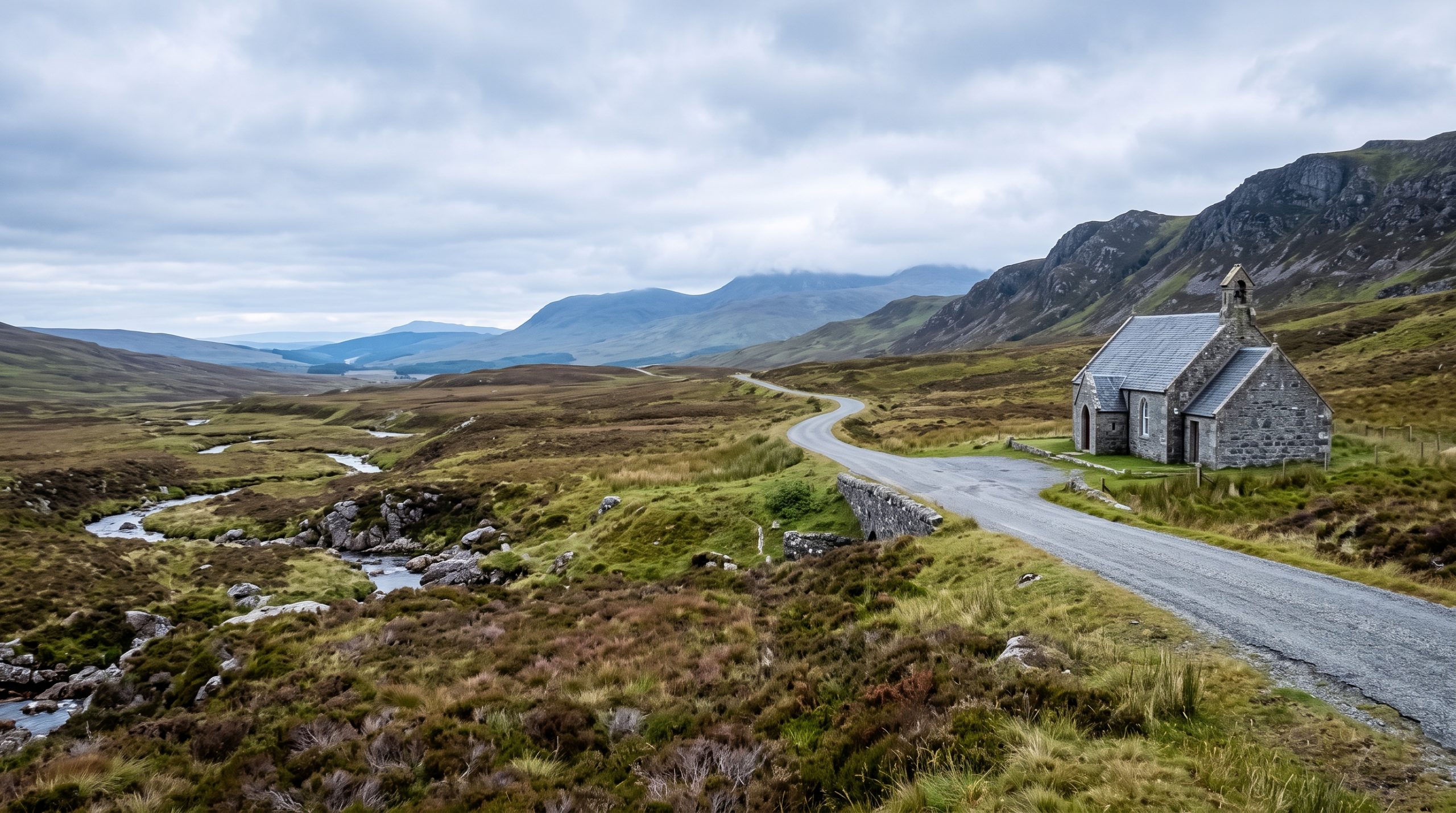
The real difference between eloping in Scotland and eloping in England is not the scenery. Both countries have coastline that makes you stop the car, and ridgelines worth a 4am start. The difference is where the law lets you stand when you say your vows, and how long you have to be in the country before it will let you say them at all.
In Scotland, a religious or belief celebrant can legally marry you anywhere. A beach on Harris, a shoulder above Glen Etive, a garden in Portree, a track into Assynt. Neither of you has to have lived there first, and the notice goes in by post from your kitchen table in Denver. In England and Wales, a civil ceremony happens at a register office or at premises approved for marriage, and since 2022 that can include the outdoor grounds of those premises. A fell above Buttermere is not approved premises, and it is not going to become one.
That single fact reorganises everything downstream: which airport you fly into, how many days the trip needs, whether the legal marriage happens on this side of the Atlantic at all. Eight of us plan around it all year, so this is the comparison we would send you in an email if you wrote and asked.
The 29-day rule against the seven-day rule
If the legal ceremony has to happen on the trip, choose Scotland. Notice is 29 clear days, £45 per person, with no residency requirement, and a belief celebrant can marry you on open ground. England and Wales require both of you to live there for seven clear days before you can give notice, then 28 days more.
on one planning page on the points with legal weight
These are the rows that actually change a plan. Everything else, including which country photographs better, comes down to the week you travel and the ground you pick.
| Legal point | Scotland | England and Wales |
|---|---|---|
| Notice period | 29 clear days, form M10 to the district registrar | 28 days, notice given in person at a register office |
| Residency before notice | None. Any two people may marry regardless of where they live | Both of you resident in England or Wales for 7 clear days first |
| Notice fee | £45 per person | A statutory fee per person, plus a ceremony fee set by the council |
| Where the vows can legally happen | Anywhere with a religious or belief celebrant. A registrar can also attend a place agreed with the registration authority | Register office, approved premises, or the grounds of approved premises since 2022 |
| Humanist and other belief ceremonies | Legally recognised since 2005 | Not legally recognised, so they run alongside a separate legal marriage |
| Walking access to open ground | Statutory right of responsible access under the Land Reform (Scotland) Act 2003 | Public rights of way, plus roughly 8% of England mapped as open access land |
| Paperwork on the day | Marriage schedule collected in person from the registrar beforehand, signed at the ceremony | Schedule issued once the 28 days have run, and you marry within 12 months of notice |
| Genuinely better at | Vows on open ground, where the law and the landscape agree | Walled gardens and estate grounds, and short travel from English airports |
Our coverage costs the same in either country, because team travel is included worldwide with no long-haul distinction. The Adventure is one full day with a dedicated photographer or a dedicated filmmaker, from $4,900. The Expedition is one full day with a photographer and a filmmaker working together, from $7,900. The Odyssey runs two to seven days across one or several destinations and is quoted as a custom proposal, and the full breakdown of what sits inside each one is on our elopement coverage and pricing page.
Scotland: the celebrant can meet you on the ridge
Scotland treats the person conducting your marriage as the licence, rather than the building. A religious or belief celebrant is authorised to solemnise a marriage anywhere in the country, which is why humanist ceremonies on hillsides became normal here rather than exotic. Belief marriages have been legally recognised in Scotland since 2005. A civil ceremony has a narrower path: a registrar works from the registration office or from a place agreed between you and the registration authority, so an outdoor civil ceremony is possible but negotiated, not assumed.
The paperwork is a two-step rhythm. Both of you submit an M10 marriage notice with your documents to the registrar for the district where you are marrying, at least 29 clear days before the ceremony. Edinburgh’s registrars ask for it six to eight weeks ahead, and if either of you is subject to immigration control they advise allowing three months instead of the minimum. Then the registrar issues a marriage schedule, which is collected in person before the wedding and signed on the day. That collection is the detail that catches couples out. It happens in an office, in working hours, and it means at least one of you is somewhere with a registration office a few days before you are standing in Torridon.
The second Scottish advantage is access. The Land Reform (Scotland) Act 2003 and the Scottish Outdoor Access Code, both live since February 2005, give a statutory right of responsible access to most land and inland water. Private gardens and a few other categories sit outside it. Walking to a place is therefore rarely the problem in Scotland, and that is genuinely different from planning in England.
Standing a ceremony up is a separate question from walking there. An estate, a Forestry and Land Scotland forest, a National Trust for Scotland property and a council-owned beach car park each have their own process, and some charge. We do that research and the logistics around it as part of planning. Any fee the landowner or government body charges is paid by you, directly, and we tell you what it is before you commit to the location rather than after. The same applies to aerials, which run under UK-wide civil aviation rules and any local restriction, so we confirm the window before building a sequence of the film around a drone.
The honest limit: Scotland is not permission-free, and the 29-day clock plus the in-person schedule collection means the front end of your trip is shaped by an office, not by the weather. If you have five days and want all of them in the hills, tell us at the inquiry stage and we will build the legal hour into the arrival day near the office, then push the rest west.
England’s real advantages: gardens, gateways and December light
England loses the legal argument and wins several practical ones, and pretending otherwise would be useless to you.
Travel is the first. Newcastle Airport to the Northumberland coast at Bamburgh is about an hour of driving. Manchester to Buttermere is roughly two and a half. Glasgow to Portree, by contrast, is a five-hour day with a ferry decision in the middle if you want Harris as well. If you are landing from the East Coast with four nights, England buys you an extra half day on the ground, and half a day is the difference between one location and three.
Winter light is the second, and it surprises people. Late December on Dartmoor gives you roughly eight hours between sunrise and sunset. On Skye it is nearer six and a half, and the sun stays so low that a north-facing glen can go flat by two in the afternoon. That flips completely in June, when Skye holds usable light past 10pm and the sky over the Minch never really darkens, while Cornwall has gone blue by half past nine. Neither country is better lit. They are better lit at different times, which is why we ask for your month before we argue about the map.
Third, the approved premises rule cuts both ways. If two sets of parents are flying in, a fire, a table for eight and a walled garden with the ceremony legally held in its grounds is a better shape for the day than a summit in a squall. England is full of that: a stone house in the Yorkshire Dales, a Georgian garden in Dorset, a coastal estate in Cornwall. You get a legal ceremony and a roof, in the same postcode, without a second ceremony to arrange.
What we would actually add to an English plan is a second, celebrant-led ceremony out on the ground, because the paperwork does not need to be there for the words to matter. A Northumberland beach at 6am in October is one of the emptiest places in Britain, and Embleton Bay with the tide going out and the light hitting Dunstanburgh has no queue at all. Our published elopement galleries and films are the fastest way to see how the two countries differ once they are finished work, rather than in a table: Scottish frames tend to be bigger, emptier, more weather; English frames hold more texture, walls, woodland and hedgerow, and often a warmer ceremony interior an hour after the coast.
Spring belongs to England too. Bluebells in southern woodland in late April and early May arrive weeks before the Highland glens have properly greened, and English lowland footpaths are walkable in shoes at a point in the year when a Torridon approach still needs boots. Our destination elopement guides go region by region on when each one is actually at its best.
The three variables that usually decide the day
- Seven clear days of residence. To marry legally in England or Wales you both must live there for seven clear days before the notice appointment, then wait 28 days. Scotland asks for none of that, and takes your notice from abroad.
- Who is allowed to marry you. In Scotland the celebrant carries the authority, so the ceremony can be on a ridge. In England the building carries it, so the ceremony is at a register office or approved premises, including their grounds.
- How easily you reach the ground. Scotland’s statutory access right covers most land and water. England gives you public rights of way and roughly 8% mapped as open access, so the route matters more and the landowner conversation happens earlier.
Four trips, and the country each one needs
Here is how this resolves in practice, using the shapes couples actually write to us with.
Eight days, legal ceremony on the trip, vows outdoors. Scotland, without much argument. Notice lodged from home, schedule collected on day two near your arrival city, then a belief celebrant meets you somewhere that needs a walk. This is the case where the Scottish rules do something no other part of Britain can, and where the professional audio in the Expedition earns its keep, because vows on open ground are half wind and half voice and the difference between those is a microphone.
Four nights, flying from Boston or New York, already legally married at home. England. The legal question is gone, so the whole decision becomes travel time and light, and the Northumberland coast or the Lake District western valleys give you more usable hours than a five-hour transfer to Skye ever will.
Two ceremonies, six guests, one of them ninety years old. England, in the grounds of approved premises, with a house to come back into. Guest count never changes our fee, but it does change access, parking, permits and how long the walk-in can be, and a ninety-year-old grandmother is a timeline constraint we would rather design around than discover.
Five days, two contrasting landscapes, the sea in the film. Scotland’s west coast, and this is Odyssey territory rather than a single day: an Assynt morning of bare rock and lochans, then a Harris beach where the water is turquoise over white sand and the sound of it carries the whole film. Two locations, one country, no second legal process.
If your trip does not look like any of those four, that is the useful case rather than the awkward one. Send us the dates, the number of nights and the one thing you refuse to compromise on, and we will tell you which country the constraint points at. Check Your Date and we will reply with an initial brochure within 24 hours.
Why generic UK advice reverses the legal comparison
The received wisdom online is that Scotland is a free-for-all and England is impossible. Both halves are wrong.
Scotland is not a free-for-all. The law is generous about where you stand, and completely unbothered by how many other people are standing on the spot you chose. The Old Man of Storr car park on Skye is full by mid-morning most of the summer, the Fairy Pools path is a procession, and Glen Coe’s roadside viewpoints have coach traffic from ten onwards. That is not a reason to avoid Skye. It is a reason to be on the north end of Trotternish at 5am, or to spend those hours in Assynt and Ardnamurchan instead, where the same geology arrives without an audience. Our planning notes on how to plan an elopement deal with this hour by hour rather than in general terms.
England is not impossible either. It is only impossible if you insist that the legal marriage and the mountain be the same event. Take the paperwork out of the landscape, and every fell, cove and stone circle in the country reopens. Plenty of American couples marry at home in a courthouse ten minutes from their apartment and then have the ceremony that means something to them on a footpath above Wast Water, with a celebrant, two witnesses and nothing else booked. That is a legitimate, unromantic, extremely effective plan, and we build it often.
The other reversal worth knowing: the assumption that going further north always buys better light. From late October to February it does the opposite. The southwest of England has more workable daylight, softer coastal weather, and roads that stay open when the Highland passes are running on their winter schedule. If you are set on a winter elopement and someone has told you the Highlands are the only serious answer, they are describing July.
Common questions
Can we legally marry in Scotland if we live in the United States?
Yes. Scotland has no residency requirement, and any two people may marry there regardless of where they live. You both submit M10 marriage notices with your documents to the registrar for the district where the ceremony will happen, at least 29 clear days beforehand, and one of you collects the marriage schedule in person before the day.
Do we really have to be in England for seven days before giving notice?
If the legal marriage itself is happening in England or Wales, yes. Both of you must be resident there for seven clear days before the notice appointment, excluding your arrival day and the day of notice, and you both give notice on the same day at the office for the district where you have been staying. The 28-day wait then begins.
Can we legally get married on a mountain or a beach in England?
Not as the legal marriage. A civil ceremony has to take place at a register office, at approved premises, or in the outdoor grounds of approved premises. A celebrant-led ceremony with your own vows can happen on a Lake District fell or a Northumberland beach, and it carries no paperwork, which is exactly why it is so flexible.
Is a humanist ceremony legal in England and Wales?
No. Humanist marriages have been legally recognised in Scotland since 2005, and in England and Wales they are not recognised, so a humanist ceremony there sits alongside a separate legal marriage. In Scotland the same ceremony does both jobs at once, in the same place, with the same celebrant.
Who signs as witnesses if we are eloping with no guests?
Two witnesses sign in either country, and celebrants and registrars arrange this routinely for couples travelling alone. Your photographer and filmmaker have both done it. Tell us at the planning stage so the witness question is settled inside the timeline rather than on the morning.
Can one trip cover a legal ceremony in Scotland and a second one in England?
It can, and the paperwork belongs on the Scottish side. We lodge the Scottish notice from wherever you live, hold the legal ceremony in the first days of the trip, then travel for a second, non-legal ceremony in England. That is an Odyssey shape rather than a single day, and it needs the timeline built backwards from the schedule collection.
Start with the constraint, not the map
Couples arrive at this decision from the wrong end almost every time, with a saved photograph of a Skye ridge and no idea that the marriage schedule is collected in an office. Start instead with the one thing that cannot move: the dates, the number of nights, whether the legal marriage has to happen in Britain, whether anybody is flying in. The country falls out of those answers, and both of them are good.
We keep every planning decision in writing, asynchronously, across whatever time zone you are in. Send the inquiry form, we reply with an initial brochure within 24 hours, then a tailored proposal follows with a custom timeline built around light and real travel time. A signed contract and a 30% retainer start the planning. Highlights reach you five days after the day itself, and the full gallery or film three weeks after the day. We currently have elopement dates open across 2027–2029 now, in both countries. Tell Us Your Story and tell us the constraint first.