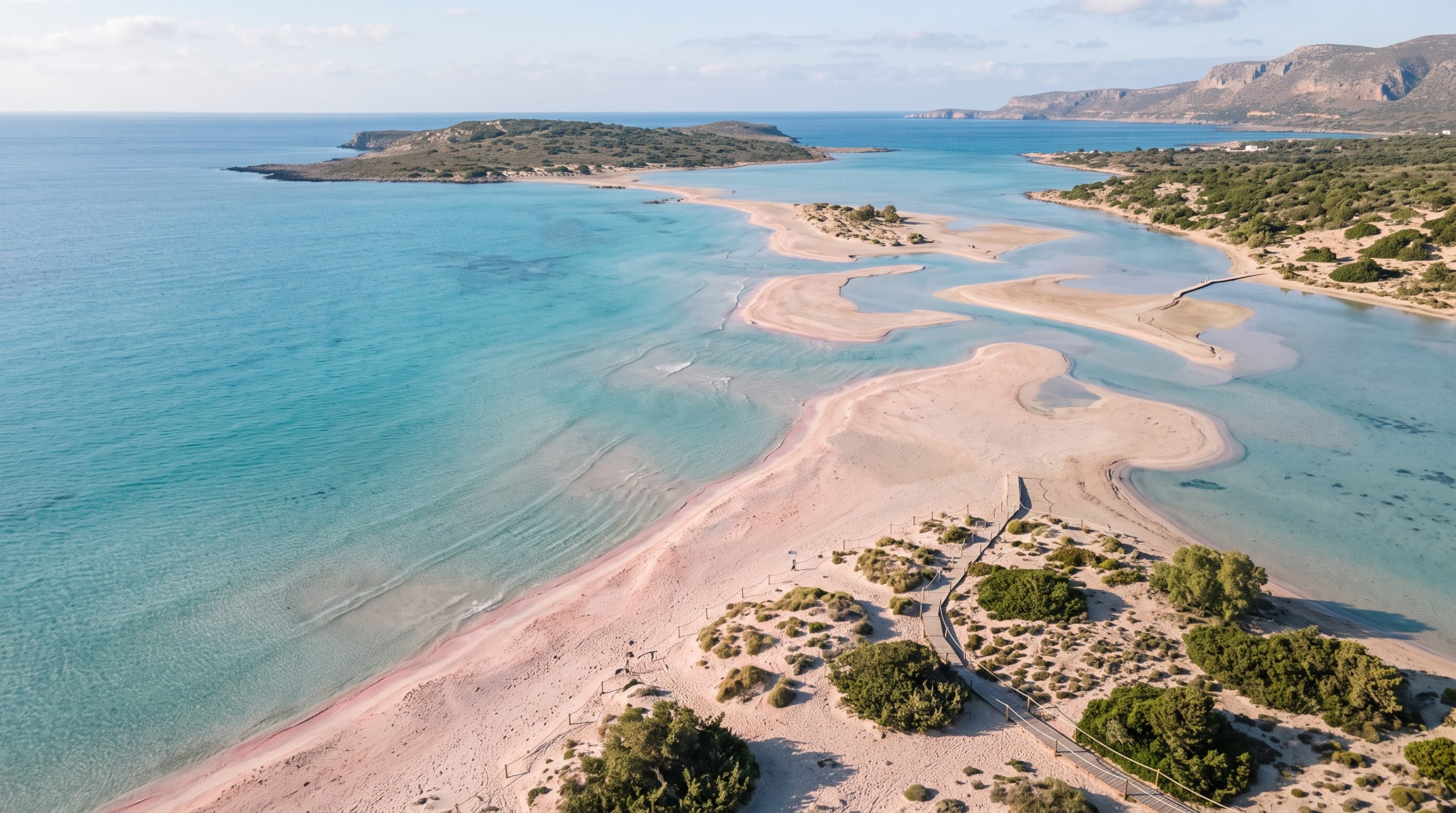
The pink at Elafonissi is not spread across the whole beach. It sits in patches along the waterline, where the sea has spent a very long time grinding shell against shell, and it reads strongest when the sand is wet and the light arrives low and from the side. That is why nearly every photograph you have seen of this place was made in the last hour of the day rather than at eleven in the morning.
The second thing worth knowing before you plan anything is that Elafonissi now sits on Greece’s list of high-protection beaches, the ones Greek law calls apatites paralies, the untrodden beaches. The Ministry of National Economy and Finance and the Ministry of Environment and Energy jointly signed the decision that lifted the number of these beaches from 238 to 251, and Elafonissi is on the list. On a beach with that status, no concession is granted for sunbeds, umbrellas or canteens, and nothing may be placed on the shore that alters it.
Read that as a design brief rather than a restriction. It rules out the arch, the rented chairs and the fabric draped over driftwood. What it leaves is two people standing on wet pink sand with 150 meters of shallow water behind them, and we would take that trade every time.
What high protection means for a ceremony on this sand
Elafonissi is a Natura 2000 site and one of Greece’s high-protection beaches, so no sunbeds, umbrellas or temporary structures are licensed on it. A private ceremony still works: you stand on open shore, place nothing and leave nothing behind. Arches, chairs, aisle runners, petals and confetti are all out.
Two hours from Chania, then the last 600 meters on foot
Elafonissi sits at the southwest corner of Crete, roughly 75 kilometers from Chania, and the drive takes between an hour and a half and two hours depending on where in Chania you start. The route runs west on the national road, turns inland near Kaloudiana, threads the Topolia gorge and its tunnel, then climbs through Elos and Kefali before dropping back to the coast past the monastery of Chrysoskalitissa. The monastery stands on its own rock about 5 kilometers north of the beach and you see it long before you reach it. The road is properly surfaced the whole way and narrow for most of it.
Cars no longer come down to the sand. Since 2023 you stop in the designated parking areas on the higher ground and walk in on a made path, roughly 600 to 800 meters, depending on which area you land in. The car parks are paid, currently around 5 euros for the day.
In wedding clothes, that path is the part to plan for. The gradient is gentle and the surface is fine, but there is no shade on it and there is a pale dust that finds a hem inside the first hundred meters. Walk it in flats and carry whatever you want to be married in. If you are bringing four grandparents rather than nobody, the 600 meters is the real constraint on the day, not the ceremony, and we time the arrival so nobody does that walk in the worst heat of the afternoon.
The other number that changes the plan is the drive back. If your light is the last hour of the day, you are leaving the car park in the dark and you are two hours from Chania. Almost every good version of this day involves sleeping within twenty minutes of the beach, in Chrysoskalitissa, Kefali or one of the villages behind the coast, rather than commuting from the north. That decision comes early in planning, and it sits alongside the rest of the groundwork in our destination guides.
The channel is 150 meters wide and the islet is mostly dune
The Municipality of Kissamos, which administers this stretch, gives the geography plainly. The islet lies about 150 meters off the facing shore, separated by a shallow channel. It runs up to 1,500 meters long and up to 500 meters wide, though for most of its length it is only 150 to 300 meters across. Its highest point is 39 meters, at the rocky western end. Everything else is low sand.
On the dunes you get marram grass, a substantial population of sea daffodils, and behind them tall juniper scrub growing straight out of the sand. Those plants are the reason for the status, and the reason the marked lines across the sand are lines rather than suggestions. Sand, shells and plants all stay where they are.
In settled weather you walk across the channel rather than take a boat. Depth varies with the day, and the honest version for a long dress is that it is somewhere between ankle and knee, over firm sand with a soft patch or two. Salt water dries stiff and pale on a hem, so we cross once and deliberately, either well before the ceremony or after it, and never in the middle of a timeline. Beyond the first dunes the ground turns uneven, and the rocky western end is a shoe change rather than a barefoot wander.
Where the light lands on a beach with nothing tall on it
This coast faces the open sea to the south and west, and the high ground sits inland behind it. At sunrise the sun comes up over the interior of Crete rather than over water, so the sand stays grey and cool for a while after the official sunrise time. When the first direct light does arrive it comes in low and from behind you, raking along the dune line, and it is genuinely good for about forty minutes before it turns ordinary.
The evening is the better half of the day here, and the reason is topography. There is nothing tall on this beach to cast a shadow across it. With the only real elevation being those 39 meters at the far western end of the islet, the sun stays on the sandbar all the way down to the sea horizon, which is unusual and worth building a timeline around. Low side light on wet sand is exactly the condition that brings the pink up.
Middle of the day, we will be blunt with you. At one in the afternoon Elafonissi is a beautiful place to stand and a flat photograph to make. The sun is overhead, the pink washes out to grey, and the water goes to the even turquoise you have seen on a hundred screens. If your ceremony has to sit at midday for reasons of guests or celebrant availability, we will tell you honestly and move the couple’s hour to the end of the day instead, which is how most of these days work anyway.
Season shifts this hard. In June the last usable light runs very late into the evening. By the end of September that same window has moved forward by well over an hour, which changes the ceremony time, the walk back and where you sleep. How this coast actually renders in a finished film or gallery, the pink at the waterline and the channel shot at eye level, is easier to see than to describe, and that is what our elopement stories and films are for.
The width of the sandbar is what lets two of us work it at once. On a strip 150 to 300 meters across, a photographer can stand close enough to hear the vows while a filmmaker holds a long lens thirty or forty meters down the beach, and neither of them lands in the other’s frame. Sound is the harder problem, because there is no rock, wall or tree line here to sit behind. That is why the audio for vows goes on the couple rather than on a microphone arguing with the sea, and why one team briefed together beats a photographer and a videographer introduced to each other on the morning. How the coverage is shaped, one camera or two, one day or several across western Crete, is set out on our pricing page.
The nine o’clock bus, and the hour after it leaves
Elafonissi is not a quiet beach and pretending otherwise would waste your time. Tripadvisor’s travelers voted it the second best beach in the world for 2028, with Balos and Falassarna also in the list, and the beach behaves accordingly. The public bus leaves Chania’s central station at nine in the morning and takes about two hours. Day boats run in from Paleochora. The wave lands late morning and it thins out through the late afternoon.
Which means the standard advice to arrive early only half works here. Early gets you an empty beach in weak backlight. The hour you actually want is the one after the coaches have gone, and the price of it is walking back to the car in the dark. We plan for that end of the day on purpose, with headlamps in the bag and the driving sorted in advance.
Designing a ceremony that places nothing on the ground
Once you accept that nothing gets built here, the ceremony gets simpler and better. It goes on the firm wet sand below the dune line, where nothing grows and nothing needs protecting. Guests stand in a loose half-circle rather than sitting in rows. Vows come off a card that goes back in a pocket. The bouquet stays in a hand instead of being staked into a dune, and nothing is thrown, because petals, confetti and rice all count as material left on a protected shore.
On the question of permission, the chain is worth understanding, because most pages hedge it. The beach and the islet are public shoreline inside a Natura 2000 area, the high-protection designation comes from the two ministries above, and the Municipality of Kissamos administers the ground locally. The mechanism that a wedding setup would need is a concession for simple use of the shore, and on a high-protection beach that concession is not granted. Two people, a celebrant and a handful of guests standing on open sand, placing nothing and taking nothing, are not asking for a concession at all. Anything beyond that shape belongs in a conversation with the authorities before the date is set, and that research is part of what we do rather than something we hand you.
Aerials work the same way. Drone footage happens where it is legal, safe and appropriate for the exact strip of coast and the exact date, so we confirm the position before any part of the film is designed around a wide shot from above.
The legal side is a separate piece of work with its own appointment and its own document list, handled through a municipality rather than on a beach. Plenty of couples sign the paperwork at home or in town and keep Elafonissi for the ceremony they actually experience, which is a legitimate and common choice rather than a compromise. We walk through both routes in our notes on how to plan an elopement, and we will tell you which one fits your passports and your calendar. Tell us the shape you want and we will build the day around it: Start Your Story.
When the wind is up, and what sits fifteen minutes away
The channel crossing is a fair-weather move. In settled conditions it is a wade; when there is swell running and the wind is pushing along the coast, the islet comes off the plan and the mainland beach carries the day instead, running east toward Cape Krios with the same sand and the same water. That is a decision made on the morning, not a day that falls apart.
Beyond that, the alternatives are close. Kedrodasos lies just along the coast, reached on foot, where old junipers grow low over white sand and the light works differently because there is finally something to stand under. The monastery road at Chrysoskalitissa, 5 kilometers north, gives height, hard edges and shelter from a south wind. Inland, Elos and the villages of the chestnut country sit under deep shade in high summer. We hold two of these open as a matter of routine, and the couple usually never hears which one we had lined up.
Common questions
Can we put up an arch or chairs for a ceremony on Elafonissi?
No. Elafonissi is one of Greece’s high-protection beaches, which means no concession is granted for structures, sunbeds or umbrellas on the sand, and nothing may be placed there that alters the shore. Ceremonies here are standing ceremonies, and they photograph better than a rented arch ever does.
Can you walk across to Elafonissi island in a wedding dress?
In settled weather, yes. The channel is about 150 meters wide and shallow, somewhere between ankle and knee on a calm day, over firm sand. Salt dries stiff and pale on a long hem, so we cross once and deliberately rather than back and forth through the timeline.
Do we need a permit for a small ceremony on the beach at Elafonissi?
A private ceremony that places nothing on the sand is not the sort of use that requires a shore concession. Anything involving structures, vehicles, generators or aerials is a different question, and we research the current position with the relevant authority for your date before the day is designed around it.
Can we take pink sand home from Elafonissi?
No, and this one matters. Removing sand, shells or plants from Elafonissi is prohibited, as are camping and fires. The pink comes from shell and the remains of tiny marine organisms broken down at the waterline, and the whole reason it is still there is that it stays there.
Where do we get changed after the walk in from the car park?
Treat the car park as your last fixed point. With concessions no longer licensed on this beach, facilities are minimal and shade is nonexistent, so we plan a change at the accommodation twenty minutes away or in the vehicle, then the 600 meter walk in flats with the good shoes carried.
Putting a date on Elafonissi
This beach rewards couples who are happy to be walking out in the dark at the end of a long day, and who like the idea of a ceremony with nothing in it but the two of them, the celebrant and 150 meters of shallow water. If that is not the shape you want, say so and we will tell you which stretch of western Crete, or which month, fits it better. Our planning calendar for Crete currently covers 2027, 2028 and 2029, all of it handled in writing from the first message onward, and our reply with the opening brochure comes back inside 24 hours. Check Your Date.