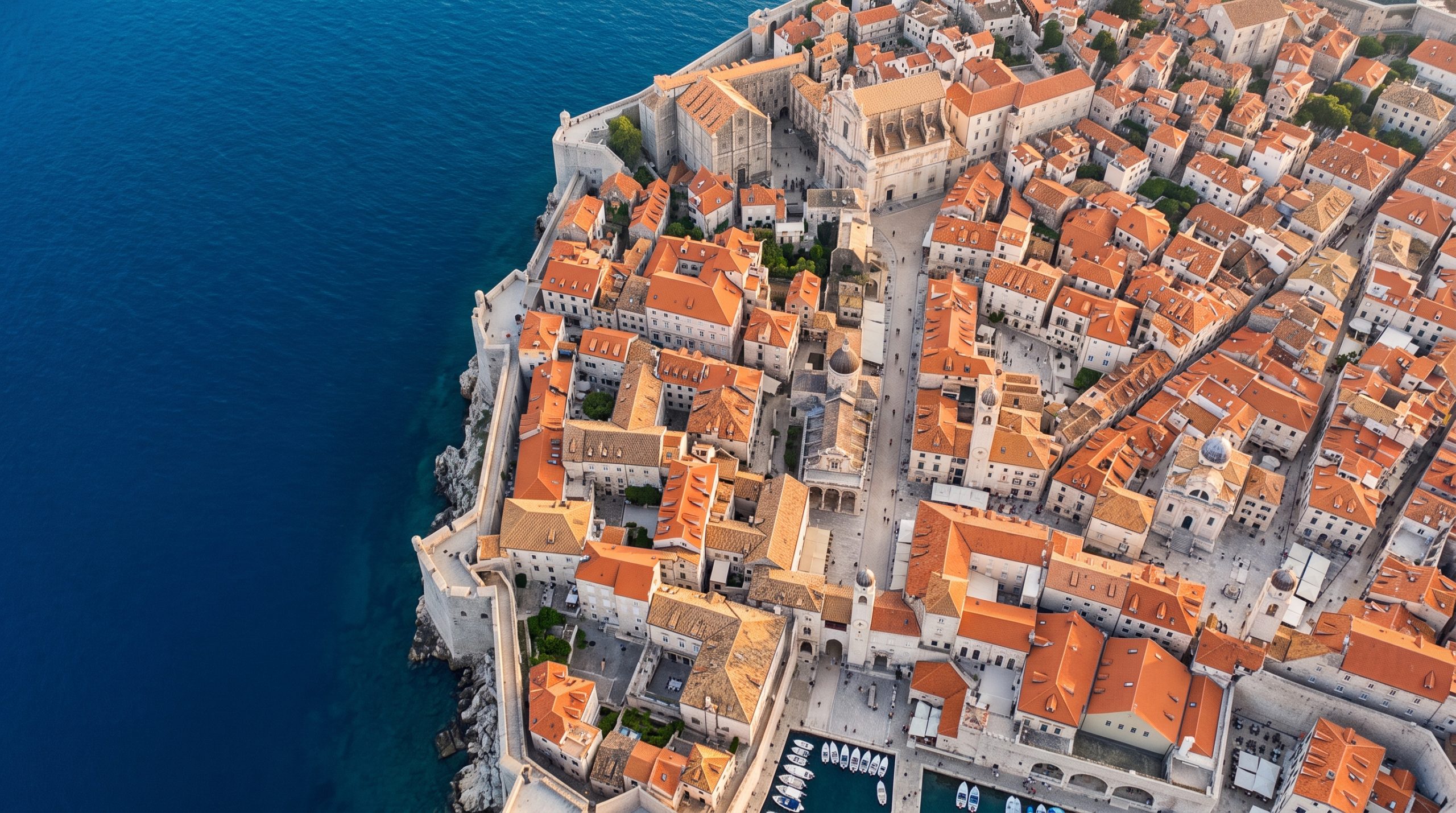
The question couples send us about Dubrovnik is almost always about permits. The document that actually sets your calendar is quieter than that: a fresh copy of your U.S. birth certificate, apostilled by your own state, which has to be less than 90 days old by the time it reaches a Croatian registrar. Most things in this process bend. That one does not.
The second thing worth knowing is that no permit in Croatia can give you an empty Stradun. Nothing drives into the walled town, the limestone is polished to a shine, and by ten in the morning in July the main street is a moving corridor of people. The hour is the only lever that works on that, and it works completely.
So this page separates two things couples tend to blend into one. There is the legal file, which is fiddly and entirely doable. And there is access inside the walls, which has far less to do with paperwork than most planning guides suggest.
Who governs what inside the walls
No single Dubrovnik permit covers a wedding. The marriage itself belongs to the registry office, the matični ured, which wants your complete file 30 days before the date. Public space belongs to the City of Dubrovnik, the walls are entered on a ticket, churches grant their own permission, and anything that flies answers to the Croatian Civil Aviation Agency.
The permit is manageable; timing and access are the real constraints
Call it fiddly. Nothing about a Croatian civil marriage is difficult once the file is complete, and the slow parts sit in the United States rather than in Croatia: ordering a fresh certificate, getting a state apostille, finding the right translator. The Croatian side is orderly by comparison. A registrar performs the ceremony, and the Ministry of Justice and Public Administration also recognizes a religious ceremony carrying the effects of a civil marriage, where that religious community has regulated legal relations with the Republic of Croatia.
Outdoor ceremonies are not a workaround here. They are a booked option. The Ministry’s own marriage registration service lets couples submit their notice of intent, reserve a date and a location either inside or outside official premises, and pay the administrative fee online. Two adult witnesses sign the record alongside you. The U.S. Embassy in Croatia notes that an American arriving to marry and staying under 90 days needs no special visa, so there is no residency period to sit out on the ground.
One limit is worth knowing before you build a plan on top of it: Croatian civil marriage is available to opposite-sex couples. Same-sex couples we work with in Dubrovnik marry at home and hold the ceremony on the Adriatic, which is a route we plan often and cover further down this page.
We plan photographs, film and logistics rather than give legal advice; the registry or your consulate should confirm the requirements that apply to you.
Your documents, in the order you collect them
This is the list the U.S. Embassy in Croatia sets out for an American marrying in Croatia, rearranged into the order the work actually happens. Each of you needs a full set of your own.
- Valid passports. Nothing to apostille, nothing to translate. Check the expiry date anyway, because it is the one document nobody thinks about until the counter asks for it.
- Papers from a previous marriage, if they apply. If either of you has been married before, the registrar needs apostilled proof that the marriage ended, and the consular guidance also asks for the previous marriage certificate. Nothing here carries a freshness window, so clear these first and get them off the list.
- A brand new birth certificate. Order a fresh certified copy from the state that issued it. The Embassy’s summary is specific about this: a new copy, issued within the past 90 days.
- The apostille, from your state. The apostille has to come from the competent authority of the issuing U.S. state, which for most couples means a Secretary of State office, not a federal one. The Embassy warns plainly that obtaining the apostille or the new certificate can take days or weeks, and that variance is the whole reason we start this clock early.
- Translation into Croatian by a sworn court interpreter. Not any translator. Both the Ministry of Foreign Affairs’ consular guidance and the Embassy specify an official court interpreter, a sudski tumač, and the Embassy publishes a list of them. The requirement is the interpreter’s standing, not the quality of the English, so an agency certificate of accuracy is a different instrument from a court interpreter’s stamp.
- The file, lodged with the Dubrovnik registry office. Originals or certified copies bearing the apostille stamp, translated. The Ministry of Foreign Affairs sets the deadline at 30 days before the wedding takes place.
- Two witnesses on the day. Adults, with photo ID on them. They sign the record with you.
- Your Croatian certificate. You leave with an izvadak iz matice vjenčanih, the extract from the marriage register. Ask for more than one copy while you are standing at the counter, because requesting another one later from six thousand miles away is a slower errand than it sounds.
Build the Dubrovnik permit calendar from the photo hour
Fix the hour first, then work backwards. The Ministry of Foreign Affairs asks couples to contact the local registry office at least three months before the desired date, and to have documents submitted 30 days ahead. Those two deadlines, plus the 90-day life of the birth certificate, are what shape the calendar below.
| Counting back | What happens | Why it sits there |
|---|---|---|
| Nine to six months | Date and ceremony hour chosen, Dubrovnik registry office contacted, our team booked | The registrar’s diary is finite, and Dubrovnik accommodation and boats go early for the good weeks |
| Four to three months | Documents from any previous marriage ordered and apostilled | No validity window on these, so they clear before the items on a clock |
| Three months | The registry office contact the Ministry treats as the minimum | Ministry of Foreign Affairs consular guidance: at least three months before the date |
| Twelve to seven weeks | Fresh birth certificate ordered, then apostilled, then translated | The 90-day issue window and the 30-day filing deadline overlap into an ordering window roughly six weeks wide |
| 30 days | Complete translated file lodged in Dubrovnik | The Ministry’s stated submission deadline |
| The final week | Witnesses confirmed, timeline locked to actual sunrise and sunset for your date | Sunset in Dubrovnik moves by well over two hours between June and October |
The real minimum is around three months, and it holds only if both of you were born in states with quick turnarounds and neither of you has been married before. The comfortable minimum is six. We work to six to nine months, which is also roughly how far out the light, the accommodation and the boats settle, and we are currently booking 2027, 2028 and 2029. If you want the underlying planning sequence rather than the Croatian specifics, our guide to planning an elopement covers the order we build every day in.
The small print that decides whether your file is clean
Almost nothing goes wrong in Dubrovnik itself. What trips couples up sits in the eight weeks before they fly, and it is nearly always one of these.
- The 90-day clock runs both ways. Order the birth certificate too early and it ages past the window before the file is lodged. Order it too late and the apostille and the translation have nowhere to fit. That narrow overlap is the single most useful thing on this page.
- Two states, two timelines. If the two of you were born in different states, you are dealing with two separate apostille authorities working at two different speeds. Start with whichever one you have heard is slower.
- Ask for the apostille page to be translated too. It is a separate sheet attached to your certificate, and it is easy to hand the interpreter only the certificate itself.
- Assume what you lodge stays lodged. Order duplicates of the birth certificate and have both apostilled. Carrying a spare set into the country costs very little and removes an entire category of last-minute scramble.
- Names have to agree. Middle names, hyphens and a former married name should read the same way across the passport, the birth certificate and any earlier marriage papers. Where they do not, flag it to the registrar early rather than at the desk.
- A church booking does not replace the registrar. The Embassy is explicit: even for a religious ceremony, you still see the matičar to prepare the marriage legally. Book the church second, not first.
- The ceremony hour is a negotiation with two parties. A location outside official premises is reservable and separately chargeable, and the registrar has to be able to be there. That is where paperwork collides with light, and it is the collision we spend the most time preventing.
Which is where having eight of us matters more than it sounds. There is always a second camera on the ground and a colleague in reserve, and photography and film come from one team rather than a photographer plus a videographer who introduce themselves in the hotel lobby. It also means the witness question has an answer. Couples eloping with nobody else present still need two adults to sign, and it is worth raising with us early so we can help you solve it instead of improvising at nine in the morning.
Administrative charges and deadlines change, so re-check the current numbers with the office handling your application before you commit travel.
What no permit buys you on Stradun
Here is the honest part. Dubrovnik’s historic core is one of the most photogenic square kilometers in Europe, and for a good stretch of the day it is also full. Stradun at eleven in the morning in high season is a beautiful street with several thousand people in it, and no permission slip changes that. The variable that changes it is the alarm clock. Before the walls open, before the first coaches and tenders deliver the day’s visitors, the town belongs to bakers, cats and you.
The walls themselves are ticketed and walked one way, which is worth planning for rather than discovering. The circuit’s famous view over the roofs is at its worst at noon, when the red tiles go flat and white and the stone throws heat back at you. Come at opening or in the last hour and the same view is a different photograph entirely. Church interiors set their own terms, including dress, and permission comes from the church rather than from the city.
Aerials are a separate conversation. Anything flying over the historic core answers to the Croatian Civil Aviation Agency, so we confirm where flying is permitted and inside which window before a single aerial shot enters your timeline, and we build the film so it never depends on one. Mount Srđ, the water off Lokrum and the ridgelines behind the city all give us height without a rotor.
If you want the wider picture of Croatia, including how the shoulder months behave and which islands reward a second day, our destination elopement guides go region by region. And when you know roughly what you want your morning to look like, Send Us a Message and we will tell you which hour in your month actually delivers it.
Married at home, ceremony on the Adriatic
A large share of the couples we film in Dubrovnik are already legally married when they arrive, and they are not settling for anything. They signed in a county office at home on a Tuesday, with a parent or a friend as witness, and then came here to hold the ceremony that matters to them. It is a genuinely good route, and for some couples it is the better one.
What changes practically: the 90-day certificate window, the state apostille, the sworn interpreter and the 30-day filing deadline all fall away, along with the outside-premises reservation. What you gain is the hour. Without a registrar’s availability in the equation, the ceremony can start at 6am on empty limestone or at the last light of the day on the water, which are the two windows Dubrovnik does best and the two that a registry office diary rarely reaches. You bring a celebrant, or a friend, or nobody, and read to each other.
What does not change at all is the day itself, or what you receive. The planning, the timeline built around light and real travel time, the permit research, the weather alternatives, the coastal hour held against wind direction: identical. Highlights land within 5 days, the full gallery or film within 3 weeks. If you want to see how the town holds up on film at that hour rather than take our word for it, the finished work in our stories is the fastest way to judge us.
Common questions
Can Americans get legally married in Dubrovnik?
Yes. A registrar performs the marriage, and there is no residency period to serve on the ground. The U.S. Embassy in Croatia notes that an American arriving to marry and staying under 90 days needs no special visa. Your documents must be apostilled and translated into Croatian first.
How recent does our birth certificate have to be for a Croatian wedding?
The Embassy’s summary for Croatia asks for a new copy issued within the past 90 days, carrying the apostille of the competent authority of the issuing state. Because the complete file is due 30 days before the date, order the certificate somewhere between twelve and seven weeks out.
Do we need a permit to take wedding photos in Dubrovnik Old Town?
The regulated event is the marriage, through the registry office. Beyond that, each owner sets its own terms: the City of Dubrovnik for public space, ticketed entry on the walls, individual churches for their interiors, the Croatian Civil Aviation Agency for anything airborne. We confirm which of those touch your locations before the timeline is built.
Who is allowed to translate our documents into Croatian?
An official court interpreter, a sudski tumač. Both the Ministry of Foreign Affairs’ consular guidance and the U.S. Embassy specify a sworn court interpreter, and the Embassy publishes a list. Ask yours to translate the apostille page as well as the certificate itself.
How far ahead should we contact the Dubrovnik registry office?
The Ministry of Foreign Affairs asks for contact at least three months before the desired date, with documents submitted 30 days ahead. We plan on six to nine months, because the ceremony hour you want and the accommodation near it both go long before the paperwork becomes urgent.
Can we get married outside, on a terrace or a boat?
Yes. The Ministry of Justice and Public Administration’s marriage registration service lets you reserve a location outside official premises and pay the administrative fee with the booking. Expect a separate charge for the location, set by the office rather than by us, and expect the registrar’s availability to shape the hour.
Do we need witnesses if we are eloping with nobody else there?
A legal Croatian marriage needs two adult witnesses to sign with you. A ceremony held after marrying at home has no legal witness requirement at all. Either way, tell us early in the planning and we will help you solve it rather than improvise on the morning.
What we coordinate around the Old Town permit
We hold your date against the registrar’s availability, build the timeline so the ceremony hour and the light agree, research the permissions each location needs and tell you which ones to expect. We do not file paperwork and we are not lawyers: the certificate, the apostille, the interpreter and the government, venue and landowner permit fees stay on your side of the line. What is included in each experience, and what sits outside it, is set out on our pricing page.
Everything between us happens in writing, on your schedule and across whatever time zone you are in. Send us the date you are circling and the shape of the morning you want, and you will have a reply and an initial brochure within 24 hours, then a tailored proposal. Planning begins once the contract is signed and the 30% retainer is paid. Check Your Date.