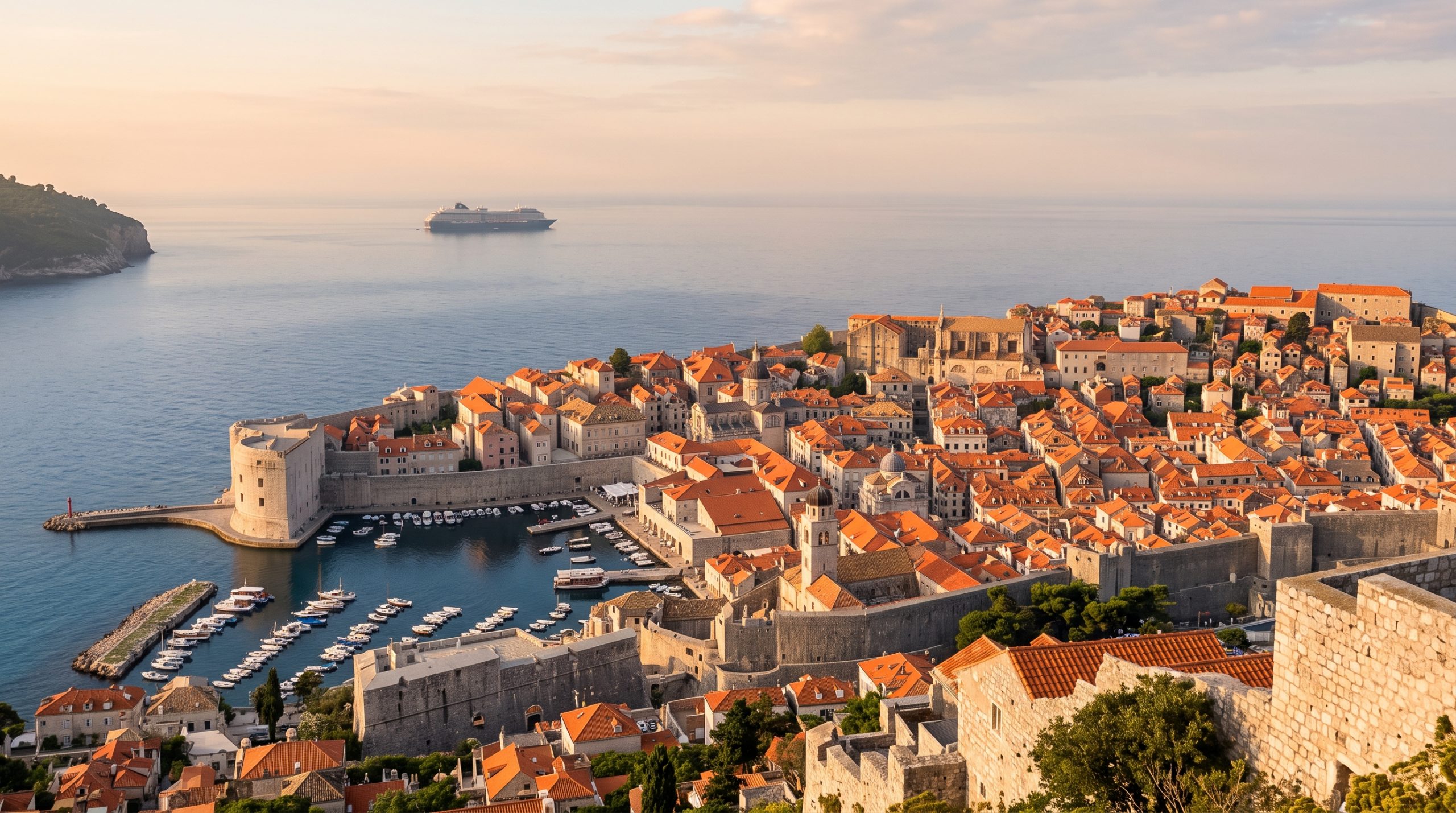
Ten past eight on the wall walk above Pile Gate, and there are more swifts than people. The limestone is still cool. Somebody is hosing down a cafe terrace in the street below and the sound carries all the way to Bokar. Two hours later the same stretch of stone moves at the speed of the slowest person on it.
That gap is not luck. Dubrovnik has held its cruise calls to a maximum of two ships a day, contracted with the lines before the season starts, with a ceiling of roughly 5,000 passengers between them. Those ships berth over at Gruž rather than under the walls, and their passengers reach the Old Town in a wave rather than a trickle. The city walls open at eight in the main season, and the first hour of that is a different city from the fourth.
So a ceremony here is a scheduling problem before it is anything else. Get the hours right and one of the great walled towns of the Mediterranean is very nearly yours. Get them wrong and you are standing on Stradun at eleven in the morning in a wedding dress, waiting for a gap in the crowd that is not coming.
Two ships a day, and the gap they leave
Cruise arrivals here are capped at two ships a day and booked with the lines well before the season, so Dubrovnik’s quiet window is predictable rather than lucky. We build ceremonies into the hour around the city walls’ eight o’clock opening, or into late afternoon, when the streets thin out again and the western stone turns warm.
First light comes down Stradun from the Ploče end
The Old Town sits with its back against Mount Srđ, 412 metres of bare limestone rising directly behind the northern wall, and its face to open water on the south and west. That single fact governs the light. Nothing to the east is high enough to hold the morning sun off the town, so the first direct light of the day arrives low over the sea and runs the length of Stradun from the Ploče end towards Pile, down a street polished by four centuries of footsteps.
Up on the circuit, that same low sun rakes across the roofs from the seaward side. It is the only hour when the terracotta reads as separate tiles rather than one orange mass, and Minčeta, the high point of the walls, catches it first.
Evenings work in reverse. The sun goes into the water west of the city, so Lovrijenac on its 37-metre rock, the Bokar corner and the western wall hold colour right down to the horizon. Because Srđ stands behind the town rather than beside it, nothing steals the last twenty minutes off the day.
Midday is the honest problem. Overhead sun, no shade at all on the walls, and heat that regularly pushes past 35°C on the exposed southern stretch in high summer. We do not put vows there at noon. What midday does buy you is the one window when the sun clears the rooflines and drops into the narrow stepped lanes climbing the slope north of Stradun, which sit in shadow the rest of the day. That inversion is genuinely useful. When the open ground is at its worst, the tight lanes are at their best, and almost nobody is standing in them.
The walls open at eight, and the ticket buys one loop
The circuit is run by the Society of Friends of Dubrovnik Antiquities rather than the city, and their rules shape your morning more than anything else you will read about this place. An adult ticket is currently 40 euros and it also admits you to Fort Lovrijenac. It is valid for one tour: once you come down, you do not go back up. Closing time doubles as the last entry time, so any late-afternoon plan has to be built backwards from it.
The loop is a little under two kilometres, 1,940 metres in total, standing as much as 25 metres above the streets, and most people need an hour and a half to two hours to walk it without stopping much. Gates open at eight in the main season and at nine in winter. There are three ways up: Pile, Ploče, and the Maritime Museum entrance by the Old Port.
Nothing drives inside the walls. Cars stop outside at Pile or at Ploče and everything after that happens on foot over stone, which is why we schedule the walk in from the gate as real minutes rather than pretending it is free. Ploče is the calmer of the two ends first thing, and it is also the side that gets the sun first, which is a rare case of the quiet option and the good option being the same option.
In wedding clothes, two things matter. The limestone is polished smooth by several million pairs of feet, and after rain it is genuinely slick under a leather sole, so when there has been weather we put flat shoes in the timeline and the good ones travel in a bag. The other is shade, of which there is none up there. No trees, no awnings, a couple of small kiosks and that is the lot. A long train on stone stairs in full sun at ten in the morning is a hard half hour, and it shows in the frames.
Because of the one-loop rule we treat the walls as a single scene with a direction of travel, not somewhere to drift in and out of. Usually that means going up at Ploče early, working west with the light behind us, and coming off before the first larger groups reach Minčeta.
Terracotta, salt water and a lot of vertical stone
Dubrovnik gives you two kinds of frame and very little in between. Wide: the whole walled town from the circuit, or from the top of Srđ, four minutes up in a cabin from a lower station a short uphill walk from the Old Town. Tight: a doorway, a stairway, the two of you against shuttered stone. The middle distance is where the crowds live, so we mostly leave it alone. Our published galleries and films show how that cuts together, a lot of air and then a lot of texture. Highlights reach you in five days, the full gallery or film in three weeks.
The wall walkway is narrow, and in stretches you pass one person at a time. That is exactly where a photographer and a filmmaker who met that morning end up in each other’s frames. Ours work as a pair by habit: one moves ahead and shoots back, the other holds position, and they trade without discussing it. Sound is the other half. On the seaward wall the breeze comes off the water straight into a microphone, so vows go where stone stands between you and the sea, whether that is the Buža terraces under the southern wall or a courtyard off Stradun. The wide, windy frames get filmed once the words are said.
One day with a dedicated photographer or filmmaker starts at $4,900 and a day with both of them working together starts at $7,900, with team travel to Croatia included either way; everything else, including multi-day work across the coast, sits on the pricing page.
Who marries you, and the paperwork that comes first
A civil marriage in Dubrovnik is conducted by a registrar from the Dubrovnik-Neretva County registry office. It can take place in the office’s official premises or outside them at an agreed location, and marrying outside official premises carries a separate fee set against established criteria. The administrative fees themselves are modest: 9.29 euros for drawing up the record of your declaration of intention to marry, and 18.58 euros for the act of marriage, so 27.87 euros in total.
Timing is the part to plan around. The declaration of intention is lodged between 30 and 45 days before the date of the marriage, and the Ministry of Foreign Affairs asks couples to contact the registry office that will conduct the ceremony at least three months before the date they want. Documents must be originals or certified copies carrying an Apostille stamp, translated into Croatian by an official court interpreter. None of this is difficult. It is sequential, and the translation step is where couples lose a fortnight they had not budgeted for.
The county registers life partnerships on the same footing, with the same two administrative fees and the same option of a location outside official premises.
Permit research and logistics guidance come with every experience we run. We work out what your date, your locations and your guest count actually require, and tell you plainly which fees are payable and to whom. Those fees are yours to pay, along with the celebrant, accommodation and anything with an engine. If you would rather handle the legal signing at home and keep Dubrovnik for the ceremony you care about, a lot of couples do exactly that, and our guide to planning an elopement sets out both routes.
Lokrum, Srđ, and what we swap when the sea gets up
Lokrum costs you a quarter of an hour. Boats leave the Old Port at Luža, cross to Portoč in ten to fifteen minutes and run about every half hour through the season, and the return ticket, which includes entry to the island reserve, currently sits at around 30 euros a head. It also depends on the sea. The boats pause in poor weather and generally do not run through winter, so every plan involving Lokrum arrives with its mainland version already written: the Buža terraces, the rock under Lovrijenac, the shaded lanes above Stradun.
Srđ keeps its own calendar. The cable car’s published operating months begin in spring and run into late autumn, with the last cabin up leaving half an hour before closing, so a February date gets built at street and sea level and the summit becomes a bonus rather than the centrepiece. A southerly running up the Adriatic changes what the water looks like far more than it changes what a ceremony looks like, and the stepped lanes do not care about wind at all.
If you want the whole day at sea level with the summit off the table, tell us. If you want to be on the walls at eight and swimming by eleven, we will build that instead, or say honestly which month gives you the better version of it. Our destination guides show how differently a coastal day can be shaped.
Common questions
Can the ceremony itself happen on the city walls?
The walls are a ticketed monument with fixed hours and a strict one-loop rule, so they belong in the day around your vows rather than at the centre of them. A civil ceremony held outside the registry office’s official premises has to be at a location the office agrees to, with the additional fee that applies. We propose spots the registrar will accept and that are quiet at your hour, then confirm both before the timeline is locked.
Is arriving for the eight o’clock opening early enough to have the walls to ourselves?
Early enough to be in front of the crowd, yes. Alone, no. The first hour after opening is the calmest stretch of the day and it thins the circuit dramatically, but you will still be sharing it. If you want the stone genuinely empty, the answer is a date outside the peak weeks, or an evening on the western wall instead of a morning.
Does the Lokrum boat run if the sea is up?
Not always. The crossing is only ten to fifteen minutes and boats go about every half hour in season, but the service pauses in poor weather and generally stops for the winter. Every Lokrum plan we write carries a mainland alternative inside the walls or a few minutes outside them, so a change in the forecast moves the location rather than the hour.
How far ahead do we have to file the Croatian paperwork?
The declaration of intention to marry is lodged with the registry office between 30 and 45 days before the wedding date, and the Ministry of Foreign Affairs asks couples to make contact at least three months out. Documents need an Apostille and a translation into Croatian by an official court interpreter, so we work backwards from the ceremony date and build the translation window into the plan.
Will the cable car up Srđ be running for an early spring date?
Not reliably. The operator’s published months begin in spring and the last cabin up leaves half an hour before closing, so for a March date we plan everything at street and sea level and add the 412-metre summit only if it is open. The view from 25 metres up on the walls does more work than most couples expect.
Working out which morning is yours
We are currently taking Croatia elopement bookings for 2027 through 2029, and the useful first move is a month and a rough shape: first light on the walls, or a long western evening, with guests or with nobody at all. Send that and you get a reply and our initial brochure within 24 hours, then a proposal built around your date. If it fits, a signed contract and a 30% retainer start the planning. All of it happens in writing, in your own time, with nothing to schedule. Check Your Date and tell us the hour you have been picturing.