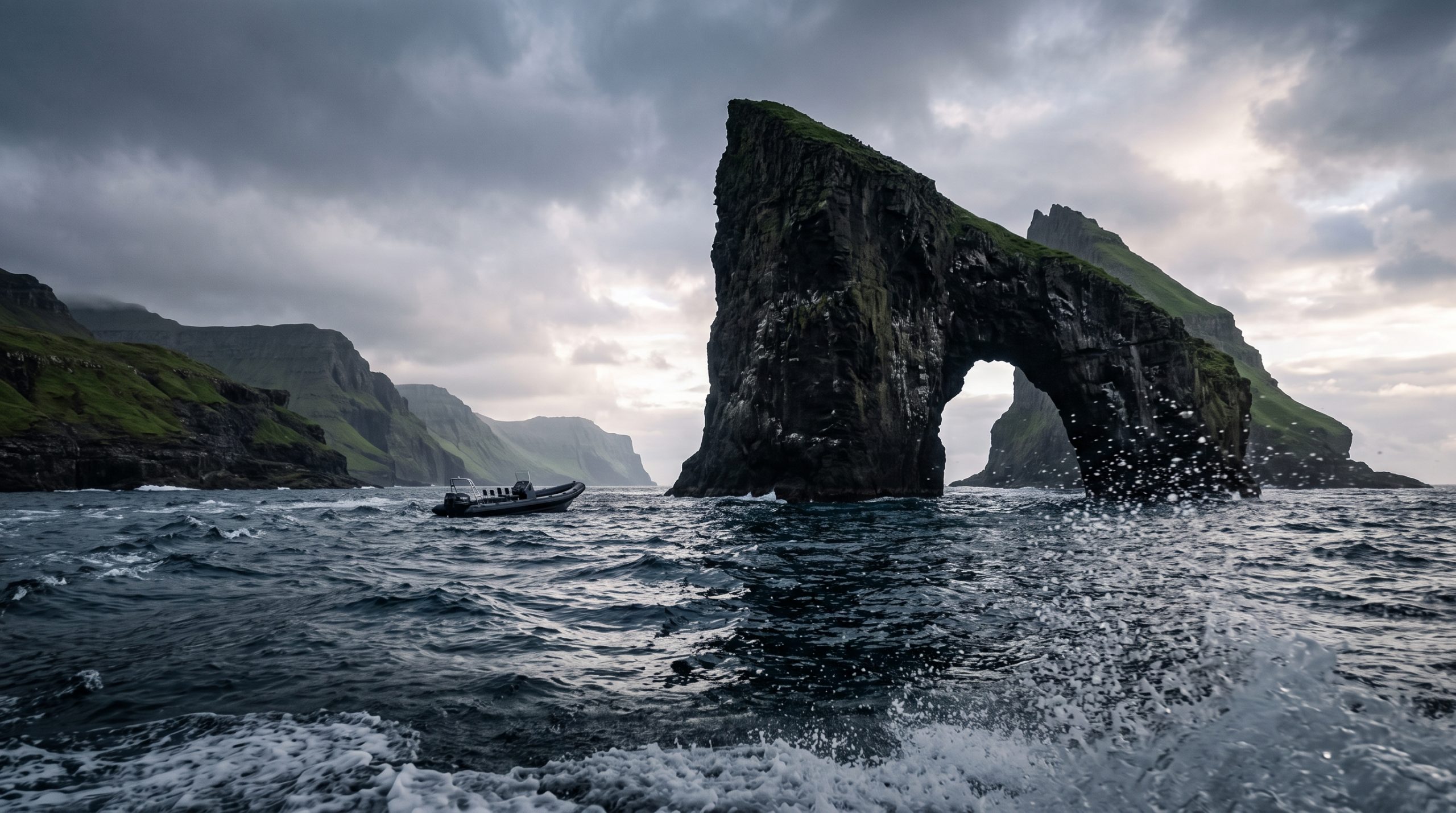
Access to Drangarnir runs on somebody else’s clock. Three mornings a week, one departure time, half the year: Wednesdays, Saturdays and Sundays at 11:00, from 1 April to 1 October, DKK 600 a head, with a guide, and no self-guided option at all.
That one line decides most of a wedding day at the two stacks standing between the tip of Vágar and the islet of Tindhólmur. It fixes the hour you stand on the basalt. It fixes which days of the week can carry your vows, and therefore which weekday you are in Tórshavn dealing with paperwork. It also has nothing whatever to do with the hour those stacks look their best from land, which is about twelve hours later.
So here is the whole shape of it: what the ticket costs, how the booking actually works, and what gets moved rather than lost when the Atlantic pushes a swell into the mouth of Sørvágsfjørður.
Three mornings a week, and what the ticket costs
Guided access to Drangarnir costs DKK 600 per person and runs Wednesdays, Saturdays and Sundays at 11:00, from 1 April to 1 October, booked through hiking.fo. There is no unguided option. Departures leave from the small boat marina in Sørvágur, five minutes from Vágar Airport, and weather changes the route far more often than it cancels the day.
What the sun is doing at eleven
Eleven in the morning is nobody’s first choice for photographing a sea stack. We say that out loud, because the timetable does not care what we would prefer.
What saves it is the aspect. From the Vágar side you are looking west and slightly south at Lítli Drangur, Stóri Drangur and the pyramid of Tindhólmur behind them. At 11:00 the sun is still in the southeast and well short of its high point, so it arrives over your shoulder and lands on the faces you are actually looking at. Wet basalt takes that better than it takes anything at noon. On the grey days this coast hands out generously, contrast collapses, the arch reads as shape instead of glare, and the water goes the colour of slate.
The frame most couples have in their heads is the other one, the stacks in silhouette with the sun dropping behind them. That picture belongs to the road above Bøur, on the north side of the fjord, and not to the boat. In the second half of September the sun sets close to due west, straight out of the fjord mouth and near Tindhólmur. At midsummer it swings far into the northwest and misses the islet completely, but it is still full daylight at 22:30, which is late enough to work the roadside properly and still make an 11:00 sailing the next morning. In June you can genuinely have both ends of the same location in one day, with a long sleep in the middle.
Marina to beach, and what the ground is like in a dress
The whole thing takes an hour and forty-five minutes door to door. Roughly ten minutes of that is sailing out along Sørvágsfjørður, then the boat puts you ashore, and you have over an hour on the ground at the stacks, at beach level and on the slope above it, before a short walk back to the boat and the run home to Sørvágur.
That drop-off replaced the old way in. On foot from the village it is close to twelve kilometres round trip with several hundred metres of climb, three and a half to four hours of it, all on private ground. The boat version gives you the same view without spending your wedding morning earning it.
In wedding clothes, the honest brief is this. Wear boots for the crossing and the landing, because the going is grass, sheep tracks and soft ground rather than a maintained path, and after rain the turf holds water like a sponge. A hem will take on weight from wet grass in the first thirty seconds and stay damp for the rest of the morning, which matters not at all in the pictures and quite a lot to how you feel, so a shorter or gatherable skirt is worth thinking about. Heels are pointless here. A veil will fly, and that is usually the best thing that happens all morning. Bring the jacket you would actually wear on a boat, because the crossing is colder than the beach and we can take it off you between frames. Anything you set down on the basalt should be weighted or held.
There is not much floor at the landing, and that shapes how we work rather than whether we can. One of us takes the low line near the water where the arch of Stóri Drangur rises directly behind you, and the other climbs the slope for the wide frame that puts you at the foot of seventy metres of rock, which keeps both cameras out of each other’s shots on a beach this size. Sound is the other reason two people is not a luxury here. Vows at the base of a sea stack compete with swell and wind coming straight off open water, so on the Expedition the filmmaker runs dedicated audio for the vows rather than hoping the camera microphone survives the gust. If you want to see what this coast gives back, our published films and galleries are the fairest answer we can offer.
Booking the boat, and the small print that actually bites
The landowner side and the sailing are booked through hiking.fo, which is where the national tourism board points for Drangarnir. DKK 600 is per person, not per couple. Kroner run at roughly seven to the dollar, so think of it as a little under a hundred dollars each, and note that it buys access and a guide rather than any kind of exclusivity.
Two pieces of small print are worth knowing before you plan a ceremony around a scheduled seat. A departure that has fewer than three people booked on it can be moved or cancelled outright, which on a shoulder-season Wednesday means your ceremony hour is partly in the hands of strangers with a booking form. And cancelling inside one day of departure is charged in full, which is also, conveniently, the point at which a Faroese forecast becomes readable.
The way around both is to take the boat privately rather than buy seats on it. That also settles the guest question, because the boats here are small and it is the number of seats, not us, that decides whether two sets of parents are coming. Chartering a boat, along with the DKK 600 access fees themselves, sits on your side of the ledger. What sits on ours is one full day with a dedicated photographer and filmmaker working together, from $7,900, or the single-camera version of the same day from $4,900, both including our team’s flights and accommodation to Vágar, with the full breakdown of what each experience covers written out plainly. Our fee does not move with your guest count. A signed contract and a 30% retainer start the planning.
Who signs what, and where
The legal part happens in Tórshavn, not on Vágar, and the municipality handles it by email. Inquiries go to vigslur@torshavn.fo and they must come from the two of you rather than through anyone acting on your behalf, so we prepare the whole file and you press send. Notice has to reach them no later than four weeks before the date, and six weeks if your date falls in weeks 34, 35 or 36, which is the late-August into early-September stretch when the country is busiest. The Notice of Marriage form itself goes back to them no sooner than four months ahead.
Bring two witnesses to sign the register. If you are travelling as a pair, tell the municipality in advance and two members of staff can attest the marriage instead. Afterwards they hand over an international marriage certificate in Faroese and English. One detail that surprises people: they cannot process a name change for anyone who is not a Faroese resident, so that is a job for your own registry at home.
Geography then does the scheduling for you. Tórshavn is around forty-seven kilometres of road from Sørvágur, and the stacks only open on Wednesdays, Saturdays and Sundays, so a Saturday at Drangarnir usually pairs with a Thursday or Friday in the capital and a Wednesday at the stacks with the start of that week. If the sequence matters to you, our guide to planning an elopement walks through the order we normally recommend.
What the swell changes, and what it does not
Nobody publishes a cancellation rate for Drangarnir, and any figure you are quoted is somebody’s guess dressed up as data. What we can tell you is that two very different things get called a cancellation here, and only one of them affects your wedding.
The first is the sail through the arch under Stóri Drangur. Operators do that only when the sea allows, and it is the part of the day that moves most often, because the stacks sit at the mouth of the fjord where it opens straight onto open water. Wind direction and swell decide it, not rain. So we never hang the vows on the arch. We treat going through it as a gift, we shoot it as the film’s opening move when it happens, and the ceremony itself is built to work from the beach or the deck either way.
The second is the sailing itself, and this is where a land plan earns its keep. The road above Bøur looks across the fjord at the same two stacks with Tindhólmur beyond them, which is the frame most people recognise and it needs no boat at all. Ten minutes further on, through the tunnel, Gásadalur puts Múlafossur over the edge of the village and into the sea. East of Sørvágur, Trælanípan above Sørvágsvatn charges DKK 200 per person to walk in unguided and runs guided departures at 09:00, 12:00 and 15:00 through tralanipan.fo. Every one of those is inside half an hour of the marina, which is why a boat that does not sail costs you a location rather than a wedding. We write the alternates into your timeline before you fly, with the switch decision made the evening before, and we keep a fuller set of options in our destination elopement guides.
If the eleven o’clock start is the part you cannot love, say so early. There is a version of this day that never touches the boat and lives entirely on the north shore in the last two hours of light, and it is a beautiful day. Tell us which of the two you actually want and we will build that one.
Common questions
Can we actually get out and stand at Drangarnir, or is it boat only?
You can stand on it. The 11:00 trip on Wednesdays, Saturdays and Sundays is a boat ride with a drop-off, an hour and forty-five minutes in total, with over an hour ashore at beach level and on the ground above it. The shorter one-hour tours from the same marina stay afloat the whole time.
How likely are we to sail through the arch on our date?
No operator publishes odds on it, and we will not invent them. The transit under Stóri Drangur happens when the sea is calm enough, and it is decided on the morning rather than in advance, so we plan the ceremony to stand on its own and treat the arch as the bonus it is.
Can our parents come out on the boat with us?
Usually yes, and the limit is seats rather than anything else, because these are small boats. Taking the boat privately is the clean way to guarantee room for four or six guests. Our fee stays the same whoever comes; guests change permits, seats and transport, not the price of the coverage.
Do we need to bring two witnesses to the Tórshavn ceremony?
Two witnesses sign the marriage register, and most couples bring them. If you are travelling alone as a pair, email the municipality ahead of the date and two members of staff will attest the ceremony instead, which is a normal arrangement rather than a favour.
Where do we change out of boots and into wedding clothes?
Plan on arriving dressed. Realistically the wardrobe is your accommodation in Sørvágur or Bøur, then the car at the marina and the boat itself for layers, boots and a hem you keep out of the wet until you are ashore. We build that into the timeline so nobody is improvising on the jetty.
Choosing your Wednesday
If a late morning on the basalt and a long evening on the Bøur road sound like the two right ends of one day, that is the day we would build here, and our current Faroe Islands availability runs across 2027–2029. Send us the week you are considering and which of the three sailing days it holds, and we will come back within a day with a brochure and a first shape for the hours. Every planning step stays in one written thread, at whatever hour suits your time zone. Check Your Date.