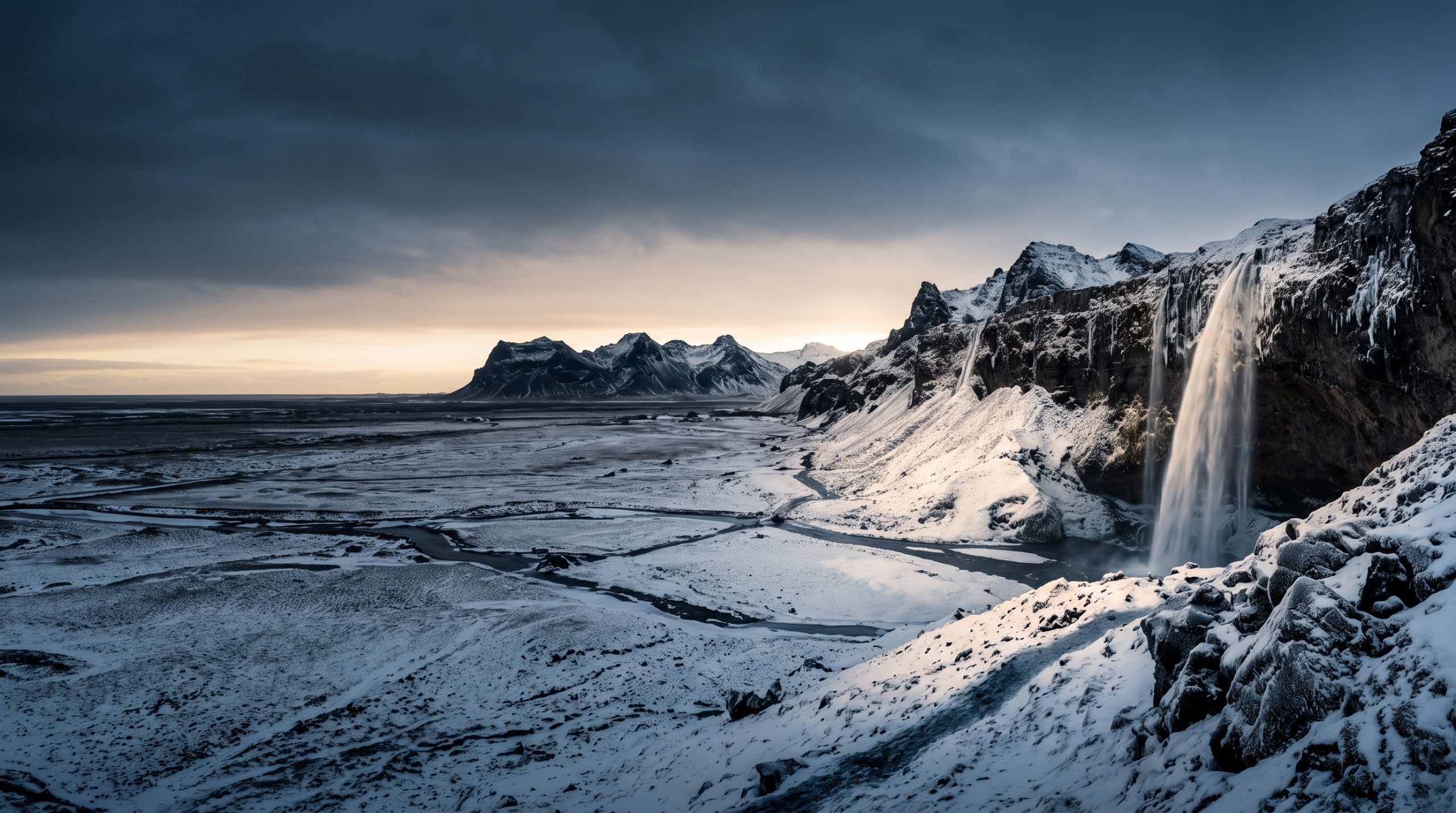
On the first of December the sun clears the horizon over Reykjavik at 10:46 and is gone again by 15:49. Five hours and three minutes. Breakfast happens in the dark, the drive out happens in the dark, and the light you booked us for arrives late morning while the rest of the country is already halfway through its working day.
What that number hides is how good those hours are. Iceland sits at 64 degrees north, so in December the sun never climbs far. It tracks low across the southern sky from the moment it appears until it drops again, which means the flat overhead light that ruins a July noon does not exist here. You get something much closer to one continuous golden hour, with a long blue twilight stacked on either end and roughly nineteen hours of real night wrapped around all of it.
This is that day as we actually run it. Where the hours go, which week of December we would book if the date were ours to pick, what the season closes, and what happens to the plan when the forecast turns on the Tuesday before.
What five hours of daylight actually gives you
Reykjavik averages 4 hours 23 minutes of daylight across December, opening the month a little over five hours and finishing close to four and a quarter. Because the sun stays low the entire time, that window behaves like one long golden hour rather than a normal day. It comfortably holds a ceremony, two locations and a film.
The December day, hour by hour
Iceland stays on UTC+0 all year and never moves its clocks, so the times below are the times your weather app shows and the times in the forecast, with no conversion to get wrong. This table is built on the first week of the month. By New Year’s Eve sunrise sits 35 minutes later and sunset 8 minutes earlier, so everything slides in and tightens at the front.
| Hour | What the sky is doing | Where we put you | Verdict |
|---|---|---|---|
| 08:30 to 09:45 | Full night, first grey in the southeast | Getting ready indoors, letters, layers, coffee | Unhurried, and no light to lose |
| 09:45 to 10:45 | Long blue twilight, headlamps still earning their place | First location, wide frames, tripod work | The most underrated hour in Iceland |
| 10:46 | Sunrise | Already standing there, not still driving | Non-negotiable |
| 10:46 to 12:30 | Low sun out of the southeast, colour on every ridge | Ceremony | The hour the whole day is built around |
| 12:30 to 14:00 | Highest the sun gets, still low | Second location, interiors, drive time, hot food | Detail work and warming up |
| 14:00 to 15:45 | Second warm run as the sun falls southwest | Portraits, and vows read again if you want them on film twice | Equal to the morning, quieter |
| 15:49 | Sunset | Coast, water, anywhere with a low horizon | Colour holds well past it |
| 15:49 to 17:15 | Long dusk into blue hour | Lanterns, headlights, snow turning lilac | Quietly the best frames of the day |
| After 17:15 | Dark, and dark until mid-morning | Dinner, then out again if the sky opens | Aurora strictly as a bonus |
Nothing on that list is a sprint. What ruins a December day is not the short light, it is a plan with four locations in it. Two is realistic, three if they sit close together, and the drives between them happen in the dark on purpose so no daylight is spent watching the road. Our guide to planning an elopement covers that sequencing.
Why we push for the first week over the solstice week
Given a free choice of date, we book the first days of December. The month opens with close to an hour more daylight than the solstice week carries, and daylight in December is not a luxury, it is the difference between two locations and one. From there the day gives up about three minutes every morning until the sun turns.
| Date in December | Daylight | What matters about it |
|---|---|---|
| 1 | 5 h 03 m, sunrise 10:46, sunset 15:49 | The longest day of the month, and the one we ask for |
| 18 | Just over 4 hours | The earliest sunset of the entire year |
| 21 | Just over 4 hours, sunrise about 11:20, sunset about 15:30 | Solstice, the narrowest window |
| 25 | Just over 4 hours, sunrise 11:21 | The latest sunrise of the year |
| 31 | 4 h 20 m, sunrise 11:21, sunset 15:41 | Sunset already climbing back |
There is a second reason, and it has nothing to do with the sun. Every visitor in the country is working from the same four hours you are, which stacks the well-known stops into the middle of the day. A Golden Circle car park at 12:30 in December is busier than the same car park at 07:00 in July. Early in the month we can reach a first location in twilight and finish the ceremony before the vans arrive.
Plenty of couples do not have a free choice. If your date sits on December 27, we do not ask you to move it. We lock the ceremony nearer midday, cut the plan to one strong location with a sheltered second option, and lean harder on the twilight either side. Send us the date you are holding and we will tell you which hour it wants, and whether a different week would serve the day you are describing better.
What the low sun does, and what the cloud does
The sun rises in the southeast, crosses low over the south, and sets in the southwest. Practically, that means we choose locations by aspect. A south-facing beach or valley mouth catches whatever light exists for the whole window. A north-facing gorge sits in shade from open to close, which is a problem if you wanted sun on your faces and exactly right if you wanted a still, even-lit place to say vows out of the wind.
Now the part most December articles skip. Reykjavik’s midwinter climate normals give January around half an hour of sunshine a day, which is roughly twelve per cent of the time the sun is even above the horizon. The pink-light-on-a-glacier version of Iceland is a minority of winter days. Most of them are soft, blue-grey and low in contrast, and it rains or snows on something like nineteen days of December.
We plan for that sky rather than against it, because it is a genuinely good sky. Snow keeps its texture in flat light instead of blowing out. Black sand reads like graphite. A red jacket, green moss under thin snow, the specific brown of winter grass all hold their colour when there is no hard sun bleaching them out. Our galleries and films are the fastest way to see what a low, cloudy December afternoon actually delivers, and what the same coastline does on the days the sun breaks through.
Ice caves, aurora, and the nineteen hours of night
December is the first month of the year that reliably hands you both of Iceland’s winter set pieces, and they behave completely differently.
Ice caves are the dependable one. The park manager at Vatnajokull National Park puts the window between November and March, once the weather has been cold long enough for the ice to firm up, and the only way in is with certified glacier guides who read conditions daily. The caves melt out and re-form every year, so no one can name your cave months ahead. A guide picks it on the morning, which is why any operator who promises you a specific chamber is guessing. Budget two to three hours on the glacier and treat it as its own chapter of the day rather than a stop on the way somewhere.
Aurora runs on probability instead. The season stretches from late August to mid-April and is strongest between October and March, and December’s nineteen to twenty hours of darkness give the widest nightly window of the year. Two things still have to line up: solar activity, and a break in the cloud. The Icelandic Met Office publishes a cloud forecast each evening and that is what we plan the night against, which is why aurora tours out of Reykjavik leave at 20:30 or 21:30 rather than at some heroic hour. Across three nights your odds are decent. On one named night they are close to even, so we never build a ceremony hour around them. When it does not happen you get a long dinner and a plan for tomorrow. When it does, we are already outside with a second camera on it. Our destination guides go further into how the winter regions differ.
Cleared, closed, and guided only
The Ring Road is kept clear through winter, including the run to the south coast waterfalls about 130 kilometres from Reykjavik, where the access roads, car parks and main paths are cleared too. The path that goes behind the curtain at Seljalandsfoss closes once it ices over, so we work the front of the falls and the cleft at Gljufrabui next door, where the short flat walk usually stays open and a pair of cleats handles the rest. The Highland F-roads are shut for the season and reopen in stages from mid-June, so Landmannalaugar is a July plan, not a December one. Glaciers and ice caves are guided access only, and we build the timeline around the guide’s window rather than the other way round.
How the December fallback is built before you arrive
Reykjavik in December runs to daytime highs around 4 degrees C, 39 F, and nights near minus 2 degrees C, 28 F. Mild numbers by North American winter standards, and not the ones that reorganise a day. Wind is. The south coast is milder than the north and also windier and wetter, and Icelandic forecasts give wind in metres per second, which is the figure we watch.
So the plan is written before anyone gets on a plane, and it is specific. Every primary location has a partner within about fifteen minutes chosen for the opposite wind direction, so a southerly does not end the day, it just changes which valley we are standing in. One option is always indoors or under cover. The Met Office publishes forecasts region by region, we read them the week before, the night before and the morning of, and we tell you the evening before which version of the day is running.
December also hands us a flexibility that summer does not. Because every daylight hour has the same low, warm quality, moving your ceremony from 11:30 to 13:30 costs you nothing at all in light. In June, a 22:00 ceremony hour is fixed to the minute. In December we can slide the whole thing two hours to sit in a gap in the weather, and it still looks like the hour we designed.
This is also where having a photographer and a filmmaker from the same team stops being a nice idea. With four usable hours there is no second attempt at the vows in better light, because no better light is coming. Two people covering the same moment at once means it is held properly the first time it happens, from two positions, with audio running on the words. Eight of us work here, so there is always a second camera on the ground and a colleague in reserve. What each experience covers, and what we handle from the planning side, sits on our pricing page. Permit research and logistics are ours; the government, venue and landowner fees sit with you, along with your celebrant and any guided glacier access.
Guest count changes none of that. It changes access, permits, transport and the shape of the timeline, and we would rather hear about your six people early than work around them late. Check Your Date and we will come back with what that specific December day gives us.
Common questions
Is five hours of daylight really enough for a full elopement day?
Yes, because the useful part of an Iceland summer day is not much longer. Between the blue hour from about 09:45, the four to five hours of low sun, and the long dusk after 15:49, a first week of December date carries a ceremony, two locations, portraits and a film without hurrying anyone.
What time should we hold a December ceremony in Iceland?
Between 11:30 and 12:30 in the first half of the month, and nearer 12:00 to 13:00 in the last week, when sunrise has slipped to 11:21. That puts the vows inside the warmest light of the day and leaves the second half of the window for portraits and the drive to a sunset location.
What are our chances of getting the northern lights in the photos?
Over three or four nights in Iceland in December, good. On any single named night, roughly even, because you need activity and clear sky together. We plan the day so it is complete without them, then go out on the best night of your stay and treat anything the sky does as an addition.
Can we visit an ice cave and get married on the same day?
It fits, but it is a full day. Glacier access is guided, the cave is chosen that morning, and two to three hours disappear into it. More often we split the two across a multi-day shape, with the ceremony on one day and the glacier on the next, which also gives the weather two chances instead of one.
What happens if the forecast for our date is bad?
We change the order and the location, not the date. The written plan already names the wind alternative for every stop, the indoor option, and the hour each becomes the plan, and you hear the decision the evening before rather than on the morning.
Is getting married in Iceland between Christmas and New Year harder to organise?
It is workable, with two adjustments. Registers Iceland examines your marriage conditions before the ceremony, so we start that paperwork earlier for a late December date than for a June one, and we book celebrant and any guided access further out because the whole country is travelling that week.
How cold does it get, and can we actually stand outside in a dress?
Daytime highs sit near 4 degrees C, 39 F, so the cold itself is manageable. Wind and wet are what you dress for. We plan outdoor stretches in blocks of twenty to forty minutes with a warm vehicle at the end of each, and we send a layering plan that works under and over what you are wearing.
Reserving one of December’s narrow light windows
We currently have elopement dates available through 2027–2029, and December dates tend to be decided further ahead than summer ones because the good windows in the month are narrow. Send the inquiry form and you will have a reply and our initial brochure within 24 hours, then a tailored proposal for your date. A signed contract and a 30 percent retainer start the planning. Highlights reach you 5 days after the day itself, and the full gallery or film within 3 weeks.
The planning stays in writing from the first message onward, at whatever hour suits you, from wherever you are, so nothing has to line up with a time zone. Tell us the date you are looking at, the two or three things that matter most to you about it, and we will build the December day around them. Tell Us Your Story.