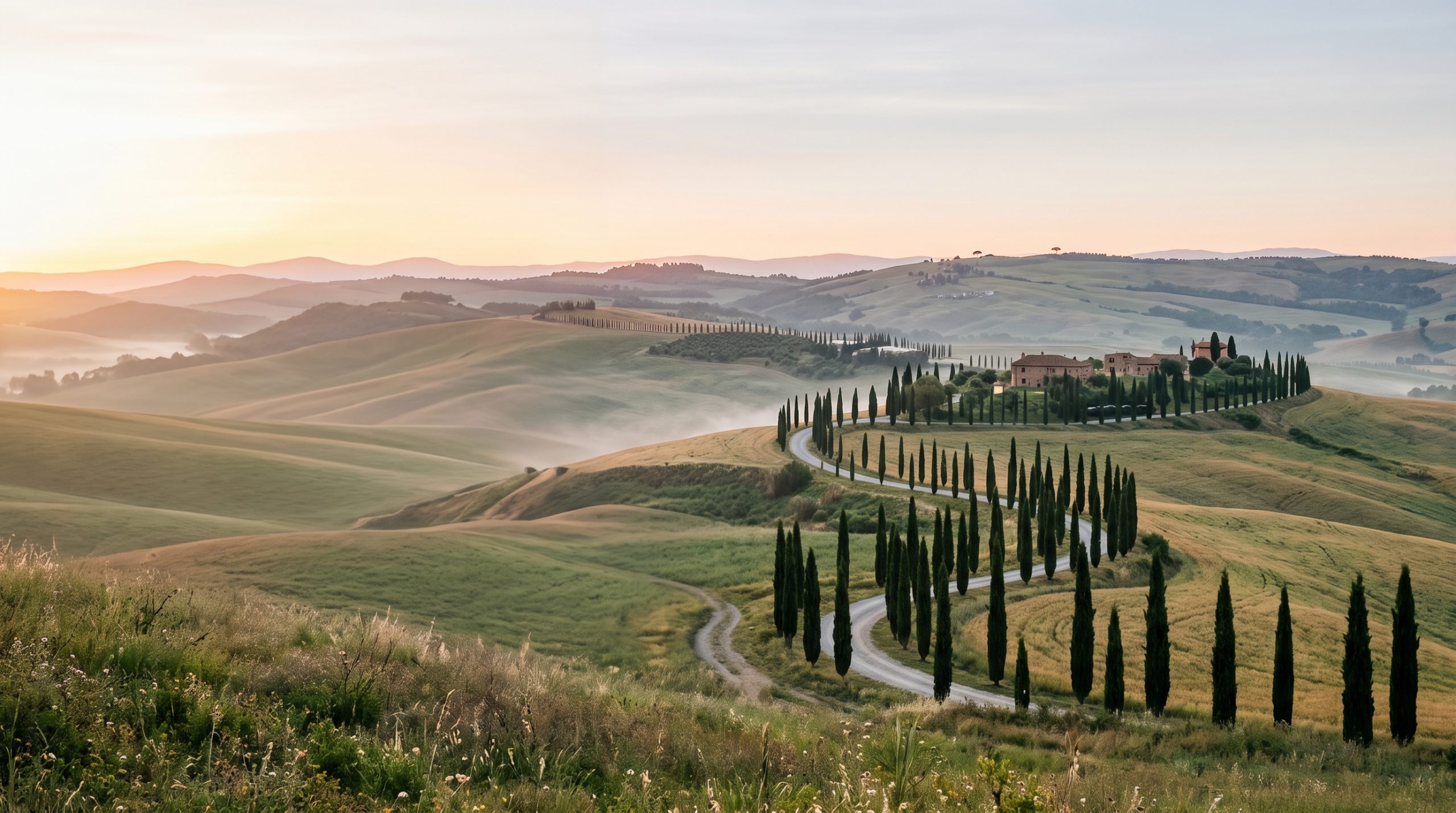
The road has an English name on the map and nothing at all on the ground. No sign, no gate, no board explaining itself, just a track of white gravel leaving the SP146 between San Quirico d’Orcia and Pienza and dropping between two files of cypresses toward the farm buildings at Poderino. In Italian it is a strada bianca, one of hundreds. Online it is the Cypress Road.
The gravel is crushed pale stone and it behaves like chalk dust in dry weather. Walk it in July and a light-coloured hem picks the road up and carries it for the rest of the day. After a wet week it does the opposite, because the crete underneath is clay, and clay holds on.
Here is the part that never makes a location list. You can hold a ceremony on this road. You cannot be legally married on it, because Italian law puts the signing indoors in a place the council has named for the purpose. That one constraint shapes the entire day, and once you know it the day gets better rather than smaller.
Whether you can marry on this road, and where the signing happens
A symbolic ceremony on the Cypress Road needs no municipal permission, provided you stay on the public road and out of the crop. A legal Italian civil marriage must be celebrated where San Quirico’s council has formally designated: Palazzo Chigi Zondadari on Piazza Chigi, or the Horti Leonini garden. Both are ten minutes from the trees.
The turn off the SP146, and what the walk is like in a dress
San Quirico d’Orcia sits just over 400 metres up, roughly 45 km south of Siena and about an hour on the Cassia if nobody is towing a trailer in front of you. Florence is a little over two hours, Rome under three, and the nearest station worth using is Chiusi-Chianciano Terme, itself close to an hour of driving. Couples base themselves in San Quirico, in Pienza ten minutes east, in Bagno Vignoni ten minutes south, or up in Montalcino, which is nearer 25 minutes to the west.
The turn is unmarked and easy to drive straight past. There is no car park and no gate. The verge of the SP146 is where cars stop, and the white road beyond it is working farm access, so it stays clear.
Then the walk, which is shorter than most people expect and steeper than the photographs suggest. The gravel is firm and close to level for the first stretch, then it tips downhill toward the farm. Loose stone on a slope is the only real issue: a smooth leather sole skates on it, and a long train goes down without complaint and comes back up carrying dust. Flats or trainers on the way in, change at the top, and accept that the bottom of a pale dress will be the colour of the road by the end of the morning. There is no shade except the trees, no water, no shelter and nowhere to sit down. All three are under ten minutes away in San Quirico, which is why we build these timelines around two short visits to the road rather than one long stand on it.
Two windows of light, and which one the trees are built for
The valley opens eastward rather than closing in, so the sun becomes usable within minutes of clearing the ridge. There is no hour of standing around waiting for it to climb over a mountain. For roughly the first two hours the light runs low and side-on along the valley, and that is the only stretch of the day when the cypresses do the thing they are known for.
They are narrow and very tall. At low sun they lay hard bars of shadow across the white road, so anyone walking up from the farm passes in and out of light every few steps. In a film that reads as rhythm, and it is a large part of why this road is worth an early alarm. In stills it is an exposure problem for anyone who has not planned for it, and the answer is to place the vows where the gaps between trunks are widest instead of fighting the pattern.
Turn around and shoot into the same low sun and the trees go to flat black cutouts with flare burning between them. Both versions are good, and they sit a few steps apart, which is why the ceremony hour on this road gets planned to the ten minutes rather than to the hour.
By mid-morning the sun is high and the hills flatten out. That is the honest part: from about ten until five in summer, Val d’Orcia photographs like a green bedsheet, and no amount of enthusiasm changes it. Sunset drops behind higher ground to the west, Montalcino’s hill through the long days and further round toward Monte Amiata in winter, and the last half hour before it goes turns the whole valley the colour of the gravel.
On still mornings after a cold night, mist pools in the low fields and the cypress rows and the Cappella della Madonna di Vitaleta, on the hill opposite, stand out of it. It is at its most reliable in the second half of autumn and in early spring, it burns off fast once the sun is properly up, and what it does to a wide frame is easier to see than to describe in our published galleries and films.
Green in May, stubble in July: choosing the month by the crop
This is farmland on a working cycle, and the picture most couples have in mind is a three-week picture. What the fields are doing matters more here than the forecast does.
| Window | What the fields are doing | What it gives the day |
|---|---|---|
| Late March to April | New wheat, bare clay still showing between the rows | Cool mornings, soft ground underfoot, very few cars on the verges |
| May | The green from every photograph you have saved, poppies along the field edges | Long days and the steadiest ceremony light of the year, plus company at every viewpoint |
| June | Wheat turning gold, then bronze | Early starts get warm quickly; the ridge shadows are at their longest |
| Late June to July | Cut and baled, pale stubble left behind | Hard light by nine, haze after lunch, dust on everything |
| August to September | Ploughed clay, brown and combed into lines | Cleanest air from mid-September, with the Montalcino grape harvest under way |
| October to November | Re-sown and green again | The best mist mornings and a sunrise at a civilised hour |
| December to February | Bare and green by turns, sometimes frosted | Short days, empty roads, fewer farm stays open |
Month-by-month thinking for other places we work sits in our destination elopement guides. For this particular road the year splits simply: the green belongs to spring, and the mist belongs to autumn.
Tripods before dawn at Podere Belvedere, and why arriving early is not the whole answer
Landscape photographers reach Val d’Orcia viewpoints in the dark. The pull-off above Podere Belvedere, a couple of minutes further along the SP146, has tripods on it before there is any light to use, and they are waiting for exactly the mist you are.
The most photographed cypresses in Tuscany are not on this road at all. The circular group known as the cipressini stands in a field within sight of the Cassia, north-west of town, and because there is no car park, cars stop on both verges and rotate through the morning. It is worth seeing once. By eleven o’clock it is a flat green field with a queue of people in it, and it is not where we would put your vows.
Coach and minibus tours work the Pienza and Montalcino loop through the middle of the day, which is the same middle of the day the light has already given up on. So an early start here is not a sacrifice, it is the only version of this that works. What early does not solve is the road itself. The Cypress Road is farm access, and a tractor has right of way over a ceremony. We put the vows in the first light on the road, keep the famous views for the drive in and the last half hour of the evening, and hold a second stretch of white road ten minutes away for the mornings when somebody is cutting hay.
Who owns the wheat, and the twenty minutes back to Palazzo Chigi
The road and its verges are public. The wheat on either side is somebody’s crop and somebody’s year of work, and the cypresses stand on private land. Making vows while standing on the road needs nobody’s permission. Putting anything with legs on the field side, a chair, a table, an arch, is a conversation with the landowner, and the farm at the end of the road is who to have it with. That asking is part of our planning, not something we hand you a week out.
A symbolic ceremony needs nothing at all from the town hall. You choose the celebrant, the words are yours, and there is no register waiting to be signed. Most American couples we work with here either complete the legal marriage at home before flying, or do both in one day: the civil ceremony in San Quirico, and the one that matters to them out on the road.
The legal half has a fixed rule behind it. An Italian civil marriage is celebrated by the mayor or a delegate, in the municipal house or in a place the council has formally designated for it. San Quirico has designated more than one room. Palazzo Chigi Zondadari on Piazza Chigi is the standard setting. A council resolution added the Horti Leonini, the sixteenth-century garden in the middle of town, with specific corners inside it used for ceremonies: the rose garden, and the avenue under the holm oaks. The Nilde Iotti garden is on the list too. The council publishes its own tariff for the garden, banded by day and by slot, and the top of that band has sat at around 800 euro.
For a foreign couple the file is assembled in writing with the ufficio di stato civile before you fly, and what goes into it depends on your citizenship and where you live. That research and the order of the paperwork are ours. The government and venue fees themselves are yours. If you are earlier in the process than this, our guide to planning an elopement lays out the sequence.
Two more things specific to this stretch. Aerials in Italy run on operator registration and an airspace check before anything leaves the ground, so we confirm the zone and the time window for this road and then design the film around what we know we can fly. And the valley has been on the UNESCO World Heritage list since 2004, inscribed as a cultural landscape rather than as a building, which is exactly why nobody here drives into a field for a photograph. The fields are the monument.
Two cameras on a road wide enough for one tractor
The width of this road changes how two people work. A photographer and a filmmaker cannot stand in the same spot here, so they take opposite ends of it: the filmmaker up the slope on a long lens, where the cypresses compress into one dark wall, the photographer in close, then a swap. The trunks themselves act as blinds, so neither ends up in the other’s frame and nobody has to whisper about it mid-vow. Wind runs the length of this valley most afternoons and the ridge has nothing to break it, so vows recorded up here need a microphone on the couple rather than a hopeful one on top of a camera, and we angle the ceremony so a cypress takes the worst of the gusts.
Photography, film and planning come from the same eight-person team, which is why that choreography is settled before the morning instead of during it. One full day with a dedicated photographer or filmmaker starts at $4,900, the two of them working together is from $7,900, and travel for the assigned team is included wherever the day happens. The rest sits on the pricing page. Highlights reach you five days after the day itself, and the full gallery or film three weeks after.
Common questions
Is there anywhere to park at the Cypress Road?
There is no car park. Cars stop on the verge of the SP146 near the turn, and the white road itself is farm access, so we keep it clear. We plan the arrival for first light, when there is room to leave the car well off the tarmac, and walk in from there.
Do we need a permit for a symbolic ceremony among the cypresses?
Not for standing on the public road and saying your vows. Anything set up on the field side belongs to the landowner and is a permission we request in advance. Municipal, venue and landowner fees are paid by you; the research and the asking are ours.
Can we do the legal civil marriage and the Cypress Road on the same day?
Yes, and it is the shape we plan most often. The signing happens where the council has designated it, at Palazzo Chigi Zondadari or in the Horti Leonini, and the road is under ten minutes from both, so the ceremony you actually care about can sit in the best light of the day.
Will the hills still be green if we come in July?
No. The wheat is usually cut in the last days of June or the first days of July, and what follows is pale stubble, round bales and very long shadows. It photographs beautifully and it photographs nothing like May. If the green is the thing you have pictured, tell us, and we will say May and mean it.
Is the white road walkable in wedding shoes after rain?
The clay under the gravel holds water, so after a wet spell the surface turns greasy on the slope. Flats or trainers for the walk in, and the car is the only place to change; we build the schedule so that change happens with time to spare rather than at a run.
Shaping a Val d’Orcia day around your own hour
A day here can start before five in the morning with a car parked on the SP146 verge and finish with the last light going down behind Montalcino, or it can begin in San Quirico at ten, give up the mist entirely, and be built around lunch and the evening instead. Both are real days. Tell us which one you actually want, and if the month you have chosen works against it, we will say so and name the month that does not.
We keep every planning decision in writing, which suits a six to nine hour time difference better than anything else. Write to us and a reply and our first brochure reach you within 24 hours; from there it is a proposal built for your date, a contract, a 30% retainer, and planning begins. Dates are currently open across our 2027, 2028 and 2029 Tuscany seasons. Start Your Story.