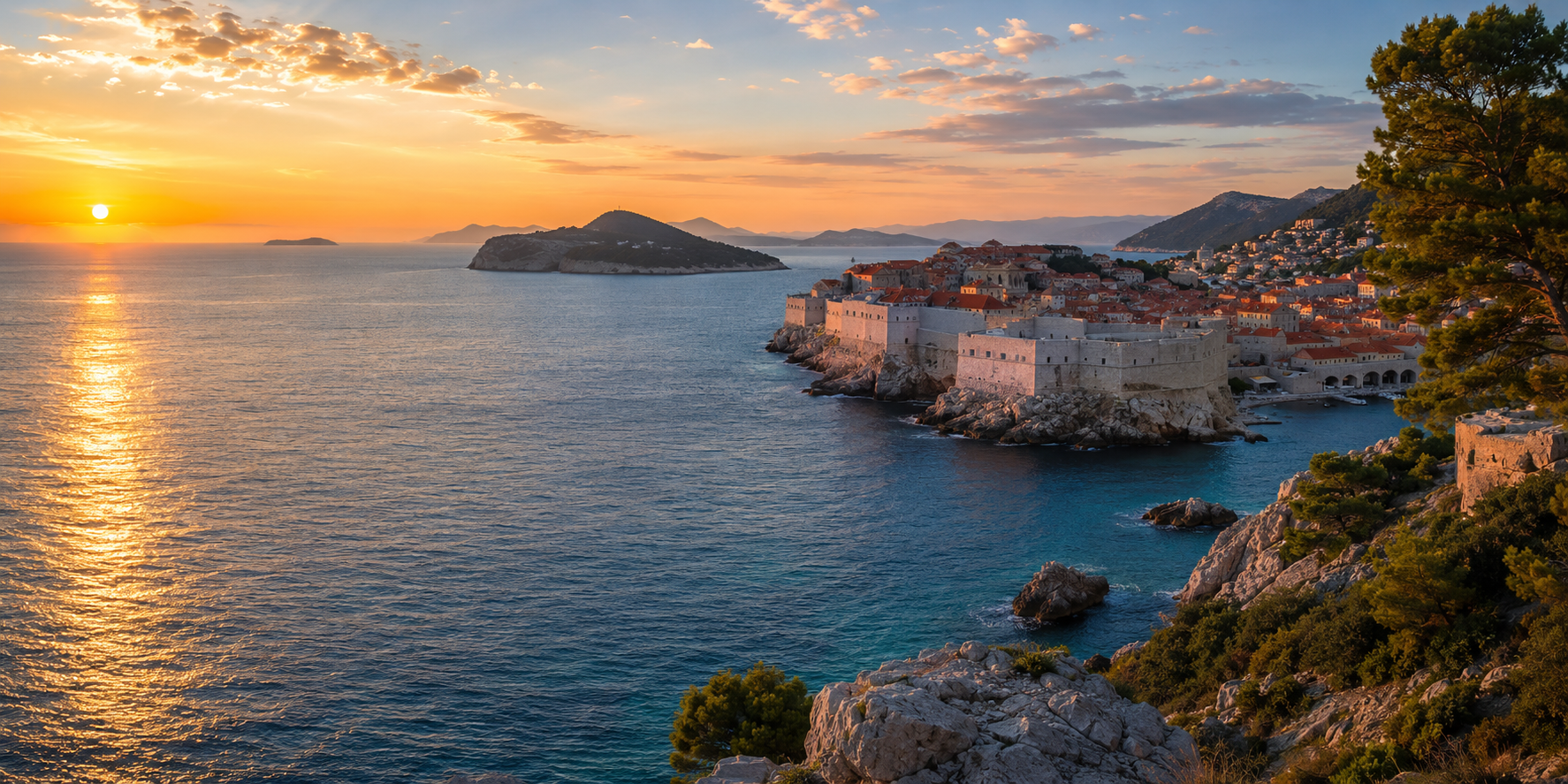
The circuit on the Dubrovnik city walls runs one way. You enter at Pile Gate, at Ploče Gate or at the stair beside the Maritime Museum, and then you go around counter-clockwise, and you do not double back for the frame you walked past. Most people take about two hours. Be up there at eight in the morning and the stone is still cool, the sea light comes in low and sideways, and the terracotta roofs have shadow in them. Arrive at eleven on a July morning and you have a line at the gate, sun straight overhead, and a great deal of company.
That is the whole planning problem in Croatia stated once, and it repeats itself at every famous location in the country. The fix is not a secret spot. It is arithmetic. Around the summer solstice the sun clears the horizon at Dubrovnik at 5:09 a.m. and sets at 8:29 p.m., with roughly half an hour of workable light before the first and after the second. A couple of hundred kilometers up the coast in Hvar town, that same evening sun goes down about eight minutes later. Eight minutes sounds like nothing. It is the reason we write timelines to the minute rather than to the hour.
Croatia is really three destinations wearing one name: a walled city on a rock, more than a thousand islands you reach by boat, and karst lakes several hours inland where the water is loud and the sky is small. Each one has a different best hour and a different set of permissions. We photograph, film and plan all three, and We are currently taking Croatia elopement bookings for 2027 through 2029.
Photo, film and planning under one Croatian contract
We are eight people who photograph and film elopements, and we plan them too. In Croatia that means location design across coast and islands, a timeline built around real sunrise times and boat timetables, permit research, and weather alternatives. Coverage runs from one full day to a multi-day itinerary across several islands. Team travel is included.
Four thirty in the morning to nine at night: a June day on the Adriatic
A midsummer Dalmatian day gives you sixteen and a half hours of usable light, which sounds generous and is actually a trap. The good hours are stacked at both ends and the middle is flat, hot and crowded. So the day gets built as two working blocks with a long, deliberate gap in the center.
First light at Dubrovnik in late June arrives around 4:34 a.m. We are moving before that, usually driving up onto Srđ, the ridge behind the city, while the Old Town below is still lit by street lamps. Sunrise at 5:09 a.m. is not the moment to be looking for a spot. It is the moment to already be standing in one, with the second camera set on the wide and the first one close.
From about seven the sea is glass. This is the window for a private skippered boat, before the north-westerly known locally as the maestral builds through the middle of the day. Vows on a bow, or on a beach on the Elafiti islands with nobody else on it, work best in this block. If you want the legal ceremony rather than a symbolic one, it usually anchors here too, because registry office hours will not bend to the light.
Then we stop. Midday on this coast in July is not a photographic asset, and pretending otherwise produces squinting. Lunch in a konoba, a swim, a real rest, and we pick the cameras up again when the shadows lengthen and the breeze starts to drop.
The evening block is the long one. Sunset at 8:29 p.m. in June, then thirty-five minutes of civil twilight until 9:04 p.m., and the limestone of the Old Town holds warmth long after the sun has gone. Narrow alleys that were a white slot of glare at noon turn into soft bounced light. That is when the walls, the Buža gaps out through the seaward stonework, and the empty lanes behind the cathedral finally give you what the postcards promised.
| Dubrovnik | Sunrise | Sunset | Light ends | What that means for a day |
|---|---|---|---|---|
| Mid-May | 5:25 a.m. | 8:03 p.m. | 8:35 p.m. | Warm light, cool sea, quiet streets. Long day, early alarm. |
| Solstice | 5:09 a.m. | 8:29 p.m. | 9:04 p.m. | Maximum light, maximum heat, maximum company at midday. |
| Mid-September | 6:27 a.m. | 6:57 p.m. | 7:26 p.m. | Sunrise 78 minutes later than June. Sea still warm. |
| Mid-October | 6:54 a.m. | 6:13 p.m. | 6:42 p.m. | Humane hours, softer sun, shorter twilight to work in. |
The crowd question, answered with hours instead of hope
Dubrovnik in high season is busy, and no photographer can talk you out of noticing that. What we can do is move you through it in an order of hours that mostly avoids it. The walls at opening. The lanes before the first coaches arrive. Water in the middle of the day, because a boat is the one place a crowd cannot follow you, and the Elafiti and Lokrum sit just off the city.
Inland, the answer is different again. Plitvice Lakes, on the UNESCO list since 1979, allows photography and filming at its most attractive locations by arrangement with the park, with notice and a reservation made at least a week before you arrive. That single administrative step is what separates a booked, unhurried hour on the boardwalks from shuffling along behind a tour group. Krka, closer to the coast and an easy drive from Split, Šibenik, Zadar or Trogir, works as a short inland block if you are staying in central Dalmatia. Kornati is boat-only, which filters the crowd by itself.
If you would rather see the shape of a whole Croatian day laid out, our destination guides go region by region.
Tell us the date you are holding and the coast you keep coming back to, and we will send back the hours that actually work. Check Your Date.
What a filmmaker changes on a boat deck and a stone stair
Here is the practical case for photography and film from one team, in the specific conditions this country hands you.
A skippered day boat has maybe four meters of usable deck. Two people hired separately, who first work together on the morning of your day, will spend the first hour of that boat ride negotiating position, and one of them will be in the other’s frame. Our photographer and filmmaker have agreed the geometry over breakfast: who takes the bow, who works from the stern with the gimbal, which side the skipper approaches the headland from, and what the single pass looks like. Because on a boat you get one pass. A second, separately booked shooter asks the skipper to circle back. We do not need to ask.
The wind is the other reason. The maestral builds through the afternoon and then eases off in the evening, which is lovely to sail in and unhelpful for recording vows outdoors. On the Expedition, professional audio for vows and the moments that matter is part of the coverage where conditions allow, and the planning that goes with it is just as important: we read the forecast the day before, put the ceremony in the lee of the headland rather than on top of it, or shift it to the hour the breeze drops. That decision is made once, by one team, and both cameras already know about it.
Then the alleys. The photographer wants the hour when light bounces off the opposite wall, not the hour when a white strip of sky sits above black stone. The filmmaker wants an uninterrupted move down worn limestone stairs with nobody appearing at the far end. Those two things want slightly different minutes of the same evening, and they only both happen if one plan owns them.
Aerials sit on the same logic. Flying in Croatia means operator registration with the Croatian Civil Aviation Agency, a pilot who has passed the required competence, the 120-meter ceiling that applies across the EU, and a geozone check for the exact stretch of coast on the exact day. We confirm the window before we design anything around it, and we build the film so it stands up whether or not the aerial happens. When it does, an island coastline from above is one of the few shots that explains this landscape in a single move.
What all of that produces is worth looking at rather than reading about. Our published galleries and films are the honest answer to how the Adriatic renders: the blue is genuinely that color, the stone is warmer than you expect, and the wide frames are wide because the islands earn it.
What travels with us along the Croatian coast
Every experience, in every destination, includes the same core. Nothing on this list is an upgrade.
- Destination and location design for your dates, across coast, islands and inland parks.
- Planning, and a custom timeline built around light and real travel time, including ferry and boat reality rather than optimism.
- Permit research and logistics guidance, including national park photography reservations and municipal permissions.
- Weather alternatives and backup planning, held ready rather than improvised.
- Drone footage where it is legal, safe and appropriate.
- Professional audio for vows and meaningful moments on the Expedition, where conditions allow.
- Team travel worldwide: flights, accommodation and ordinary travel for the assigned team, with no European or long-haul distinction.
- Highlights delivered in 5 days. Full gallery or film in 3 weeks.
The three-month window and the thirty-day file
The paperwork is the part couples worry about most, and it is genuinely procedural rather than difficult. Croatia’s Ministry of Foreign and European Affairs directs couples to contact the local registry office, the matični ured, in the district where the marriage will take place at least three months before the date they want, and to confirm with that specific office which documents it requires, because districts differ. Documentation then has to be submitted to that register office 30 days before the ceremony.
For a typical American couple that file holds a birth certificate no more than three months old carrying the Apostille seal of the issuing state and translated into Croatian by a sworn court interpreter, plus an Apostilled certificate showing you are free to marry. The U.S. Embassy in Zagreb notes the birth certificate copy must have been issued within the past 90 days, and provides the marriage affidavit sworn before a consular officer for a fifty-dollar notarial fee, which then needs authenticating by the Ministry’s International Legal Assistance Service in Zagreb. Two witnesses are required, and Americans staying under 90 days need no special visa to come and marry.
Plenty of couples read that and decide to complete the legal marriage at home, then hold a ceremony with a celebrant on a Croatian headland with the paperwork already behind them. Both routes work and both change the timeline. Our planning covers the research and the sequencing either way, and the government, venue and landowner fees themselves are paid by you. If you are still deciding, our guide to planning an elopement sets out the fundamentals.
Where Croatian coverage begins, and which costs stay local
Croatia is on the euro, so everything local below is quoted in euros and nothing here needs converting twice.
| Experience | Length | Team on the ground | Starts at |
|---|---|---|---|
| The Adventure | One full day | One dedicated photographer or one dedicated filmmaker | $4,900 |
| The Expedition | One full day | A dedicated photographer and filmmaker working together | $7,900 |
| The Odyssey | Two to seven days | Photography and film, one or several destinations | Custom proposal |
Team travel to Croatia is inside that figure. Flights, accommodation and the ordinary travel of the team assigned to you, in Dubrovnik or Hvar or Plitvice, are ours to arrange and ours to pay. The fee also does not move with guest count. Ten guests at your ceremony instead of none affects access, permits, transport and the shape of the timeline, not the price. Full detail sits on our coverage and pricing page.
What Croatia adds on top, paid by you directly:
- Registry office fees, sworn court translation and, for a symbolic ceremony, your celebrant.
- Site tickets and entries. The Dubrovnik city walls are ticketed per person and currently sit around 40 euros for an adult in high season, and national parks charge admission that varies by park and month.
- Accommodation, food, and any vendors you bring in.
- Unusual transport: private boats, helicopters, 4×4 charters, mountain guides. An organized group day boat out of Murter or Šibenik into Kornati runs in the region of 35 to 40 euros a head, while a private skippered boat for the two of you costs considerably more and buys you the freedom to set the hours, which is usually the point.
- The per-person visitor tax that charter operators collect at check-in, currently a little over a euro per adult per day.
From your first message to a signed date
- You send the inquiry form with your dates and whatever you already know about the day you want.
- We reply within 24 hours with an initial brochure.
- We put together a tailored proposal: coverage, the team assigned, and the shape of your day.
- You sign the contract and pay a 30% retainer. The remaining payment schedule is set out in the proposal.
- Planning begins: locations, timeline, permit research, weather alternatives.
- After the day, highlights reach you in 5 days and the full gallery or film in 3 weeks.
Who the Adriatic suits, and the month that changes the answer
This coast rewards a particular kind of morning person. In June, being in position for a 5:09 a.m. sunrise means an alarm before four and a coffee you drink in the car. Couples who love that get the best two hours in the country. Couples who read that sentence with dread should say so, and mean it, because there is a much gentler version of the same day in mid-September, when sunrise is 6:27 a.m., sunset is 6:57 p.m., and the sea is still warm enough to swim in after the ceremony.
It also suits people who are steady on their feet. Croatian limestone has been polished by centuries of shoes, boat steps are boat steps, and island paths are stony rather than smooth. None of that requires an athlete. It does mean shoes you can walk in, and telling us if uneven ground is a problem so we choose ground that is not.
And it suits couples relaxed about a plan that moves on the morning. If the wind swings, we run the evening block first and the boat second, and that reordering is a normal Tuesday for us rather than a crisis. If open water is not your idea of a good time at all, tell us that too. The lakes at Plitvice, the Krka boardwalks and the walled towns make a complete day with no deck under your feet. What we want from you is the honest version of what you enjoy. From there we either build the day around it or tell you plainly which month or which region fits it better.
Common questions
Can we legally get married in Croatia as Americans, or should we do the paperwork at home?
Both are possible and we plan either. A legal Croatian marriage means contacting the registry office in the district of your ceremony at least three months ahead, and filing Apostilled documents translated by a sworn court interpreter 30 days before. Many couples instead marry at home first and hold a ceremony with a celebrant here, which shortens the file considerably.
How far ahead do we need to contact the Croatian registry office?
At least three months before your date, according to Croatia’s Ministry of Foreign and European Affairs, and it should be the office in the district where the ceremony happens, because requirements vary between districts. Documents go in 30 days before. Our planning includes researching that sequence for your specific location so nothing arrives late.
Is Dubrovnik too crowded in summer for an elopement?
No, but it is only worth it on the right hours. The city walls at opening, the lanes before the coaches, then water in the middle of the day when the Old Town fills. The Elafiti islands are a short crossing by boat and change the day entirely. If you want quiet all day rather than quiet at the edges, we would point you at the islands or inland instead.
Can you fly a drone over the Dalmatian coast?
Often, and always on the paperwork. Aerials in Croatia need operator registration with the Croatian Civil Aviation Agency, a pilot with the required competence, the EU 120-meter ceiling, and a geozone check for that stretch of coast on that day. We confirm the window in advance and design the film so it works with or without the aerial.
Do we need a private boat, and what does it add?
You do not need one, and it is the single addition that changes a Dalmatian day most. It buys the morning glass before the afternoon breeze, beaches with nobody on them, and a running order set by you rather than by a ferry timetable. Boats are booked and paid separately from your coverage, and we handle fitting one to the timeline.
Does the price change if we bring a few guests?
No. The fee is the same with two people or twelve. Guests change access, permits, transport and how the timeline is built, and we plan for all of that, but they do not change what you pay us. Ticketed sites like the city walls and the national parks do charge per person, and those entries are paid by you.
How soon do we see our photos and film?
Highlights arrive 5 days after your day. The full gallery or film follows within 3 weeks. Those windows are the same in Croatia as everywhere else we work, and they are not seasonal, so a September date does not sit in a queue behind August.
What happens after your first Croatia message
We keep every planning decision in writing, asynchronously, across whatever time zone you are in. You send the form, we read it properly, and a real reply with a brochure comes back inside 24 hours. Nothing to keep, nothing to be awake for. A date in mind for 2027, 2028 or 2029 is plenty to start with, and so is a rough week and a feeling about which coast. Tell Us Your Story.