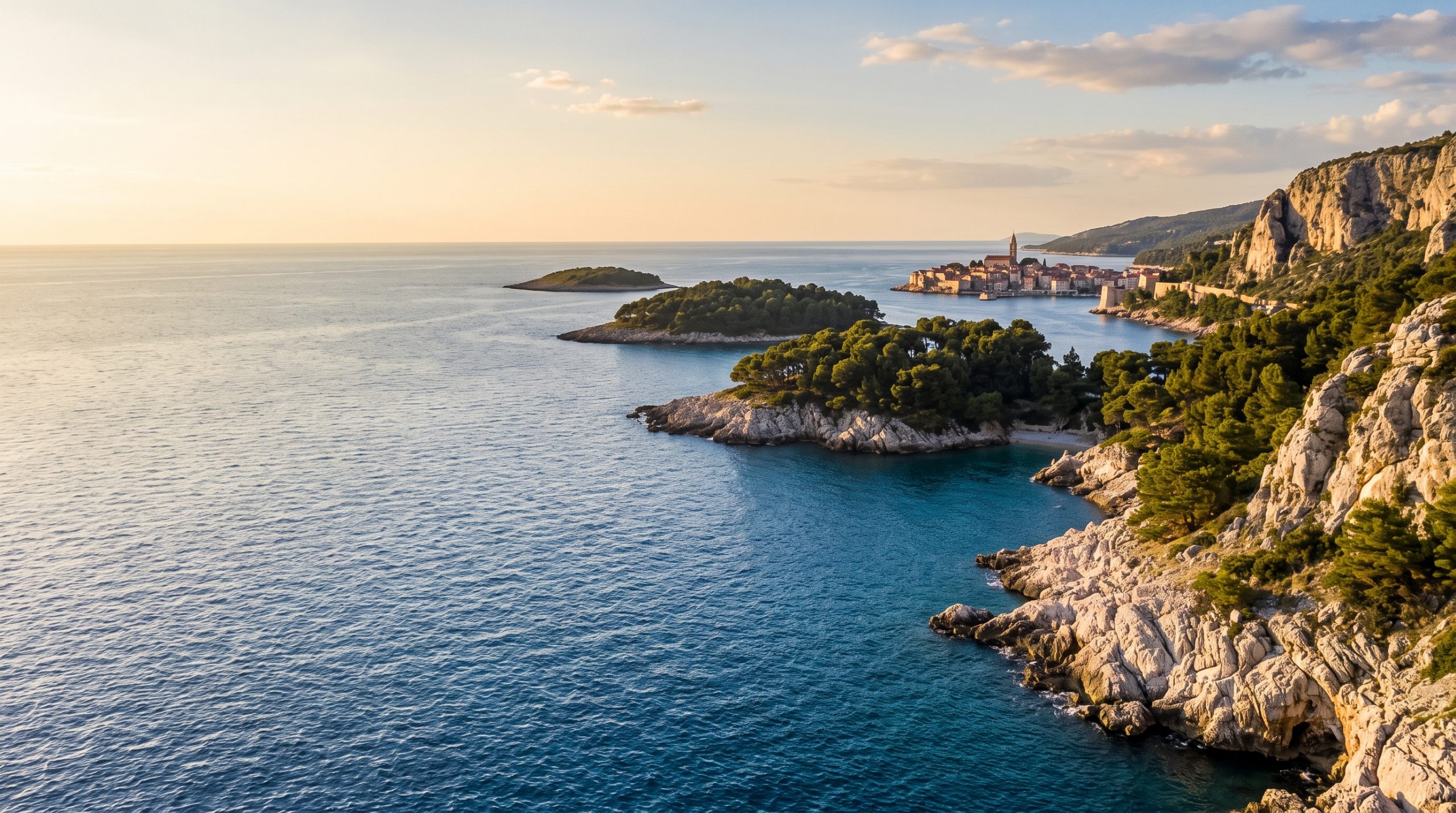
Dubrovnik lets two cruise ships into port on a given day, with a ceiling of 5,000 passengers between them. That sounds generous right up until you stand on the Stradun at nine in the morning in July and watch what 5,000 people do to a marble street roughly 300 metres long. It is also the most useful number in Croatian elopement planning, because it tells you which hours of the day belong to you.
The rest of a Croatian budget follows the same logic. The legally binding part of marrying here is nearly free: the state’s administrative fees are €9.29 for the record of your intention to marry and €18.58 for the ceremony performed by the registrar. Everything above that line is priced by season, by access, and by how many boats and tickets your particular day needs. Croatia is on the euro, so every local figure on this page is in euros.
We are eight photographers and filmmakers who plan, shoot and film elopements as one job rather than three. This page is the cost conversation written out the way we would write it in an email: what Croatia charges, where our coverage starts, and which of the two you should be thinking about first.
Two numbers to hold before anything else
We photograph, film and plan elopements across Croatia, from the Dubrovnik walls to Hvar, Krka and the Velebit coast. One full day with a dedicated photographer or filmmaker starts at $4,900. A photographer and filmmaker working together starts at $7,900. Team travel is included. Croatia’s own marriage paperwork costs €27.87.
A June day here has two ends and a long empty middle
On 21 June the sun comes up over Dubrovnik at 5:10 and sets at 20:29, with usable twilight running to about 21:04. That is just under sixteen hours of daylight, and almost none of the middle of it is worth photographing. The stone reads bone white at noon, the harbour fills, and the shade in the lanes goes hard-edged and unfriendly.
So we build the day at the two ends and treat the middle as travel time. An alarm around 3:45 gets you into the Old Town before the first delivery van. One thing the sunrise table will not tell you: Srđ rises more than 400 metres directly behind the city, so the clock time of sunrise and the moment light actually reaches the lanes are separate events. We plan backwards from the second one, which means walking the route the evening before and knowing which end of the Stradun goes gold first.
From roughly 5:00 to 8:00 the Old Town is yours. Lovrijenac, the western walls, the Ploče steps, the harbour before the excursion boats load. If your civil ceremony is with a Croatian registrar, that appointment is a fixed point set by the registry office, and the whole timeline hangs off it. By 10:00 we are usually somewhere else entirely — driving north, on a ferry, or eating lunch while the coaches do their circuit.
The second end starts around 17:30. Out on a boat by 18:00, vows somewhere sheltered, then the long fall of light between 19:30 and sunset, and another half hour after it when the sea holds more colour than the sky. Late September changes the arithmetic in your favour: on 20 September sunrise is 6:32 and sunset 18:49, so the alarm moves back by more than eighty minutes and you still finish with a whole evening in front of you.
| Date in Dubrovnik | Sunrise | Sunset | What that shape gives you |
|---|---|---|---|
| 21 June | 5:10 | 20:29 | Longest envelope, earliest alarm, hardest midday. Two separate shooting blocks with six dead hours between them. |
| 15 July | 5:23 | 20:24 | Same shape, more heat and more boat traffic. The 5am hour matters most in this month. |
| 20 September | 6:32 | 18:49 | Warm sea, thinner crowds, a civilised start. Our favourite compromise on this coast. |
| 10 October | 6:54 | 18:14 | One continuous day rather than two halves. Softer light, and the bura starts to be part of the plan. |
The crowd question, answered with a timetable
Couples write to us worried that Croatia in summer means strangers in every frame. It can, and we will not pretend the famous angles are pristine at the hour most people shoot them. The view from the southern walls at midday is flat, hot and queued. The cliff bar everyone photographs is small, and at six in the evening it is a bar.
What fixes it is a timetable, not luck. The cruise cap means arrivals are predictable rather than random, and passengers come ashore in a mid-morning wave. Krka is the same story from the other direction: the park’s own price list cuts the individual adult ticket by 25% after 15:00 from June through September, currently €30, which pulls a second crowd into the falls in the afternoon. We would rather have you at the gate for opening. Plitvice sells timed-entry tickets and will not let you in before the slot on the ticket, so on days that include the lakes the entire morning is built around which slot we hold.
Narrow lanes, one boat, one pass at the light
Croatia puts a photographer and a filmmaker in each other’s way more than almost anywhere else we work, which is exactly why we send them out as a pair who already know the choreography. An Old Town lane is a stone corridor two or three metres across with a stair at one end. The spot where the photograph works is the spot the filmmaker needs to move through. Two people hired separately, who have never worked together and arrive at 4:30 in the morning, spend that first hour negotiating. Two people from the same eight-person team split the lane without discussing it.
Boats make the same point harder. A skippered boat off Hvar or the Pakleni islands has one bow and one stern, and a cove holds good light for about twenty minutes before the ridge behind it takes the sun away. There is no second pass. Whoever is not shooting is holding the reflector, minding the rope, or already climbing to the vantage point for the next frame instead of standing in it.
Wind decides where the words happen. The maestral fills in most summer afternoons from the northwest, and it is the reason an afternoon on the water is bearable and also the reason vows recorded in it are unusable. On the Expedition our filmmaker carries professional audio, so we put the vows in a leeward cove and go back out into the breeze afterwards for the sailing frames. That is a planning decision made a month before your date, not a scramble on the day.
Aerials are decided park by park. Plitvice prohibits drone use for aerial photography inside the national park, so a film built around the lakes is a ground film: boardwalk movement, water sound, the long lens across the terraces. On the coast we plan aerials around permission and a time window, and confirm both before we promise you a single frame of them. You can see how all of this resolves in the finished work — the galleries and films on our stories page are shot exactly this way, by two people who planned the day together and then went out and made it.
What travels with us to Croatia
Every experience, whichever coverage you choose, includes the planning as well as the shooting:
- Destination and location design for your dates, not a template itinerary.
- A custom timeline built around real light and real travel time, including ferries and the hour the coaches arrive.
- Permit research and logistics guidance for parks, towns and private land.
- Weather alternatives and backup planning, held in reserve rather than improvised.
- Drone footage where it is legal, safe and appropriate.
- Professional audio for vows and meaningful moments on the Expedition, where conditions allow.
- Team travel worldwide: flights, accommodation and ordinary travel for the assigned team, with no European or long-haul distinction.
- Highlights delivered in 5 days, and your full gallery or film in 3 weeks.
Guest count does not change the fee. Eight people instead of two changes access, permits, transport and the shape of the timeline, and we plan for that, but the price is the price. We currently have Croatia elopement dates available through 2027–2029.
Where Croatia coverage begins, and what remains a local cost
Both coverage tiers are named above and set out in full on our pricing page, including what sits inside each one. The Odyssey runs from two to seven days across one or several destinations, photography and film together, and is quoted as a custom proposal because a Dubrovnik-and-Hvar week and a Velebit-to-Krka week are not the same job. There is no half-day version of what we do.
Team travel to Croatia is included. We do not add flights, hotels or transfers for our own people to your invoice, and there is no surcharge for an island rather than a mainland town.
These are the Croatian costs that sit outside our fee, and it is worth having them in front of you early:
- State administrative fees for the civil marriage: €9.29 for the record of intention and €18.58 for the ceremony.
- Sworn court translation into Croatian, plus apostille certification of your home documents, priced per document by the translator.
- A separate fee for a ceremony held outside official registry premises, set locally by the county rather than nationally, so it depends on where and when you marry.
- National park admission where your day includes one. Krka is priced per adult with a cheaper afternoon rate, and Plitvice is sold as a timed-entry ticket tied to a slot.
- Dubrovnik city walls admission, currently around €40 per adult in the main season, if the walls are part of your route.
- Unusual transport: a private boat with a skipper, a 4×4 for the Velebit tracks, a mountain guide. Boat rates rise sharply in July and August and are quoted per day.
- Accommodation, a celebrant if you want a symbolic ceremony alongside the legal one, flowers, hair and makeup, and dinner.
Tell us the region and the month you have in mind and we will come back with the actual third-party list for that day, in euros, before you commit to anything. Check Your Date.
How a Croatia cost enquiry becomes a held date
- Send the inquiry form with your dates, your rough region, and how many people are coming.
- We reply within 24 hours with an initial brochure and our first honest read on your dates.
- We build a tailored proposal around your month, your region and the coverage that fits.
- You sign the contract and pay a 30% retainer.
- Planning begins: locations, the hour-by-hour timeline, permit research, weather alternatives.
- The rest of the balance falls as set out in your proposal, with nothing added later.
If you are earlier than that and still working out whether Croatia is your place at all, our planning fundamentals and our destination guides are the right starting point.
Who gets the most from this Croatian coast
Croatia rewards couples who will get up at 3:45 in June without resenting it, who are comfortable on wet marble and uneven stone in whatever they are wearing, and who can hear “the wind moved us to the other side of the island” at breakfast without the day falling apart.
It also rewards flexibility about the calendar. If a 3:45 alarm is genuinely not your idea of a good morning, say so in your first message and we will build you a late September or early October day instead, where sunrise is closer to seven and the whole thing runs as one continuous stretch rather than two halves. If you want the Adriatic without the summer intensity of the walled towns, the Velebit coast and the Kornati channels are quieter at every hour, and we plan days there too.
The one thing that does not work is a plan nobody has told us about. Couples who write two paragraphs about what they actually want in their first message get a far better proposal than couples who ask us for a quote.
Common questions
How far in advance do we have to file paperwork to marry legally in Croatia?
Croatia’s foreign ministry advises contacting the registry office in the district where you will marry at least three months ahead. Documents go in 30 days before the date, and the registrar then sets the ceremony between 30 and 45 days after you declare your intention to marry.
Do our American documents need to be translated?
Yes. Foreign documents must be translated into Croatian by a sworn court interpreter and carry an apostille from the issuing authority. Requirements vary a little by nationality and by district, which is why we confirm the list with your specific registry office rather than working from a generic checklist.
Is it cheaper to elope in Croatia in September than in July?
Our fee does not move with the season. What moves is everything else: boat charters, accommodation and park tickets all soften after the peak, and late September gives you warmer sea, thinner lanes and a 6:32 sunrise instead of a 5:10 one. It is the month we recommend most often.
Do we need a permit to photograph in a Croatian national park?
Often, yes, and it depends on the park. Plitvice asks for commercial photography and filming requests at least 20 days before the planned date. Permit research and the paperwork guidance are part of what we do; the fees the authority charges are paid by you.
Can you fly a drone for our film in Croatia?
Where it is legal, safe and appropriate, yes. Plitvice prohibits drone use for aerial photography inside the park, and coastal sites vary, so we confirm permission and a time window before the film is planned around aerials rather than after.
Does the price change if we bring our parents and two friends?
No. The fee is the same for two people as for twelve. Guests change access, permit paperwork, transport and the pace of the timeline, and all of that is planning work we do either way.
What happens if the bura is blowing on our date?
From October through April the bura is a normal part of Dalmatian planning rather than a surprise. We hold a leeward alternative for every exposed location, usually within twenty minutes, and we decide the morning of, based on the wind direction rather than the forecast summary.
How soon do we see our photos and film?
Highlights land in 5 days, while you are probably still travelling. The full gallery or film follows within 3 weeks.
What to send us first for a Croatia date
One message with your dates, the part of Croatia you keep coming back to, and whether you want photography, film or both. We answer everything in writing, across time zones, so nothing on our side ever requires you to be available at a particular hour. We reply within 24 hours with a brochure and a straight opinion on whether your month and your idea fit each other.
Whether your 2027 date is fixed or still a rough week somewhere in September, that opinion is the useful thing to have in hand. Tell Us Your Story.