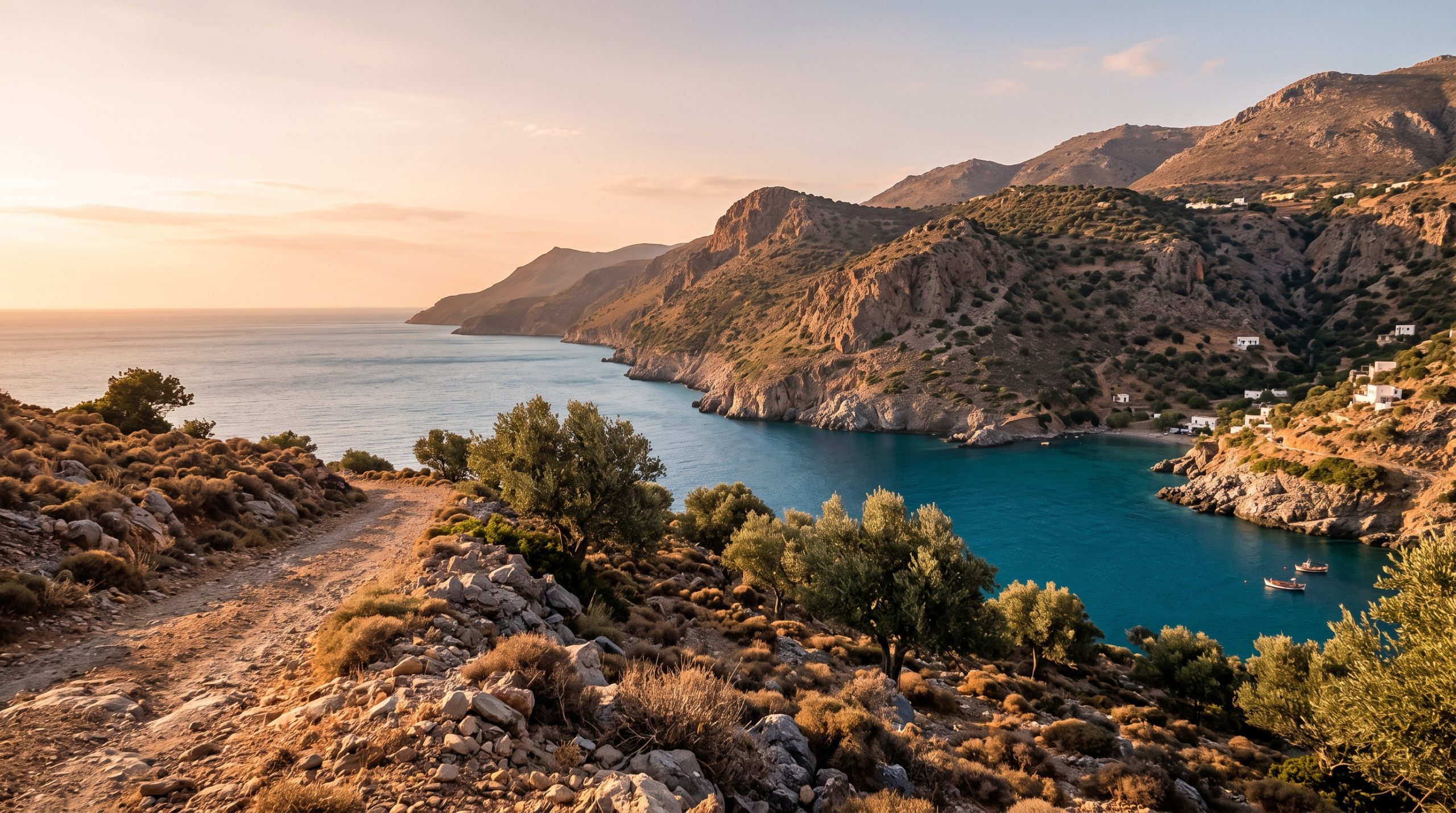
The dirt road to Balos leaves the tarmac at Kaliviani and runs roughly eight kilometers along the Gramvousa ridge before it ends at a cliff-top parking area. From there it is a rocky twenty to thirty minute walk down to the lagoon. The first day boat out of Kissamos crosses in about forty minutes. Which means that if you are standing on that sand at six in the morning you have the most photographed beach in Crete to yourselves, and if you arrive at eleven you are sharing it with several hundred people who all had the same good idea.
That gap is the whole job here. In mid-June the sun clears the horizon at Chania a little after 6:00am, with workable light from around 5:40. In July and August the meltemi, the north-northwesterly that defines a Cretan summer, usually gets going between ten and eleven in the morning and eases again after six in the evening. Both ends of the day are cool and nearly empty. The middle belongs to the heat and the coaches.
So we build Cretan days backwards from those two windows. There are eight of us, four working in stills and four in film, and every day we plan is designed by the same people who turn up to shoot it. No handover on the morning, no photographer and videographer meeting for the first time in a hotel car park at 4:45am with different ideas about where the light will be.
One team, three jobs, from Chania to Sfakia
We photograph, film and plan Cretan elopements as a single team. Coverage runs from one dedicated photographer or filmmaker for a full day, up to a multi-day project across several parts of the island. Location design, the timeline, permit research and our own travel are all part of it, not add-ons. Highlights reach you in five days.
The day runs on two clocks: the sun and the meltemi
Crete gives you an enormous amount of daylight in high summer and almost none of it is good. Mid-June sunset at Chania falls close to 8:40pm, and the sky stays workable until about 9:10. That is more than fourteen hours between sunrise and sunset, of which we will use maybe five. Here is how a June or July day usually falls when the west of the island is the plan.
- 4:45am. Leave Chania. The tarmac to Kaliviani takes a little over an hour, and we add thirty minutes for the dirt road because it is driven slowly and nobody enjoys being rushed on it.
- 5:40am. On the ridge for first light. Cold blue, no wind, the lagoon still gray.
- 6:10am. Sunrise, low and sideways along the peninsula. This is the hour the drone earns its place, when the air is still and the water reads clean turquoise from above.
- 6:30 to 8:30am. Down on the sand. Vows here if you want them at the empty end of the day, and this is when audio behaves.
- 9:30am. Back up the path, breakfast in Kissamos or Kaliviani, everyone out of the sun.
- 11:00am to 5:00pm. The wind is up, the sun is straight overhead, and we stop. Sleep, or swim somewhere with shade. Shooting through this block buys you nothing you would keep.
- 6:00pm. Back out, usually somewhere sheltered from the north, or into the shaded lanes of Chania old town where the Venetian stone throws warm light back at you.
- 7:30 to 9:00pm. The long run. Sunset near 8:40pm, then the quiet twenty minutes after it that most timelines waste by heading home too early.
Shift that day into late September and the arithmetic changes in your favor. Sunrise moves to just after 7:00am, sunset to about 7:30pm, and the wind is far less insistent. The whole shape fits inside hours a person can enjoy without being heroic about it.
The day-boat question, and the two hours that answer it
The single worry couples send us about Crete is that it will feel crowded. It is a fair worry and we are not going to pretend Balos and Elafonissi are quiet places in August. They are not. What they are is quiet at particular hours, and enormous distances apart from everything else on an island long enough that the west and the east are effectively different holidays.
Elafonissi sits 76 kilometers west of Chania, five kilometers south of the Chrysoskalitissa monastery, and it is a Natura 2000 protected area: designated parking only, and the sand, shells and plants stay where they are. Committing to it means roughly two hours of driving each way, so we either go at first light and are leaving as the buses arrive, or we do not go at all and take the day inland and upward instead. The Omalos plateau and the Xyloskalo trailhead above it, at 1,230 meters, are cool and largely empty at the hour the coast fills up. The south coast beyond Sfakia is a different island again. Choosing between those is planning work, and it is work we do before you have booked a single hotel.
| When | Chania sunrise and sunset | Wind and heat | What we usually plan |
|---|---|---|---|
| Late April to May | Around 6:20am and 8:20pm in mid-May | Green hills, mild, wind variable | High ground and gorges before the heat arrives |
| June | About 6:10am and 8:40pm | Hot, meltemi building through the month | Long dawn starts, hard midday stop |
| July and August | About 6:20am and 8:40pm in mid-July | Hottest, meltemi at its most reliable | Sheltered coves, early water, evening old town |
| September | Just after 7:00am and about 7:30pm mid-month | Warm sea, wind fading, fewer people | Our first suggestion for most couples |
| October | About 7:25am and 6:55pm in early October | Softer light, first weather fronts | Mountains, villages, dramatic skies |
Wind, water and the reason two cameras travel together
Here is what having both formats on the ground actually changes on this island, in ways that have nothing to do with owning more equipment.
Sound is the first one. A Cretan north-coast beach at eleven in the morning is a wind instrument, and vows read into that are vows nobody hears again. On the Expedition, where professional audio for vows is part of the coverage, the vow location gets chosen for what it sounds like as much as what it looks like: a cove with a headland to the north of it, a walled courtyard, a chapel doorway, or simply the first ninety minutes of the day before the meltemi wakes up. A photographer working alone has no reason to think about any of that. A team planning stills and film together has no choice but to.
Movement is the second. The footpath down to Balos is narrow and single-file in places. One person trying to shoot stills and film at once on that descent delivers half of each, and you can see it in the results. With a filmmaker holding a long, static wide from the ridge while the photographer walks two steps behind you, the same three minutes produce a frame of you as specks in a turquoise landscape and a film sequence with real scale in it. You can see how that pairing resolves on the island in our published galleries and films, where the photographs and the footage came out of the same morning rather than two people’s separate versions of it.
Aerials are the third. Drone footage is included wherever it is legal, safe and appropriate, and in Greece that means operating under EASA rules with registration through the Hellenic Civil Aviation Authority, plus a check of the local zone map for the exact spot. Protected ground such as Elafonissi carries its own conditions. We confirm what is permitted and in what window before we design any part of the film around aerials, which is also why the drone work usually lands in that still, early hour rather than into a Force 5 afternoon.
Continuity is the last and least obvious. A film shot across a fourteen-hour Cretan day has to look like one day, not like three different weather systems edited together. Building the timeline in one place, with both cameras in mind, is what makes the finished film feel like the morning you remember.
If any of that sounds like the day you want, tell us the window you are looking at and we will tell you honestly what that week of the year does on Crete. Check Your Date.
What travels with us across Crete
One price, one team, whatever the guest count. Guests change access, permits, transport and the timeline, but they do not change the fee.
- Destination and location design for Crete, chosen against your dates rather than off a list
- Full planning and a custom timeline built around real light and real driving times, including the dirt-road ones
- Permit research and logistics guidance
- Weather alternatives and backup planning, which on this island means a sheltered option held in reserve for every exposed one
- Drone footage where it is legal, safe and appropriate
- Professional audio for vows and meaningful moments on the Expedition, where conditions allow
- Team travel worldwide: flights, accommodation and ordinary travel for the assigned team, with no European or long-haul distinction
- Highlights delivered in five days, and the full gallery or film in three weeks
Because there are eight of us, there is always a second camera on the ground and a colleague in reserve. The shortest shape we offer is one full day, and that is deliberate here: a Cretan day that respects both ends of the light needs both ends of the day. Our current Crete availability runs across 2027–2029.
Where coverage starts, and the Cretan costs that are not ours
The Adventure covers one full day with one dedicated photographer or one dedicated filmmaker, from $4,900. The Expedition covers one full day with a dedicated photographer and filmmaker working together, from $7,900. The Odyssey runs from two to seven days across one or several destinations with photography and film throughout, quoted as a custom proposal. Full detail sits on the pricing page.
Our flights to Chania or Heraklion, our accommodation and our ground travel are inside that figure. Crete is not surcharged for distance and neither is anywhere else. What you pay locally, in euros, is the third-party layer:
- The municipal ceremony fee, set by each municipality and in some cases different for a weekday and a weekend slot
- Apostille certification and sworn Greek translation of your documents
- For US citizens, authentication of the affidavit of marriage at the Greek Ministry of Foreign Affairs, which requires a paravolo voucher currently priced at 30 euros
- Site entrance charges where they apply: Samaria National Park is currently 10 euros a head, and the Balos road has a small per-person entrance and a parking charge collected at the booth past Kaliviani
- Boat tickets, if you want them, such as the Kissamos crossing to Gramvousa and Balos, which operators price by season and usually land near 30 euros a head
- Accommodation, your celebrant, florals, hair and makeup, dinner
- Anything unusual on wheels or water: a private boat, a 4×4 charter, a mountain guide
How a Crete photo-and-film enquiry becomes a held date
- Send the inquiry form with your rough window and a sentence about how you want the day to feel.
- We reply within 24 hours with an initial brochure and our first read on your dates.
- You get a tailored proposal: coverage level, the shape of the day, the regions that fit that week of the year.
- Contract signed and a 30% retainer paid. The rest of the schedule is set out in the proposal.
- Planning begins in earnest. Locations, the hour-by-hour timeline, permit research, transport, the weather alternatives.
- We shoot, then your highlights arrive in five days and the full gallery or film in three weeks.
If you are earlier in the process than that, our guide to how eloping actually works covers the fundamentals before destination comes into it.
Early risers, uneven ground, and a plan that can move
Crete rewards a specific kind of morning person. The couples who get the most out of it are happy to be in the car at 4:45am, fine on a twenty-five minute rocky descent and the climb back up, and relaxed about the coastal hour being decided the evening before once we have looked at the wind.
If a 4:45am alarm is not your idea of a good start, say so in your first message. September and October hand you sunrise after 7:00am and sunset before 7:30pm, which puts the entire day inside civilized hours without giving up a single thing that matters. If uneven ground is the issue, there is a whole version of Crete on tarmac and flagstone: the old Venetian harbor at Chania, monastery courtyards, headlands you can park beside. And if what you actually want is emptiness above all, we will point you at the east of the island or the shoulder months rather than the famous two beaches in August. Our destination guides are a good place to compare Crete against the other islands before you commit. Tell us which of those sounds like you and we will shape the day accordingly.
Common questions
Can we legally marry in Crete as Americans, or is it easier to do the paperwork at home?
Both work. To marry in Crete, your documents need an Apostille and a translation into Greek by a Greek translator, and the marriage licence is issued by the relevant municipal department, generally within about a week of a complete application. US citizens using an affidavit of marriage also have it authenticated by the Greek Ministry of Foreign Affairs, with a 30 euro paravolo voucher. Plenty of couples handle the legal side at home instead and treat the Cretan ceremony as the real one. We research and guide either route; you pay the fees.
Who actually performs a civil ceremony in Chania?
In Chania the Deputy Mayor officiates, either in the room set aside for it at the Town Hall or at a location of your choosing once the municipality has issued the necessary permits. That second option is the one most couples want, and it is the one that needs the earliest planning, because the location has to be agreed before anything else in the day can be fixed around it.
Is Balos worth it if we only have one morning?
If you are willing to leave Chania at 4:45am, yes. Eight kilometers of unpaved road from Kaliviani, a twenty to thirty minute walk down, and you get the lagoon before the first boat from Kissamos lands. If the alarm is negotiable but the emptiness is not, we would rather take you to the south coast or up onto the plateaus and leave Balos for a second day.
Which month gives the best light and the fewest people?
September, then early October. Mid-September gives you sunrise just after 7:00am and sunset around 7:30pm, the sea is at its warmest, and the meltemi has mostly stopped rearranging the afternoons. October brings softer light and the first real skies of the year, which suits mountain and village days better than beaches.
Can you fly a drone at Balos or Elafonissi?
Aerials in Greece run under EASA rules with operator registration through the Hellenic Civil Aviation Authority, and protected ground such as the Natura 2000 area at Elafonissi carries extra conditions. We confirm the zone and the window for your specific spots during planning, then build the aerial part of the film around what is genuinely available rather than promising a shot we cannot fly.
What happens if the wind is up on the morning of our elopement?
We will already have a sheltered alternative held for every exposed location, usually within twenty to thirty minutes of it, and the north and south coasts of Crete rarely behave the same way on the same day. Morning and evening blocks can also swap. This is what the weather alternatives in your timeline are for, and the decision gets made the night before rather than on the beach.
Could we hike the Samaria Gorge as part of our elopement day?
Not as part of a ceremony day. The park opens for the season in May and runs daily from 6:00am, the trailhead at Xyloskalo sits at 1,230 meters, entrance is currently 10 euros a head, and the walk out to Agia Roumeli is a full day on its own. On a multi-day Odyssey it works beautifully as its own chapter, with the vows somewhere gentler.
How soon do we see anything, and how does it arrive?
Highlights land in five days, which is usually while you are still on the island or barely home. The full gallery or the finished film follows within three weeks. Nothing about that timeline changes with the destination.
The next message is the easy one
We keep every planning decision in writing, on your schedule and across whatever time difference sits between us. You send the form, we reply within 24 hours, and you read our brochure with coffee instead of holding a slot on a calendar. Nothing is committed until you sign something, and until then it is just two people telling us they are thinking about a rock ridge above a turquoise lagoon at ten to six in the morning.
Tell us your dates, your rough idea, and how early you are genuinely prepared to get up. We will tell you what Crete does that week and what we would build. Start Your Story.