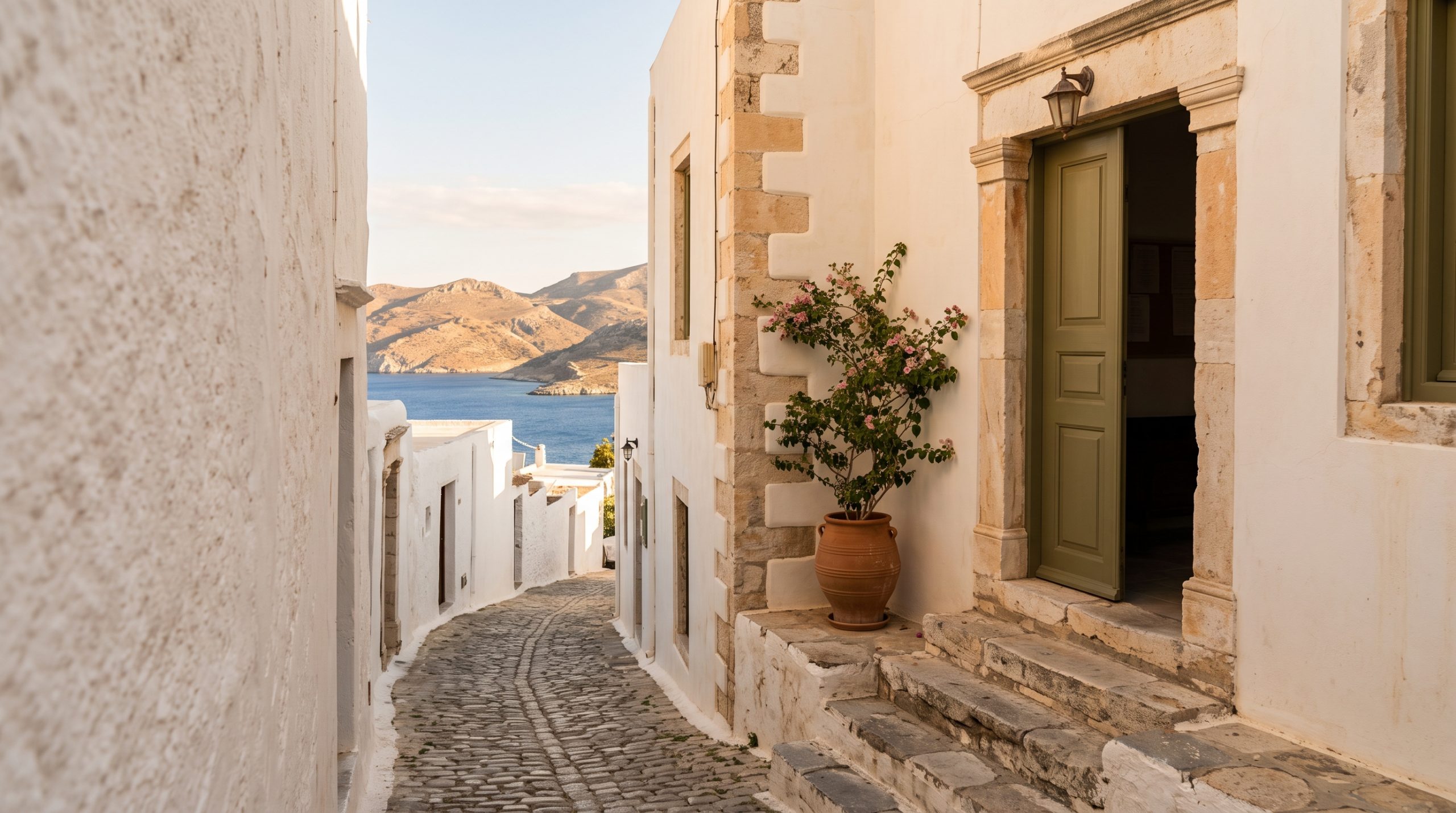
There is no single Cretan authority you apply to. Twenty-four municipalities cover the island, from Kissamos in the far west to Sitia in the east, and the one that governs your wedding is whichever one your ceremony location sits inside. The paperwork chain is national and identical everywhere. The desk you hand it to is local, and local is where the differences live.
Couples search for a Cretan wedding permit. No office issues a document with that name. What exists is the adeia gamou, the marriage license, plus the municipality’s agreement to perform the ceremony at a given place and hour. The license costs 18 euros in state fees and normally lands eight days after you apply. Everything upstream of it, the apostilles, the certified translations, the affidavit sworn in Athens, is what actually eats the calendar.
We plan elopements right across Crete, from the Venetian harbor at Chania to the empty switchbacks above the Libyan Sea, and we have built enough days around a town hall appointment to know exactly where the friction sits. Here is the chain in order, with the parts that catch people out named plainly.
What a Cretan town hall actually issues you
A Cretan municipality issues the marriage license, or adeia gamou, for a wedding inside its boundary. Each partner applies separately with an apostilled birth certificate, a sworn single status affidavit and certified Greek translations. The license carries an 18 euro state fee, is normally issued eight days after the application, and stays valid for six months anywhere in Greece.
Where the Cretan town-hall route takes extra patience
Marrying legally in Crete as two visiting Americans is entirely possible, and couples do it every season. It is not hard in the sense of being uncertain. It is fiddly in the sense of having four or five separate offices in it, each with its own hours, its own fee and its own idea of how your surname is spelled.
The single biggest planning fact is that the Affidavit of Marriage, the sworn statement that no impediment to your marriage exists, is a US Embassy service handled in Athens. The Embassy asks American citizens to plan on being in Athens for at least two days to complete the required paperwork, and the notarial appointment is booked online. Athens is not Crete. It is a flight or an overnight ferry from Chania, and it belongs in the itinerary from the start rather than being discovered halfway through it.
Add the eight day wait for the license, which Cretan municipalities count from the day your documents are submitted, and the full legal route asks for something like a week and a half inside Greece before anyone speaks a vow. Some couples love that. Ten days of driving mountain roads and eating in Vamos and Margarites before the ceremony is a genuinely good way to arrive at a wedding. Others have twelve days of leave and want all twelve on the south coast, and there is a cleaner shape for them further down this page.
We are photographers and filmmakers, so the legal decision is not ours to make. Confirm the final Crete requirements with the relevant official office before you rely on them.
The Cretan town-hall file from first document to application
Each of you assembles a full set. If both partners are foreign nationals, each submits their own documents separately, so nothing here is shared between you except the newspaper and the appointment.
- Passports. Carried to every office in this list, including the ceremony itself.
- A birth certificate each, apostilled. The long form copy from the state that issued it, carrying the apostille of that state’s competent authority. Documents issued federally are apostilled by the US Department of State.
- Evidence that any earlier marriage has formally ended. A final, irrevocable divorce decree, apostilled and officially translated. If neither of you has been married before, skip this one entirely.
- The Affidavit of Marriage, sworn in Athens. The Embassy form is printed on a single two sided page, completed in English and in Greek, and left unsigned until you are in front of the consular officer. The notarial fee is 50 dollars per person, so 100 dollars if you are both American. Bring your passport, your apostilled birth certificate and its translation to the appointment.
- Authentication of that affidavit by the Greek Ministry of Foreign Affairs. This runs on a 30 euro paravolo generated online and paid at any Greek bank. You then carry the receipt and the affidavit to the validation office at Akadimias 3 in Athens, which opens at 9am and closes at 1pm.
- Certified Greek translations. Official translations are produced by translators on the Ministry of Foreign Affairs Register of Certified Translators. A foreign public document has to carry its apostille before it is officially translated, which fixes the order of steps two and six for you.
- The newspaper announcement. A marriage announcement published in a local daily paper, one for each of you, with your names written phonetically in Greek characters. Heraklion’s own guidance for foreign applicants names Patris and Nea Kriti, and the newspaper issue containing the notice is handed in with the file. The notice predates the license application.
- The application at the town hall. Presented in person at the demarcheio of the municipality where the marriage will take place, with the 18 euro state fee.
- The license itself, eight days later. Once issued it runs for six months and is valid anywhere in Greece, which is why a license obtained in Chania does not evaporate if your plans shift east.
- The declaration afterwards. The marriage is declared at the lixiarcheio, the registrar’s office, within 40 days of the ceremony. That declaration produces the lixiarchiki praxi gamou, the marriage certificate, which is the document the rest of your life will ask to see.
Build the Cretan permit calendar from your ceremony date
Two clocks matter and they run at different speeds. The Greek side is short and rigid. The American side, apostilles and vital records, is slow and entirely within your control if you start early.
| Stage | The rule | What we build to |
|---|---|---|
| Birth certificates, divorce papers, apostilles | No published deadline, they simply have to exist before you apply | In hand three months out |
| Certified Greek translations | Apostille first, then a translator from the Ministry register | Ordered the week the apostilles arrive |
| Athens, affidavit and authentication | Appointment only, and allow two days in Athens | Appointment booked before you leave home |
| Newspaper announcement | Published before the license application goes in | Out a full week ahead |
| License application, in person | License issued eight days after submission | Filed at least two weeks before the date |
| The ceremony | License valid six months from issue | Hour agreed with the municipality and with the sun |
| Declaration at the lixiarcheio | Within 40 days of the ceremony | Done before you fly home |
One honest note on those eight days. Published guidance places the count in two slightly different spots. The national registry of administrative services describes the license as issued within a week of the application, while Cretan municipal guidance, Heraklion’s included, counts eight days from the day the documents are submitted. Work to eight days from submission and you are covered whichever way your office reads it.
The comfortable minimum is different from the legal one. Legally you could compress the Greek half into ten days on the ground. We hold dates on a longer runway than that, because the apostille from a county records office in the United States is the step nobody can hurry, and because the town hall’s own ceremony calendar is a separate question from the license.
The Greek alphabet, the paper newspaper, and other things that catch couples out
Your name goes into Greek characters. Heraklion’s guidance for foreign applicants states plainly that the names on the application and in the newspaper are written in Greek letters. Transliteration is phonetic and there is more than one defensible way to spell most American surnames in Greek. Agree one spelling at the very start, write it down, and hand the same one to the translator, the newspaper and the town hall. A mismatch between two documents is the most common reason a file goes back across the counter.
The newspaper is an actual newspaper. The requirement is not a receipt or a screenshot. The issue containing the published announcement is submitted with the file, which means someone buys copies on the morning it runs. Anyone helping you locally will know which Cretan dailies the office in question accepts.
The Athens offices close at lunchtime. The Ministry validation office at Akadimias 3 opens at 9am and closes at 1pm, and the paravolo has to be paid at a bank before you walk in. Two mornings in Athens covers it comfortably. One morning covers it only if nothing goes sideways.
- Ceremony days are a local decision. The license rules are national. Which days a municipality performs civil ceremonies, at what hour, and whether it will marry you somewhere other than the town hall are all decided by that municipality. Ask the exact office, not the internet.
- You have to be there. The application is presented in person, by the applicants, at the town hall where the marriage will take place.
- Two witnesses attend. They carry passports or Greek ID, and Embassy guidance notes that one of them acts as interpreter for the ceremony.
- Declare the marriage before you leave. The 40 day window is generous, but doing it from Ohio is far harder than doing it in the same week, three streets from where you married.
Fees and administrative timing in Crete are moving parts. The authority handling your file should be the final check on the current numbers.
The simpler Crete route: legal at home, vows above the Libyan Sea
A large share of the couples we work with in Crete sign the legal paperwork at a courthouse at home, usually with two people and no fuss, and then hold their real ceremony on the island. This is not a compromise version. It is the route that gives you the most control over the one thing that cannot be rescheduled, which is the light.
What changes: no eight day wait, no newspaper, no Greek transliteration of your names, no Athens leg, no 18 euro fee, no ceremony calendar to negotiate. You can stand on a ridge above Sfakia at 6am on a Tuesday because that is when the sun clears the mountains, rather than at 11am on the day the town hall has free. You can write vows that say what you mean instead of what a statute requires. Your officiant can be your brother.
What does not change: anything about the day itself. Permission still matters, because a protected coastline like Elafonissi and a private terrace above Loutro are two completely different conversations, and we research both the same way. The planning we do is identical. The film is identical.
If you already know which route you want, or if you genuinely cannot tell yet, that is the first thing to put in a message to us. We will tell you honestly which one fits the month, the region and the shape of day you are describing. Send Us a Message and we will come back with the specifics for your date.
What we coordinate with the Cretan town hall, and what stays in your name
We handle destination and location design, the planning, and a custom timeline built around light and real travel time on Cretan roads. Chania to Elafonissi is 75 kilometers of switchbacks and closer to two hours than to the number a distance chart suggests. We do the permit research and the logistics guidance, we hold weather alternatives, and we coordinate the ceremony hour against sunset, which moves nearly two hours between late June and early October.
What stays with you: the paperwork itself. We do not file applications, we do not translate documents, and we are not lawyers. What we do is build the day so the legal hour and the good light are not fighting each other, and so the drive between them is honest about the road.
Witnesses are the one place our shape of team matters here. On the Expedition a photographer and a filmmaker are both on the ground with you, which means two adults with passports are already standing there when a registrar asks who is signing. Tell us early if you are coming to Crete with no guests, and we will confirm with that specific municipality how it handles witnesses before the date is locked.
Photography, film and planning come from one team as a single service, and the coverage levels are set out on our pricing page. If you want to see how Cretan light behaves at the hours we are talking about, and what actually arrives afterwards, our published stories and films are the honest version. Highlights reach you in 5 days and the full gallery or film in 3 weeks, which for most couples means the pictures land before the tan does. For the wider planning questions that sit around the legal ones, our guide to how to elope covers the fundamentals, and the destination guides go region by region.
Common questions
How long do we need to be in Greece before the wedding?
Count eight days in Crete from the day you submit your documents in person, plus the two days the US Embassy asks American citizens to allow in Athens for the affidavit. That is roughly a week and a half inside the country before the ceremony. Couples who marry legally at home before traveling have no minimum stay at all.
Can our planner submit the marriage license application for us?
The application is submitted by the applicants themselves, in person, at the town hall of the municipality where the marriage will take place. Plenty of the surrounding work can be done locally on your behalf, including placing the newspaper announcement, ordering certified translations and confirming the ceremony slot with the municipality.
How much does the marriage license cost in Crete?
The license itself carries an 18 euro state fee. Around it sit the Embassy notarial fee of 50 dollars per person for the affidavit, a 30 euro paravolo for the Ministry of Foreign Affairs authentication, apostille fees charged by your own state, and certified translation at market rates. Any ceremony fee is set by the individual municipality.
Is a beach ceremony in Crete legally binding?
The civil marriage is performed by the mayor or an authorized municipal official, and whether that official will conduct it somewhere other than the town hall is a decision for that municipality rather than a national rule. Ask the office that governs the exact spot. Many couples avoid the question by marrying at home and holding the ceremony wherever they actually want to stand.
Can same-sex couples marry in Crete?
Yes. Greece legalized same-sex civil marriage on 15 February 2024 under Law 5089/2024, becoming the first Orthodox majority country to do so. The document chain and the eight day license wait are exactly the same, and the municipality process is the same one described above.
Who signs as our witnesses if we are eloping with nobody else there?
Two witnesses attend the civil ceremony carrying passports or Greek ID, and Embassy guidance notes that one of them acts as interpreter. If you are traveling without guests, raise it at the planning stage so we can check with that municipality how it prefers to handle it well before your date.
Will our Greek marriage certificate work back home?
The document that carries the marriage is the lixiarchiki praxi gamou, issued once the marriage is declared at the lixiarcheio within 40 days of the ceremony. Order several copies while you are still on the island, and ask your own state authority and your consulate what they want to see alongside it.
What happens if our names are spelled differently on two documents?
Names go into Greek characters phonetically, and Heraklion’s guidance asks for Greek letters on both the application and the newspaper notice. Fix one spelling of each name at the beginning and use it identically on the translation, the announcement and the application. It is the cheapest problem on this page to avoid and the most annoying one to fix.
Start with the date, then the town hall
The order that works is simple. Pick the month for the light and the temperature you want, pick the corner of the island, then find out what that specific municipality does about ceremonies before you commit to anything. Everything else on this page bends around those three decisions.
Everything on our side happens in writing, in your own time and across whatever zone you are reading this in. Send us your date and the part of Crete you have in mind, and a reply with our brochure comes back within 24 hours. Dates are currently open across 2027, 2028 and 2029, and the earlier a Cretan date is on our calendar, the more room there is to shape it around the sun rather than around an office. Start Your Story.