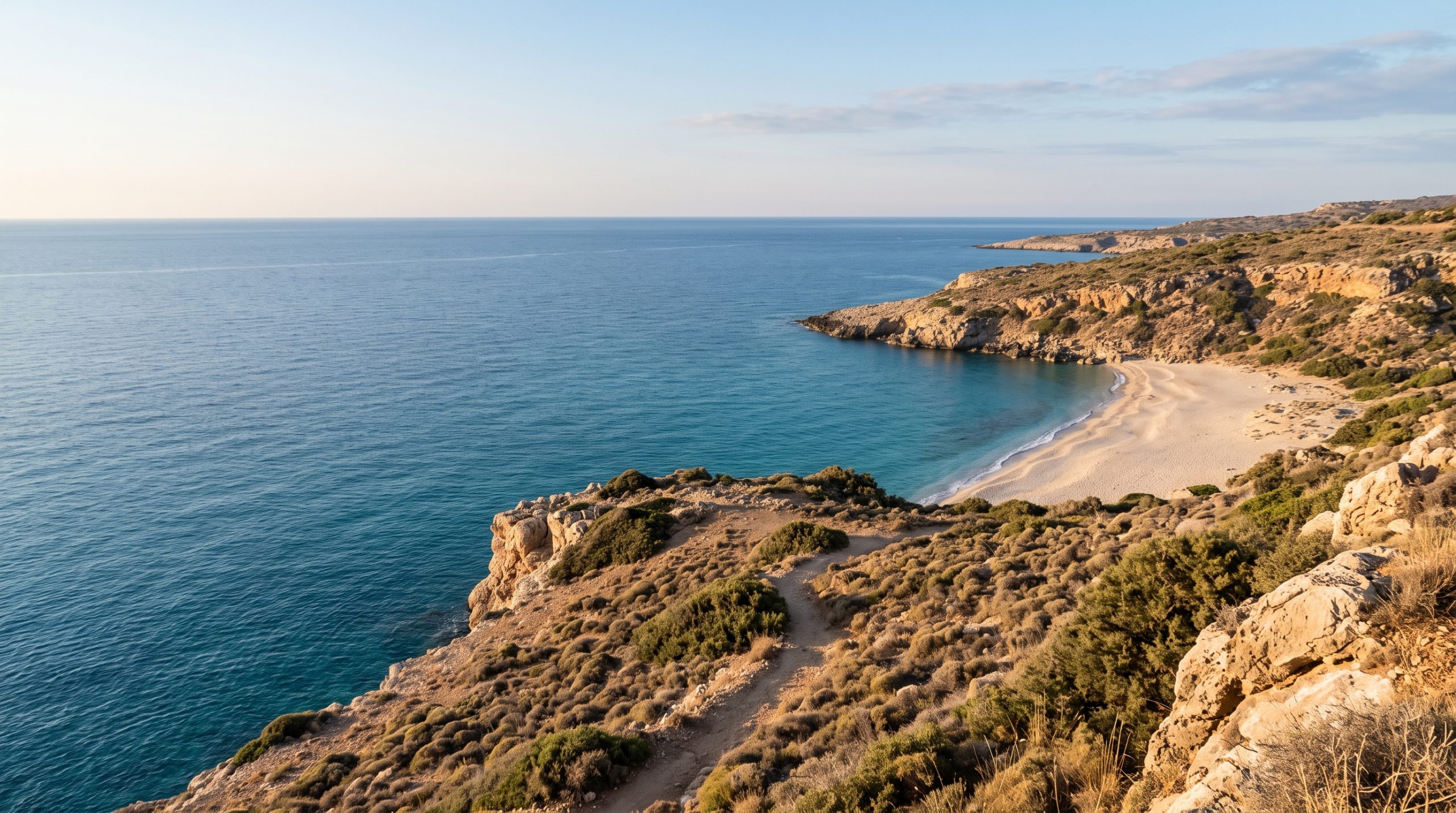
Come over the rise above Balos at seven in the morning, before the first boat has left Kissamos, and the lagoon is the emptiest bright thing in Crete. Then look at the paperwork sitting underneath it. Since 2024 that sand has carried a legal designation, and the designation is the reason our answer about Balos reads differently from our answer about a beach twenty minutes east of it.
Greece created a category called untrodden beaches, apatites paralies, in Law 5092/2024. On a beach that carries the label, the state will not grant anyone the right to use the shore, and the decision goes further and names what else is out: motor vehicles, amplified sound, tables and chairs and umbrellas, and the organising of any event with more than ten people taking part. That last clause is the one that decides whether a wedding ceremony can happen there. It was not written about couples. It was written about events.
Below is the list as it applies in Chania, where most of the beaches couples ask us about sit, the document chain for a civil marriage in Crete, and the shape of a morning on protected sand that stays inside the rules without feeling like a consolation prize.
The untrodden list, in one paragraph
No Cretan beach bans a marriage outright. What the state bans on the beaches it lists as untrodden is the event. On Balos, Elafonisi, Falasarna, Gramvousa and Gavdos there is no concession, no furniture, no amplified sound and no gathering of more than ten people. Small and quiet stays legal.
What the decision actually names in Chania
The joint ministerial decision does not use the names couples use. It lists areas, in Greek, by the boundaries an ecologist would draw. In the Chania regional unit the entries include the beach running from the Chrysoskalitissa monastery down to Cape Krios; Imeri and Agria Gramvousa, Tigani and Falasarna, Pontikonisi, Livadi Bay and Vigla; Elafonisi together with its coastal marine zone; the islands of Gavdos and Gavdopoula; and, in the Municipality of Sfakia, the White Mountains and their coastal zone.
Tigani is the sandbar everyone means when they say Balos. Once you match the official wording to the place, the picture gets clearer, and a little wider than most couples expect.
| As written in the decision | What couples call it | What that rules out |
|---|---|---|
| Imeri and Agria Gramvousa, Tigani, Falasarna | Balos lagoon, Gramvousa island, the Falasarna reef | Any concession of the shore, furniture, vehicles, amplified sound, events over ten people |
| Elafonisi and its coastal marine zone | The pink sand at the southwest tip | The same restrictions, reaching into the water rather than stopping at the tideline |
| Beach from Chrysoskalitissa to Cape Krios | The coast below the monastery, south of Elafonisi | The same restrictions across a whole stretch of coast, not one named cove |
| Gavdos and Gavdopoula | Gavdos, the southernmost point in Europe | The same restrictions island-wide, on top of a ferry timetable |
| Municipality of Sfakia: White Mountains and coastal zone | The south coast around Sfakia and Loutro | An area rather than a beach, so the question becomes which stretch of shore you are standing on |
The list is signed jointly by the environment and the finance ministries, on the recommendation of the state body for the natural environment and climate change, using criteria that include protected habitats and rare endemic plants and animals. It has only grown: 198 beaches when the idea launched in 2024, then 238, then past 250 in the spring of 2028. A public reporting app called MyCoast runs alongside it, which tells you how seriously the designation is meant.
Proximity to a famous protected area is not the test either. Preveli, on the south coast of Rethymno, sits inside a Natura 2000 area and does not appear on the untrodden list, a gap local reporting in Crete has queried. The entry in the current decision is the only thing that governs, which is why we read it against a shortlist rather than assuming. If you are still choosing between coasts, our destination guides are the better starting point for that part.
Ten people, no speakers, no chairs
The decision spells out what may not happen on an untrodden beach, and the list is short enough to hold in your head:
- The presence of motor vehicles
- The organising of events with more than ten people taking part
- Music or other sound produced through electrical playback or amplification
- Movable items: tables and chairs, umbrellas, sunbeds and the rest
- Services for bathers, watersports rental, and mobile canteens
Read that as a wedding planner would and the shape of the day writes itself. No arch, because that is a movable item. No speaker for a first dance, because amplification is named. No car to the sand. And a total of ten people taking part, which includes the two of you, whoever reads your vows, any parent who has flown out, and us.
None of this is unique to the protected beaches, either. Under Greek coastal law there are no private beaches anywhere in the country, at least half of any beach has to stay free and open, and the state only ever grants a temporary right of use with strict limits attached. Crete has no venue that can sell you exclusive sand. What changes on an untrodden beach is that the temporary right cannot be granted at all.
So there are two questions with two different levels of difficulty. The paperwork for a civil marriage in Crete is fiddly rather than hard: a fixed document list, a week for the licence, offices that process foreign couples all summer. A full wedding on Balos or Elafonisi, with seating and sound and thirty guests, is not fiddly. It is simply not available, and no amount of planning changes that. Keeping those two problems apart is most of the work.
Treat this as a planning map for the Cretan coast, not a legal opinion. The office issuing the documents or permission remains the source of truth for your case.
The legal file behind a ceremony on protected Cretan ground
Greece issues a marriage licence through a municipality, never through a beach. The office that issues yours sets the document list, and municipal lists in Crete are close cousins of each other rather than identical twins. Heraklion publishes the clearest one for foreign nationals who are not permanently resident in Greece, and it is the list most visiting couples end up working from.
The documents, in the order you need them
- Birth certificate. Ordered from the office that holds the record, then apostilled. In the United States that stamp comes from the Secretary of State of the state that issued the certificate, not from Washington. Translation into Greek comes after the apostille, so the translated bundle covers the apostille page too. The national registry of public services is specific that documents from Hague Convention countries are accepted with an apostille and translated into Greek by a Greek translator.
- Proof that you are free to marry. Heraklion asks non-resident foreign nationals for a marriage licence from their own country, apostilled and translated into Greek. The United States does not issue such a thing. What stands in its place is an affidavit sworn in front of a consular officer at the US Embassy in Athens or the Consulate in Thessaloniki, in English and Greek, printed on one page, both sides. Notarisation is fifty dollars a person, one hundred for two, by online appointment only, and you sign it there rather than at home.
- Passports. Copies for the file, originals in your hand.
- The newspaper announcement. Published for one day in a daily local paper. Heraklion names Patris and Nea Kriti. Your names must appear in Greek characters, in the announcement and on the application form.
- The licence fee. €18 a person. Heraklion’s own page still describes it as a green fee stamp bought at the tax office.
- The application. Filed with the municipality’s civil marriage department. The national registry of public services puts the licence in your hands within a week of a complete submission.
- The declaration afterwards. Every marriage in Greece, civil or religious, is declared to the Lixiarcheio of the municipality where it happened, within forty days. Chania publishes a €30 fee after forty days and €60 after ninety.
Counting backwards from the ceremony hour
Two of those steps have a published clock on them: a week for the licence once the file is complete, forty days for the declaration afterwards. Everything else is a queue in another country. The tight version is legal and people do it. The comfortable version is what we build a timeline around, because a translation that arrives late does not just move paperwork, it moves the hour you stand on the sand.
| Stage | The tight version | The version we plan to |
|---|---|---|
| Apostilles on certificates | Ordered once flights are booked | Ordered before we lock the ceremony hour, months ahead of the date |
| Greek translations | Arranged after you land | Done at home, so the file arrives complete |
| Embassy affidavit, US citizens | One Athens appointment, both signatures the same morning | The same appointment, with a spare day in Athens either side of it |
| Newspaper announcement | Placed on your first working day on the island | Placed with room to spare before the application goes in |
| Marriage licence | Issued in the week of the ceremony | Issued before that week starts |
| Declaration at the Lixiarcheio | Inside forty days, from home if you must | Done before you fly out |
Greek letters, green stamps and a page printed both sides
Almost nothing goes wrong at the ceremony. It goes wrong four steps back, in a detail that reads like a formality until it isn’t. These are the ones worth getting right first time.
Your name in Greek. Heraklion requires the names on the application and in the newspaper announcement to be written in Greek characters. Transliteration is not a science, and a name can be spelled two defensible ways. Pick one Greek spelling early, write it down, and use exactly that on every document, so the announcement and the application and the licence agree with each other.
The €18 that looks like €15. The national registry of public services lists the licence fee as €18. Heraklion’s page describes a green fee stamp bought from the tax office at €15 with a real value of €18. Published guidance genuinely varies in its wording here, and the office issuing your licence is the one whose version counts.
The affidavit’s format. The US Embassy is precise about it: English and Greek, one single page printed on both sides, and not signed before you arrive. You sign in front of the consular officer. The appointment is online only, and it happens in Athens or Thessaloniki, not in Crete, so it belongs in your travel plan rather than your wedding week.
Whether you need the affidavit at all. The Embassy words it as being required if the town hall performing your marriage asks for it. Municipalities differ. The one marrying you settles the question, and it is worth settling it before the translator starts work.
Which newspaper. Heraklion names two dailies by name. Another municipality will accept another paper. This is a five minute job that becomes a two day job if it is placed in the wrong title.
Where the request has to be handed in. Chania takes requests in person, at the central protocol desk on Kydonias 29 or at the protocol desks in the outlying municipal units, the old town halls of the villages. Distances in Chania are deceptive. A twenty kilometre errand on the Akrotiri road is an hour of a morning you had planned to spend somewhere else.
The hour, and who has to be free for it. A civil marriage is performed by the mayor or by someone the mayor has designated for the job. The tariff Chania’s council last published puts a weekday slot in the town hall or its courtyard at no charge, a Saturday midday or Sunday evening slot in the November to May window at €150, and a ceremony held away from the town hall at €400. The council votes those figures, so they move. What does not move is the sequence: the officer’s diary first, then the light.
The charges and deadlines quoted for the Cretan coast are not permanent tariffs. Re-check them with the issuing office before flights or accommodation depend on them.
Vows on protected sand, and the route that gets you there
The version of the day we plan most often on the west coast would still be our first suggestion even if the untrodden list did not exist.
You marry at home, in a county office, with as little ceremony as you like. Then you fly out, and the ceremony that matters happens where you want it to happen. No Cretan daily paper prints your names. No apostille. No municipal officer’s diary deciding when you are allowed to be at the water. The hour becomes yours, which on that coast is the whole point, because the light that makes Falasarna worth the drive arrives late in the evening and no town hall works then.
What does not change: the untrodden rules still apply. Ten people at most, taking part, counting us. Nothing placed on the sand. No amplification, which means your reader projects and the sea is louder than they are, and that is a better recording than a speaker anyway. The shape is the two of you, someone to read, and a photographer and a filmmaker who stay out of each other’s frames.
What also does not change is the film and the photographs. That morning is identical whichever route you took to it. If you want the paperwork version instead, the fundamentals are laid out in our guide to how to plan an elopement, and the honest recommendation depends less on principle than on which coast and which month you have your heart set on.
Tell us the beach you have been looking at and the week you can travel, and we will tell you which of these two routes fits it. Send Us a Message and we will come back with the version that works.
What we coordinate on the coast, and what only you can sign
We design the destination and the locations, build a timeline around the light and real travel time, research the permits that apply to your specific spot, give you the logistics guidance that goes with it, and hold weather alternatives for the hours that need them. Team travel is inside the price, worldwide, so flights and accommodation for the assigned team are not a line you get billed for later. Aerials run where they are legal, safe and appropriate, and we confirm that before we plan a sequence around them.
On a beach where the entire gathering has to stay at ten, the size of your creative team stops being an abstract question. A photographer and a filmmaker from the same eight person team is two people in that count, working from one plan, rather than two suppliers who met that morning and each brought help. It also means the ceremony hour gets set once, with both cameras, the officer’s availability and the direction of the sun weighed together. Highlights reach you in five days and the full gallery or film in three weeks, and you can see how Cretan light lands in finished work in our stories and films. Coverage across Crete, from a single day to a multi day route, is set out on our pricing page.
What stays with you is the paperwork itself. We are not a law firm and we do not file documents on your behalf: ordering certificates, apostilles, the certified Greek translations, the Embassy appointment and every signature are yours. We plan around them, hold your date against what the municipality can offer, and make sure the two halves of the day meet.
Common questions
Can we get married on Balos or Elafonisi?
Not as a wedding with guests, chairs and sound. Both are on Greece’s untrodden list, where no use of the shore is granted and events with more than ten people taking part are prohibited. A very small vow exchange with nothing set up on the sand is a different proposition, and the legal marriage happens with a municipality rather than on the beach.
How many people can be on an untrodden beach for a ceremony?
The decision draws the line at ten taking part, and everyone counts: the two of you, whoever reads, a parent who has flown out, and your photographer and filmmaker. It is one of the reasons we plan those mornings with a two person team rather than a crew.
How long do we need to be in Crete before a civil ceremony?
The licence is issued within a week of a complete application, and the newspaper announcement is published before that. Arrive with apostilles and translations already done and a week on the island is realistic. We build in more than that, because a queue in another country is the part nobody controls.
Do Americans need a certificate of no impediment for Greece?
The United States does not issue one. The US Embassy affidavit does the same job, sworn in Athens or Thessaloniki, in English and Greek on a single page printed both sides, at fifty dollars a signature. Whether your town hall asks for it varies by municipality, and the office marrying you settles that.
Can a civil ceremony in Crete happen outside the town hall?
Yes, where the municipality allows it and you pay the fee its council has set for the year. Chania publishes a tariff with free weekday slots inside the town hall and a charge for ceremonies held elsewhere. The mayor or a designated deputy performs it, so the hour has to suit them as well as the sun.
Can same-sex couples marry in Crete?
Yes. Law 5089/2024 opened civil marriage to same-sex couples in February 2024, making Greece the first Orthodox majority country to do so, and the Council of State has since upheld it as constitutional. The document chain is the same one.
How do we get the marriage certificate after the ceremony?
Declare the marriage at the Lixiarcheio of the municipality where it took place, within forty days, and the certificate comes from that office. The US Embassy does not register marriages of American citizens in Greece, so this step belongs to you, and it is easier done before you fly home than after.
Picking the week, then picking the hour
Send us the beach and the range of dates you can travel. We will tell you whether the sand you have in mind is on the current list, what that changes about the shape of the morning, and which route to the legal side of it fits your calendar. Everything happens in writing, at whatever hour suits you: an inquiry gets a reply and an initial brochure inside 24 hours, then a tailored proposal, and planning starts once the contract is signed and the 30% retainer is paid. Our current booking window runs through 2027, 2028 and 2029.
Check Your Date and tell us which coast you have been looking at.