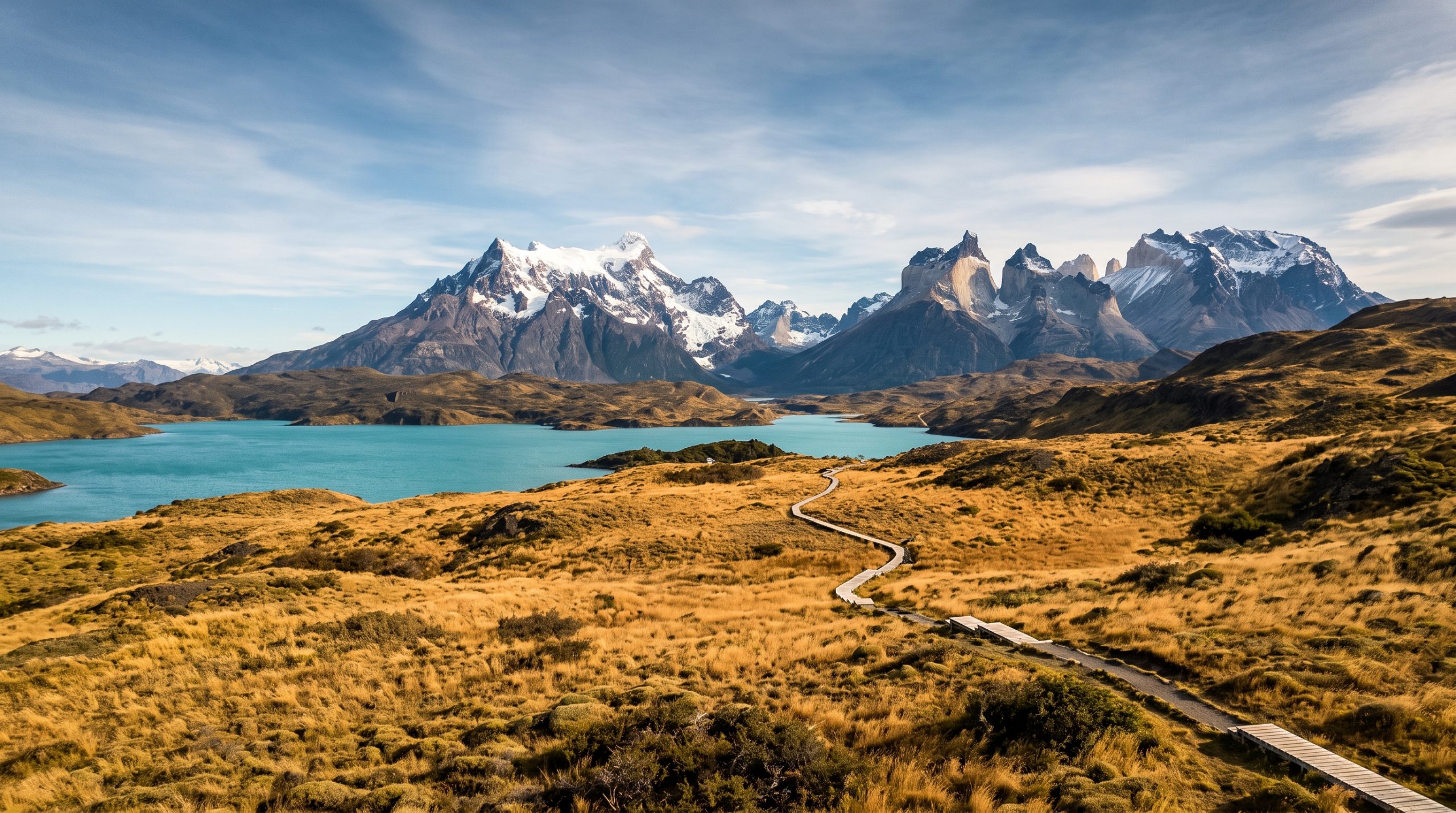
Around the December solstice, the last good light on the Cuernos del Paine holds until close to ten at night. Registro Civil offices keep office hours. That gap, not any form or fee, is what actually shapes a legal elopement in Torres del Paine, and it is the first thing we work out with a couple who wants the paperwork and the light on the same trip.
Two authorities are involved and they have nothing to do with one another. CONAF, the Corporación Nacional Forestal, runs the park: your entry, your route, and the permit that covers professional cameras. The Servicio de Registro Civil e Identificación runs marriage in Chile, through a sequence of steps set out in the country’s civil marriage law. Neither office issues anything called a wedding permit.
So the title has a two-part answer, and the useful version of it is procedural. What follows is the chain in the order you need it, the ninety-day clock that governs the legal side, what each office charges, and the shape most couples travelling from the US settle on once they can see the whole picture.
The park permits the cameras, not the vows
A ceremony here is allowed. CONAF regulates your cameras and your entry, not your vows: professional filming and image capture runs on a permit requested through CONAF Magallanes around two months ahead, alongside a route ticket. Legal marriage is separate, handled by the Registro Civil, and it needs an in-person manifestación and two witnesses holding Chilean ID.
Where couples usually spend the extra time
The park side is administrative and predictable. A letter, a form, a ticket, a lead time. The legal side is fiddly, and the difficulty concentrates in two places: the manifestación, the formal notice of intention to marry, has to be made in person before the civil officer who will later conduct the marriage, and the Registro Civil’s published guidance asks for two witnesses who hold a valid Chilean identity card.
Those two conditions are why the shape we plan most often in this part of Patagonia is the legal marriage completed at home and the ceremony held in the park. That is not a lesser version of the day. It removes an appointment and a clock from your trip and hands the ceremony hour back to the light, which in Torres del Paine is the variable worth protecting. Couples who want the Chilean civil marriage itself can absolutely have it, and the section below sets out exactly what it takes.
We are photographers and filmmakers, not lawyers. Rules change and circumstances differ, so confirm the detail with the relevant registry office or your own consulate before you book flights.
The CONAF chain: a letter to Magallanes, a form, a route
Professional filming and image capture inside any unit of Chile’s protected areas system, SNASPE, runs on a permit. Torres del Paine publishes the procedure on its own special permits page, and republishes it for each season, so the version to work from is the current one rather than a copy saved last year.
The procedure is specific. You send a letter to the Dirección Regional de CONAF Magallanes requesting the filming and image capture permit, with the official form attached as a colour PDF, by email to oficina.partes.magallanes@conaf.cl. The government’s own service description adds the deadline and the language: the written request goes in at least two months before the date, in Spanish, and the applicant has to know the filming and image capture regulation and commit to it. Where a foreign crew works in a border zone, a Dirección de Fronteras y Límites authorisation comes into it as well, which is why we name the sectors precisely in the request rather than writing “Torres del Paine” and hoping.
Fees under that regulation are set in Chilean pesos and quoted without IVA. Projects that need equipment on the ground for a prolonged, active period, or large-scale commercial promotion, can be assessed on a special tariff, and any supervision cost CONAF has to carry is charged to the applicant and agreed with the park administration or the regional protected areas department. The category your day falls into is the regional office’s call, which is another reason the request describes the crew, the gear and the sectors in plain detail.
Entry is the other half. Tickets are bought ahead through CONAF’s park pass platform at pasesparques.cl, and the park has moved to selling entry by route rather than by number of days, split into a full day, Base Torres, the W and the Paine Massif circuit. Tariffs are adjusted annually for inflation, so check the current figure for your route when you buy. The practical consequence is that your ticket now defines the ground you can legitimately stand on, which means the ceremony point and the ticket have to be chosen together, not in that order.
Volume is the last thing to plan around. CONAF counted 367,426 visitors in the park in 2024, and 201,731 of them were foreign. That is why we put a ceremony either in the first hour after the porterías open or in the last two hours of light, and why the drive from Puerto Natales, roughly two hours to the park entrances, gets built into the timeline as a real number rather than an estimate. You can see how that light behaves on the ground, and what a finished delivery looks like, in our published stories and films. Aerials sit on their own authorisation and their own window, so we confirm what is permitted for the exact sector before any part of the film is planned around them.
The Registro Civil chain, and the ninety-day clock
For two foreign nationals with no previous marriage, the document list is shorter than most couples expect. The complexity is in the sequence, not the paperwork.
- Passports. Foreign parties identify themselves with their home country identity document or passport, plus the tourist visa where one applies. There is no Chilean identity card requirement for the two of you.
- Any foreign document the office asks for, apostilled and translated. Chile is an apostille country, so a document issued abroad carries an apostille from the country that issued it, or consular legalisation if that country is outside the convention. Translations into Spanish run through Chile’s Ministry of Foreign Affairs, or through the relevant consulate in Chile if the Ministry has no translator for your language.
- Two witnesses. Over 18, holding a valid Chilean identity card, present at the información beforehand and again on the day, declaring that neither of you has any impediment to marrying.
- The Family Court step, if it applies to you. Where either of you has a child under 18 from a previous relationship in your care, the published guidance adds the appointment of a curador through the Family Court, on a form the civil officer signs, before the marriage goes ahead. This is the one item to start first, because it involves a court rather than a counter.
- The manifestación and the información. Made in person before a civil officer: your details, your intention to marry, and the fixing of the date and hour of the ceremony. The witnesses give their información at the same appointment.
- The celebration. Before that same officer, before the same two witnesses, within ninety days of the información. On the day the officer reads the información aloud in front of you and the witnesses. Let that time limit lapse and the manifestación and información have to be done again from the start.
- Registration. The Registro Civil registers the marriage itself. The certificate it issues carries both names, the identity numbers, the place and the date, under the signature and seal of the service.
One clause decides whether a ceremony can happen where you want it. Chilean law lets the celebration take place either in the officer’s office or at a place the couple names, provided that place sits inside that officer’s territorial jurisdiction. Location is therefore a jurisdiction question rather than a taste question, and the way to settle it is to name your exact point, by sector and by landmark, at the manifestación, and let the office confirm it.
The fees are modest and published.
| Where and when the ceremony happens | What the Registro Civil charges |
|---|---|
| In the office, within working hours | No charge, plus 1,830 pesos for the marriage booklet |
| Outside the office, within working hours | 21,680 pesos |
| Outside the office, outside working hours | 32,520 pesos |
Chilean pesos run at close to a thousand to the US dollar, which puts the out-of-office ceremony in the region of twenty dollars. Fees and deadlines quoted here were correct at the time of writing and are worth re-checking with the office that issues them.
Six places couples get caught here
None of these are hard to solve. They are simply the items that do not appear in the order a couple naturally thinks about them.
- The witnesses. The Registro Civil’s own guidance asks for a valid Chilean identity card, and the law separately excludes anyone who cannot understand Spanish from acting as a witness. Both point the same way: your witnesses come from Chile, not from your flight. Tell us early and the hour gets built around their availability.
- The officer is not interchangeable. The marriage is celebrated before the same officer who took your manifestación and información. Choosing the office is therefore choosing the jurisdiction your ceremony point has to fall inside.
- The ninety days run from the información, not from your first email. An early enquiry costs you nothing. An early manifestación can expire before a ceremony date at the far end of a long planning run.
- Working hours and Patagonian light are not the same hours. The fee tiers exist precisely because ceremonies happen outside both the office and its hours, and in high summer here the best light lands hours after any counter has closed. We treat the legal hour and the light hour as two separate slots on the timeline and stop trying to force them together.
- The CONAF request has a form, a language and a colour. Two months minimum, in Spanish, to the Magallanes regional office, with the form attached as a colour PDF. It is a small detail that quietly resets a lead time when it is missed.
- Your ticket follows your route. With entry sold by route, a ceremony point in one sector and a ticket for another is an avoidable problem, and any supervision CONAF has to provide sits on the applicant’s side of the ledger.
The legal hour happens once. Nobody re-runs the moment an officer reads the información back to you, and in a place where the wind decides how a veil and a jacket behave, a single angle on that hour is a thin record of it. On the Expedition a dedicated photographer and a dedicated filmmaker work that hour together from two positions, with professional audio on the vows where conditions allow, so nothing has to be repeated afterwards for the benefit of a second camera.
The simpler route: sign at home, hold the ceremony here
This is the route we plan most often in Chilean Patagonia, and it deserves describing properly rather than as a fallback. You complete the legal marriage in your own county or state, on a Tuesday morning, with whoever you like standing there. Then you fly south and hold the ceremony that matters to you in the park, with a celebrant, in the hour the light is doing something.
What changes: no manifestación appointment, no ninety-day clock, no search for two Chilean witnesses, no Registro Civil jurisdiction map deciding where you can stand, and nothing to register in Chile afterwards.
What does not change: the CONAF filming permit and its lead time, the route ticket, the drive, the timeline built around light and real travel time, the vows you write, the film, and the delivery. Highlights reach you in 5 days and the full gallery or film in 3 weeks either way. The ceremony reads the same on screen, because what makes it read is the two of you and the weather, not which office holds the record.
Couples who are earlier in the process than permits usually find it easier to work outwards from the shape of the day. Our guide to planning an elopement covers that order, and our destination guides cover the places we work in and the seasons that suit them.
Where our planning stops and the legal office takes over
Ours: destination and location design, the planning itself, a custom timeline built around light and real travel time, permit research and logistics guidance, and weather alternatives with a backup for every fixed point. We hold the ceremony hour against office availability and against the light, we coordinate with your celebrant and your accommodation so the drive times work, and we carry the CONAF request through its own lead time. There are eight of us, photographers and filmmakers in one team, so there is always a second camera on the ground and a colleague in reserve. Team travel to Chile is included: flights, accommodation and ordinary travel for the assigned team, in every destination we work in. What each experience covers, and where each one starts, is set out on the pricing page.
Yours: the permit fees themselves, government, venue or landowner, since the research and the guidance are ours but the payments are yours. Your celebrant, accommodation, vendors and activities. Any unusual transport, such as a private boat, a 4×4 charter or a mountain guide. And the legal filings, because we are not lawyers and we do not lodge paperwork on your behalf.
Booking runs in one direction and takes very little of your time. You send the inquiry form, we reply with an initial brochure within 24 hours, we build a tailored proposal around the date and the route, and planning starts when the contract is signed and the 30% retainer is paid. Our planning calendar is open for 2027–2029. If you already have a week in mind, Send Us a Message with the dates and the sector you are drawn to, and we will tell you what the permit calendar allows.
Common questions
Can we legally get married inside Torres del Paine National Park?
Chilean law allows the celebration to happen at a place the couple names, as long as that place falls inside the territorial jurisdiction of the civil officer who took your manifestación. So the answer depends on your exact point and on that office’s availability, which is why you name the sector and the landmark at the manifestación and let the office confirm before flights are booked.
Do we need a permit for our photographer and filmmaker in Torres del Paine?
Yes. Professional filming and image capture in the park runs on a CONAF permit. The request goes as a letter to the Dirección Regional de CONAF Magallanes with the official form attached as a colour PDF, emailed to oficina.partes.magallanes@conaf.cl, in Spanish, at least two months before the date.
Who can be our witnesses if we do not know anyone in Chile?
The Registro Civil asks for two witnesses over 18 holding a valid Chilean identity card, and the law excludes anyone who cannot understand Spanish. In practice that means local witnesses rather than travelling friends. Tell us at the planning stage and we build the ceremony hour around when they can be there.
How far in advance do we have to do the manifestación?
The marriage has to be celebrated within ninety days of the información given at that appointment. Miss that window and both the manifestación and the información have to be repeated, so the appointment is booked well ahead but the visit itself sits inside the ninety days before your date.
Can same-sex couples marry in Chile?
Yes. Chilean law regulates marriage between people of the same sex on equal terms, and the process is the same one: manifestación, información from two witnesses, then the celebration within ninety days.
How much does the Registro Civil charge to marry us outside its office?
21,680 Chilean pesos within working hours and 32,520 pesos outside them. In the office during working hours there is no charge beyond 1,830 pesos for the marriage booklet. These are adjusted from time to time, so confirm the current figure when you book the appointment.
Do we have to live in Chile or arrive a certain number of days early?
The requirements the Registro Civil publishes do not include residency or a minimum stay. They cover age, legal capacity, not being currently married, free consent and eligible witnesses. What does dictate your arrival is the manifestación, since it happens in person and has to precede the ceremony date it fixes.
Choose the hour before you choose the date
In Torres del Paine the hour is the decision that everything else hangs from. Get the ceremony hour right for the light, the wind direction and the porterías, and the permit lead times and the office appointments arrange themselves around it. Get it wrong and you spend the trip negotiating with a calendar. We keep the practical planning on email and in writing, at whatever hour suits you on your side of the world: you write, we reply, and the plan accumulates in one thread you can read back.
Send us the week you are thinking about, whether you want the Chilean civil marriage or the ceremony alone, and how you feel about a 4am start, and we will come back with the route and the timeline that fits it, or tell you honestly which month fits it better. Check Your Date.