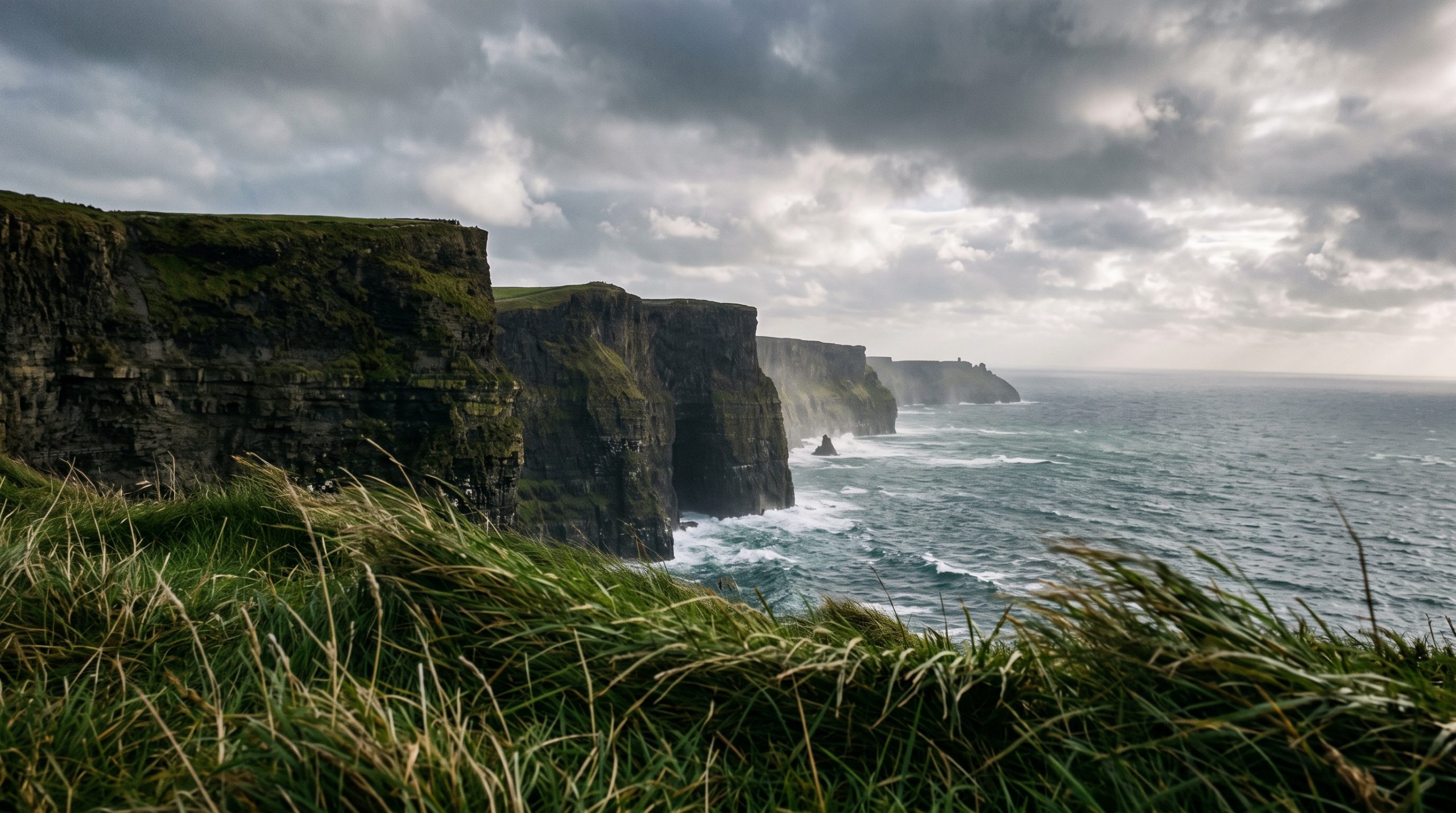
The wind at Moher does not arrive from the side. It hits the base of a wall standing a little over 200 metres above the Atlantic, runs straight up it, and comes over the lip vertically. That is why a veil at the cliff edge does not stream out behind you. It lifts, hangs above your head, and stays there until the gust passes.
That one piece of physics shapes a Cliffs of Moher date more than temperature or rainfall ever will. It decides the month, the hour inside that month, how the hair is pinned, whether the vows are audible on the film, and how far back from the lip the ceremony actually sits when the ocean is having a loud afternoon.
So here is the calendar we work from, with the numbers behind it: sunrise and sunset for every month, the hours the coach traffic owns the clifftop, the weeks the Burren is in flower, and the dates the Doolin boats start and stop for the year.
Why the last ten days of May get first choice
Late May. Met Éireann’s thirty-year averages make May the sunniest month in Ireland, the year’s lightest winds are arriving, the Burren gentians are still open, and sunset sits near 21:45 with usable light past 22:30. Coach season has not yet peaked, so the evening clifftop is close to empty.
What the wind does to a veil, a train and a set of vows
Fabric behaves differently here than it does on a beach. A cathedral veil is a sail with a person attached to it, and on the cliff line it will fly upward rather than backward, which means every frame either has a veil filling the sky above you or a veil wrapped across your face. Both happen within the same minute. A fingertip or elbow-length veil in a heavier tulle keeps its shape in a fresh breeze, which on the Beaufort scale starts at seventeen knots and is an ordinary spring afternoon on this coast.
What actually holds a veil on: two combs rather than one, sewn to the tulle instead of clipped, sunk into braided or pinned hair with the pins crossed. A single comb in loose hair does not survive the walk from the car. If the veil is long and non-negotiable, and it often is, we plan it as a deliberate ten-minute act with one of us on the hem, rather than something worn all day.
The same logic runs through the rest of it. Silk crepe and heavier satin hold a line in wind that turns chiffon into a flag. Vows go on stiff cards, not loose paper. A handfasting cord works outdoors where a candle simply will not. Petals thrown at the lip come straight back at the thrower, and that is a good frame rather than a problem, as long as everyone knows it is coming.
Gusts arrive in sets rather than continuously. We stand you so the wind crosses from behind one shoulder, which lifts the veil clear of the face instead of into it, then work the quiet gaps between sets. For vows, the Expedition puts professional audio on both of you, and the microphone placement changes with wind direction. Where the air is genuinely loud, we move the ceremony two hundred metres back from the lip onto lower ground, keep the ocean in frame, and gain a soundtrack you can hear. You can see how the coast holds up on film in our published stories and galleries, wind and all.
One honest note about the place. The walled viewing area either side of O’Brien’s Tower in the middle of a July afternoon is busy, and the high sun flattens the cliff faces into grey. The cliff line is a completely different landscape from the path south toward Hag’s Head in the last hour of light, and that is where we take couples.
Month by month on the Moher clifftop
Times below are mid-month at the cliffs. Daylight swings by more than nine hours across the year here, which matters more than any temperature reading.
| Month | Air and conditions | Light | Crowds | Our verdict |
|---|---|---|---|---|
| January | Windiest stretch of the year on the west coast | Sunrise 08:44, sunset 16:52, 8 hours | Very quiet | Midday ceremony only |
| February | Still lively, sea state large | Sunrise 07:56, sunset 17:50, 10 hours | Quiet, boats resume at month end | Late February works well |
| March | Unsettled, clear air between fronts | Sunrise 06:53, sunset 18:42, 12 hours | Building slowly | Sharp light, dress for it |
| April | Winds easing, showers moving fast | Sunrise 06:40, sunset 20:38, 14 hours | Moderate | Strong choice before peak |
| May | Ireland’s sunniest month, Burren in flower | Sunrise 05:40, sunset 21:30, 16 hours | Rising but evenings clear | Our pick, last ten days |
| June | Second sunniest, lightest mean winds | Sunrise 05:12, sunset 22:06, 17 hours | Busy 11am to 4pm | Excellent, work the evening |
| July | Mildest air, hazy horizons | Sunrise 05:31, sunset 21:57, 16 hours | Peak of the year | Sunrise or a 20:00 ceremony |
| August | Warm, more Atlantic moisture | Sunrise 06:19, sunset 21:05, 15 hours | Still peak | Evenings good, middays not |
| September | Settled spells, warm sea | Sunrise 07:12, sunset 19:54, 13 hours | Falls away from mid-month | Second pick of the year |
| October | Wet, dramatic, clocks change | Sunrise 08:04, sunset 18:43, 11 hours | Thin after the boats stop | Underrated for film |
| November | Wind returning, low cloud | Sunrise 08:02, sunset 16:43, 9 hours | Empty clifftop | Tight but genuinely wild |
| December | Strongest mean winds, softest sun angle | Sunrise 08:45, sunset 16:22, 8 hours | Empty, site closed 24 to 26 | One long golden hour |
Three windows that move from year to year
The Burren’s flowering weeks are the narrowest. Spring gentians and early purple orchids open through May, and most Burren orchids flower across May and June, because the limestone dries out in high summer and the plants have to finish early. The peak week slides a fortnight either way depending on how warm April has been, so we hold two candidate stretches in the calendar rather than one date, and confirm the ground about ten days out.
The long-evening window is fixed and generous. At the solstice the sun sets at 22:08 at the cliffs and civil twilight runs to 22:59, which gives an hour of afterglow when the clifftop is completely quiet. From late May to mid-July you can hold a ceremony at 20:00 and still have two hours of workable light behind it. By mid-September that same ceremony hour has to move to 18:00.
The third window is the water. The Doolin boats, which are how you see the cliff wall from below rather than from above, run from the end of February to the start of November, with 2028 sailings listed from 28 February to 1 November. Individual departures depend on sea conditions, so we treat a boat as an add-on to the day and never as its spine. Our other destination elopement guides follow the same rule wherever a ferry is involved.
Where we push back on a date, and what we offer instead
Mid-July to mid-August. The visitor experience’s own ticketing treats 11am to 4pm as peak, and that is exactly when the sun sits close to sixty degrees above the horizon and drains the contrast out of the cliff faces. The landscape you came for is available in the last ten days of May or the second half of September, when mid-September still gives thirteen hours of daylight and a 19:54 sunset with a fraction of the traffic. If August is the only month your people can travel, we build the day around a 06:19 sunrise on empty ground, or an evening ceremony with sunset at 21:05 behind it.
Late December to mid-January. Mid-December gives seven and a half hours of daylight, the sun never climbs above about fourteen degrees, and the visitor experience is closed on 24, 25 and 26 December. If your date is flexible, late February into the first half of March gives ten to twelve hours of daylight, a quiet coast, and boats sailing again from the end of February. If your date is fixed in December, and plenty are, the shape that works is a ceremony at 14:00 with the whole of the golden window afterward, which in that month is unusually long.
Why December’s golden hour outlasts the one in March
Warm light lasts as long as the sun takes to travel the last six degrees down to the horizon, and a low winter sun takes a long time to do it. At the cliffs, that window runs about 66 minutes in mid-December, 57 minutes at the June solstice, and only 45 minutes in mid-March, when the sun drops almost vertically. The shortest day of the year has the longest good hour in it. That is the trade nobody explains when they tell couples to avoid winter.
Direction changes too, and it changes a lot. The sunset point on the horizon moves more than eighty degrees between the solstices, from the northwest in June to the southwest in December. In June the last light comes in over the sea to the north and rakes along the cliff line one way. In December it arrives from beyond Hag’s Head and travels the line the other. Which stretch of cliff has light on its face in the final hour is a calendar question, not a taste question, and it is the single most useful thing to know before choosing where to stand.
This is also where two people on the ground stops being a luxury. In December the entire warm window is one continuous block just over an hour long, with a ceremony, a first look at the cliff edge, wide landscape frames and vows audio all inside it. One person cannot be filming the vows and photographing the wide frame at the same time. A dedicated photographer and a dedicated filmmaker working together can, and in a short winter window that is the difference between a full film and a partial one. The coverage options and what each includes are laid out in full on our pricing page. In late May the same warm light runs from 20:51 to 21:45 with dusk behind it, and there is room to work slowly.
If you have a month in mind and want to know what it does to the light and the wind on your particular stretch of coast, send us a message with the dates and we will tell you what that week actually looks like.
How we build Moher around the wind direction
Every Moher day we plan carries a written alternative for each wind direction, chosen before anyone gets on a plane. The prevailing air here is southwesterly, which means it comes straight onto the cliff line with nothing in front of it for three thousand kilometres.
Alternatives chosen by direction
On a hard southwesterly we move inland and low: the Caher valley behind Fanore, where the only river in the Burren cuts down to the sea, or the Galway Bay shore near Ballyvaughan with the Burren hills standing between you and the wind. On a northerly, that logic inverts. The bay side gets the weather and the cliff line goes clean and unusually sharp, so the clifftop becomes the right call rather than the wrong one. On a wet southerly we work the walled boreens and limestone terraces above Doolin, where stone walls give shelter at eye level and the ocean is still audible. The ceremony hour moves within the day. The day itself does not move.
Gates, boats and the quiet hours
The visitor experience runs its own hours and its own timed tickets, with off-peak windows from 8am and again from 4pm to closing, which in high summer means an evening that runs well past most people’s dinner. Those two windows are where the good work happens. The clocks go forward on the last Sunday in March and back on the last Sunday in October, so an October date can lose an hour of evening light between the booking and the wedding week if nobody is watching. Access to specific ceremony ground, permissions and the timing of paperwork are part of what we research for you, and the planning fundamentals for eloping abroad cover the sequence in general terms. Permit and venue fees themselves are paid by you, directly, at cost.
Common questions
How windy is it really at the Cliffs of Moher?
Windier than the nearest official figures suggest. Met Éireann’s thirty-year averages put the mean hourly wind at Shannon Airport at nine knots for the year, rising in winter, and an exposed Atlantic clifftop reads well above an inland airport. Plan for moving air on every date and a still hour as a gift.
Will my long veil work at the cliffs?
Yes, as a planned few minutes rather than an all-day garment. Two sewn combs in pinned hair, one of us on the hem, and the wind crossing from behind a shoulder so the tulle lifts away from your face. Tell us the veil length when you book and we will build the frames around it.
Which single month has the best weather for a Cliffs of Moher elopement?
May. It is Ireland’s sunniest month across the thirty-year averages, the winds are easing toward their summer minimum, and sunset near 21:30 hands you a long empty evening on the clifftop. September is the close second, with quieter paths from mid-month.
Can you actually hear the vows on the film in wind like that?
Yes, with planning. The Expedition includes professional audio for the vows, placed according to wind direction, and where the air is too loud at the lip we hold the ceremony on lower ground a couple of hundred metres back with the ocean still in shot. The choice is made on the morning, from the forecast.
What time do the tour coaches take over the clifftop?
The site’s own ticketing treats 11am to 4pm as peak, and that matches what we see. Before 11am and after 4pm the paths thin out sharply, and in June and July there is real light in both windows: a 05:12 sunrise and a 22:06 sunset in mid-June.
Is a December elopement at the cliffs worth doing?
For the right couple, very much so. You get roughly seven and a half hours of daylight, an empty coast, and the longest golden window of the year at around 66 minutes. The day is built tight around a midday ceremony, and it needs a photographer and filmmaker working simultaneously to catch all of it.
Send us the date you are circling
Dates are currently open across the 2027–2029 seasons, and we work asynchronously and in writing from the first message to the final delivery, so nothing depends on catching us in the same time zone. Send an inquiry and you will have a reply and our initial brochure within 24 hours, usually with a note on what the light and the wind do in the week you are considering.
If Moher is on your list, tell us the month and we will tell you the truth about it, including which stretch of coast to stand on at which hour. Check your date and we will take it from there.