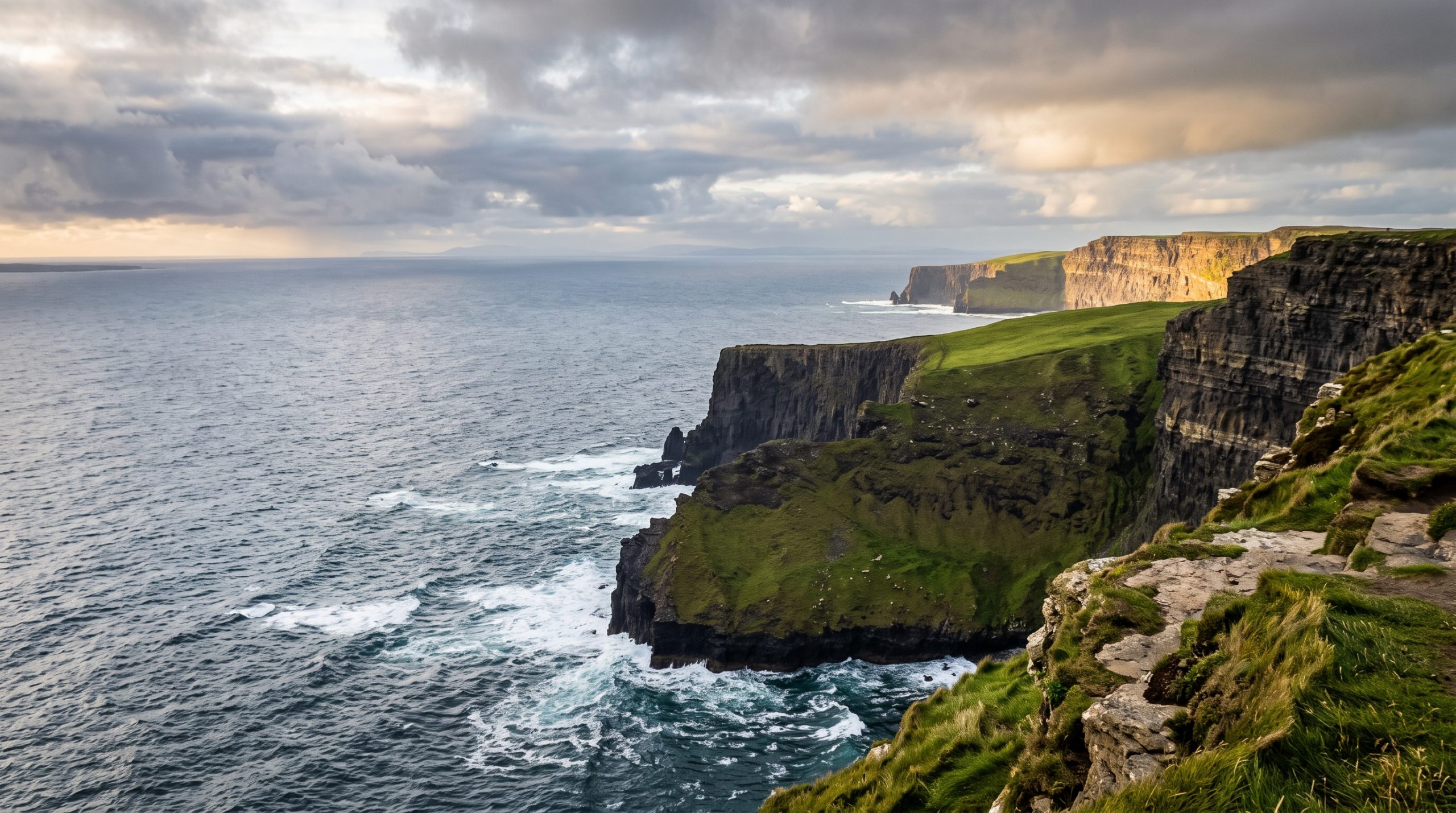
On the longest day of the year the sun drops into the Atlantic off the Cliffs of Moher at seven minutes past ten in the evening. The Cliffs of Moher Experience closes its gates at nine. That hour of daylight after the last car leaves the paid site is the most useful thing anyone can tell you about eloping here in June, and it is the thing almost nobody writes down.
The second thing worth having early is the direction of the rock. These cliffs face west, all fourteen kilometres of them, from Doolin in the north to Hag’s Head in the south, rising to 214 metres near O’Brien’s Tower. West-facing rock sits in cool shadow at sunrise and takes the warm light in the evening. So sunrise here is not really for the cliff faces. It is for the paths, which at half five on a May morning belong to you and the seabirds.
We are Unmapped Stories: four photographers and four filmmakers who work as one team, and we build Clare days around those two clocks rather than around a template. Dates are currently open across our 2027, 2028 and 2029 Cliffs of Moher seasons.
Photography, film and planning from Doolin to Hag’s Head
We cover Cliffs of Moher elopements as a single service: photography, film, and the planning that holds both together. Coverage starts at one full day with a dedicated photographer or a dedicated filmmaker, and travel for the assigned team is included. Highlights reach you five days after your date, and the full gallery or film three weeks later.
Sunrise for the empty paths, sunset for the cliff faces
Two clocks govern a day here. One is the sun, which at this latitude swings through more than nine hours of difference between the longest and shortest day. The other is the site’s own timetable, which runs 09:00 to 17:00 in January and February, 08:00 to 19:00 in March, April, September and October, and 08:00 to 21:00 from May through August. Read them side by side and the year sorts itself out fast.
| Date | Sunrise | Sunset | Paid site hours | What that means for the evening |
|---|---|---|---|---|
| 15 March | 06:53 | 18:41 | 08:00 to 19:00 | Sunset falls inside opening hours with minutes to spare |
| 1 May | 06:06 | 21:05 | 08:00 to 21:00 | Sun sets five minutes after the gates close |
| 21 June | 05:12 | 22:07 | 08:00 to 21:00 | A full hour of light after the site shuts |
| 15 September | 07:11 | 19:54 | 08:00 to 19:00 | Golden hour arrives just after closing |
| 15 October | 08:03 | 18:43 | 08:00 to 19:00 | The best evening window of the year on the paid site |
| 28 December | 08:51 | 16:28 | 09:00 to 17:00 | Sunrise happens before the gates open, sunset before they close |
The practical consequence is that a summer elopement here has to be planned across more than one piece of ground. From May to August, the light everyone comes for arrives after the paid site is done for the day, so the evening happens on other clifftop and coastal ground along that fourteen kilometre line. In mid-October the two clocks finally agree, which is why October is quietly one of the strongest months on this coast and not the compromise couples expect it to be.
Here is how a real mid-May day tends to run. Sunrise is 05:40, civil twilight starts at 04:56, and the light does not leave until after ten at night. That is a very long day, which is why the middle of it is for eating and sleeping.
- 04:40 Coffee in Doolin, dressed, in the car. Nothing is open, nothing needs to be.
- 05:00 On low coastal ground north of the village. No gate, no ticket, no one else. Twenty-five minutes of flat blue light that photographs better than most people believe.
- 05:40 Sunrise comes up behind the ridge. The faces stay cool, the clifftop grass goes gold, and the frames that work are the ones looking north along the line.
- 07:00 Back to the village. Dry off, change, eat properly.
- 09:30 Ceremony on cleared ground, with your solemniser and two witnesses. The marriage registration form gets signed while everyone is still standing there.
- 11:00 The coaches start arriving. We are already inland, in the limestone of the Burren, which sits in the same UNESCO Global Geopark and looks nothing like the coast.
- 13:00 A long break. Flat overhead light on grey rock is the weakest hour Clare offers, and we would rather spend it at a table than pretend otherwise.
- 16:30 Back toward the cliff line as the day-trip traffic thins.
- 20:00 The good light finally lands on the faces. This is the hour the whole day was built around.
- 21:29 Sunset over open water, from ground that does not close at nine.
- 22:13 Civil twilight ends. Last frames, then home.
Shift that day into October and everything compresses: an 08:03 sunrise means no alarm before five, and the evening happens inside the site’s own hours. Shift it into late December and you get a day of well under eight hours, where sunrise, ceremony and sunset can sit in one continuous stretch. The legal spine is the same in every month, and we set it out in our guide to planning an elopement.
Ireland’s busiest natural attraction, and the hours when it is not
Roughly 1.5 million people a year come to the Cliffs of Moher, which is the objection every couple raises with us before anything else. It is a fair one. At half past one on a July afternoon the main viewing platform is a queue with a view, and no photographer alive can make that look private.
What changes it is arithmetic rather than luck. The site names 11:00 to 16:00 as its own peak window, and almost all of that traffic stays within the 800 metres of paved path near the visitor centre. Arrive at first light and the same view has nobody in it. Come back after four and the coach park empties in stages. We build the ceremony so it never sits inside the peak hours, and we hold ground away from the paved section for the parts of the day that need to feel like they belong to two people.
One team, two cameras, and what the wind does to sound
The prevailing weather here comes off the Atlantic from the southwest and hits the faces head on. For stills that is a gift. A veil pulled sideways, hair that will not behave, spray coming up off water that sits two hundred metres below you: this coast hands a photographer material that a calm day never would.
For sound it is the whole problem. Vows spoken into a southwesterly disappear before they reach a microphone, and no amount of editing brings them back. The Expedition puts a dedicated filmmaker alongside the photographer with professional audio for vows and the moments that matter, where conditions allow, and that changes how we choose the ceremony spot in the first place. We look for a rise, a field wall, a fold in the ground that puts the wind behind you rather than across the microphone. A photographer choosing that spot alone would pick differently, because the photographer only needs the background to work.
Then there is room to stand. The paved section is narrow in places, and a photographer and a filmmaker who have never worked together will both want the same three metres of it at 06:10, facing the same direction. Ours plan the day in the same document weeks earlier. One takes the ridge line, one drops back for the reverse angle, they swap on a signal rather than a conversation, and neither ends up in the other’s frame. Because there are eight of us, there is always a second camera on the ground and a colleague in reserve.
Aerials get their own answer here. This stretch of coast is a designated Special Protection Area for breeding seabirds, and drones are not flown within the grounds of the Cliffs of Moher Experience. Where we do fly on this coast it is from cleared ground, with the operator registered with the Irish Aviation Authority and a time window agreed in advance, and we confirm both before we plan any part of the film around an aerial shot. You can see how the finished work reads, the same coastline in stills and in motion, in our published stories and films.
If you already have a date in mind, or two possible weeks and no idea which one holds better light, tell us and we will map the day against the sun before you commit to anything. Check Your Date.
Included, from permit research to the finished film
Everything below comes with every experience, in every destination, including this one.
- Destination and location design for this coast, including the ground beyond the paved section
- A custom timeline built around actual sunrise, sunset and real travel time between Doolin, Liscannor and the Burren
- Permit research and logistics guidance, so you know what needs asking and who to ask
- Weather alternatives and backup planning, which on the west coast of Ireland is not a formality
- Drone footage where it is legal, safe and appropriate
- Professional audio for vows and meaningful moments on the Expedition, where conditions allow
- Travel for the assigned team: flights, accommodation and ordinary travel, included worldwide with no long-haul distinction
- Highlights delivered in 5 days, and the full gallery or film in 3 weeks
Our fee does not change with your guest count. Two of you or twelve, the number affects access, permits, transport and the shape of the timeline, not the price.
Where coverage starts, and the euro costs Clare adds
The Adventure is one full day with either a dedicated photographer or a dedicated filmmaker, from $4,900. The Expedition is one full day with a photographer and a filmmaker working together, from $7,900. The Odyssey runs two to seven days across one or several destinations, photography and film, and is quoted as a custom proposal. Full detail sits on the pricing page. There is no half-day version of any of them.
Team travel to Ireland is inside that figure. What sits outside it, and gets paid locally in euro, is short and worth knowing before you plan a budget:
- The state notification fee for marrying in Ireland, currently 200 euro, paid at your notification appointment
- Your solemniser’s fee, set by them
- Admission to the Cliffs of Moher Experience if your day uses the paid site, charged per person rather than per car, around 15 euro at the gate and less on an off-peak online slot
- Any site or landowner permission fee for a ceremony, where one applies
- Accommodation, vendors, flowers, food
- Anything unusual that moves you: a private boat out of Doolin, a helicopter, a 4×4 charter
How a Cliffs of Moher enquiry becomes a held date
- You send the inquiry form with your dates, or your rough month, and what you picture.
- We reply within 24 hours with an initial brochure.
- We put together a tailored proposal for your date, your ground and your light.
- You sign the contract and pay a 30% retainer, which holds the date.
- Planning begins: location design, permit research, timeline, weather alternatives.
- The remaining payment schedule runs as set out in your proposal, and the day arrives already decided.
Who does well on this coast, and which month fits
The couples who get the most out of Clare are the ones who will set an alarm for 04:40 in May, who are happy on wet uneven grass in wind, and who can hear at 07:00 that the plan has changed because a front came in faster than forecast. That last one matters more than fitness. A day here that moves twice is a normal day here.
If a pre-dawn start is not your idea of a good morning, that is worth telling us early, because the fix is a month rather than a compromise. October and November put sunrise at eight o’clock and sunset before dinner, which gives you the same coastline with a civilised clock. If you want the long, slow northern evening instead, June gives you light until eleven, and we plan the evening on ground that keeps its own hours. If you want puffins on Goat Island, you want spring or early summer, and we will say so plainly rather than let you book November and find out. Tell us the day you actually want and we will tell you which weeks on this coast deliver it, or where else in our destination guides it lands more reliably.
One more thing about fit. This is a two-clock destination, and it rewards couples who are willing to treat the middle of the day as downtime rather than shooting time. If you would rather have one continuous four-hour block than two strong ends of a long day, say so in your first message and we will build the day that way, most likely in the shoulder months when the whole thing fits inside one stretch of good light.
Common questions
Can we legally get married at the Cliffs of Moher?
You can marry in Ireland outside a registry office as long as your ceremony is performed by someone on the state Register of Solemnisers and the venue is open to the public. You give at least three months notice to a Civil Registration Service, both of you sign a declaration at that appointment, and you are issued a marriage registration form valid for six months.
Do we need a permit for a ceremony at the cliffs?
It depends entirely on the ground. The paid site is a managed visitor attraction and anything resembling a formal ceremony there is arranged with the operator rather than assumed. Ground beyond it may belong to a landowner. Establishing which applies to your spot, and what it needs, is part of the planning we do for you. The fee itself, if there is one, is yours to pay.
What time should we arrive to avoid the crowds?
The site names 11:00 to 16:00 as peak. First light and the last two hours before sunset are consistently the quietest, and the traffic drops off through the afternoon. In practice we plan the ceremony well outside that middle window and use the paved section, if at all, at the start or end of the day.
Can you fly a drone at the Cliffs of Moher?
Not within the grounds of the Cliffs of Moher Experience, and this coast is a designated Special Protection Area for breeding seabirds. Where aerials are possible we fly from cleared ground with an operator registered with the Irish Aviation Authority and an agreed time window, confirmed before your film is planned around it.
What happens if it rains or the wind picks up on our date?
We plan for it rather than hope around it. Every Clare timeline we build carries alternative ground, usually a sheltered inland option in the Burren and a lower coastal option near Doolin, and we move the hours rather than the date. Rain on this coast tends to travel through, so a morning that looks written off at 06:00 is often the best light of the day by 08:00.
Is the coastal walk from Doolin to Hag’s Head open?
Not end to end at the moment. The southern six kilometres between Liscannor and the visitor centre are closed, and from Doolin the northern trail is open only as far as Surfers Path, with an 800 metre stretch north of O’Brien’s Tower also open. Access here changes year to year, so we confirm what is open for your dates and design the day around that rather than around a map.
How many guests can we bring?
As many as your ground and your permissions allow, and our fee does not change either way. Guest numbers affect parking, admission, transport and how quickly the group can move between locations, which is exactly the kind of detail the timeline is for.
How long until we see the photos and the film?
Highlights arrive five days after your date, which is usually while you are still travelling. The full gallery or film follows three weeks after that.
Standing on that clifftop in 2027, 2028 or 2029
Everything between your first message and your date happens in writing. You send us the month or the date, we reply within 24 hours, and the plan builds up in a document you can read at your own pace and argue with, from whatever time zone you happen to be in.
Tell us the week you are looking at and whether you want the five in the morning version of this coast or the ten at night one, and we will come back with the light, the ground and the honest answer about which fits. Tell Us Your Story.