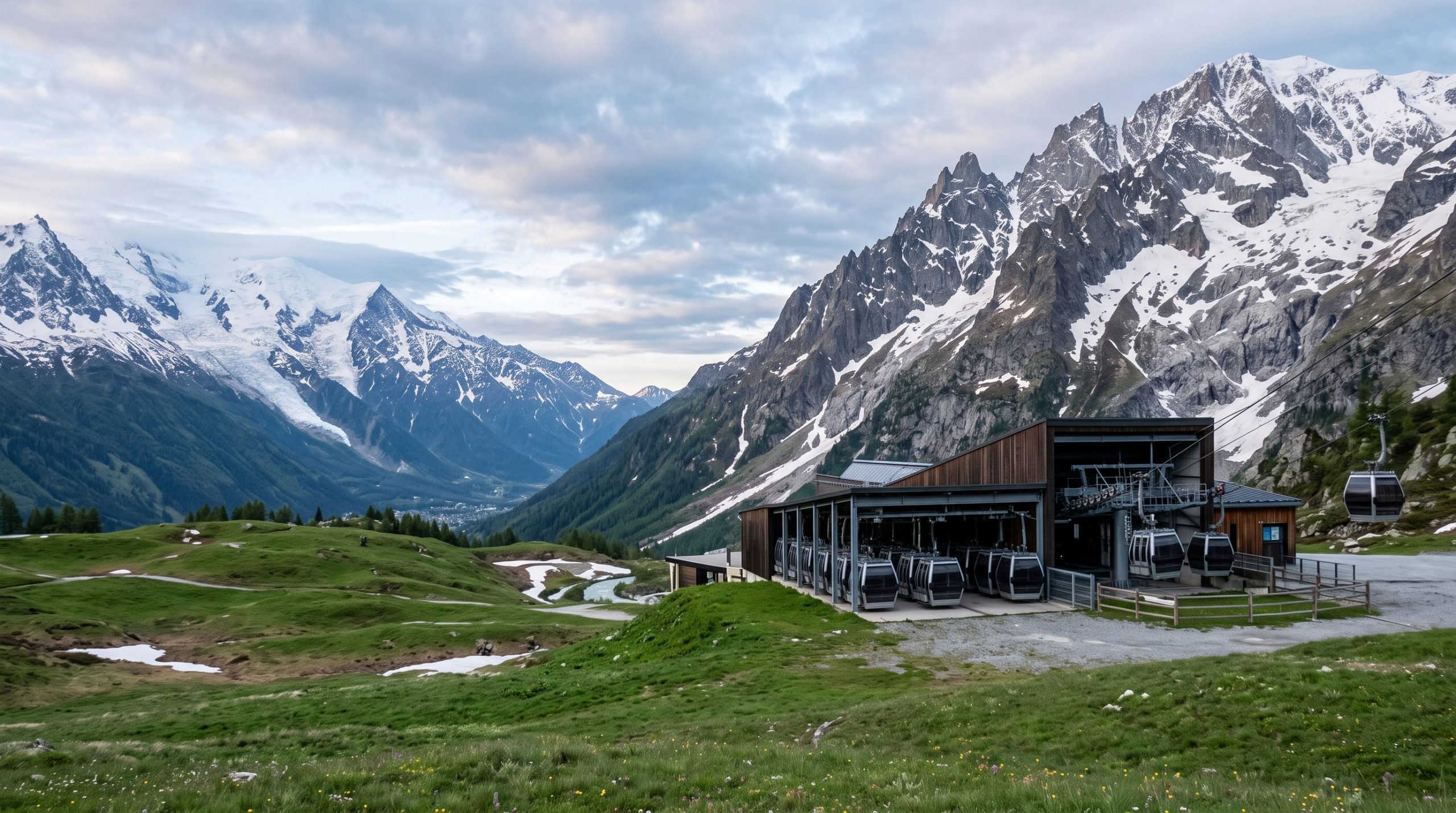
In the middle of May, two lifts in the Chamonix valley are turning. The Aiguille du Midi cable car climbs to 3,842m the way it does for most of the year, and the red rack railway still runs its twenty-minute line up to Montenvers at 1,913m. Everything else is standing still. Brévent, Flégère, Bellevue, Prarion, Charamillon, the Bossons chairlift and the Tramway du Mont-Blanc are all waiting for June, and the gondola that drops from Montenvers toward the ice does not restart until the first week of it.
Early October runs the same trick in reverse. The valley-side gondolas finish for the year across the second half of September, one at a time, a week apart. The Mer de Glace gondola then takes a nineteen-day break of its own. The Aiguille du Midi keeps going into the first days of November, which is why it ends up carrying so many autumn plans.
Neither month is a write-off and we book both. What they punish is a timeline built from July photographs. Know which cabin is moving on your date, put the ceremony in the right hour, and mid-May and early October hand you a valley with almost nobody in it.
Mid-May and early October, in plain numbers
In mid-May only the Aiguille du Midi and the Montenvers train are running, and the valley gondolas reopen between 6 and 20 June. In early October the Mer de Glace gondola pauses for nineteen days. If your date is open, book the last ten days of June, when every lift is turning.
The lift and light calendar, month by month
Published dates move by a week or so each year, and the operator releases the coming season a few months ahead. The pattern holds regardless: the network wakes up across three Saturdays in June and shuts across three in September. The specific dates below are the 2028 ones.
| Month | Lifts and access | Light | Crowds | Our verdict |
|---|---|---|---|---|
| January | Full ski domain; Aiguille du Midi back since 18 December | 2.3 hours of sunshine a day; latest sunrise of the year, 8:12am on 1 January | Packed to 2 January, then quiet | Deep winter, short working day |
| February | Everything open; highs near minus 2°C | Sun clears the ridgelines late morning | Half-term peak | Cold, graphic, book a compact day |
| March | Full domain; up to 194mm of snowfall | Daylight past twelve hours | Busy weekends | Best snow with real light |
| April | Most ski areas close mid-month; highs near 5°C | Long days, soft low sun | Emptying fast | Good if you accept patchy ground |
| May | Aiguille du Midi and Montenvers train only; highs 8.8°C | Late evenings; around 58mm of rain | Quietest weeks of the year | Valley floor plus one summit hour |
| June | Reopenings on 6, 13 and 20 June | 15h 48m of daylight at the solstice | Fills after the third week | Our first choice: the last ten days |
| July | Everything running; Panoramic Mont-Blanc last to start | 9.2 hours of sunshine a day | High all month | Excellent, if you start at dawn |
| August | All areas open; UTMB races 24 to 28 August | Warm haze; sunset pulling back | Peak of the year in race week | Strong outside those five days |
| September | Closures begin 13 September, more on 20 and 27 | Sun angle drops fast, evenings still warm | Collapses after the first week | Our second choice: first fortnight |
| October | Mer de Glace gondola off until 17 October | Low sun all day; roughly 119mm of precipitation | Very quiet | Larch colour at valley level |
| November | Aiguille du Midi closed from 2 November | Shortest usable light of the year | Empty | The one month we would move |
| December | Whole domain open from 20 December; 245mm of snow across 10.4 days | 8h 42m at the solstice; earliest sunset 4:49pm on 10 December | Quiet until the 20th, then full | Winter with a two-hour window |
Every row above is a different valley to work in, and the difference is mostly light rather than snow. Our destination guides go month by month for other mountain regions, but Chamonix has an unusually rigid calendar, so read the dates before you fix one.
How September closes down, and what October leaves open
The autumn shutdown is a sequence rather than a date. In 2028 the Brévent cable car, the Flégère gondola, the Bellevue cable car at Les Houches and the Glacier des Bossons chairlift all finish on the evening of 13 September. The Planpraz gondola and the Charamillon gondola above Le Tour run one more week, to the evening of 20 September. The Tramway du Mont-Blanc stops on 27 September, and the Montenvers gondola and ice cave the day after.
So a ceremony on 10 September has an entire valley of options, and a ceremony on 22 September has two lifts. Both can be superb. They are not the same day, and the difference is invisible on a map.
October is better than its reputation. The Mer de Glace gondola returns on 17 October after its nineteen-day maintenance break, though the ice cave itself stays shut until 1 November, so in October the glacier is something you look down on rather than stand inside. One valley-side gondola usually reopens for a short late-October run: in 2027 that was Flégère, from 18 October. Which lift gets the window changes, so we confirm it with the operator before building a day around it.
Above all of that, the Aiguille du Midi holds. It closes in the first days of November for annual maintenance and reopens shortly before Christmas. In 2028 those dates are 2 November and 18 December, and they are the most useful pair of numbers in the Chamonix year.
May, and why the valley floor is not a consolation prize
Chamonix’s ski areas mostly finish in mid-April, the highest lifts hang on into the first days of May, and in 2028 the last of them stops on 3 May. Then the valley exhales for a month. Trails below 1,500m dry out, the meadows at Les Bois and Le Lavancher come green, and the high ground stays white and unreachable by cable.
The reopening lands on three Saturdays. In 2028 the ice cave and the Bellevue cable car restart on 6 June. Planpraz, the Brévent cable car and the Bossons chairlift follow on 13 June. Flégère with the Index chairlift, plus Charamillon and Autannes in the Balme area, come back on 20 June, which is the date that finally opens the walk to Lac Blanc. The Panoramic Mont-Blanc gondola across the Vallée Blanche is always last, and does not begin until July.
None of that prevents a May ceremony from being one of the best days of the year. Average highs sit near 9°C, nights hover around freezing, and roughly 58mm of rain falls across the month, so it is spring in a fleece rather than winter in a jacket. We use the valley properly: the Arve running high and grey with meltwater, the crag and lake at Les Gaillands, the forest above Le Lavancher, the old hamlets at Le Tour, and the climb to Col des Montets at 1,452m where the Aiguilles Rouges reserve begins. Then one high hour on the Aiguille du Midi, early, before the afternoon cloud builds. If you are still working out the shape of a day rather than the date, our guide to planning an elopement sets out the sequence.
What the light does when the lift day ends before golden hour
Chamonix is a deep valley with 4,000m of rock on one side, so official sunrise and the moment light reaches you are two different times. That gap shapes a ceremony hour here more than temperature ever does.
At the solstice the numbers are generous. Earliest sunrise is 5:39am on 15 June, latest sunset 9:29pm on 26 June, and the longest day carries 15 hours 48 minutes of daylight. A 7pm ceremony still has two hours behind it, so the summit hour and the vows never compete. July averages 9.2 hours of sunshine a day, the best odds in the year on a clear Mont Blanc, which in practice still means planning for the morning when it hides.
December inverts all of it: 8 hours 42 minutes of daylight, the year’s earliest sunset at 4:49pm on 10 December, and January averaging 2.3 hours of sunshine a day. Low, sideways, pink light for most of the working day, and about two genuinely useful hours in it. Both ends of the year are in our elopement stories and films.
May and October sit between the two and share one specific constraint: the high lifts stop mid-afternoon, well before the light turns. So we invert the usual order. Summit first, in the cold, when the air is clearest. Descend. The ceremony and the slow hour then happen on the valley floor or on foot above it, at exactly the moment the last cabin would have been leaving.
That inversion is why we send two people. An October window can come down to forty minutes when the light is doing something specific, and one person cannot hold a long lens on the two of you and also build the wide film frame of the massif behind. A photographer and a filmmaker working simultaneously means the window gets used once rather than split. In late June the reverse applies: the evening is long enough to work slowly, and the second camera goes to the things nobody thought to ask for.
The dates we would move, and how we make a fixed one work
November is the month we would ask you to shift. The Aiguille du Midi is down from the first days of it, the valley gondolas finished in September, and the snow that makes winter here worth filming usually has not arrived to stay.
What we offer instead: the first fortnight of September, when every lift still turns and the summer crowd has gone, or the second half of January, when the domain is open and the light stays low all day. If November is fixed for reasons that have nothing to do with cable cars, we go on foot, and the forest, river and hamlet locations below 1,500m carry the whole day comfortably.
The other week we would nudge is the last of August. The UTMB races run 24 to 28 August in 2028 and the valley is at its fullest. Moving seven days either way changes the entire texture of the town. And if the Mer de Glace ice cave is the reason you chose Chamonix, plan outside 28 September to 1 November and outside the second half of May.
Send us the date you are holding and what you want the day to feel like, and we will tell you which lifts are turning that week, or which fortnight would serve you better. Check Your Date.
Photography, film and planning come from one team as one service, and the coverage shapes are set out on our pricing page.
Our weather plan, written before anyone flies
A weather plan is written weeks ahead, not on the morning, and ours names places rather than moods. When cloud sits on the Mont Blanc side, we cross to the Aiguilles Rouges side where the base often sits higher and the massif becomes backdrop instead of subject. When the whole valley is grey, we work in the larch and along the river, where flat light is an advantage. The ceremony hour itself is written to move by up to two hours, and your celebrant and any guests know that in advance.
The Aiguille du Midi depends on wind and visibility, so we never build the only version of a day on it. There is always a ground-level version of the ceremony that needs no cable car at all.
Common questions
Is the Aiguille du Midi open in November?
For the first day or two only. It closes for annual maintenance in the first days of November and reopens shortly before Christmas, which in 2028 means 2 November to 18 December. A November ceremony works on foot at valley level, with the massif as backdrop rather than underfoot.
Why are so many Chamonix lifts closed in May?
May is the gap between two seasons. The last ski lifts stop in the first days of the month, and the summer network restarts across three June Saturdays, which in 2028 are 6, 13 and 20 June. Only the Aiguille du Midi and the Montenvers train run right through.
Can we still reach the Mer de Glace in early October?
You can take the train to the Montenvers station at 1,913m and look out over the glacier. The gondola down toward the ice pauses for nineteen days from 28 September, returning on 17 October in 2028, and the ice cave stays closed until 1 November.
Is May or October better for a Chamonix elopement?
October, for the photographs. The lift day is equally short, but you get larch colour at valley level, low sun from morning to evening and a better chance of a clear, snow-covered massif. May gives you greener ground, far longer evenings and the emptiest streets of the year.
Do we need a cable car at all?
No, and some of our best hours in this valley have been an hour’s walk from a car. Access on foot removes every closure date from your timeline, which is why we build a lift-free version of the day even when everything is running.
How early does the sun rise in Chamonix in June?
The earliest sunrise of the year is 5:39am on 15 June and the latest sunset is 9:29pm on 26 June, giving 15 hours 48 minutes of daylight at the solstice. The valley walls delay first light, so we plan against the ridgeline rather than the published time.
What if the cable car does not run on the morning of our ceremony?
We move to the alternative already written into your timeline, chosen for the wind direction and cloud base that kind of morning brings. The ceremony hour is designed to shift. Nothing about the vows depends on a lift turning.
Booking around the calendar rather than against it
We are booking 2027, 2028 and 2029, and the earlier a Chamonix date reaches us the more of the calendar we can work with. We keep the planning in one written thread, at whatever hour suits you: the inquiry form brings a reply and our brochure within 24 hours, then a tailored proposal, then planning begins once the contract is signed and the 30% retainer is paid. Highlights reach you five days after the day itself, and the full gallery or film three weeks later.
Send us the date you are holding, even if it lands in the middle of May or the third week of October. We will tell you exactly which lifts are turning that week and what we would build around them. Tell Us Your Story.