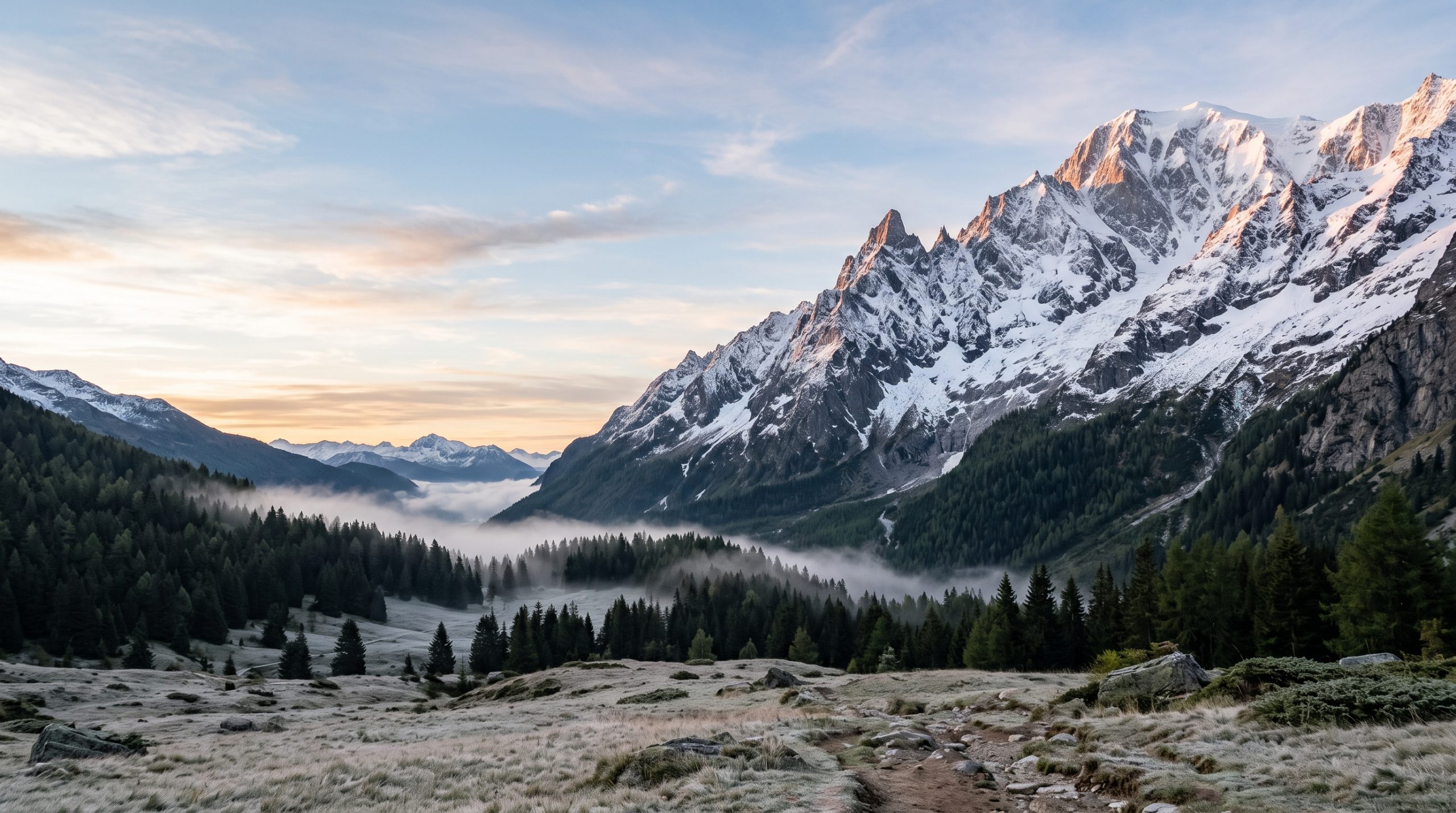
The first cabin of the day leaves the Chamonix station at 6:10 in high summer and sets you down at 3,842 metres about twenty minutes later. The town it left sits at 1,035 metres. Nearly 2,800 metres of vertical, crossed before most of the valley has finished breakfast, and the air you step out into is not the air you got dressed in.
On the first of July the sun clears the horizon at 05:46 and does not go down until 21:26. Neither of those times is when the light actually reaches you. The valley floor stays blue and cold for a long while after sunrise, because the walls on both sides run two and three thousand metres above it, and the granite of the Aiguilles Rouges is already burning red on the west side while Chamonix is still in shade. A day here is planned around that lag, in both directions.
We are eight: four photographers, four filmmakers, with the planning built into the same team. We have stood on the Aiguille du Midi terrace at 6:40 in the morning unable to feel our fingers, and we have watched cloud swallow the whole massif at noon while the Brévent side stayed clean and gold. Both of those days produced work. The difference was the plan underneath them.
What we cover in the Mont Blanc valley
Unmapped Stories covers Chamonix elopements with photography, film and planning from one eight-person team. A full day runs from the first cabin at 6:10 to the last light on the massif after 21:00 in July. Coverage starts with one dedicated photographer or filmmaker, and team travel to France is included.
From the 6:10 cabin to the last light on the Drus
The Aiguille du Midi runs from 6:10 in the morning to 18:00 between 1 July and 23 August, with cabins leaving every fifteen or thirty minutes depending on the queue and a time slot that has to be booked in advance during those weeks. The first two departures are the ones worth having. By mid-morning the summit terrace belongs to everyone who came up on a day ticket, and no lens makes that private.
So the day starts in the dark. Around 04:45 in the valley, unhurried, with the hotel corridor still silent.
Twenty minutes of cable and you are at 3,842 metres, walking out into cold that bites through a jacket in August. The whole visit averages two to three hours including travel, and the useful part of it is much shorter than that. We work the terraces and the Pas dans le Vide glass box early, then move through Le Tube, the steel gallery at 3,700 metres, before the second wave of cabins arrives. Nobody is asked to say anything twice up there. At that altitude, on that little air, once is what you have.
Mid-morning, we drop to the mid-station at Plan de l’Aiguille, 2,310 metres, where you can be off concrete and onto a trail in five minutes and the frame stops looking like an observation deck. The alternative is the Montenvers cog railway: twenty minutes from town to 1,913 metres, standing above the Mer de Glace with the Drus and the Grandes Jorasses filling the sky in front of you. Choosing between them is a light decision, not a preference one, and we make it the evening before.
Midday is for eating and changing. The sun is directly overhead, the massif has begun manufacturing its own cloud, and there is nothing in that hour worth burning your legs on. We plan a real gap here, usually two hours, and it is the reason couples still look fresh at nine in the evening.
Late afternoon we go back up, or we go along the valley instead. The Brévent side faces the massif straight on from 2,525 metres, with the Planpraz gondola at 2,000 metres below it, and in July and August it runs from 8:20 to 18:00. That closing time matters more than the opening one: everything after six o’clock has to be reachable on foot or by road. Which is why the evening usually belongs to the upper valley, the meadows above Argentière, the pine and boulder ground toward Le Tour, the reserve edge at the Col des Montets where the rule is silence and no overflight of any kind.
Vows at seven. Dinner light at eight. And then the part almost nobody plans for: sunset is at 21:26 on the first of July, and the summits hold colour for a while after the valley has lost it entirely. By the end of the month the sun is up at 06:14 and down at 21:03, so the whole frame of the day shifts by half an hour across four weeks. We build your timeline against your actual date, not against July in general.
| Window | What is running | How we shape the day |
|---|---|---|
| Mid-December to April | Aiguille du Midi roughly 8:10 to 16:30 | One high window in the middle of the day, everything else on snow at valley level |
| Late April to early June | Brévent and Planpraz on their maintenance break, back around 13 June | Low ground: the Arve, the forest above Les Praz, meadows under Argentière |
| Mid-June to 23 August | Everything open, Aiguille du Midi 6:10 to 18:00 from 1 July, timed slots compulsory | Pre-dawn start, summit first, long protected gap at noon, ceremony after the lifts stop |
| September | Brévent and Flégère close mid-month, Planpraz about a week later | Quiet trails, shorter days, more weight on mid-mountain and the valley floor |
If you already have a week in mind, send it to us and we will tell you what is turning and what is not on those exact dates. Check Your Date
When the massif is in cloud at six in the morning
This is the thing couples write to us about most often, and it is a fair worry. Mont Blanc makes its own weather. Lift operation here is openly conditional, published as subject to favourable conditions, and the Chamonix lift status is updated live every morning before the first departures.
The answer is not optimism. It is building the day on three altitudes instead of one. The valley floor at 1,035 metres, the mid-mountain band between 1,900 and 2,300 metres, and the summit at 3,842. Cloud in this valley almost always sits as a layer rather than a fog, which means one of those three is usually clear, and often the best morning of the whole season is the one where the town is grey and you come out of the cabin above a white floor with nothing but the Grandes Jorasses on the horizon.
So we set a decision time, normally around 05:15, we read the status and the webcams, and we commit. If the summit is out, the mid-mountain plan is already written, the drive times are already measured, and nobody spends the morning arguing on a pavement. Weather alternatives are not an extra we sell. They are part of the planning that comes with every booking, and in Chamonix we write two of them before we write the timeline.
Two cameras inside one cable car window
Here is what the split booking looks like in practice. You hire a photographer, then hire a filmmaker separately, and in July and August they need to be on the same compulsory time slot as you on a cable car that departs every fifteen or thirty minutes. If the slots do not match, the film starts twenty minutes after the photographs do. On a summit where you have maybe forty usable minutes before the terrace fills, twenty minutes is most of the day.
Booked with us, that problem does not exist, because it is one booking. The photographer and the filmmaker travel on the same ticket, ride the same cabin, and have already agreed the night before who takes the north terrace and who takes the ridge line. When you turn to each other at 3,842 metres, one of them is close and one of them is wide, and neither is asking you to do it again.
The valley shapes the film in specific ways, and knowing them in advance is the job. Drones are prohibited over the Aiguilles Rouges nature reserve all year, so Lac Blanc and the Chéserys ground are filmed entirely from the shoulder. Over the Mont Blanc massif itself the airspace closes to drones through July and August. That is not a problem if the filmmaker knew in February: the aerial sequences get planned into the places and months where they are legal and safe, and the rest of the film is built to carry itself without them. It is a problem if you find out on the morning.
Sound works the same way. The reserve asks for silence, so amplified music and speakers belong further down the valley, not at a high lake. On the Expedition, where a filmmaker and photographer work the day together, professional audio for vows and the moments around them is part of it wherever conditions allow, which in practice means a sheltered spot chosen for the audio as much as for the view. You can see how the finished work holds together in the films and galleries we have published, where the stills and the footage come from the same two people standing in the same wind.
What sits inside the fee, and what the valley charges on top
Everything below is included in every experience, in Chamonix and everywhere else we work:
- Destination and location design for your date, not a template
- A custom timeline built around real light and real travel time, including lift timetables and the noon gap
- Permit research and logistics guidance
- Weather alternatives and backup planning at three altitudes
- Drone footage where it is legal, safe and appropriate
- Team travel worldwide: flights, accommodation and ordinary travel for the assigned team, with no long-haul surcharge and no European exception
- Highlights delivered in 5 days, and the full gallery or film in 3 weeks
The Expedition adds professional audio for vows and meaningful moments where conditions allow. Guest count does not change the fee. Ten people instead of two changes access, transport and the shape of the timeline, and we plan for that, but it does not change what you pay us.
The Adventure is one full day with a dedicated photographer or a dedicated filmmaker, from $4,900. The Expedition is one full day with both working together, from $7,900. The Odyssey runs from two to seven days across one or several destinations and is quoted as a custom proposal, which for Chamonix often means the valley plus a night over the border. Full detail sits on the pricing page.
What Chamonix adds on top, paid by you and not to us, is mostly mountain infrastructure. An adult return on the Aiguille du Midi currently runs between about 60 and 83 euros depending on the date, because pricing moves with the season. A return to the Brévent summit is around 43 euros, and the Montenvers train starts near 31 euros return before the ice cave ticket. Add your accommodation, your celebrant, any permit fees a specific venue or landowner charges, and unusual transport if you want it: a helicopter, a 4×4 to a road head, a mountain guide for glacier ground. We arrange and coordinate all of it. You pay the operators directly.
How a Chamonix enquiry becomes a held mountain date
- You send the contact form with your date, or the month you are circling, and a sentence about the kind of day you want.
- We reply within 24 hours with an initial brochure and our first read on your dates.
- We go back and forth in writing about locations, altitude, guests and the shape of the day.
- You get a tailored proposal: coverage, the team assigned, the outline timeline.
- Contract signed and a 30% retainer paid. The remaining payment plan is set out in the proposal.
- Planning begins in earnest: location design, permit research, lift slots, timeline, alternatives.
We are currently taking Chamonix elopement bookings for 2027 through 2029. It is worth raising a Chamonix date with us before you commit to flights, because the lift calendar decides a lot about what your particular week can hold.
The couples this valley fits best
Chamonix rewards people who will get up at 04:30 without resenting it, who are steady on uneven granite, and who can hear at 05:15 that the summit is out and answer with a shrug. It suits couples who want scale rather than seclusion, and who understand that the most famous viewpoints in the Alps come with other people standing on them.
If early starts are genuinely not you, say so in your first message. July light in this valley runs past 21:00, and we can build a day backwards from the evening instead, with the ceremony in the upper valley and the high ground kept for the following morning if you want it. If you want empty trails more than you want the whole lift network, mid-September gives you that, at the cost of the Brévent and Flégère closing partway through the month. And if your dates fall near the Mont Blanc Marathon in June or UTMB at the end of August, when the valley fills with runners and beds vanish, tell us early and we will work around it or point you at the quieter fortnight either side. Our destination guides are a good place to compare the valley against the other alpine ground we cover.
Common questions
Can we legally get married in Chamonix if we live in the United States?
French civil marriage requires at least one partner to show around 30 days of continuous residence in the commune before the banns are published, which rules it out for most visiting couples. The standard route is to complete the legal paperwork at home and hold the real ceremony here, with a celebrant, your own words and no registry office clock. Our guide to planning an elopement walks through how couples usually sequence the two.
Do we have to book the Aiguille du Midi in advance?
In July and August, yes: a timed slot is compulsory and pricing moves with the date. That slot is one of the first things we lock, because the entire morning hangs off it. Outside high summer you have more freedom, and the first cabin moves later, to 7:10 in late June and 8:10 in winter.
Can you fly a drone over Mont Blanc?
Not over the Aiguilles Rouges nature reserve, where overflight is prohibited all year, and not over the massif itself during July and August. Elsewhere in the valley, and in the other months, aerials are flown where they are legal, safe and appropriate, and drone footage is included in every experience on that basis. We confirm what is possible before the film is designed, never after.
What happens if the cable car is closed on our wedding morning?
We move to the plan we already wrote. Lift operation here is weather-dependent by design and status is published live each morning, so we read it, decide by about 05:15, and go to the mid-mountain or valley version of the day. Nothing gets improvised on the pavement.
Do we need to book a photographer and a videographer separately?
No. Photography, film and planning come from the same team of eight, on one contract, with one timeline. On a day governed by lift slots and a forty-minute window at altitude, that is the difference between two records of the same moment and two people arriving at different times.
How soon do we get the photographs and the film?
Highlights land 5 days after your day. The full gallery or film follows within 3 weeks.
Does it cost more if our parents and a few friends come?
Our fee does not change with guest count. What changes is logistics: everyone needs their own lift ticket, altitude affects who is comfortable at 3,842 metres, and children under three are not admitted on the Aiguille du Midi at all. We build the timeline around whoever is coming.
Writing to us about a Chamonix date
The full planning trail stays written and easy to revisit, which means you can send a message at eleven at night from a laptop in another time zone and have a real answer, with a brochure, inside 24 hours. Nothing to arrange in advance, nothing to commit to before you know whether we are right for your day. Tell us the date or the month, the number of people, and one honest sentence about what you actually want the morning to feel like at 3,842 metres. We will tell you what the valley is doing then, what is running, and what we would build. Tell Us Your Story