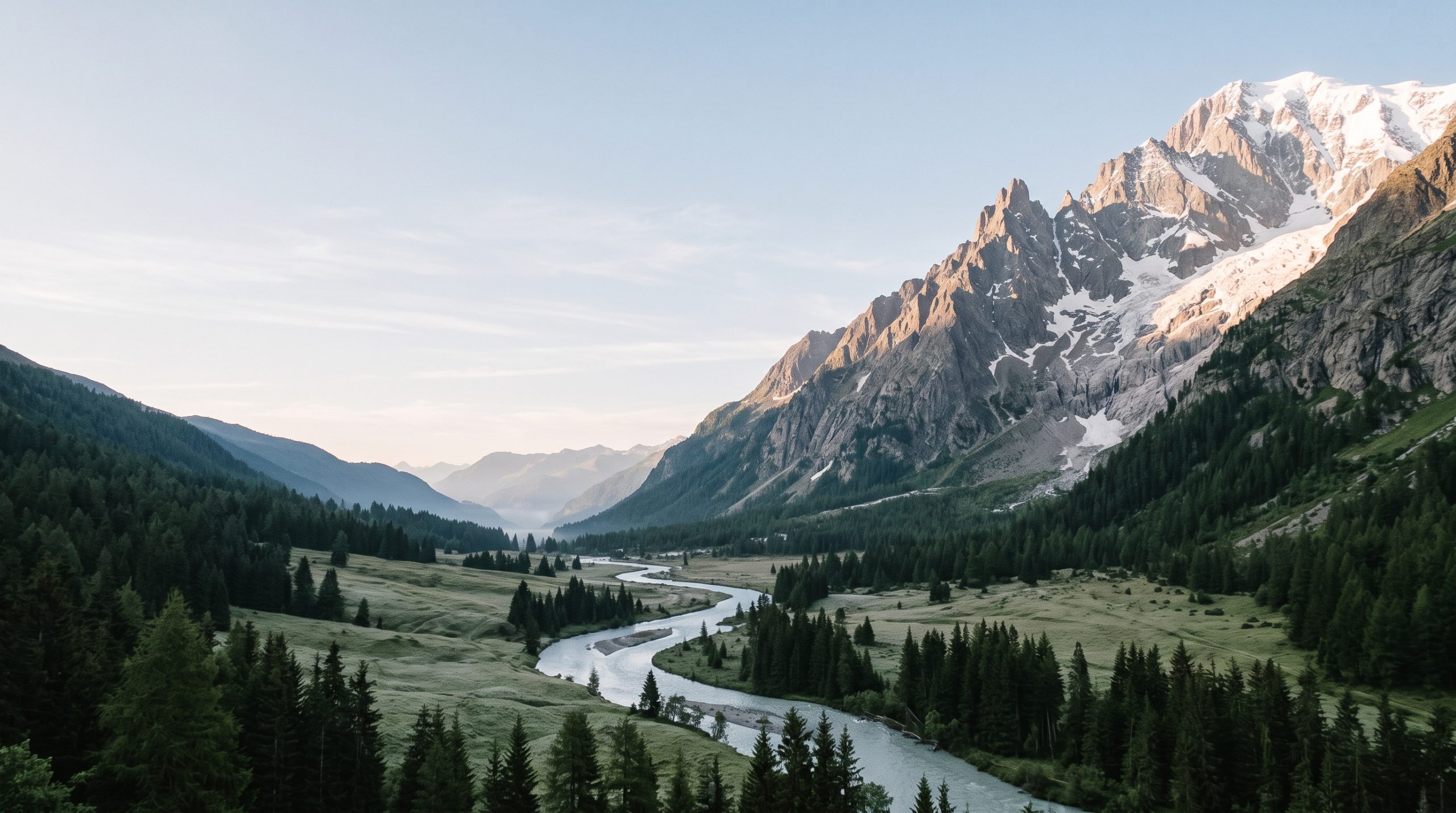
Mid-June hands Chamonix its earliest sunrise of the year, 5:39am, and its latest sunset two weeks later at 9:29pm. The lifts that carry you above the treeline start turning at 8:20am and have brought everyone down by six. Almost all of the good light in a Chamonix day happens while the cable cars are switched off, and that one gap decides how a day here is planned, where it goes, and what it ends up costing.
The rest of the arithmetic is local and small. A return on the Aiguille du Midi cable car runs at around 83 euros a head for the twenty minutes up to 3,842 meters, the cog railway to Montenvers is about a third of that, and the rechargeable card the turnstiles need is 3 euros on top. None of that is the expensive part of eloping here. The expensive part, if the hours go wrong, is arriving at 3,842 meters at ten in the morning, when the terrace has become a viewing platform with a line for the lift and no amount of skill makes it feel like yours.
We photograph and film in this valley as one team, so the timeline gets written by the people who then have to stand in it at 4:45am. Here is what a 2027 day in Chamonix costs, what the mountain charges on top, and the hours we would actually book.
The figure, and what sits underneath it
A full day of Chamonix coverage starts at $4,900 with one dedicated photographer or one dedicated filmmaker, and at $7,900 with both working as a pair. Team travel is included. The valley adds its own costs: lift tickets, any site permit fee, a celebrant, accommodation, and a mountain guide if you want glacier ground.
A July day, from 4:45am to a sunset after nine
Printed sunrise is not sunrise in a valley whose walls stand nearly 2,800 meters above the street. At the moment the almanac calls sunrise, the top of the massif takes color and the valley floor, a little over a thousand meters up, is still holding blue. That lag is the most useful thing about the place. You can have high alpenglow and soft, shadowed meadows in the same half hour, in two locations twenty minutes apart by car.
4:45am. We meet in the dark at Les Praz, where the fields run flat to the base of the Aiguilles Rouges and the mist sits knee high. Nothing is running yet, nobody else is out, and the first twenty minutes of frames are the quietest of the day. If privacy matters to you more than altitude does, this is where we would put the vows.
Around 6am. Color arrives on the summits from the top down. We work you small in the frame here, because the scale is the whole point and a tight portrait wastes it.
6:10am. In the peak weeks of July and August, the first Aiguille du Midi cabin leaves at 6:10am and reaches 3,842 meters about twenty minutes later. Either side of those weeks the first departure is an hour or more later, which changes the entire shape of the morning. Up top it is properly cold, the wind cuts across the terraces, and you have roughly one quiet half hour before the next cabins land. Cabins run every fifteen to thirty minutes depending on the crowd, and the last return trip down leaves at 4:30pm.
8:20am. The Flégère cable car opens, and with the Index chairlift above it you are put on the balcony side of the valley looking straight at Mont Blanc. The walk to Lac Blanc from there is about 6.1 kilometers out and back with 360 meters of ascent, topping out around 2,410 meters, and two to four hours with stops. It is rocky underfoot and there is often old snow in the shaded sections well into summer.
9:45am. Ceremony above the water. Lac Blanc sits inside the Aiguilles Rouges nature reserve, and the reserve rules are worth knowing before you plan anything around them: overflight is prohibited, so there is no drone here, dogs are not allowed, swimming in Lac Blanc and the Lacs des Chéserys is prohibited by prefectoral decree, and sound equipment is out, so no speaker and no playlist. The ceremony is two voices and weather, which is a better soundtrack anyway.
11am. An honest note. The Lac Blanc trail is one of the most walked paths in the Alps and by late morning you are sharing it. The light on the massif is still good, but the solitude is gone, so we use this hour for the walking and the wider work and drop back toward the Chéserys lakes, which face the same view with a fraction of the traffic.
2pm. The Montenvers cog railway climbs from town to 1,913 meters in front of the Mer de Glace, the Drus and the Grandes Jorasses. A return train ticket sits at about 31.50 euros a person, and the full package with the cable car down to the ice cave costs more and takes longer. Allow two to three hours for the whole thing.
6pm. The last descent from Planpraz. Three hours of the best light in the day are still to come, and every lift has stopped, which is exactly why the evening plan is built on ground you reach on foot or by road. That means the Grand Balcon walked down rather than ridden, the meadows toward Les Bossons with the glacier tongue above them, or the quiet end of the valley at Vallorcine.
9:15pm onward. The sun goes behind the Aiguilles Rouges long before it sets, so the last hour is soft and shadowless rather than golden. Then a long blue hour that holds until nearly ten. Our destination guides go further into how the valley’s two sides trade light through the day, and the rule we plan by is that mornings belong to the Mont Blanc side and evenings belong to whatever you can still stand on.
The morning the Aiguille du Midi does not run
This is the thing couples write to us about most often, and it is a fair worry. High wind or low cloud on the summit means the top stage stays closed, and the call comes in the morning, not the week before. Two facts make it far less costly than it sounds. Lift tickets are bought on the day, so nothing is committed in advance, and this valley has three completely different altitude bands within twenty minutes of each other.
So we plan in bands rather than in one line. The high plan lives at 3,842 meters. The middle plan works between 1,900 and 2,500 meters at Planpraz, Le Brévent, Flégère or Montenvers, where you often sit above the cloud layer while town sits under gray. The valley plan runs a little over a thousand meters among the meadows, larch woods and river ground, which photograph beautifully in flat light and are the reason a cloudy Chamonix day is not a lost one.
You get all three bands written into your timeline before you fly, with the walking times and the decision points marked. We look at the forecast the evening before, again at 4:30am, and your celebrant knows which of the three plans is live. There is a fourth constraint most planners miss: the Brévent lift shuts for maintenance between the ski season and the summer season, which can run from late April to the second week of June, so a late spring date is built on foot access and valley ground from the start.
Two cameras on a windy ridge, and vows that happen once
Photography, film and planning here come from one team of eight. Not a photographer who has a videographer’s number, meeting at the lift station on the morning and negotiating who stands where. That distinction sounds like marketing until you are at 2,400 meters in wind, and then it becomes the difference between two sets of coverage and one set with gaps in it.
Chamonix punishes improvisation in specific ways. Everything you use has to be carried up a chairlift and along a rocky traverse, so gear is decided days before, split between two people, and nothing gets left at the car because one person could not manage it. Cold at 3,842 meters drains batteries fast, so the filmmaker runs a warm reserve in an inside pocket while the photographer keeps working. Wind is constant on the ridges, which is why lavalier microphones go under a jacket collar rather than on a stand, and why the Expedition day includes proper audio for vows where conditions allow. Recording is one thing and playing sound out loud is another, and inside the reserve only one of those is permitted.
The bigger gain is time. Because drones cannot fly over the reserve, the film has to earn its wide shots on foot, with long lens compression across the Chéserys basin and moving shots along the balcony path. Those take passes. A photographer working alone cannot give you those passes and also cover a ceremony that happens once, in one direction, in ten minutes of light. Two people mean the vows are held from two angles while the wind does whatever it does. You can see how this valley behaves on camera in our published galleries and films, where the same ridge reads completely differently at 6am and at 8pm.
There is always a second camera on the ground and a colleague in reserve, because we are eight people rather than two, and Chamonix is not a place to have a single point of failure.
If your date is in 2027 and you want to know what this looks like on your specific week, tell us your story and we will send the shape of the day back to you in writing.
What is in the day, and what the mountain charges on top
Every experience includes destination and location design, planning, a custom timeline built around light and real travel time, permit research and logistics guidance, and weather alternatives with the backup planning that goes with them. Drone footage is included where it is legal, safe and appropriate, which in this valley means outside the reserve and inside whatever restrictions apply on the day. The Expedition adds professional audio for vows and other moments that matter, where conditions allow.
Team travel is included worldwide, and Chamonix is no exception. Flights, accommodation and ordinary travel for the assigned team are ours, not a line on your invoice, and there is no long haul surcharge hiding anywhere. The price does not change with guest count either. Ten guests instead of two changes access, permits, transport and the timeline, not the fee.
Highlights reach you in 5 days. The full gallery or film follows within 3 weeks. Full detail on what each experience covers sits on our coverage and pricing page, including the multi-day Odyssey for couples who want the Italian and Swiss sides of the massif as well as this one.
What you pay locally is set by other people. The euro amounts below are what the operators charge at their own counters, and a euro has been trading a little above a dollar lately, so the mental conversion is small. Treat these as the current shape rather than a quote: the lift company resets its summer tariff each spring, and 2027 rates are not published yet.
| Cost | Who sets it | Where it currently sits |
|---|---|---|
| Aiguille du Midi return, per person | Compagnie du Mont-Blanc | Around 83 euros |
| Montenvers railway return, per person | Compagnie du Mont-Blanc | About 31.50 euros, more for the full Mer de Glace package |
| Turnstile card for any lift pass | Compagnie du Mont-Blanc | 3 euros, rechargeable, not refundable |
| Site and permit fees where a site charges one | Commune, reserve or landowner | Varies by site and month, and we do the asking |
| Mountain guide for glacier terrain | Guide company you book | Quoted as a day rate for the route |
| Helicopter, private boat or 4×4 charter | Operator | Quoted per trip, only if you want one |
Your celebrant, accommodation, dinner and anything you do for fun the day before are also yours to book, and we will happily tell you which side of the valley to sleep on for a 4:45am start.
How a Chamonix 2027 date moves from enquiry to hold
- You send the inquiry form with your dates and roughly what you picture.
- We reply within 24 hours with an initial brochure.
- We build a tailored proposal around your week, the light and the access.
- You sign the contract and pay a 30% retainer.
- Planning begins: locations, timeline, permits, weather bands, vendor coordination.
- The remaining payment schedule is set out in the proposal, so you always know what is next.
Couples this valley suits, and the month that suits the rest
Chamonix rewards people who are willing to be moving before five, comfortable on rocky ground at 2,400 meters, and relaxed about a plan that can change over breakfast. If that sounds like a good morning to you, high summer is yours: the days are enormous and the alpine ground is open.
If it does not, say so in your first message, because the fix is easy and it is not a compromise. Late September gives you the same massif with a day that is hours shorter at both ends, so first light happens at a civilized hour and sunset does not need a second dinner. If long ascents are not for you, Planpraz, Montenvers and Plan de l’Aiguille all put you at real altitude within a few minutes’ walk of a lift station. If you want a ceremony on the valley floor with the summits as a backdrop and no walking at all, that day exists here too, and it costs the same. Our guide to how an elopement day is actually built covers the trade-offs before you commit to a week.
Common questions
Can we legally get married in Chamonix?
Not on a short trip. French civil marriage requires at least one partner to have been resident in that commune for a minimum of 30 days, and the civil ceremony has to take place there. Almost every couple we work with in Chamonix completes the legal paperwork at home and treats the mountain ceremony as the day itself, with a celebrant and their own words.
Can you fly a drone over Lac Blanc or Mont Blanc?
Not over the Aiguilles Rouges nature reserve, where overflight is prohibited, and other parts of the massif carry their own restrictions depending on the season. We confirm what is permitted for your date and location before we design any aerial into the film, so the plan you receive is one that can actually be flown.
What happens if the summit lift is closed on our date?
Your timeline already contains a middle plan between 1,900 and 2,500 meters and a valley plan a little over a thousand meters, both written with walking times. Because lift tickets are bought on the day, moving between bands costs you nothing and we make the call together the evening before and again at 4:30am.
How early do we really have to get up in June or July?
We usually start at 4:45am. Mid-June sunrise is 5:39am, the summits color before the valley does, and the hour before the first lift is the only time you will have these places to yourselves. Late June sunset comes at 9:29pm, so the day is long and there is a gap in the middle for a nap.
Can we reach Lac Blanc without a serious hike?
The Flégère cable car and the Index chairlift do most of the climbing. From the top it is roughly 6.1 kilometers out and back with 360 meters of ascent, two to four hours at a relaxed pace. If that is more than you want, the Chéserys lakes below it face the same view, and Planpraz gives you Mont Blanc from 2,000 meters a few minutes from the lift.
Do we need a mountain guide?
Only if you want glacier terrain or roped ground beyond the lift stations. Everything in a standard Chamonix day sits on marked paths and lift-served viewpoints. If you do want the ice, we plan around the guide’s route and timing, and the guide is booked and paid separately.
When are the lifts closed?
There is a maintenance gap between the ski season and the summer season, which for Brévent can stretch from late April into the second week of June. Dates in that window get built on foot access, valley ground and the lifts that are still turning, and we tell you which is which before you book flights.
When do we get the photos and the film?
Highlights land within 5 days, while you are probably still traveling. The full gallery or film follows within 3 weeks.
Picking your week in the valley
We currently have Chamonix elopement dates available through 2027–2029, and Chamonix weeks are chosen mostly by what you want the light to do. Every planning step stays in one written thread, at whatever hour suits you across the time zones, so nothing depends on us both being awake at once. Send us your dates and the roughest version of your idea, and you will have a reply and an initial brochure within 24 hours. If a different month serves your day better, we will say that too. Check your date and we will start with the light.