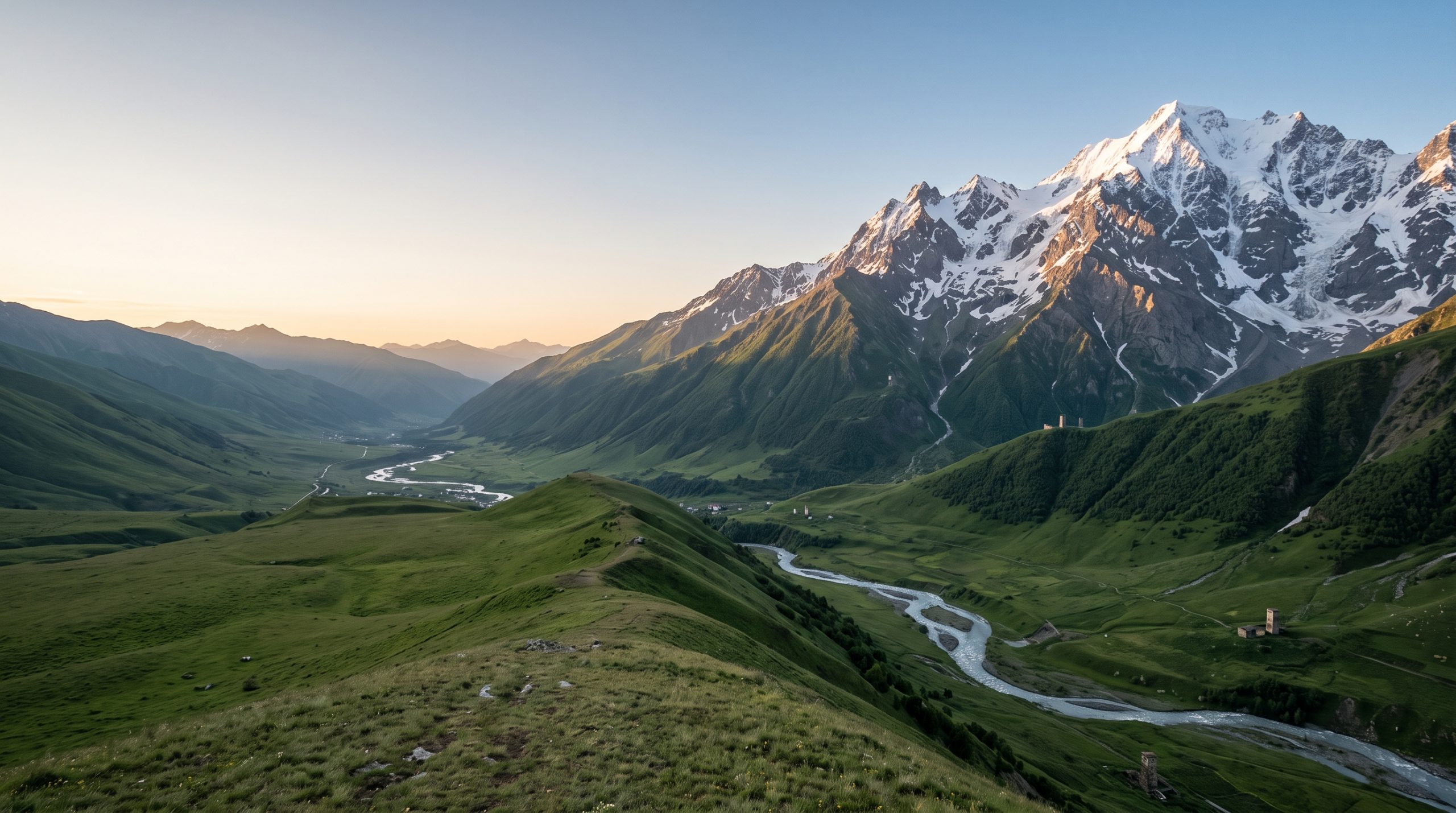
At half past five on a June morning above Stepantsminda, there is nobody at Gergeti Trinity. A dog barks somewhere down in the village, the wind comes off Kazbek in short pushes, and the light lands on the east wall of the church about ten minutes before it reaches the meadow below. By eleven the same hillside holds a line of 4×4 taxis and forty people with phones out. The early version and the late version of that place are two different photographs, and only one of them is worth flying for.
None of that early hour needs a registrar. A symbolic ceremony is set by the light and the drive rather than by an office diary, because nothing about it is filed anywhere. The legal marriage runs on its own track: signed at home before you fly, or registered at a Public Service Hall in Tbilisi if you would rather have it stamped in the country you are standing in.
What follows is the practical side. What a symbolic ceremony in Georgia, Armenia or Azerbaijan actually costs, what each registry asks for if you do want the legal side handled in the region, and the places where the two get tangled. Treat this as a planning map for the Caucasus, not a legal opinion. Rules change and circumstances differ, so confirm the detail with the relevant registry office or your own consulate before you book flights.
No registrar, no file, no notice period
A symbolic ceremony has no state office behind it. Nothing is submitted, so there is no notice period, no witness rule and no state duty attached to it. You choose the hour, the place and the words, and you handle the legal marriage separately, most often at home in the weeks before you fly out.
Georgia, Armenia and Azerbaijan: how hard the legal route really is
The three South Caucasus countries are not interchangeable on paperwork, and the distance between them is wider than the distance between their mountains.
Georgia is the straightforward one. Marriage is registered by the Public Service Development Agency through the Public Service Halls, the minimum age is 18, and registration through a representative is not permitted, so both of you attend in person. Two legally capable witnesses of full age have to be present. Any document issued in another country, other than an identity document, must be apostilled or legalized and submitted with a notarized Georgian translation, and the agency can accept a foreign passport without a translation where the personal data appears in Latin transliteration. A foreign citizen also has to show a document proving they are in Georgia on legal grounds, which is a lighter thing than residency.
Armenia is slower by design, and there is nothing wrong with that once you plan for it. Registration sits with the Civil Status Acts Registration Agency, the office most people still call ZAGS. Documents have to be apostilled and come with notarized Armenian translations, permission for a marriage involving foreign citizens is issued within 10 working days, and the state duty for that registration, certificate included, is 100,000 AMD. At recent exchange rates that is a little over 250 US dollars, and it is the only conversion in this article. The date can be set no earlier than the next working day after the application, and no later than six months from it. Both of you attend in person on the day, though an authorized representative can lodge the application beforehand, which is what lets those 10 working days run while you are still at home.
Azerbaijan registers marriages through the ASAN service centers. Documents issued abroad are apostilled in the country that issued them, translated into Azerbaijani, and only then submitted. The marriage age is 18.
| Country | Office that registers | Timing rule to plan around | Documents issued abroad |
|---|---|---|---|
| Georgia | Public Service Halls and territorial offices of the Public Service Development Agency | Both people attend in person with two adult witnesses; registration by representative is not permitted | Apostilled or legalized, with a notarized Georgian translation |
| Armenia | Civil Status Acts Registration Agency (ZAGS) | Permission within 10 working days; the date falls no earlier than the next working day after the application and within six months of it | Apostilled, with notarized Armenian translations |
| Azerbaijan | ASAN service centers | Applications filed in person at ASAN | Apostilled in the issuing country, then translated into Azerbaijani |
Published guidance varies on witnesses. A lot of pages written for foreign couples say none are needed for a Georgian registration. The agency’s own service description says the marriage is registered with two legally capable witnesses of full age present, and the agency is the office that governs the answer, so plan for two.
One thing worth naming plainly: Georgian legislation defines marriage as the voluntary union of a man and a woman, in the wording Georgia’s own consular pages use. Same-sex couples marry at home and hold the ceremony here, which is exactly the shape this article describes and a genuinely good one. Tell us where the legal marriage is happening and we will build the week around the mountain instead of around an office.
If Georgia is your legal route, this is the file behind it
This applies only if you want the legal marriage registered in Georgia. Collect in this order, because two of the steps can happen nowhere but home.
- Both passports. A translation is not needed where the personal data is written in Latin transliteration, which covers most Western passports.
- Proof that you are in Georgia on legal grounds. Keep whatever your entry gave you with the passports rather than in a bag at the guesthouse.
- If either of you has been married before, the document ending that marriage, apostilled or legalized in the country that issued it. This is the step that has to be done at home.
- A notarized Georgian translation of that document, and of anything else issued abroad other than your ID.
- Two witnesses, legally capable and of full age, present at the registration itself.
- The joint application, filed by the two of you in person.
Where the money goes on a symbolic day
Strip the state out and a symbolic ceremony costs nothing to hold. No duty, no license, no filing fee, because there is no file. What you pay for in the Caucasus is getting two people and a team to the right spot at the right hour, and that is a transport question far more than a wedding question.
The line items, roughly in order of size:
- Getting up the mountain. A driver with a real 4×4 for the Abano Pass into Tusheti, or the climb to Ushguli in Upper Svaneti, is usually the largest local cost of the day. Roads here are measured in hours, not kilometers.
- Where you sleep. Guesthouses in Kazbegi, Mestia or Dilijan, plus the night in Tbilisi or Yerevan on either side of the flights.
- Whoever reads the ceremony. A celebrant you bring, a friend who flies out, or nobody at all: two people, written vows, and an empty hill at six in the morning.
- Paperwork, if you register in the region. Apostilles at home, notarized translations once you land, and in Armenia the 100,000 AMD state duty.
- Land and venue courtesies. A guesthouse terrace, a family’s hayfield, a marani courtyard in Kakheti. Where a fee applies we find out early, so it is never a conversation on the morning itself.
Our coverage sits alongside all of that: The Adventure is one full day with a dedicated photographer or filmmaker from $4,900, The Expedition puts a photographer and a filmmaker on the ground together from $7,900, and everything else, including multi-day work across Georgia and Armenia, is set out on the pricing page.
Build the Caucasus day from the ceremony light rather than from paperwork
Start with the hour, not the date. In late June above Stepantsminda the sun is up before six and there is usable light past nine at night, which hands you two good ends of a day and a long empty middle for driving. In October the day is shorter, the valleys go gold, and the soft light lasts longer at both ends. The general shape of a planning year is in our guide to how eloping actually works; below is the version specific to these three countries.
- Twelve to eighteen months out. Country, region and date window, then a contract and the 30 percent retainer that opens planning. Our current booking window runs through 2027, 2028 and 2029.
- Six months out. If Armenia is the plan, find out exactly which certificate your home authority issues to show you are free to marry, and how long that authority treats it as current. Order it late enough that it still is on the day it is read.
- Two months out. Apostilles, at home. Nothing in Tbilisi or Yerevan can substitute for this.
- Ten working days out at the absolute earliest. Armenia’s permission for a marriage involving foreign citizens. A representative can lodge the application before you land, which is the only reason this fits inside a normal trip.
- Two clear working days in the capital. Translations, notarization, and the registration itself, before anybody drives north.
- The day. Ceremony hour set by the light, drive times set by the road rather than the map.
The real minimum in Georgia is short: documents in hand, two witnesses, one office visit. The comfortable minimum we work to is different, and it is the one we would put in your timeline. Arrive with every apostille already stamped, keep two working days in Tbilisi or Yerevan before the mountains, and put a night between the registration and the ceremony so that a delayed office does not move your light. Send Us a Message with the month you have in mind and we will tell you what the light does then and which passes are open.
Six things that catch couples out
An apostille only comes from where the document was born
No office in Tbilisi or Yerevan can apostille a divorce decree issued in Ohio or a certificate of no impediment issued in London. That stamp comes from the authority in the place that issued the paper. It is the one item on the list with no local workaround, so it goes in the suitcase, not on the to-do list for arrival.
Translations and notarization are their own working day
Georgia asks for a notarized Georgian translation with any foreign document other than your ID. Armenia asks for notarized Armenian translations across the board. Most couples handle this in Tbilisi or Yerevan, where the translators and the notaries sit close together, which is why we keep a city day at the front of an itinerary instead of routing you from the airport straight to the peaks.
Two witnesses, decided before the morning of
A Georgian registration needs two legally capable adults in the room. Couples eloping with no guests often have not thought about this until the car is moving, and it is a much better question to raise when you file the application. Small things like this are what move a ceremony hour by two hours.
The offices are in the cities and the mountains are not
Stepantsminda sits about 155 kilometers north of Tbilisi up the Georgian Military Road, and in summer that drive takes most of a morning. Mestia is considerably further. Registration day and ceremony day are separate days in every plan we build, with a night in between and a spare morning if the season is generous.
The Abano Pass is a summer road
Tusheti opens late in the spring and closes again in the autumn, so a June week and a late September week are two different maps of the same country. We plan Tusheti inside that window and hold Kazbegi, Khevsureti or Racha as the alternative when the season is tight, and you will know which one we are building around before flights are booked.
Card machines thin out as you climb
Tbilisi and Yerevan are card cities. Omalo, Ushguli and the smaller guesthouses around Dilijan are not always, and a driver, a guesthouse and a village supper can all want cash on the same morning. We plan mountain days assuming cash, and then it is never a problem.
The charges and deadlines quoted for the Caucasus are not permanent tariffs. Re-check them with the issuing office before flights or accommodation depend on them.
What we take off your hands for a Caucasus symbolic day
We plan around the constraints rather than pretending they are not there. That means holding your date against the season and against office availability, setting the ceremony hour by the light rather than by a diary, mapping real drive times instead of map distances, and keeping a second location fifteen minutes away for the morning the cloud sits on the ridge. Destination and location design, the timeline, permit research and logistics guidance are part of every experience. The permit fees themselves are yours, along with the celebrant, the vendors and any helicopter or 4×4 charter. So is the paperwork: we do not file documents, act as agents or give legal advice.
There are eight of us, so there is always a second camera on the ground and a colleague in reserve. On a ceremony-only day that matters more than couples expect, because the vows happen once, often in a wind that eats sound, and a photographer and filmmaker who already work as one team can cover that single hour from two positions without either of them asking anyone to move.
Highlights reach you five days after the day. The full gallery or film follows within three weeks. If you want to see how these valleys actually render before you commit to one, our published stories and films are the honest version, flat grey mornings included alongside the ones where Kazbek clears at exactly the right minute.
Common questions
Is a symbolic ceremony in Georgia legally binding?
No. Nothing is filed, so nothing changes your legal status. The marriage itself is made either at home or by the Public Service Development Agency at a Public Service Hall. Most couples sign at home first and treat the mountain morning as the ceremony they will actually remember.
Do we need witnesses for a symbolic ceremony?
Not for the symbolic one. Two legally capable witnesses of full age are required at a Georgian registration, but a symbolic ceremony has no such rule, and many of them happen with nobody present except the two of you and the team covering it.
How much is the state duty to get married in Armenia as a foreigner?
The state duty for registering a marriage involving foreign citizens, certificate included, is 100,000 AMD, with permission issued within 10 working days and a government-set additional fee if you need it sooner. Apostilles and notarized Armenian translations are separate and are paid where each document is issued.
Can we legally marry in Georgia while we are there as tourists?
The agency asks a foreign citizen for a document proving they are in Georgia on legal grounds, which is not the same as residency. Both of you attend in person, you bring two adult witnesses, and any foreign document other than your ID needs an apostille or legalization plus a notarized Georgian translation.
Can two men or two women hold a ceremony in the Caucasus?
Georgian legislation defines marriage as the union of a man and a woman, so the legal marriage happens at home and the ceremony happens on the ridge. That is the same route plenty of opposite-sex couples choose as well, and it changes nothing about the day itself. Tell us where you are signing and we will plan around it.
Can we hold the ceremony at Gergeti Trinity or Tatev Monastery?
Both are working churches with their own service times and their own view of what happens inside them, so we ask well in advance rather than assume. In practice the vows usually sit outside, on the grass or on the ridge with the building in frame, which is the picture most couples had in their heads anyway.
How far ahead should we book a Caucasus elopement?
We are booking 2027, 2028 and 2029, and the high mountain dates inside the short summer window go first. Planning begins once the contract is signed and the 30 percent retainer is paid, which for most couples lands twelve to eighteen months out.
Do you travel to Georgia and Armenia for a single day of coverage?
Yes. Team travel is included worldwide: flights, accommodation and ordinary travel for the assigned team, with no long-haul distinction. Guest count does not change the fee either. It changes access, permits, transport and the timeline, which is planning work rather than a surcharge.
Choosing your morning above the valley
Everything on our side happens in writing. You send the inquiry form, a reply and our initial brochure come back within 24 hours, then a tailored proposal, a contract and the retainer, and planning starts properly from there. Region by region notes are in our destination elopement guides if you are still choosing between Khevi, Svaneti and southern Armenia. Tell us the month, the country and whether you are signing at home or in Tbilisi, and we will come back with what that mountain does at that time of year and which hour we would hold for the vows. Start Your Story.