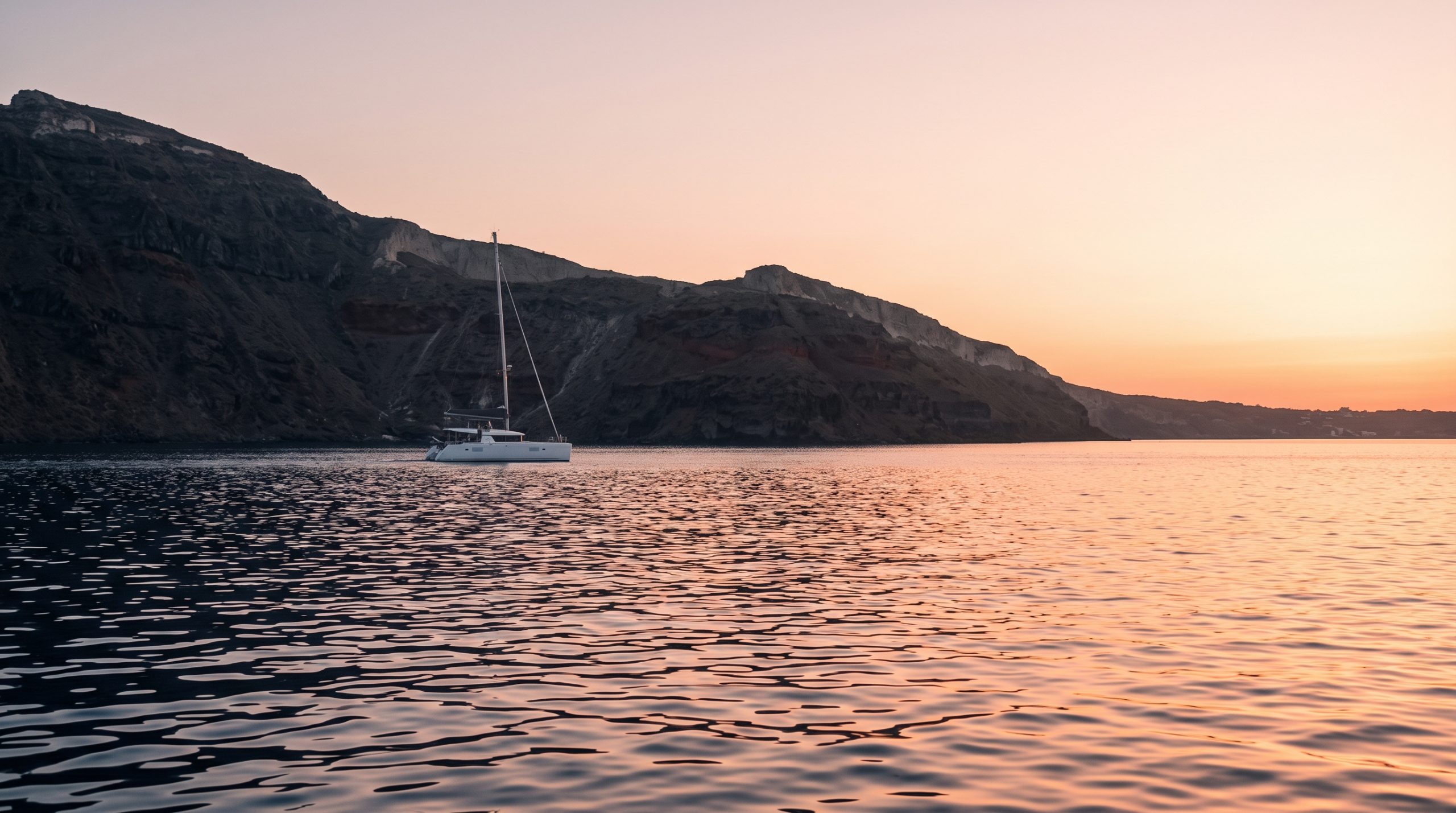
On the June solstice the sun sets over Santorini at 20:39. Sit in the middle of the caldera and it will be gone from your deck before that. Thirasia stands 295 meters out of the water on the western side of the basin, roughly 970 feet of dark ridge, and depending on where the captain has parked you it takes the last ten to twenty minutes of direct sun off your faces.
No cruise listing mentions this. It is the first thing we work out when a couple asks about saying vows on a catamaran here, because it decides the whole afternoon: which port you leave from, what time you board, and which patch of a flooded volcano ten kilometers across the boat is holding when you turn to face each other.
The rest of it is more forgiving than the cliff path in Oia. No permit office to satisfy for the ceremony itself, nobody standing behind you at a viewpoint, no queue for the frame everyone else came for. Just salt, a moving deck, wind, and the handful of decisions below.
Symbolic vows, a private charter, and the last hour of light
Vows said on a catamaran in the Santorini caldera are symbolic: the charter contract is your permission, so there is no landowner or park office involved. Greece’s legal route runs separately, through the Municipality of Thira’s civil marriage office in Fira. Everything else about the day is timing, and the timing is set by sunset.
Why the sun leaves the water before it leaves the sky
Two things shift through the season: the hour the sun goes down, and the point on the horizon where it does it. Between mid October and the June solstice that setting point swings about forty degrees along the western horizon, from southwest to well north of west. The swing is what decides whether Thirasia is standing in your way.
| Date | Sunset, island time | Bearing of the setting sun |
|---|---|---|
| 20 April | 19:56 | 285° |
| 20 May | 20:22 | 296° |
| 21 June | 20:39 | 300°, its furthest north |
| 20 July | 20:33 | 297° |
| 1 September | 19:46 | 281° |
| 25 September | 19:10 | 269°, due west |
| 15 October | 18:42 | 260°, into the southwest |
At this latitude the sun’s final three degrees of altitude take about twenty minutes. That is the whole budget for the closing frames, and geometry spends it for you. Thirasia’s high ground covers roughly three and a half degrees of sky from five kilometers away and half of that from ten, so a boat holding close under the Thirasia shore gives up around twenty minutes of sun, while a boat under the Santorini cliffs keeps nearly all of it.
Which is convenient, because the Santorini side is where you want to be anyway. The caldera wall faces west. From late afternoon until the last of it, that wall takes light full in the face, and the whitewash at Imerovigli runs white to bone to apricot inside half an hour while the volcanic rock underneath turns red brown and holds the color. Frames looking east put the lit wall behind you. Frames looking west put you against the sun and the glare on the water. Those two directions are one turn of the wheel apart on the same boat, which is the real luxury of doing this afloat. Our published galleries and films show how differently the same hour reads in each direction.
The whole fleet points at the same patch of water
Sunset catamarans here follow one pattern: away around 15:30, roughly five hours on the water, the last of it spent in the northwest corner of the caldera below Oia. There is a great deal of company doing exactly that at exactly that moment in August. Sit inside the cluster for the final forty-five minutes and other people’s boats are in your film while you are in theirs.
Santorini now caps cruise arrivals at 8,000 passengers a day, which has eased the alleys in Fira and Oia, but it changes nothing on the water. Crowding out here is boats rather than people, and it concentrates into the last hour. We choose position from the sun’s bearing for your date, which puts the traffic behind the camera instead of beside it. It is one of the very few crowd problems on this island with a clean answer.
Boarding at Vlychada or Ammoudi without wrecking the dress
Most caldera catamarans work out of Vlychada, on the south coast, and that is the practical port if you are staying anywhere south of Fira. Ammoudi, on the water directly below Oia, is the shorter transfer from an Oia or Imerovigli hotel, and it drops you into the caldera within minutes of casting off rather than after a run around the island.
Do not come down to Ammoudi on the old stepped donkey path in wedding clothes. It is several hundred uneven cobbled steps with no shade in the middle of the day, which makes it a good photograph and a poor route. Cars come all the way down to the quay, and that is how you should arrive.
Boarding is one step across from stone onto something that is moving, with a hand from the crew. Easy barefoot, awkward in heels. Heels come off once you are aboard anyway, because they mark a deck and slide on it, so choose the shoes you are photographed in for the quay and the clifftop rather than for the boat.
Two more things about fabric. Spray comes over the side on the way out even in a moderate breeze, and a long train collects everything a working deck has on it. And if your route takes in the hot springs off Palea Kameni, the water there is loaded with iron and manganese and turns light fabric orange. Swim, by all means. Swim after the vows, in something whose color you are not attached to. Our destination guides go further into what to pack for a day at sea.
Two cameras on one foredeck, and what wind does to vows
A catamaran suits this better than any other boat in the caldera, and the reason is the deck plan. Wide foredeck, shaded cockpit aft, swim platform at water level, and on most charters a position up by the helm. Four places to stand on one vessel means a photographer and a filmmaker can cover the same three minutes of vows from genuinely different angles without either appearing in the other’s frame. Attempt the same thing in the cockpit of a monohull and somebody is always in the shot.
Both of them come from the same team on the same charter, planned together, rather than a photographer and a separately hired videographer introducing themselves on the quay. Our full-day coverage comes two ways and the numbers sit on the pricing page: The Adventure, with one dedicated photographer or one dedicated filmmaker, from $4,900, and The Expedition, with both aboard working together, from $7,900. The Expedition also brings professional audio for the vows where conditions allow.
That last point matters more afloat than on land. Even a light breeze becomes apparent wind across an open deck, and unprotected vows disappear into it. So we set the ceremony where the boat’s own structure gives shelter, ask the captain to hold a heading that puts the air over your shoulders instead of into the microphone, and record the words properly rather than hoping a camera catches them. Wind noise cannot be repaired later. It has to be planned out beforehand.
The paperwork happens in Fira, not on deck
Most pages hedge this, so here it is plainly. For a private ceremony aboard a boat you have chartered, there is no ceremony permit to apply for and no office to write to. No beach authority, no landowner, no municipal viewpoint slot. The charter agreement covers the vessel and the captain’s timings cover the rest of it.
A legal Greek marriage is a separate errand with its own paperwork. Applications go to the Municipality of Thira, whose civil marriage office sits in Fira, and the documents are the fussy part: full birth certificates rather than short-form extracts, evidence that you are free to marry, official translations and apostilles, some of it dated inside a window before the wedding day. Plenty of couples complete the legal step at home and keep Santorini for the ceremony they will remember. We sequence whichever order you choose, and the permit research and logistics for the day are ours; government, venue and charter fees are yours to pay. If you are weighing the two routes, our planning fundamentals set out the difference.
Drone footage is included wherever it is legal, safe and appropriate. From a boat that means agreeing launch and recovery with the captain before you leave the quay, and flying while the vessel holds position rather than under way. Ten minutes of planning on the dock buys the film the one frame that exists nowhere else: two people on a white deck in the middle of a flooded volcano.
What a northerly changes
The Meltemi is the Aegean’s summer northerly, dry and persistent, strongest through July and August and gentler in June and September. It rarely cancels a day here. It moves it.
When it blows hard, the sheltered water is the south coast, which is exactly where Vlychada already points you: Red Beach, White Beach, the Akrotiri lighthouse, all of it in the lee of the island. The caldera crossing is the lively part, so we build the day with the ceremony hour on the protected side and the caldera as the second half, then reverse the two if the morning says to.
There is also a shape almost nobody asks for. Sunrise in late June is at 06:00, and the basin stays inside the shadow of its own wall for roughly the first hour after that, because the rim rises 250 to 300 meters above the sea and blocks 10 to 15 degrees of sky from a boat sitting a kilometer off. A dawn charter therefore gives you glass-flat water, an empty caldera and an hour of blue shade with the cliff tops burning above you. It is beautiful, and it is not the golden sunset most couples picture. If you want both, that is a two-day shape, and it is what The Odyssey is built for.
If a moving deck does not appeal at all, the caldera reads just as well from the rim, on the path between Imerovigli and Oia before the tour buses reach it. Tell us which of those two days sounds more like you and we will build that one, or say honestly which month fits it better.
Common questions
Does the charter still go out if the wind gets up?
That decision belongs to the captain and it is made on the morning, not days ahead. On a strong northerly the working water shifts to the south coast out of Vlychada, so we design the ceremony hour to survive that swap rather than depending on one spot below Oia.
Can we legally get married on the boat, or is it symbolic?
The ceremony afloat is symbolic. A legal Greek marriage is arranged through the Municipality of Thira’s civil marriage office in Fira, with certified, translated and apostilled documents. Many couples sign at home and keep the caldera for the vows. We build the timeline either way.
Is there anywhere to change on board?
Cabins on a charter catamaran are small and the bathroom is smaller, so treat changing as possible rather than comfortable. Board dressed, bring a bag with swimwear and something dry for the ride back, and keep the shoes you can walk a stone quay in near the top.
What time do we leave the hotel for a sunset ceremony?
We work backwards from sunset, which runs from 20:39 on the June solstice to 19:10 in late September. Shared sunset cruises push off around 15:30. On a private charter your ceremony hour sets the departure, plus the transfer, which is shortest of all from Oia down to Ammoudi.
Will other boats end up in our photographs?
If we sit where the fleet sits, below Oia in the final forty-five minutes, yes. So we do not sit there. Position comes from the sun’s bearing on your date, which keeps the other boats behind the camera and leaves you a clean western horizon.
Can we swim at the hot springs in our wedding clothes?
Better not. The water off Palea Kameni carries iron and manganese that turn light fabric orange, and the springs are a short swim from where boats stop. Vows first, then change into something whose color you are not precious about, then get in.
Planning backwards from the sun’s last twenty minutes
A day afloat is one of the few Santorini elopements where almost everything sits inside your control: the boat, the route, the hour, the horizon behind you. What you cannot control is where the sun goes down on your date and what the air is doing that morning, and both of those can be planned around instead of hoped about. Dates are currently open across our 2027, 2028 and 2029 Santorini seasons, and the full planning trail stays written and easy to revisit, at whatever hour suits you: send the form, and our reply and first brochure reach you within 24 hours, then a proposal built for your date, then a 30% retainer holds it. Highlights come back five days after the wedding day, the full gallery or film three weeks later. Tell Us Your Story, and tell us what you want those last twenty minutes to look like.