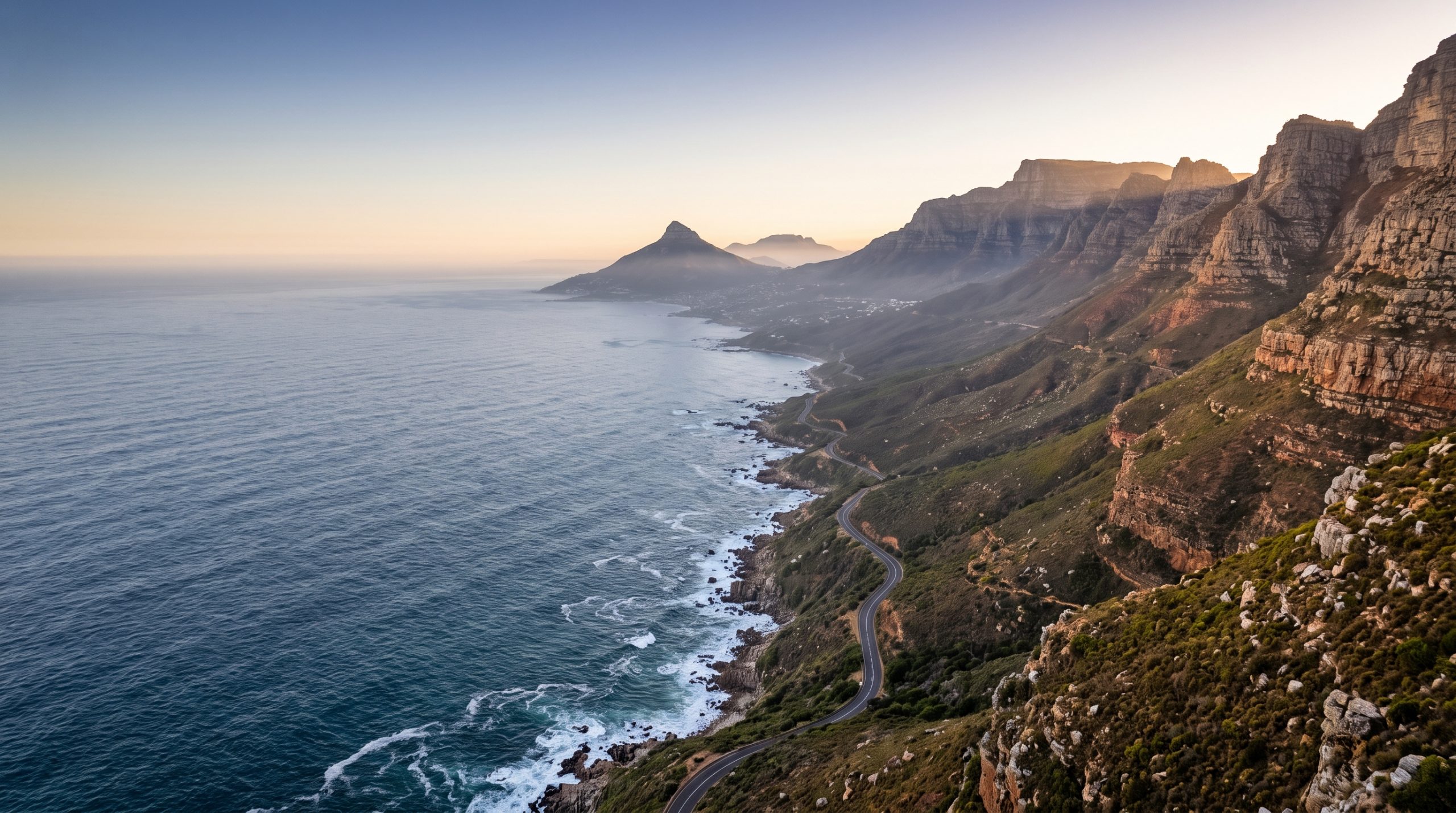
Table Mountain National Park issues no filming or photography permits at all between 15 December and 15 January. It sits in the park’s own rules as one short line, and it rearranges more Cape Town elopements than the weather does, because that fortnight is exactly when most couples flying in from the States assume they will be standing on a ridge above the Atlantic with rings in a pocket.
The second thing nobody writes down is where the sun comes from. At the December solstice it breaks the horizon at 5:32am, and it breaks it behind the mountain, over the ranges on the far side of False Bay. The Atlantic seaboard sits in shadow while the summit rock above it is already lit, so Clifton at six in the morning is a fine place for coffee and a poor place for vows. Sunset belongs to the Atlantic, just before eight, and a summer day here works backwards from those two facts.
We are eight people, four photographers and four filmmakers, and photography, film and planning are one service rather than three separate bookings. This is the cost page, so it carries the numbers, the rand you hand over at gates, and the shape of a day built around the wind instead of hoping it stays away. Our South Africa calendar is currently open across 2027, 2028 and 2029.
What coverage on the Cape Peninsula costs
We photograph, film and plan elopements across the Cape Peninsula. One full day with a dedicated photographer or filmmaker starts at $4,900. One day with both, working the same timeline, starts at $7,900. Team travel to Cape Town is included. Longer, multi-day coverage is a custom proposal. Gate fees, permits and your celebrant are paid locally, in rand.
5:32am on a ridge, 7:56pm on the Atlantic
A summer day starts in the dark, which sounds worse than it is. The alarm goes at 4:40am. The drive up Signal Hill, or the first steep 40 minutes of the Lion’s Head path, happens by headlamp, and the city is still a grid of orange below you when you reach the ground we chose.
By 5:15 the sky behind the far ranges has separated from the water. Sunrise at 5:32am does not light you; it lights the rock and the sea, and for a quarter of an hour you stand in an enormous cool shadow with a lit landscape in front of you. Then the sun clears the ridge line and the top of Lion’s Head warms all at once. In our experience the south-easter is at its most polite before seven, which is one more argument for the early hour.
Ceremonies mostly land between 7am and 9am, once a celebrant and two witnesses can reach the same piece of ground without anyone walking in the dark. South African civil marriage needs a marriage officer and two witnesses present, and that puts a road, a gate and a parking space into the timeline whether the photographs want them there or not.
Mid-morning belongs to the drive south. Boulders, where the penguins are, and Cape of Good Hope at the southern end of the peninsula both sit behind SANParks gates that open well after 5:32am, and this is the most common planning error we untangle: a sunrise at Cape Point that the gate will not allow. The park is a mid-morning or late-afternoon block, never a dawn one, and the run down the False Bay coast to reach it is worth as much as the arrival.
Then comes the flat part of the day, and we would rather name it than dress it up. Between roughly 11am and 3pm in January the sun sits almost overhead, contrast turns unkind, and the deck at Cape Point has three coaches parked below it. That is not the frame anyone books us for. So we eat, we drive Chapman’s Peak with the windows down, we use the shade of a Noordhoek pine block or the cool of a cellar an hour east, and we spend those hours moving rather than performing.
Late afternoon runs back north. From about 6pm the Twelve Apostles wall turns and the granite at Oudekraal and Llandudno starts holding light instead of bouncing it. Sunset just before 8pm goes into the sea rather than behind a hill, so the 25 minutes after it are usable, and often better than the sunset itself. We are frequently still working at 8:30pm and back at your accommodation before nine. A Cape Town summer day is long without feeling rushed, which is the whole reason one day is genuinely enough here.
The same day in June, four and a half hours shorter
Midwinter sunrise is 7:51am and sunset is 5:45pm: 9 hours and 53 minutes of daylight against 14 hours and 24 minutes at the December solstice. That compression is a gift if a 4:40am alarm is not your idea of a good start. One day still covers the whole arc of light, the fronts come through from the north-west and leave the air scrubbed clean behind them, and the mountain is green rather than blond. Park gates and trails are quiet in a way they never are in February.
Send us a week and nothing else, and we will tell you what the light does on those dates and which gates are open. Check Your Date
What the tablecloth does to a film, and why two of us are there
When the south-easter builds, cloud forms on the eastern slopes and spills over the front face of Table Mountain as the tablecloth. Underneath it the light changes every few minutes: hard, then diffused, then hard again, with a wind pushing at everything that is not bolted down. It is the best light of the year and the most demanding hour to work in.
One person alone has to choose. The wide static frame that shows the scale of the peninsula, or the moving one that follows a couple across the rock. A photographer and a filmmaker working the same timeline do not choose. One holds the frame while the other moves, and both of them already know which way the couple will walk, because we wrote the timeline together weeks earlier.
Audio is where it matters most. The Expedition adds professional audio for vows and the moments that carry sound, and in a south-easter that comes down to where a microphone can survive. Where the microphone can sit and where the light is best get decided in one conversation, before the vows, rather than negotiated on a ridge by two people who met that morning. On the Cape Peninsula that single decision is often the difference between a film with your voices in it and a film with wind in it.
Aerials follow the same discipline. Commercial drone work in South Africa needs a licensed remote pilot and an operator certificate behind them, plus permission from whoever controls the ground, which on the mountain is SANParks and on the beaches is the City of Cape Town. So an aerial is a slot in the plan with a permit and a window attached, and if the wind closes that window the film does not depend on it. The films and galleries in our stories are the honest version of what this coast looks like when both cameras are working the same hour, wind included.
Eight of us also means there is always a second camera on the ground and a colleague in reserve. That is not a slogan. It is the reason a Cape Town date holds.
The south-easter, and the plan that does not depend on it
Cape Town’s reputation for wind is earned. The Cape Doctor is a strong, dry south-easterly that runs from spring through late summer, roughly October to March, and it is the engine behind the tablecloth on the mountain. Winter weather arrives from the other direction entirely, as north-westerly fronts. The stretches visitors find calmest are late March into May, and September into early December.
We plan for it by direction rather than by hope. In a south-easter the Clifton coves sit behind Lion’s Head and the wind runs over them instead of into them, so that is where a sheltered hour goes. When a winter north-wester is up we cross to the False Bay side, where the same swell arrives politely. Every exposed location in your timeline has a named alternative a short drive away, decided before the morning rather than during it, and the ceremony goes in the lee so the vows are audible.
The cableway runs on the wind, which is why we never hang a ceremony on it. If it turns out to be a still, clear day and the cars are running, it is a bonus we can build into the afternoon in twenty minutes. It is never the plan.
What travels with us, and what you pay in rand
Our side of the budget is a single figure and it does not grow on arrival. There is no long-haul surcharge for Cape Town, no travel line added later, no mileage between the two coasts.
In every experience
- Destination and location design across the peninsula and, if you want it, the winelands an hour east.
- Planning, and a custom timeline built around real light and real driving time between the two coasts.
- Permit research and logistics guidance, including which office governs which piece of ground.
- Weather alternatives and backup locations chosen by wind direction.
- Drone footage where it is legal, safe and appropriate.
- Professional audio for vows and meaningful moments on the Expedition, where conditions allow.
- Team travel worldwide: flights, accommodation and ordinary travel for the team assigned to you.
- Highlights delivered in 5 days, and the full gallery or film in 3 weeks.
Paid locally, in rand
South African access is governed piece by piece, and the office that controls the ground sets the fee. Where coverage starts, and what sits inside each of our three shapes, is on our pricing page.
| Where you want to stand | Who controls access | What you pay there |
|---|---|---|
| Cape of Good Hope, southern end of the peninsula | SANParks, Table Mountain National Park | R515 per international adult per day, R250 per child, plus a photography permit fee |
| Boulders, where the penguins are | SANParks | R245 per international adult per day |
| Silvermine or Oudekraal | SANParks | R200 per international adult per day |
| Clifton, Camps Bay, the Sea Point promenade | City of Cape Town Film Permit Office | Permit tariff set by the City, applied for per location |
| A wine estate in Franschhoek or Stellenbosch | The estate itself | A site fee the estate sets |
Conservation fees are reviewed every 1 November, and they are charged per person per day, so extra guests move that line rather than ours: our fee never changes with guest count. The rand has been trading in the high teens to the dollar, which puts the Cape Point gate at roughly thirty dollars a head. Certain park locations also ask for an environmental control officer or a baboon monitor on the day, billed on top of the permit fee, and we find that out at application rather than on the morning.
Your celebrant, accommodation, food and vehicles sit outside our fee, as does anything unusual: a boat out of Hout Bay, a helicopter over the peninsula, a 4×4 for a farm track.
How a Cape Town 2027 date moves from enquiry to hold
Six steps, all of them in writing. If you are earlier than this and still working out what an elopement day contains, start with our guide to how to elope and come back.
- You send the inquiry form with your dates, a rough number of people, and anything you already know you want.
- We reply within 24 hours, with our initial brochure.
- We come back with locations, a shape for the day, and which authority governs each piece of ground in it.
- You get a tailored proposal: coverage, the team assigned to you, the timeline.
- Contract signed and a 30% retainer paid. The remaining schedule is set out in the proposal.
- Planning begins in earnest: permit applications, weather alternatives, and every small logistic between 4:40am and dark.
Who the peninsula suits, and the month we would move you to
This coast rewards a particular kind of morning person. Couples who will set an alarm for 4:40am in January. Couples who are steady on a rocky path by headlamp for 40 minutes and do not mind arriving at the top slightly out of breath. Couples who are relaxed when we message the night before to say the wind has swung and we are starting on the False Bay side instead.
If none of that sounds like you, it does not mean Cape Town is out. A June day starts at 7:51am and still gives you the full arc of light. The winelands an hour east of the city give a gentler shape entirely, with oaks, a cellar and no ridge in it. And if the turn of the year is your only free fortnight, tell us early, because that is the window when park photography permits pause and the days we build then run on city land and private estates instead. Our destination guides are a good place to compare the months before you write.
Whatever shape you actually want, tell us in plain words and we will build the day around it, or tell you honestly which month on this peninsula fits it better.
Common questions
Do we need a permit to be photographed on Table Mountain?
Yes. Permits come from the Table Mountain National Park permit office, and no filming or photography permits are issued anywhere in the park between 15 December and 15 January. Individual sites also have their own closed dates. Some locations require an environmental control officer or a baboon monitor, billed on top of the permit fee. The research and the application logistics are ours; the fee is yours.
Can two Americans legally marry in Cape Town?
Yes, under South African civil law, with a marriage officer and two witnesses present. South Africa asks foreign citizens for a letter of no impediment to marry. US consular officers do not issue that letter, so US citizens execute a sworn affidavit before a consular officer instead. Passports are needed, and a final decree of divorce if either of you has been married before.
How much does it cost to get into Cape Point?
The Cape of Good Hope section charges R515 per international adult per day and R250 per child, reviewed every 1 November. Boulders, for the penguins, is R245 per international adult. Those fees are per person per day, so anyone joining you pays them too.
Is the first week of January a bad time to elope in Cape Town?
It is the busiest fortnight of the Cape Town year and the window when park photography permits pause, from 15 December to 15 January. Days in that period work on city land, beaches and private estates, and we plan them that way. If your dates are movable, February through April gives you the same light with far more ground open.
How early do we have to be awake?
In late December sunrise is 5:32am, so a ridge start means a 4:40am alarm and a beach start means about 5:15am. In June sunrise is 7:51am, and the same day begins closer to 6:45am. We build the wake-up backwards from the light and the drive, and we tell you the number in the timeline.
Can you fly a drone over the Twelve Apostles or Cape Point?
Where it is legal and conditions allow. Commercial aerial work in South Africa requires a licensed remote pilot and an operator certificate, plus permission from whoever controls the ground: SANParks on the mountain, the City of Cape Town on the beaches. We confirm the permission and the time window during planning, and the film is never built so that it needs the aerial.
How soon do we see the photos and the film?
Highlights reach you 5 days after the day. The full gallery or film follows within 3 weeks. That holds whether you are home in the States by then or still driving the Garden Route.
Does the price change if our parents and two friends come?
Our fee does not change with guest count. Guests affect access, permits, transport and the timeline rather than the figure. The one place they show up is the conservation fee at a park gate, which is charged per person per day.
Your first email, and what comes back
The full planning trail stays written and easy to revisit, at whatever hour suits your time zone: your first message, our reply and brochure inside 24 hours, then a proposal you can read twice before deciding anything. Tell us the week you are thinking about, whether you want sunrise on rock or dusk on granite, and how many people will be standing near you. We will come back with the light, the gates and the honest shape of the day. Tell Us Your Story