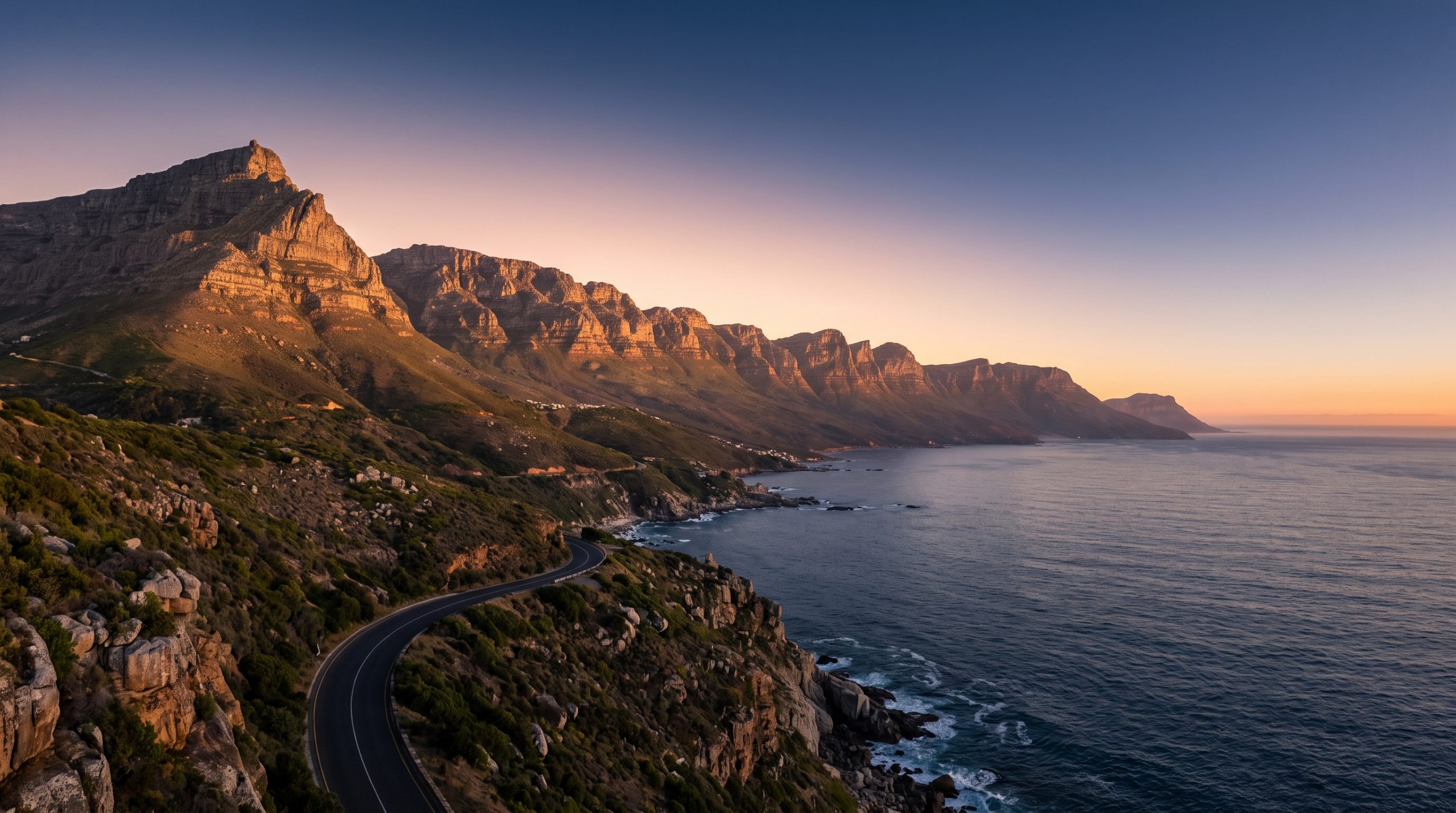
The gate at the Cape of Good Hope closes at 18:00 from October to March. In late December, the sun sets at four minutes to eight. Those two numbers settle something most couples assume is still open: you cannot stand at Cape Point for your vows in the last light of a summer evening. Nobody mentions it until you are at the gate.
Cape Town looks compact on a map. It behaves like six destinations bolted onto one peninsula, each with its own opening hour, toll booth, pay point or permit office, and each facing a different direction into the light.
We photograph and film elopements here as one team, so what follows is what we build a schedule from: the hours when the light does something worth standing outside for, the paperwork with a lead time, and the places where a route planner and the real road disagree.
Three days, two gate hours, one wind direction
Fly into Cape Town International, allow at least three full days, and plan the ceremony hour around two fixed numbers: the Cape of Good Hope gate hours, roughly 06:00 to 18:00 October to March, and sunset, which in late December falls just before 20:00. Everything else on the peninsula bends to those.
Fourteen hours of light in December, under ten in June
On 21 December, Cape Town gets 14.4 hours between a 05:32 sunrise and a 19:56 sunset. On 21 June that drops to 9.9 hours, a swing of roughly four and a half hours across the year. The earliest sunrise lands around 05:28 in the last days of November, the latest sunset around 20:01 in the first week of January, and civil twilight adds about another half hour of workable sky after the sun goes.
Then the south-easter. The South African Weather Service puts the strongest south-easterly winds in December and February, and Cape Town Tourism describes a summer running from as early as October into March, with gusts to around 60 km/h at their strongest. It funnels between Table Mountain and the Hottentots Holland range, and it tends to strengthen as the land heats rather than fade. Exposed high ground goes early in our timelines. Sheltered ground is held back for the afternoon.
Direction matters more here than almost anywhere we work, because this peninsula has coastline pointing both ways. Our destination guides go deeper on individual locations; this is the shape of it.
| Ground | Which way it faces | The constraint we plan around |
|---|---|---|
| Atlantic Seaboard: Camps Bay, Llandudno, Noordhoek | West, into the sunset | Fully exposed to the afternoon south-easter |
| Cape of Good Hope | East over False Bay near the gate, west from the point | Gate hours about 06:00 to 18:00 October to March, 07:00 to 17:00 April to September |
| False Bay side: Simon’s Town, Boulders | East, into the sunrise | Its own SANParks pay point, separate from Cape Point |
| Chapman’s Peak Drive | West, high above Hout Bay | Toll road; the free day pass covers 3 km from the Hout Bay entrance |
| Table Mountain upper plateau | North and west, across the city and the Atlantic | Cableway ticket, wind, and an annual winter maintenance break |
| Winelands: Franschhoek, Stellenbosch | Inland, mountains on several sides | Outside the park permit system, in shadow earlier than the coast |
The park permit window that closes over the holidays
Table Mountain National Park runs its own permit office for filming, photography and events, and it publishes one rule that reshapes a great many December plans. No filming, photography, events, functions or races are allowed anywhere across the park between 15 December and 15 January, and the park notes those dates can vary from year to year. Individual locations then have their own further closed dates and times.
That blackout is the fortnight either side of New Year, exactly when a lot of American couples can get away. It is not a wall, it is a map. Plenty of the peninsula sits outside the park boundary: beaches the city manages rather than SANParks, private farms in the Constantia valley, road-accessible high ground above the city. Each has a different office behind it, and working out which office owns which piece of ground is part of what we do before a timeline exists.
Where the park is the right answer, the process matters. Applications go to the park’s permit office, the impact is assessed, an invoice is issued, and the permit follows only once payment is proved. No amendments are accepted after that invoice is raised, so the location list has to be settled before anyone pays. Some locations also require an Environmental Control Officer or a baboon monitor on site, billed on top of the permit fee.
Separately from any permit, the paid sections of the park charge a daily conservation fee per person. The Cape of Good Hope rate for international adults currently sits at R515 a day, reviewed by SANParks every 1 November. The rand has recently traded near seventeen to the US dollar, which puts that just under thirty dollars a head. Boulders, Silvermine, Tokai and Oudekraal are separate pay points with their own tariffs, and the Aerial Cableway is independently operated on its own ticket, cheaper booked online than at the Tafelberg Road window. Permit research and applications are ours to handle; the fees themselves, your celebrant and your accommodation sit with you, and what is included in each experience is set out on the pricing page.
Where peninsula drive times stretch
A route planner will tell you the peninsula loop is a comfortable morning. It is not wrong about the driving. It knows nothing about the four things that actually govern the day.
Cape Point is a morning location, whatever the map suggests
The Cape of Good Hope gate opens at about 06:00 in summer and 07:00 in winter, closing at 18:00 and 17:00 respectively. In late December it opens half an hour after sunrise and shuts almost two hours before sunset, so there is no version of a summer evening ceremony out there. Arrive at opening and the headland is quiet, the light comes low off False Bay, and it is one of the better hours anywhere on the peninsula. Arrive at midday in February, where most itineraries put it, and you get flat overhead light, a full car park and wind across an exposed headland.
Chapman’s Peak Drive is an afternoon road
Chapman’s Peak winds between Noordhoek and Hout Bay as a toll road. There is a free day pass, but it covers only the first 3 km from the Hout Bay entrance, only as far as the control point, and only in daylight: 06:00 to 20:00 October to March, 07:00 to 18:30 April to September. In December, sunrise beats that opening by half an hour, which is one reason our summer first-light hour starts elsewhere. The road also sits on a west face, so early morning up there is in shade while the far side of the peninsula is already lit.
The summit is never the only plan
The cableway suspends service when the wind gets up or heavy rain sets in, and it takes an annual maintenance break in the winter months, so a July to September date needs the summit either confirmed or set aside before anything is built on it. We treat the upper plateau as a location to hope for rather than one to schedule a ceremony on, and hold road-accessible high ground such as Signal Hill for the same hour.
Two locations, not four
The temptation is to string four places across one day because they look close together. Every one has a gate hour, a toll point or a pay point attached, and a day with four becomes a day about arriving on time. Two locations with real distance between them, plus a third held in reserve for weather, is the shape that works here.
Marriage officers, two witnesses and the certificate
Marriage here is governed by the Marriage Act No. 25 of 1961, with the Civil Union Act of 2006 offering a route with the same legal consequences for same-sex and opposite-sex couples. Only a licensed marriage officer can solemnize a marriage, you and two witnesses have to be present, and you, the witnesses and the officer all sign the register.
That two-witness requirement is the piece that catches genuinely private elopements. A day with nobody else in it still needs two more names on the paperwork, so witnesses become part of the plan rather than a discovery made on the morning.
Expect to produce passports, a declaration that you are free to marry, and, if either of you has been married before, the decree that ended it. South Africa asks foreign nationals for proof they are legally able to marry, and the document depends on the country that issued your passport, so start there. Your officer hands you an abridged certificate on the day and registers the marriage with Home Affairs, which then issues the unabridged version. That one can take a while, and it is what institutions abroad ask to see.
Some couples handle the register at home and treat the Cape day as a ceremony with no paperwork in it, which removes the lead time and changes nothing about how the day looks. Our notes on how to plan an elopement work through the difference. Either way, tell us your dates and where your passports are from early, because the answer changes the order we do things in. Check Your Date.
Aerials, Part 101 and what we confirm first
Drone work in South Africa sits under the Civil Aviation Act 13 of 2009 and Part 101 of the Civil Aviation Regulations, administered by the South African Civil Aviation Authority. Commercial work needs the operating entity to hold an RPAS Operator Certificate and the pilot to hold a Remote Pilot Licence. Part 101 caps flight at 120 m above ground level and keeps drones 10 km clear of any airport, aerodrome or helipad without SACAA approval, which with an international airport this close to the coast rules out more spots than couples expect.
Inside Table Mountain National Park, aerial work runs through the same location-by-location permit office as everything else, so we confirm what is approved for your exact spot before the film plan leans on it. Aerials are included where they are legal, safe and appropriate, always as a layer on a film that stands up without them. The galleries and films in our stories show which of these locations carry motion and which are stronger as stills.
Buffers, two vehicles and a location held in reserve
Every Cape Town timeline we build has the same shock absorbers in it. The ceremony hour never sits next to a gate closing time, so an April day inside the Cape of Good Hope has the vows done and the drive back underway well before the 17:00 gate. There is always a second location on hold, fifteen to twenty minutes away and in the lee of whatever the wind is doing. And a 05:32 sunrise means leaving in the dark, so we tell you that in the proposal rather than in the car.
On peninsula days we run two vehicles. That sounds like a small thing until the drive is long. It means your filmmaker can go ahead to the second location and see what the wind is doing at the cliff edge and whether the small parking area has filled, while your photographer stays with you. There are eight of us, photographers and filmmakers on the same team, so a second set of gear is on the ground rather than an hour away. The Adventure covers one full day with a dedicated photographer or a dedicated filmmaker. The Expedition covers a full day with both working together, which is also when we bring professional audio for the vows. The Odyssey runs from two to seven days, across one destination or several.
Guest numbers do not change what we charge. They change access, permits, transport and the timeline, which is why we ask early. Highlights reach you within 5 days, the full gallery or film within 3 weeks.
Common questions
Can we legally get married in South Africa if neither of us lives there?
Yes. A licensed marriage officer solemnizes the marriage under the Marriage Act No. 25 of 1961, with you and two witnesses present and signing. You will need passports and a declaration that you are free to marry, plus proof of dissolution if either of you has been married before. The document proving a foreign national is free to marry depends on the country that issued the passport.
Do we need a permit for a ceremony at Cape Point or on Table Mountain?
Yes, from the Table Mountain National Park permit office. No filming, photography or events are permitted anywhere in the park between 15 December and 15 January, dates varying slightly by year, and individual locations have further closed periods. Some require an Environmental Control Officer or a baboon monitor, charged on top of the permit fee. We prepare the application; the fee itself is yours.
Which month has the least wind for a Cape Town elopement?
The South African Weather Service puts the strongest south-easterly winds in December and February, and Cape Town Tourism notes gusts to around 60 km/h in a summer that runs October into March. No month is a guarantee, so the answer is an hour rather than a month: exposed ground early, sheltered ground later. Tell us the weeks you can travel and we will say what shape of day they support.
Can you fly a drone for our film in Cape Town?
Where it is legal and sensible, yes. Aerial work sits under Part 101 of the Civil Aviation Regulations and the SACAA, needing an operator certificate and a licensed remote pilot, with a 120 m height cap and a 10 km buffer around airports and helipads without approval. Inside the park the location also needs clearing through the permit office, which we confirm before building a film around aerials.
How many days should we allow in Cape Town?
Four nights is our working minimum: one to land and reset, one held for weather, the day itself, and a spare. South Africa keeps a single time zone all year with no daylight saving, so the gap to the US East Coast is six hours in the northern summer and seven in winter.
What dress fabric survives the Cape Town wind?
Weight beats volume. Heavier crepe, satin and structured silk hold their line in a 60 km/h gust, while layered tulle and a long veil turn into a sail on any exposed headland. Bring shoes with grip too, because the granite up there is polished smooth exactly where the view is best.
Choosing your month, and what to send us
December buys long light and the busiest park calendar of the year. June buys soft, short days and an empty peninsula. April and October sit between the two, and that is where most of our Cape Town days end up. Tell us the weeks you can travel, whether you want paperwork inside the day, and how far you are willing to drive before breakfast.
The entire planning trail stays in writing, so every decision is easy to revisit. Send the inquiry form and your first reply with our brochure comes back by the next day, followed by a proposal built around your dates and the light on them. A signed contract and a 30% retainer start the planning, and our calendar is open across 2027–2029. Tell Us Your Story.