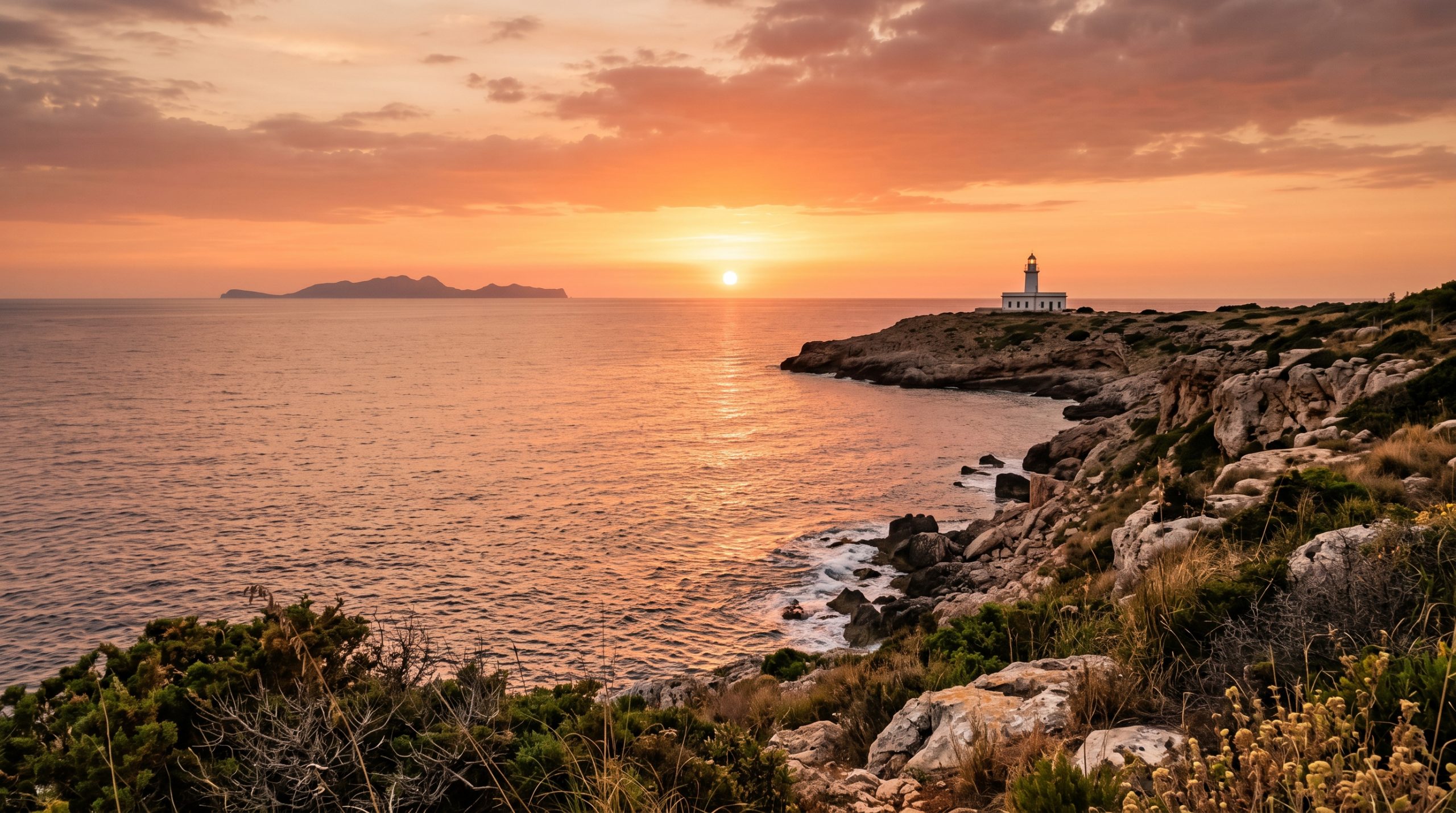
The lighthouse at Cap de ses Salines stands almost at sea level. There is no cliff beneath it and no headland above it, which is the most useful thing to know about eloping at Mallorca’s southern tip: nothing stands between you and the horizon. The sun does not slide behind a ridge forty minutes early, the way it does in half the island’s better-known spots. It goes down into the water, at the time the forecast said it would.
The light itself is a working building, occupied by researchers from the Mediterranean Institute of Advanced Studies, and it was the first lighthouse in Spain to run on solar panels. You are not getting married at its door. The ceremony happens on the flat limestone around it, low sabina scrub at your back, the Cabrera archipelago sitting out on the southern horizon. After dark this is one of the blackest skies on the island.
What follows is the practical version. When the sun arrives, when it leaves, what the walk is like in a dress, what needs permission and what genuinely does not.
Flat rock, open horizon, no ticket office
Cap de ses Salines is the southernmost point of Mallorca: flat limestone, low scrub and an unbroken sea horizon, a few minutes on foot from a rough car park. A small ceremony on public coast needs no booking. The legal marriage happens in your home country, and the ceremony here is built around the last hour of sun.
Sunset swings sixty degrees between June and December
Most pages about the cape say it faces the sunset. It does, but never from the same place twice. In late June the sun goes down around 21:20 on a bearing near 302 degrees, well north of west, which from the tip puts it over the low shoreline running up toward Colònia de Sant Jordi. By the equinox in the third week of September it sets close to 19:45 at almost exactly due west, dropping straight into open water. Mid-October brings sunset back to roughly 19:10 on a bearing near 260 degrees. On the shortest days of the year it goes down at about 17:30 in the southwest, close to 240 degrees, with Cabrera low on the left of the frame.
The other half of the calculation is how long the good light lasts. The sun sits ten degrees above the horizon, which is where the light starts doing the thing you came for, at 20:15 in late June, 18:50 at the equinox and 16:20 in the third week of December. That is an hour of it in June, nearer 55 minutes in September and a generous 70 minutes in December, because a low winter sun takes longer to cover the same vertical distance. Once the sun has gone, civil twilight runs another half hour or so, and on a clear evening pale limestone holds color for most of it.
Because the western horizon is water, none of that gets truncated. That sounds like a small thing until you have worked a west-coast valley where the published sunset time and the actual end of light are three quarters of an hour apart. The east side of the cape is open water too, so mornings work in reverse: at the equinox the sun comes out of the sea at 07:36 almost due east, and in late June it is up by 06:22, which is a serious option if you would rather have the place entirely to yourselves.
How the cape photographs comes down to that flat foreground. There is no waterfall, no ruin, no framing tree to lean a composition against, so the frames that hold up are either very wide, two people small against rock and sky, or very close. Our published galleries and films from coastal ends of the world are the fastest way to work out which of those two you respond to, and it is worth knowing before we design your hour.
Wind is the variable, not tide
The Mediterranean barely has a tide worth the name, and here that is a gift. No tide table dictates the ceremony hour, so the sunset time above is the only clock in the day. Wind is what moves the plan. A southerly or southwesterly hits the cape face on, because the cape is the first thing it reaches. A northerly does the opposite: at a south-facing tip, a tramuntana strong enough to scour the north of the island is blowing offshore here, and the water off the rock lies down. On days when the Serra de Tramuntana coast is unworkable, the southern tip is often the calm side of Mallorca.
So we build the hour around the wind direction on the forecast instead of hoping. Vows go in a sheltered pocket behind the rock spine or in the lee of the scrub, then we walk out onto open slab for the wide frames once the words are said. The dune-backed sand west of the cape is a few minutes along the shore and sits at a different angle to the weather, which makes it a real alternative rather than a consolation. A veil in a stiff southerly is a decision, not a surprise. Tell us you want one and we will put the ceremony where it behaves.
The cape also gives sightlines in every direction and nothing to hide behind, which changes how a photographer and a filmmaker have to work. On a forest trail one of them steps behind a tree. Here the geometry is agreed in the car, not negotiated during the vows: one close in for faces and sound, the other thirty or forty paces back and low so the couple reads small against the horizon, neither of them in the other’s frame. That is easier when photo and film come from the same team of eight rather than two suppliers meeting at the trailhead. Wind matters for sound as much as for hair, so on the Expedition we set the audio out of it and the vows survive a breeze.
The drive out past Botanicactus, and the walk in a dress
Access is a single road running south from the village of Ses Salines, past the Botanicactus gardens, between dry stone walls, narrowing as it goes. It ends on rough open ground near the light. Reckon on about an hour from Palma airport and something like twenty minutes from Colònia de Sant Jordi or Santanyí, which is where most couples we bring out here sleep the night before. There are no toilets, no cafe and no shade at the cape. Water, and a plan for shoes, is the entire logistics list.
The walk from the car is short, and it is the surface rather than the distance that matters. This limestone is fissured and crusted, with edges sharp enough to ruin a thin sole and gaps wide enough to take a heel. Sand collects in pockets between the slabs. A long train will find the sabina, which is stiff and does not release fabric politely. What we tell couples: leave the hotel already dressed, walk in flat shoes, keep the good ones for still frames on smooth slab within sight of the car. Nobody has ever regretted that order of operations.
The paperwork, and which half of it is ours
Spain’s civil marriage route is built for residents. At least one partner needs registered residency in the country, which a couple flying in for a week does not have, so the practical shape is the one almost everybody uses here: the legal marriage is completed at home, and the ceremony at the cape is celebrant-led, in your own words, at the hour the light is right. That is not a compromise. It takes a registrar’s timetable out of the most important ninety minutes of the trip. Our guide to planning an elopement covers how couples usually sequence the two halves.
On the ground, permission is simpler than most pages imply. Two people, a celebrant and two cameras standing on open public coast is ordinary use of it. There is no ticket and no booking desk. What changes the answer is structure and scale: chairs, an arch, a table, amplified sound, or a group large enough to fill the parking area. Then written authorization comes into it, from the town hall and the coastal administration rather than a park office, and confirming which desk applies to your date and your plan is included in every experience we run. The fees themselves are yours, along with the celebrant. Aerials follow the same logic. Drone footage is part of what we deliver where it is legal, safe and appropriate, which at the cape means registration and a confirmed window before we design a single shot around it.
Who else is on the rock at 19:40
This is a known sunset stop, and after dark a known stargazing one. Cars trickle out in the last half hour before the sun goes. The flat slab directly below the lighthouse is where nearly everyone stands, and it is the least interesting ground on the whole cape. Arriving early does not fix that, because everyone else is arriving for the same reason you are. Walking ten minutes along the shore does fix it. In December, a 17:30 sunset falls deep enough into the quiet season that the tip is frequently yours alone.
A late September day, gate to gate
These numbers come from the third week of September, because it is the week we would pick here: warm rock, quieter roads, and a sun that sets due west at 19:45.
Getting ready in Santanyí through the late afternoon, out the door around 18:00. Parked and walking by 18:30, on the ceremony ground with time to catch your breath. Vows at 18:50, as the sun touches ten degrees and the rock changes color. Portraits along the shore for the next fifty minutes, working away from the car park as the light lengthens. The last frames go into the afterglow toward 20:10 and you walk back with a headlamp. Dinner in Colònia de Sant Jordi is twenty minutes away and still being served.
Coverage starts with The Adventure, a full day with one dedicated photographer or one dedicated filmmaker from $4,900, and The Expedition, a photographer and filmmaker working the cape together from $7,900, with the multi-day Odyssey built to a custom proposal; the rest sits on the pricing page.
Highlights reach you five days after the day itself, the full gallery or film three weeks after. Guest count does not change the fee, though it does change access, parking and how long the walk out takes with everyone in tow. If you are weighing one day against two, or the cape plus a morning on the inland backroads, our destination elopement guides show how those combinations tend to work.
Common questions
Is there anywhere to change at Cap de ses Salines?
No. There are no toilets, no changing cabins and no cafe at the cape. Couples dress at their hotel in Santanyí or Colònia de Sant Jordi and drive out ready, flat shoes on for the rock and the good ones in a bag. It is a twenty minute drive, so nothing has time to crease.
Can we legally get married at the cape, or is it a ceremony only?
Spain’s civil route requires registered residency for at least one partner, so visiting couples complete the legal marriage at home and hold a celebrant-led ceremony on the rock. It is the standard shape for a Mallorca elopement, and it frees the ceremony hour to follow the light rather than a registry timetable.
How long does the light last after the sun goes down?
Civil twilight runs about half an hour past sunset here, a little over thirty minutes in June and closer to twenty-five in late September. Because the horizon is open water, none of it is cut short by terrain. We plan to still be working after sunset rather than packing, and the afterglow on pale limestone earns it.
Do we need a permit for a small ceremony on the rocks?
For two of you, a celebrant and our cameras standing on open public coast, no ticket or booking is needed. Furniture, an arch, amplified sound or a larger group moves you into written authorization from the town hall and the coastal administration. That research and those applications are ours; the fees are paid by you.
What happens if the south wind is up on our date?
We move, and we already know where to. Vows go behind the rock spine or into the lee of the scrub, and the dune-backed sand west of the cape sits at a different angle to the wind, a few minutes along the shore. A hard northerly blows offshore at the tip, which often makes this the calmest coast on the island that day.
Holding a date at the southern tip
Dates are currently open across our 2027, 2028 and 2029 Mallorca seasons, and dates here get chosen by sunset bearing as much as by month. Send the inquiry form with the week you have in mind and a line about what you want that hour to feel like, and you will have a reply and our initial brochure within 24 hours, then a tailored proposal. Everything runs in writing, which matters when you are eight time zones away, and planning begins once the contract is signed and the 30% retainer is paid. Tell us the day you actually want and we will tell you honestly which month at the cape delivers it. Start Your Story