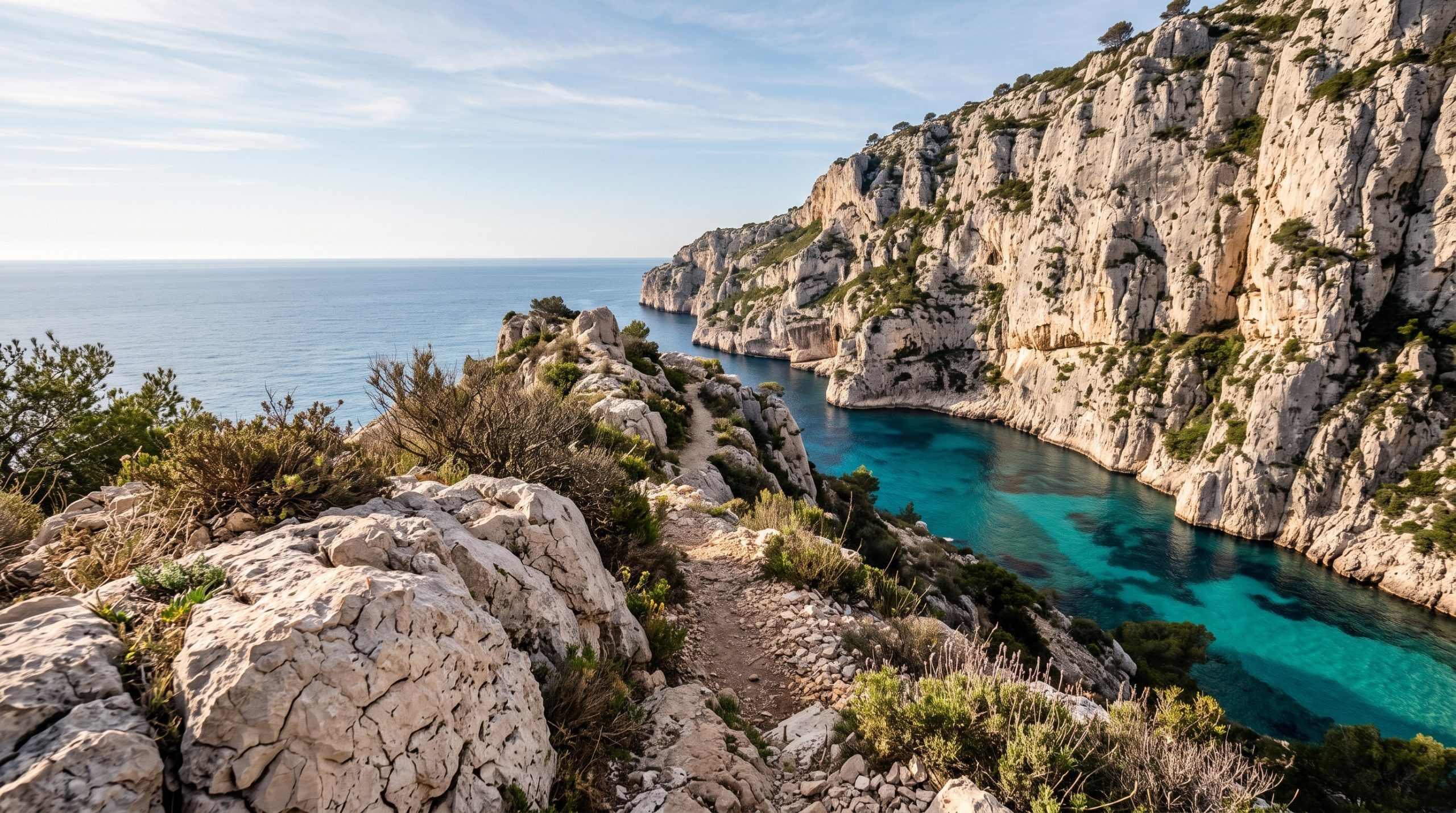
Between 1 June and 30 September, the Bouches-du-Rhône prefecture gives every forested massif in the department a color for the following day, and publishes it around six in the evening. Green, yellow and orange mean the trails are open. Red means the Calanques massif is closed to walkers, and the path you built your ceremony around is not there tomorrow.
Almost nothing written about eloping here mentions that. You get the turquoise water, the white limestone, the line about Cassis being the prettiest port in Provence, and not the one administrative fact that decides whether your morning happens on a beach or above the bay. It is not a reason to choose somewhere else. It is a reason to plan with two locations and to read the rating the night before.
The other thing nobody says: the first calanque you meet walking out of Cassis, Port-Miou, has a quarry on its north bank that was worked until 1982, and it is a yacht mooring now, thick with masts. It is the least interesting twenty minutes of the whole route. Everything past it is why people come.
What a ceremony in the park legally is
France marries you at a town hall, and only if one of you has lived in that commune for 30 days. So the legal marriage happens at home, and the ceremony in the Calanques is celebrant-led. A small private ceremony is not a public event; our professional cameras are what needs the park’s written authorization.
That paperwork is ours, not yours. The Calanques National Park requires prior authorization for photography and filming carried out professionally inside the core zone, and it allows around a month to process an application. Artificial lighting is not permitted in the core at all, which is worth knowing before anyone promises you a lantern-lit ceremony on the shingle. Permit research and logistics guidance are part of every experience we run. The government, municipal and landowner fees themselves sit with you.
Drones are the other thing to settle early, because they shape what the film can be. Motorized overflight below 1,000 meters is prohibited across the park core, so aerials are not part of a Calanques film the way they are in Iceland or the Dolomites. What replaces them is height you can walk to. The En-Vau belvedere stands 170 meters above the water and looks straight down the length of the inlet, and a long lens from up there does something a drone cannot: it puts you in the rock rather than above it. If you are still choosing a country, our guide to planning an elopement works through the questions that decide it.
The color posted the evening before
From 1 June to 30 September, access to the Calanques massif runs under a prefectural order. Each massif is graded daily on conditions including wind strength and how dry the ground has become, and the color for the next day goes up by around six in the evening. Green, yellow and orange all allow walkers in. Red closes the massif for that day. The rating is carried on the department’s MyProvence Envie de Balade app, so you check tomorrow’s answer over dinner rather than at the trailhead.
This is the single most useful thing to understand about a summer date here, and it changes how we build the timeline. Every June, July and August plan we write for this coast carries a second location that does not depend on a massif trail, confirmed against that day’s order: the Cassis waterfront, the cliff road climbing east out of town, the vineyard terraces under Cap Canaille. Nobody stands at a gate at 5am wondering. The decision was made the previous evening, in writing, with both versions of the timeline already drawn.
It also argues for a shoulder date. Late April, May, late September and October sit outside the order entirely, the limestone is not radiating heat back at you, and the walk in stops being an endurance event. If your calendar is fixed to July, tell us and we will build for July. If it is open, we will tell you honestly which weeks on this coast are kinder, and our destination guides cover the same question for the other coasts we work.
En-Vau: 12.2 kilometers, and what it does to a dress
En-Vau is the one everyone means when they say limestone fjord. Two walls of white rock running down to a short shingle beach, water the color of a swimming pool, and no road within an hour of it. That last part is the whole story.
The park’s own sheet for the least difficult approach, the one over the Col de la Gardiole, gives 12.2 kilometers, three hours and 200 meters of cumulative climb, and still grades the route difficult. It starts from the Logisson parking area on the D559, the route de la Gineste, about 16 kilometers southeast of central Marseille and directly opposite the Carpiagne military camp entrance. The tarmac lane that used to let cars up to the Gardiole pass has been closed to vehicles for years and is being returned to forest, which is exactly why the distance is what it is. A good part of the way sits in Aleppo pine shade, which matters more than anything else in September.
From the Cassis side, Port-Miou lies 1.5 kilometers from the port. Port-Pin is about forty minutes beyond it. En-Vau is another climb and another descent past that, and the descent is the part nobody photographs: polished limestone with loose gravel over the top of it, a couple of steps where you will want both hands, and a gully that funnels every walker in the massif into single file.
So, in wedding clothes, honestly. You walk in trail shoes with the dress in a bag, and you change in the pines at the top of the drop or behind the rocks at the back of the beach. We build fifteen minutes into the timeline for it and one of us carries the bag. Limestone dust here is chalk white and it does not brush cleanly off silk or fine crepe de chine; heavier weaves and anything with texture forgive it completely. A long train is a beach garment, not a path garment. Suit jackets travel in the bag too, because the climb back out is the same route in reverse and it is uphill.
If that reads as more than you want from a morning, Port-Pin is genuinely good and it is forty minutes on a stony but straightforward path: a small cove, pines standing right down at the waterline, and far fewer people once the swimmers have gone. Tell us which of those two mornings you actually want and we will shape the day around it.
Sugiton takes bookings three days out
Sugiton and the neighboring Pierres Tombées are the exception on this coast: entry there requires a reservation in very high season. It is free and it is compulsory. The park introduced it because peaks of 2,500 visitors a day were pushing the soil of the pine wood down onto the beach and leaving old roots bare. For 2028 it applies across two weekends in June, every day from late June to the end of August, and two more weekends in September. Bookings open three days before the day itself, at nine in the morning. That is a narrow window to hit on the one date that matters to you, which is why we normally point couples with a July or August date at a calanque without a quota and keep Sugiton for the shoulder months.
Where the light lands in a south-facing gorge
This coast runs east to west and faces the open Mediterranean to the south. There is no sunrise out of the water here and no sunset into it. The sun crosses in front of you, left to right, and the interesting light is always sidelight off rock rather than a horizon.
Inside En-Vau that geometry does something specific. The inlet is a slot with walls tall enough that the belvedere above it sits 170 meters up, so the first hour of the day lands high on the western wall and works downward slowly, while the shingle at the head of the inlet is still in shade. That gap is the good hour: your faces in soft reflected light, the rock above you burning. By the middle of a summer day the beach is lit hard and flat, the water is loud with swimmers, and no amount of skill makes that hour better than it is. Late afternoon reverses the whole thing onto the eastern wall.
Cap Canaille is the other half of the answer. At 394 meters it is the highest sea cliff in France, its face turned back toward the bay and going ochre then red as the hour gets late, and the 15 kilometer Route des Crêtes runs along the top of it between Cassis and La Ciotat. It takes evening light full in the face. A morning in the gorge and an evening on the crest is the strongest single-day shape this area offers, and it needs no trail at either end of the day. Our published stories and films are the honest test of all this: look at what white limestone does in the first hour and what it does at noon, then pick your hour.
The gorge is also why photo and film being one team matters here rather than being a line on a website. At the head of En-Vau there is very little ground to stand on. Two people who have not worked together spend the ceremony backing out of each other’s frames. Ours split the space by habit: one low at the waterline, one up on the rocks behind, neither in shot. Sound is the second half of it. Those walls throw voices back at you, so vows record cleanly when the air is still, and when the mistral is running the slot funnels it and the honest answer is to move the vows to the sheltered pine bowl at Port-Pin, forty minutes back along the coast, and keep the gorge for everything after. On our two-camera coverage, professional audio for the vows is included where conditions allow.
The gates that close at seven in the morning
West of Cassis, Marseille handles crowding differently. The access roads down to Sormiou, Morgiou and Callelongue close to cars from 7am to 7pm on a published calendar: Fridays, weekends and public holidays through April and into May, then every day from mid-June to the end of August, with Sormiou and Morgiou also closed at weekends in September.
Read that as an opportunity rather than an obstacle. A ceremony at first light at Sormiou means driving down before the gate closes at seven and simply staying, which buys you a fishing calanque with its cabanons and almost nobody in it. An evening ceremony means the road is open again from seven, and in June and July there is a great deal of light left after that. Both work. They are just completely different days, and the choice has to be made before anyone books accommodation. On the Cassis side the equivalent is the Les Gorguettes park and ride outside town, which is free, with a shuttle bus into the center for under two euros return and, in season, services out toward the trailheads.
Team travel is included worldwide, so a Calanques day is priced like any other day we work: from $4,900 with a dedicated photographer or a dedicated filmmaker, from $7,900 with both of them working together, and multi-day Odyssey coverage quoted individually on our pricing page.
Common questions
Do we need a permit for our ceremony in the Calanques National Park?
A small private ceremony with a celebrant is not a public event, so it is not what the park’s event authorization is aimed at. Professional photography and filming inside the core zone does require prior written authorization from the park, and we prepare and submit that file, allowing about a month. Any municipal or landowner fee is paid by you.
Can you fly a drone over En-Vau or Sugiton?
No. Motorized overflight below 1,000 meters is prohibited across the core of the Calanques National Park, and both sit inside it. We build height into the film on foot instead, from the En-Vau belvedere 170 meters above the inlet and from the Route des Crêtes above Cassis.
Where do we change out of hiking shoes before the ceremony at En-Vau?
There is no building of any kind down there. In practice you change in the pines at the top of the final descent or behind the rocks at the back of the beach, and we allow fifteen minutes for it. Carry the dress rather than wearing it in; the limestone dust is chalk white and clings to fine silk.
What happens if the massif is closed on our wedding date?
Between 1 June and 30 September the color for each massif is published around six in the evening for the following day, so the answer arrives the night before rather than at the trailhead. Every summer plan we write carries a second location that needs no massif trail, checked against that day’s order, and the timeline for it is already drawn.
Is there a calanque near Cassis we can reach without a long walk?
Port-Miou is 1.5 kilometers from the port of Cassis, and Port-Pin is roughly forty minutes further on a stony but straightforward path. Those are the two shortest ways to real water and pines. En-Vau always costs a proper walk, since the park grades even the easiest approach to it as difficult.
Choosing your calanque and your hour
The couples who love this place are the ones who want the walk to be part of the marriage rather than an obstacle before the photographs, and who would rather stand on shingle at seven in the morning than on a terrace at noon. If that is not your morning, say so plainly and we will build something on the crest and the coast road instead, or tell you which month turns the whole massif gentle.
We handle the planning in writing so nothing depends on matching time zones, at whatever hour suits you. Send the form and you will have a reply and our first brochure back within 24 hours, then a proposal shaped around your date, your calanque and the access calendar that applies to it. A signed contract and a 30% retainer start the planning. Highlights reach you five days after the day itself and the full gallery or film three weeks after that, and Our current Provence availability runs across 2027–2029 now. Check Your Date.