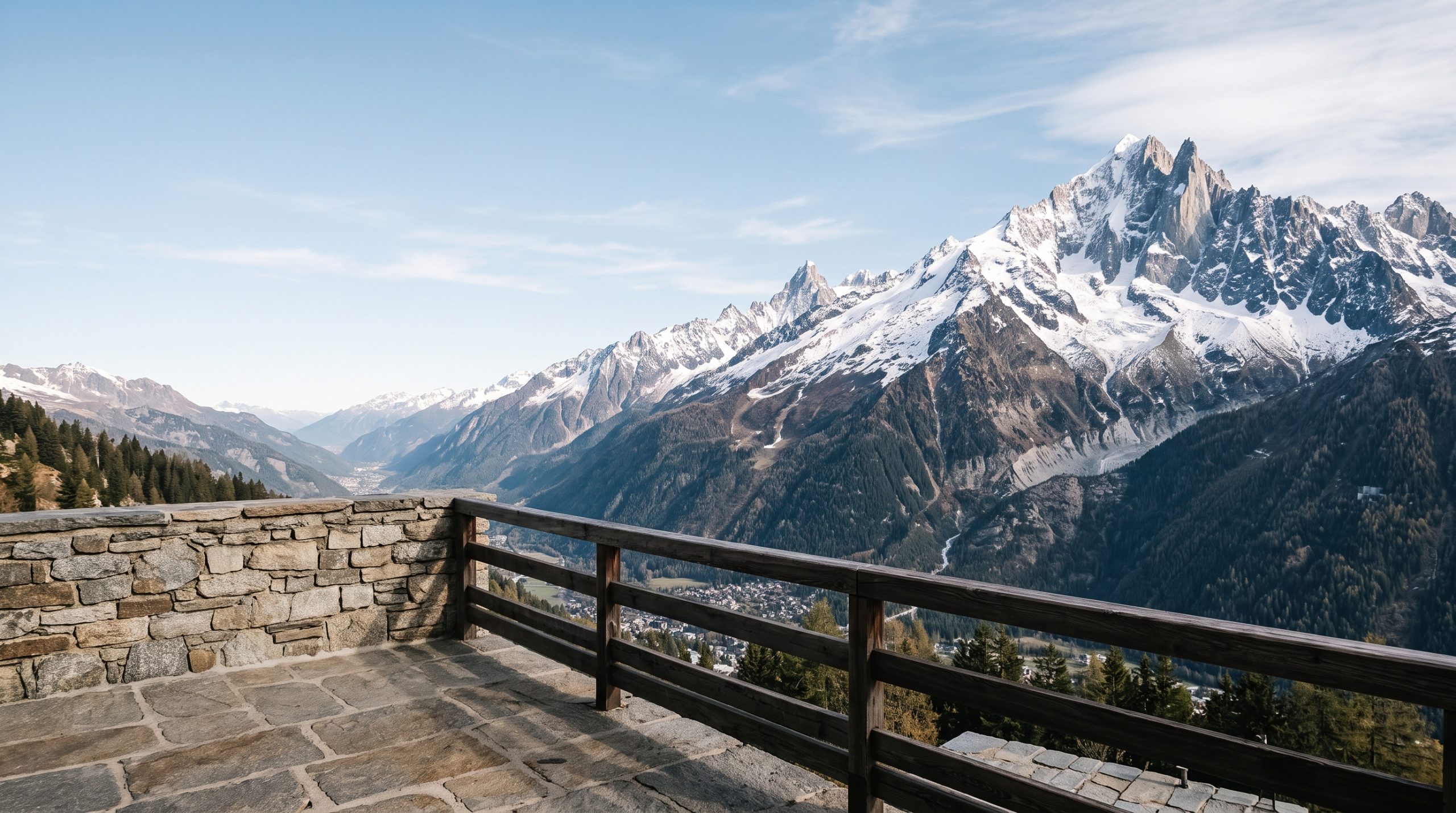
In peak summer the last cabin down from La Flégère leaves the top station at 6:00 pm. The warm light everyone has seen in photographs of Mont Blanc from this side of the valley lands a long while after that. So the famous version of this view is not the one a couple gets to stand in, and the best hour on these two mountains is the one almost nobody writes about.
Brévent and Flégère sit on the Aiguilles Rouges side of the Chamonix valley, the north-western wall, facing due south at the Mont Blanc massif. The Flégère gondola leaves the village of Les Praz, crosses the Chamonix golf course and sets you down at 1,877 m. Le Brévent is two stages from the western edge of Chamonix town: a gondola to Planpraz at 2,000 m, then a cable car to the summit at 2,525 m. Neither asks you to walk anywhere. Both ask you to be exact about time.
That trade is the whole character of these two locations. You buy an enormous view for the price of a lift ticket, and you pay for it in timetable.
Two lifts, one Mont Blanc, no walking
Both mountains put the Mont Blanc massif in front of you within a few steps of a lift door. The Flégère gondola climbs from Les Praz to 1,877 m, and Brévent’s gondola and cable car reach 2,525 m above Chamonix. A ceremony here needs no hiking, only a timeline built around the first cabin up and the last one down.
Brévent from the town, Flégère from the golf course
The Brévent base station is a walk from the middle of Chamonix, which matters more than it sounds. Couples staying in town reach the ticket window without a car, and guests can follow on foot at their own pace. From there it is two lifts with a change at Planpraz, so there is a natural pause halfway up, and a second chance to look at the sky before committing to the summit.
Flégère starts further up the valley at Les Praz de Chamonix, which has its own car park, its own stop on the valley railway and a bus stop named Flégère at the door. One gondola, one ride, over the fairways of the Chamonix golf course and onto the mountain. For guests who are not confident on stairs or at altitude, that single stage is the easier proposition by some distance.
A Brévent return currently runs a little under 40 euros for an adult, a Flégère return closer to 25, and both lifts are covered by the Mont Blanc MultiPass and by Chamonix Le Pass. Under-fives ride free, the child rate covers ages five to fourteen, and a group rate opens up once a party passes twenty people. Our fee does not move with guest numbers, but the cabins, the tickets and the timeline all do, which is why we ask early how many people are coming.
In wedding clothes the two mountains behave differently. Flégère hands you graded track and summer grass within a minute of the station, which is forgiving of a long hem. Brévent is coarse red gneiss, broken slab and metal stairs off the top station, and it is unkind to a heel of any width. Flat soles, and a hem you are content to see dusty by mid-morning. We plan changes at the base and carry what is needed up in the cabin, because a mountain top station is not a getting-ready room.
The timetable is the constraint, not the mountain
Compagnie du Mont-Blanc publishes lift hours to the minute and moves them with the season, so plan the shape rather than the digits. Through the peak weeks of July and August the first Flégère cabin goes up around 8:20 am and the last descent from the top is 6:00 pm, with the Index chairlift closing about fifteen minutes ahead of it. Either side of that block, in late June and through September, everything pulls back roughly an hour: first cabin near 8:35 am, last descent at 5:00 pm. Every published timetable carries the same qualifier, subject to favorable weather.
Winter is tighter again. In midwinter the Brévent lifts run roughly 8:30 am to 4:45 pm, with the last car off the summit at 4:30 pm. From early February the day stretches, the last summit descent moves to about 4:45 pm and Planpraz stays open until 5:15 pm.
Set those hours beside the sun and the summer answer is blunt: the mountain shuts hours before the light turns. Evening on the Brévent terrace, the frame that sells this valley, is not something a lift ticket can buy you in July. Knowing that in March, while the timeline is still being drawn, is worth more than any amount of optimism on the morning.
What we do instead is take the first hour of the day, deliberately and completely. First cabin, vows before the mountain fills, and the whole panorama to yourselves while the valley is still cool. The second move is to put the evening lower down, in the meadows at Les Praz or along the valley floor where the light is still available after the lifts have stopped. The third, for couples who genuinely want to stay on the mountain into the gold, is to walk down from Planpraz on purpose, with the shoes and the hem chosen for it weeks in advance rather than decided at the top station.
On crowds, this is one of the rare places where arriving early is not a platitude, it is the entire strategy. The Aiguille du Midi at 3,842 m takes the bulk of the valley’s day-tripper traffic, which helps, but Brévent is on every itinerary in Chamonix and by late morning its terrace is a panorama stop with a queue behind you. Midday is also when the view is at its worst. Flégère holds up better through the day, partly because it is less famous and partly because most people who ride it walk straight off toward the lakes.
Due south all day, which is not the gift it sounds like
The Flégère slope faces due south, straight at the massif, and that aspect is what you are buying. It also means the sun crosses in front of you rather than behind, which is a different problem at each end of the day.
In the first hour after the lifts open, the sun is still low and coming up the valley from the north-east, over Argentière. It rakes the Mont Blanc face from the side, so the glaciers keep their texture, the ridges separate and the snow holds detail. You are side-lit at the same time, which is the single most flattering geometry either of these mountains offers.
By the middle of the day the sun is high and almost behind the peaks. Snowfields go white and featureless, shadows collapse, and the massif reads as a flat backdrop rather than the enormous thing it is. This is the hour the cameras come out on the terrace, and it is the hour we schedule around, not into.
Late in the day the geometry turns generous and unavailable at the same time. The sun drops behind the Aiguilles Rouges at your back, Mont Blanc takes the last warm light face-on, and the lift has already gone down. October and February are the months that soften this, because the sun sits low all day and even a mid-morning ceremony gets the modelled light July only offers at breakfast.
If you want to see what mountain light like this actually returns in a gallery and in a film, our published elopement stories and films are the straight answer. Highlights reach you five days after the day itself, and the full gallery or film three weeks later.
Where the reserve begins
Walk north from Flégère toward Chéserys and Lac Blanc and you cross into the Réserve naturelle nationale des Aiguilles Rouges, created in August 1974 and covering close to 33 square kilometres of the valley’s northern side, from Les Houches up to the Col des Montets, across the communes of Chamonix and Vallorcine.
The reserve’s rules are short and they change plans, so they are worth reading before anyone falls in love with an idea. No dogs at all. No fires, no picking flowers, no camping, with bivouac by reservation only. No swimming in the Lacs Blancs or in Chéserys. And no overflight of any kind, drones included, which is why aerials on this side of the valley get planned outside the boundary with the window confirmed first, and why we build the film so it stands on its own without a single frame from the air.
The red in the name is iron oxidizing in the gneiss. It is also the reason the ground under your feet reads warm at either end of the day while the massif opposite stays white and blue, and it is the best argument for keeping some frames pointed away from Mont Blanc entirely.
The legal part stays down in the valley
A French civil marriage happens inside a mairie, in front of the mayor or a deputy mayor, and no other location is valid. Article 74 of the Civil Code places the marriage in the commune where one of you holds a domicile or a residence established by at least one month of continuous living there, measured on the date the banns are published, and the banns then stay posted for ten days. For a couple flying into Chamonix for ten days, that is not a route anyone uses.
So the legal step happens at home and what happens at 2,525 m is a celebrant-led ceremony with your own words and witnesses if you want them. It is the standard shape for an elopement in France, and it changes nothing about the day except which country issued the certificate. Our guide to planning an elopement sets out that sequence in order.
On the ground, a private ceremony for two on open mountain ground is a very different request from a staged event on lift property with furniture and a group, and the second is where permissions and operator agreements start. That research is ours on every location we take couples to, along with the alternatives for the day the weather turns. Permit fees themselves are yours, as are the celebrant and the lift tickets.
A full day here with a dedicated photographer and a dedicated filmmaker working as a pair is the Expedition, from $7,900. The single-lead Adventure and the multi-day Odyssey sit beside it on our coverage and pricing page, and team travel to Chamonix is inside every one of them.
Two cameras on a compact summit deck
Brévent’s top is a small piece of engineering bolted to a summit, and two people working the same vows have to divide it on purpose. Our photographer takes the line into the massif; the filmmaker works from behind and off one shoulder, so neither of them turns up in the other’s frame and neither of them is standing where you need to look. Flégère is the easier version of the same problem: open ground, room to move, and sightlines long enough that a filmmaker can be well back and still tight on a face.
Wind decides the audio up here more than anything else. On the Expedition we place microphones for the vows and put the second camera downwind rather than upwind of them, which is a small decision that separates usable sound from a beautiful silent film. Eight of us work together on photo, film and planning as one service, so the two people standing on your mountain have done this side by side before, and there is a colleague in reserve at home.
Common questions
Can we legally get married at the top of Brévent?
Not legally. French law puts the civil marriage inside a mairie, in front of the mayor or a deputy, and Article 74 of the Civil Code requires one of you to have a month of continuous residence in the commune before the banns are published. Couples handle the legal step at home and hold a celebrant-led ceremony on the summit.
Can we have Flégère to ourselves before the crowds arrive?
Close to it. The first cabin in peak summer goes up around 8:20 am, and the mountain stays quiet for roughly the first hour while the valley’s day-trippers are still queueing lower down. That window is small, predictable and entirely available to anyone willing to be at the Les Praz ticket window when it opens.
Can we bring our dog up the Flégère gondola?
Not on that side. The Aiguilles Rouges reserve prohibits dogs outright, even on a lead, and the Flégère gondola is listed as no dogs. The Planpraz and Brévent cable cars do carry dogs in summer, so if your dog is part of the ceremony, Brévent is the mountain to plan around.
Can you fly a drone over Lac Blanc for our film?
No. All overflight is prohibited inside the Aiguilles Rouges reserve, and Lac Blanc and Chéserys are well inside it. Where aerials are legal, safe and appropriate, we plan them outside the boundary and confirm the window before the film depends on them.
Do the lifts still run when the valley is under cloud?
Often, yes. Every timetable is published subject to favorable weather, and valley cloud frequently sits below both top stations, which puts you above it looking at a clean massif. Because that is never guaranteed, every plan we write carries a lower alternative that works in flat light.
First cabin, and the day that follows
The shape that works here is unglamorous and reliable. Paperwork done at home. Both of you at the base station before it opens, up on the first cabin, vows in the first hour with the massif side-lit and the terrace still empty. Then time on the ridge while the mountain is yours, down before the middle of the day flattens everything, and the rest of the afternoon and evening at valley level, in the meadows around Les Praz or further up toward Argentière, where the light is still working long after the last descent.
These two mountains suit couples who want the full weight of the Mont Blanc massif without giving a day to a mountain approach, and who are willing to set an alarm for it. If what you actually want is empty ground with no lift and no timetable, say so and we will point you at the month, the hour or the higher ground in this valley that gives you that, or at another of our destination elopement guides that fits it better.
Every planning step stays in one written thread, which suits time zones and mountain schedules. Send the inquiry form and you will have a reply and our first brochure within 24 hours, then a tailored proposal for your dates. A signed contract and a 30% retainer open the planning, and we are booking 2027, 2028 and 2029 now. Start Your Story and tell us which of the two mountains you keep coming back to.