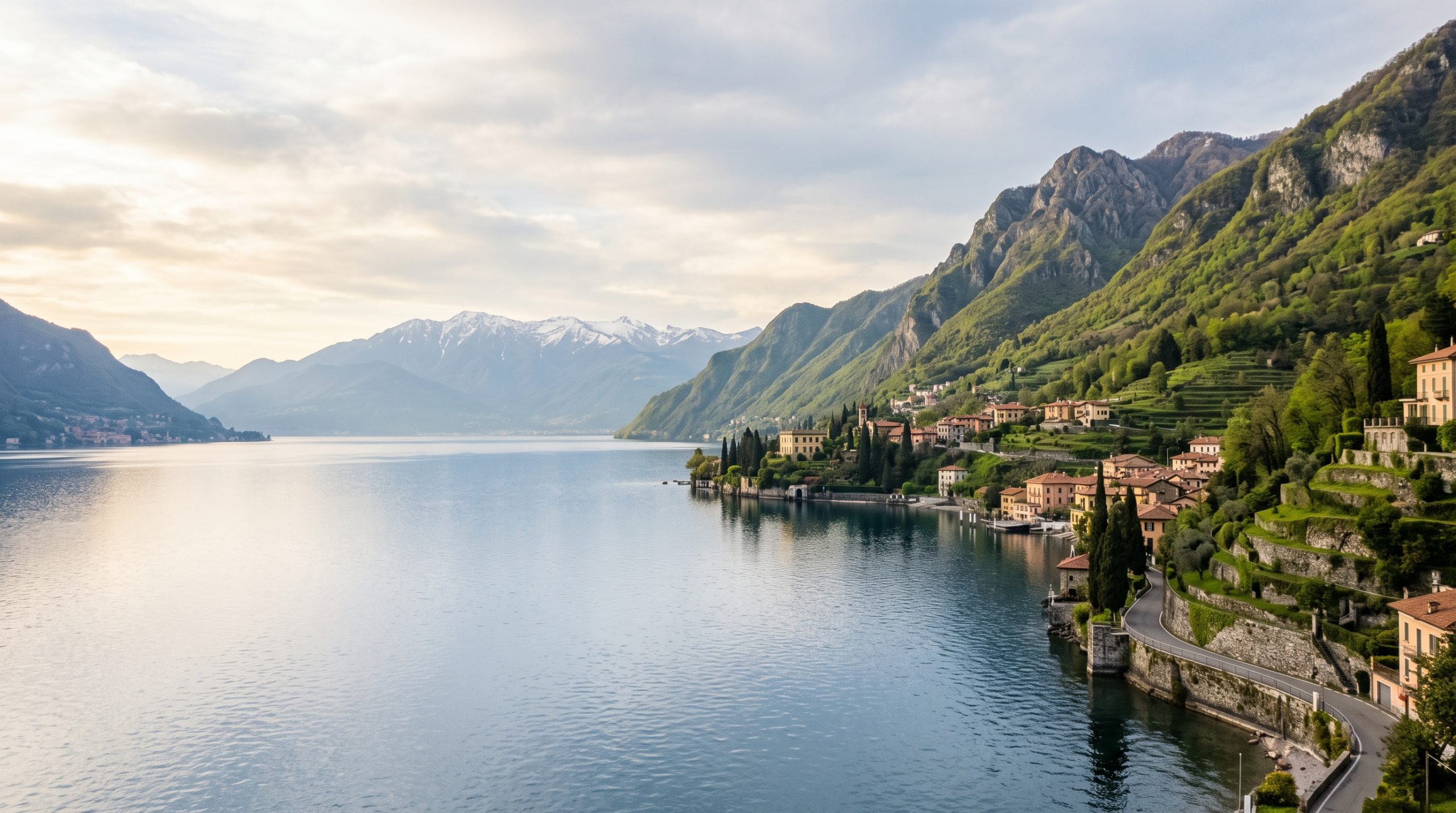
The northern half of Lake Como is usually flat until around eleven in the morning. Then the Breva comes up from the south, the surface turns from mirror to hammered metal, and every boat frame anyone planned for the afternoon changes character. That daily switch shapes how a Lake Como elopement looks as much as the month does.
The month decides the rest. Mid-June gives you 15 hours and 42 minutes between sunrise and sunset, with the sun going down at 21:15. Mid-December gives you 8 hours and 41 minutes and a sunset at 16:39. Both are workable days. They are not the same day, and they do not want the same plan.
Below is what we use when we build a timeline here: sunset by month on the 24-hour clock Italy writes, the rainfall at both ends of the scale, the bloom weeks at Villa Carlotta, and the gates and boat timetables that move with the season.
The window we book first: late April into mid-May
Late April into mid-May. The azaleas and rhododendrons at Villa Carlotta are at their peak, the boat timetables are back to full service, sunset sits around 20:45, and the crowds that fill Bellagio in August have not arrived. Mid-September is the close second, with warmer water and clearer air.
Month by month, sunset by sunset
Sunset times are for the 15th of each month. Lake Como is a wet lake, around 1,553 mm of rain a year, so no month guarantees blue sky. What changes is the length of the day, where the sun sits, and how many people stand between you and the water.
| Month | Conditions | Sunset | Crowds | Our verdict |
|---|---|---|---|---|
| January | Driest month of the year, around 67 mm over 11 days; highs near 7°C | 17:04 | Almost none | City and high ground only |
| February | Cold, with the clearest air of the year and snow on the ridges | 17:49 | Very light | Underrated for short, sharp days |
| March | Camellias, then rhododendrons; boat timetables rebuild late in the month | 18:28 | Building slowly | Excellent value in light and space |
| April | Azaleas open; frequent showers, warm afternoons | 20:09 | Easter spike, then steady | Our first-choice window opens |
| May | Peak garden colour, greenest hillsides of the year | 20:47 | Busy, not saturated | Book it |
| June | Longest days; heat builds thunderclouds over the ridges | 21:15 | High | Best month for a slow evening |
| July | Hottest, averaging highs near 28°C and 9.5 hours of sunshine a day | 21:10 | Heavy from breakfast | Sunrise work, then shade |
| August | Hot and hazy; Ferragosto on the 15th is the busiest day of the lake’s year | 20:32 | Peak of the year | We would move it |
| September | Warm water, settled spells, air clearing after the summer haze | 19:36 | Easing after the first week | Second-best window |
| October | Chestnut and beech woods turn above the western shore | 18:38 | Thinning fast | Strong for the first three weeks |
| November | Wettest month, about 173 mm across 13 days; gardens close | 16:53 | Gone | Workable with a specific plan |
| December | Low sun, cold, often startlingly clear between fronts | 16:39 | Como city only | Short, bright, town-led |
The bloom weeks, and how far they slide
Villa Carlotta at Tremezzina holds more than 150 varieties of azalea and rhododendron, and it runs a sequence, not a single event. Camellias come first, from the back end of February. The big tree rhododendrons carry the second half of March into April. The azaleas follow, banked in rounded cushions along the paths, and hold through April into May. Hydrangeas and roses take over for June, July and August, so a summer date here is not a colourless one.
The sequence moves. A warm February pulls the rhododendrons forward by ten days or so, and a cold spring pushes the azaleas deep into May. If your date is chosen around a bloom, we plan the garden hour as one strong scene rather than the only one, and we watch the season as it develops so the timeline is written against what is actually open.
Autumn runs on the same loose window. The chestnut and beech above the western shore turn through the second half of October into the first days of November, and the hillsides go copper down to the waterline. It is the shortest good window of the year here, maybe two and a half weeks. Read our destination elopement guides alongside this if you are weighing Como against a mountain autumn somewhere else.
Where the sun goes in December
This is the part most Lake Como planning skips, and the part that changes the photographs. At Como’s latitude the midday sun reaches about 68 degrees above the horizon at the June solstice. At the December solstice it peaks at roughly 21 degrees, and at the equinoxes it sits near 44. Mountains rise straight out of the water on both shores, so those numbers decide where light lands.
From November to February the western-shore villages get the morning and lose the sun early in the afternoon, while the eastern shore around Varenna and Lierna sits in shade until late morning and then gets a long, low, raking afternoon. Bellagio’s tip at Punta Spartivento, where the lake splits into two branches, sees both, which is why it carries so many of our winter sunrise hours. When the shoreline is in shadow we go up instead. The Como to Brunate funicular runs 06:00 to 22:30, climbs to about 700 m in seven minutes and leaves every half hour, and 700 m is often enough to stand in sunlight while the lakefront does not. June reverses the problem: sunrise is at 05:33, before the first car, so we drive the road up the evening before or work at water level.
One thing stays constant through the year. The low, warm band either side of the horizon lasts about 45 to 50 minutes in every month here. What changes is where it lands on the clock and whether a ridge is standing in it. In June the evening band opens around 20:29 and you can work it slowly. In December it opens at 15:49 and closes at 16:39, and there is no second attempt. That short winter band is the clearest argument for a photographer and a filmmaker working the same hour rather than one person choosing between a still and a moving frame, and you can see how differently the two read on our published elopement stories and films.
When Como’s calendar is working against you
August, first. The lake is at its yearly peak, Ferragosto on 15 August brings the whole of northern Italy to the water, and the haze over the ridges flattens the long views that make Como worth the flight. The heat pushes thunderstorms up the valleys in the afternoon too. Move the date four weeks either way and it is a different lake: mid-June holds the 21:15 sunset and the longest evening of the year, and the second half of September gives you swimmable water, clearing air and a 19:36 sunset with the summer crowd already thinned.
November, second. It is the wettest month on the lake at roughly 173 mm across 13 days, the sun is gone by 16:53, and the garden gates have closed for the season. Early October holds most of what people want from autumn here with an extra hour and three quarters of daylight, and mid-March gives you the same emptiness with the camellias out and the boats coming back.
If your date is already fixed in a hard month, that is a planning problem rather than a mistake. A November day here works when it is built for November: a first light hour at Punta Spartivento, the funicular up to Brunate to get above the low cloud that sits on the water, interiors and the old lanes of Como and Varenna in the middle of the day, and the ceremony placed inside the warm band rather than hoping for it later. We do this often enough that it has a shape, and the how to elope planning fundamentals page covers how the timeline gets built around light and real travel time rather than a wish list.
Gates, ferries and what is actually open in February
Villa del Balbianello is the most visited property the Italian National Trust owns, with well over 160,000 visitors in a full season, and its calendar is the biggest access constraint on the lake. Public opening runs 10:00 to 18:00, last admission to the park at 17:00. February is a handful of named days only, mostly weekends. From the middle of March it opens on a regular season timetable. The wedding calendar there fills from April to October a long way in advance, and a full season runs to roughly 160 ceremonies, most of them for couples flying in.
The boats matter almost as much. Navigazione Lago di Como runs a heavier timetable from April to September and a thinner one from October to March, and the car ferry triangle between Bellagio, Varenna, Menaggio and Cadenabbia is the spine that makes a two-shore day possible. In winter a plan that depends on three crossings is a plan that will not hold. The Brunate funicular, by contrast, runs all year.
On the legal side, the Comune di Como celebrates civil marriages in the Sala Consiliare and Sala Giunta of Palazzo Cernezzi, and the ceremony carries no municipal fee in those rooms. Fees at lakeside villa venues vary widely by comune and by room, and they change. Permit research and the logistics around it are ours; the permit and venue fees themselves are yours, and we tell you the number before you commit to a location.
How we plan around Como’s two daily winds
The lake runs two thermal winds, and they set the hour more reliably than the forecast does. The Tivano comes down from the north-east early, felt first in the Lecco branch. The Breva builds from the south around midday and peaks in the afternoon, strongest through the centre and the upper lake. Both tend to clear the sky. They also decide whether boat coverage looks like a glide or a chase, which is why the northern basin gets our morning hours and the sheltered bays get the afternoon.
So the weather plan is not optimism. It is written before anyone flies, and it names places. If the Breva comes in hard from the south, we move to the lee of the Bellagio promontory or into the Val d’Intelvi side valleys where the water is not the subject. If low cloud sits at 400 m, we go under it in the lanes of Varenna or above it on the funicular. If the ceremony hour needs to shift 90 minutes to hold the light, it shifts, because the timeline was built with that shift already in it. Aerials run on a permit and a time window, so we confirm both before the film is planned around them. Both shapes of coverage, a dedicated photographer or filmmaker, or the two working the same day together, include the team’s flights and accommodation worldwide, and the figures sit on the coverage and pricing page. Highlights reach you five days after the day itself, the full gallery or film three weeks after that.
There are eight of us, four photographers and four filmmakers, so there is always a second camera on the ground and a colleague in reserve. On a December date with a 50-minute band of good light, that is the difference between a complete day and a compromise. Tell Us Your Story and tell us the month you are holding, and we will tell you honestly what that month does here.
Common questions
When do the azaleas at Villa Carlotta actually bloom?
April into May, following the tree rhododendrons that carry mid-March to mid-April. The garden holds more than 150 varieties, so the display is staged rather than instant. A warm spring can pull it forward by around ten days and a cold one pushes it later, so we treat a bloom date as a strong probability rather than a fixed booking.
What time do we need to start for a June sunrise on Lake Como?
Sunrise in mid-June is at 05:33, and the low warm band closes about 46 minutes later. That means being in position by 05:10, which usually means leaving your room around 04:30. It is the emptiest and best hour of a June day here, and the trade is that the funicular has not started running yet at that hour.
Is November really the wettest month on the lake?
Yes, at roughly 173 mm across 13 rainy days, against about 67 mm in January. That still leaves plenty of dry days in the month, and November light between fronts is superb. It needs a plan built for short daylight, with sunset at 16:53 and the ceremony hour placed inside the warm band rather than after it.
Can we elope on Lake Como in winter, or is everything closed?
Plenty stays open. The Brunate funicular runs all year from 06:00, the car ferries keep the central crossings going on a thinner timetable, and Como itself is a working city rather than a resort that shuts. What does close is most of the garden villas, including Villa del Balbianello outside its named February days, so a winter day is built around towns, high ground and water level rather than villa gardens.
What time should the ceremony be to get light on the water?
Roughly 45 minutes to an hour before sunset, so around 20:15 in mid-June and around 15:45 in mid-December. In July and August we often flip it and hold the ceremony near sunrise instead, because the afternoon haze and the crowds both peak at the hour the light is hardest.
How far ahead should we book a May or September date?
Further than most couples expect, because the villa calendars fill from April to October well over a year out. Our planning calendar currently covers 2027, 2028 and 2029, and weekdays open up far more of the lake than a Saturday does in those two windows.
Does the afternoon wind spoil boat coverage?
It changes it rather than spoiling it. The Breva usually fills in from the south around midday, so we put boat hours in the morning when the northern basin is still flat, and we keep the afternoon for shorelines, villages and sheltered bays. If you want the boat specifically at sunset, we pick a bay that is in the lee of the wind that day.
Pick the week, then let the lake set the hour
Take the shape of it: choose the fortnight for the season, then hand the hour to the light and the wind. Late April to mid-May and the second half of September are the windows we would defend hardest. February, March and early October reward couples who like an empty lake more than a warm one.
Everything from here happens in writing. Send us the dates you are weighing and we reply with a first brochure within 24 hours, then a tailored proposal; a signed contract and a 30% retainer start the planning, with the remaining payment dates set out in that proposal. Check Your Date and we will tell you what that week on Lake Como looks like at the hour you want to stand there.