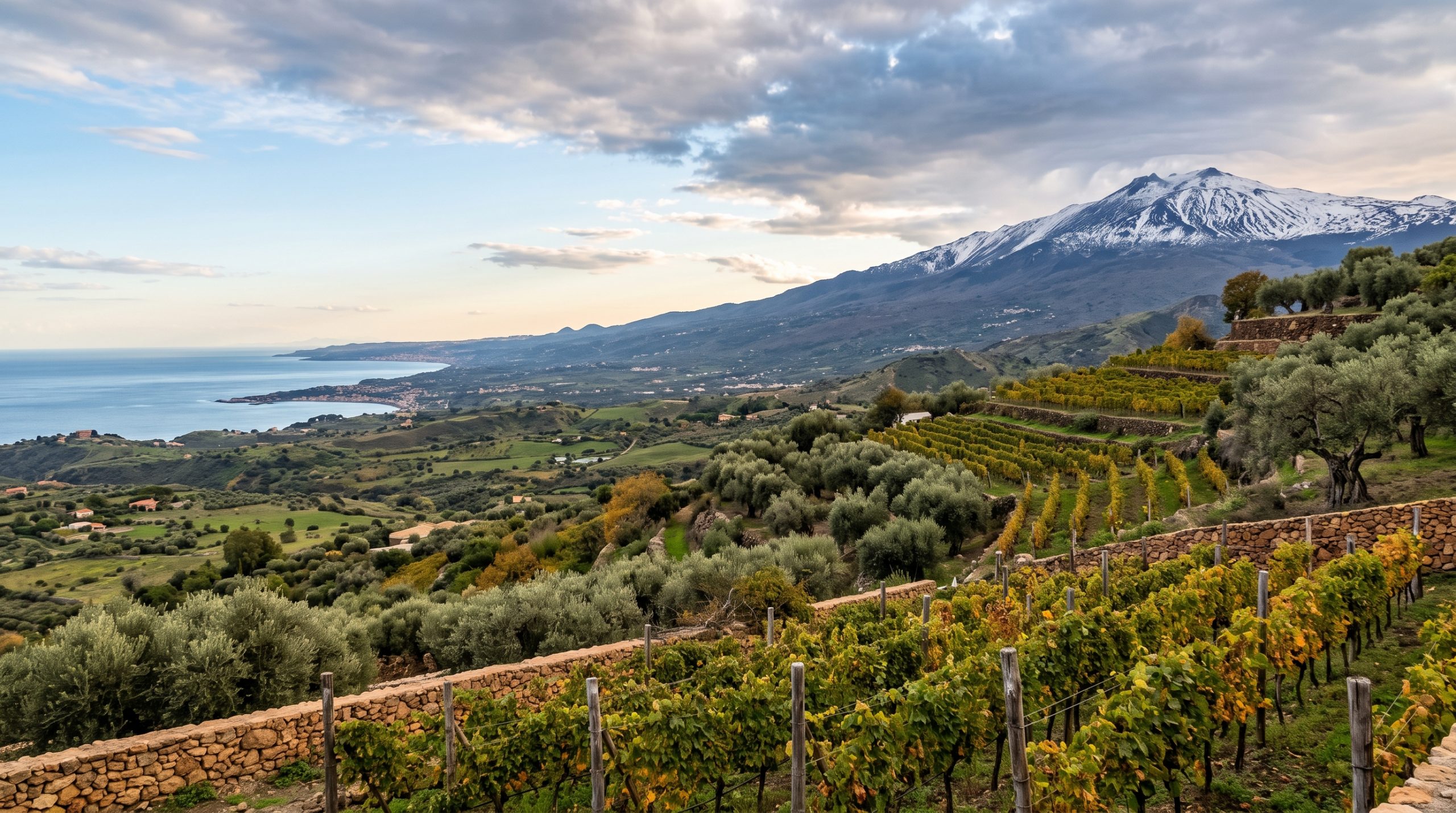
In the third week of June the sun clears the horizon at Palermo at about 5:43 in the morning and does not set until 20:31. In the third week of December the whole day lasts 9 hours 32 minutes, and the earliest sunset of the year arrives on 7 December at 4:48 pm. Same island, two completely different days to build.
Sicily also stacks its weather vertically. Etna’s summit craters stand at roughly 3,400 metres, walking is free only up to the 2,500 metre line, and above that you go with a certified alpine or volcanological guide under the access ordinance issued by the Municipality of Nicolosi. On a March morning the upper slopes can be snowshoe ground while the coast below it is warm enough for bare arms.
What follows is the version with numbers in it: temperature, light, what is open, and the weeks we would put a date in ourselves. We handle photography, film and the planning as one job, so the month you choose and the timeline we write for that month get decided together.
Late May, and why we book it before anything else
Late May is our first choice. The rain has effectively stopped, typical daytime temperature on the Catania side sits near 25 °C, and mid-May in Palermo carries 14 hours 14 minutes of light with sunset at 20:10. A seven o’clock ceremony still has a full hour of warm sun behind it, weeks before the July crowds land.
Sicily month by month, from temperature to the hour the sun quits
Temperatures are typical daytime figures for the Catania side of the island. Light times are Palermo at mid-month, and the far west runs a handful of minutes later than the east coast. If you are still weighing regions rather than months, our destination elopement guides cover the ground itself.
| Month | Daytime temperature | Sunrise to sunset, mid-month | Crowds | Our verdict |
|---|---|---|---|---|
| January | 15 °C / 59 °F | 07:22 to 17:10 | Almost nobody | Low sun all day, empty temples |
| February | 16 °C / 61 °F | 06:57 to 17:45 | Local, plus blossom week in Agrigento | Coolest month, best flowers |
| March | 18 °C / 64 °F | 06:19 to 18:13 | Light | Green hills, unsettled sky |
| April | 20 °C / 68 °F | 06:32 to 19:42 | Builds hard around Easter | Strong second choice |
| May | 25 °C / 77 °F | 05:56 to 20:10 | Moderate | Our first choice, especially the last ten days |
| June | 29 °C / 84 °F | 05:43 to 20:31 | Heavy from mid-month | Longest light of the year |
| July | 32 °C / 90 °F | 05:55 to 20:29 | Full | Sunrise starts only |
| August | 32 °C / 90 °F | 06:21 to 20:01 | Peak, everywhere | Hottest and busiest at once |
| September | 29 °C / 84 °F | 06:48 to 19:15 | Thins after the first week | Warm sea, room to move |
| October | 24 °C / 75 °F | 07:15 to 18:30 | Quiet | Excellent until the clocks change |
| November | 20 °C / 68 °F | 06:47 to 16:55 | None to speak of | Soft light, real rain in the mix |
| December | 17 °C / 63 °F | 07:15 to 16:48 | None to speak of | Wettest month, tightest timeline |
The dates that move: blossom, sirocco, and the hour the clocks take back
Four moving parts are worth planning around, and only one of them sits on a fixed calendar date.
- Almond blossom below the temples. Agrigento’s Sagra del Mandorlo in Fiore runs ten days and usually lands in the second half of February, finishing with a parade that walks down into the Valley of the Temples. In slower years the bloom drags the whole thing toward early March. Plan the week, not the day.
- Sirocco days. The hot southerly off North Africa can lift the island to around 40 °C in summer and above 20 °C in the middle of winter, and Palermo, Trapani and Catania have all recorded 44 °C on its hottest afternoons. It shows up with a day or two of warning, which is exactly enough time to move a ceremony hour.
- The clock change. Clocks go back on the last Sunday in October. The morning before is the latest sunrise of the entire year in Palermo, around 7:23, and sunset drops from roughly 6:15 pm to 5:15 pm overnight. A date on either side of that Sunday is planned differently.
- Free-entry Sundays. State-run sites, the Valley of the Temples included, let everyone in free on the first Sunday of each month. Useful to know when you are choosing which morning you want the Temple of Concordia behind you.
The Sicily months we would move away from first
December is the wettest month in Palermo, at roughly 79 mm across the month, and it is also the shortest. Nine and a half hours of daylight is workable, but it leaves one clean window rather than three, and if the front is sitting over the north coast that window is where the whole day lives. Given a free choice we would move a December date to the second half of February, which buys an extra hour of daylight and puts almond blossom on the ground at Agrigento.
August is the other one. Average daytime temperature holds at 32 °C, the sirocco can push it far past that, and the coast belongs to holiday traffic from the first week onward. The second half of September keeps the warm sea and the 29 °C afternoons while the crowds drain away, and the first three weeks of October give you 24 °C with the light still landing before the clocks change. Both are better versions of the same holiday.
None of that helps if your date is already fixed, so here is how those months actually work. In August we start on the coast at first light, hold the middle of the day for the drive and the long lunch nobody regrets, and put the ceremony after 19:30 on a west-facing headland where the last hour of sun does the work. In December we build a single block from early afternoon to sunset, because the low winter sun behaves like one continuous golden hour rather than a brief one, and we choose the region by which coast the weather is not sitting on. Tell us the date you have and we will tell you the shape that gets the most out of it.
Midday sun at 28 degrees in December, 75 in June
Palermo sits near 38 degrees north, Catania a little below 37.5. At midsummer the noon sun stands roughly 75 degrees above the horizon, which is close to straight overhead and unkind to faces. At the December solstice the same noon sun reaches only about 28 degrees. That single difference reshapes the whole day more than temperature ever does.
In June you work the two ends and accept that the middle belongs to shade and water. The 5:43 sunrise is genuinely early, which is why an east-coast morning around Syracuse or Taormina needs a 4:30 start, and the reward is a second warm window running past 20:00 that no other month offers. In October the sun is low and warm from mid-afternoon onward, so a ceremony at 16:30 is already in good light and stays there until it goes. In December there is no bad hour and not much of any hour, which makes the plan narrow rather than difficult. Our published elopement films and galleries are the fastest way to see what each of those hours actually renders like before you commit to a month.
Direction matters as much as angle here. The east coast faces sunrise over the Ionian, the west around Trapani and San Vito owns the evening, and the south coast at Agrigento takes side light at both ends of the day and sits in the sunniest part of an island that collects more than 2,600 hours of sunshine a year at low altitude. Choosing a coast is choosing which end of the day your ceremony belongs to.
Winter is also where having two people on the ground stops being a preference. When the warm light is one 40-minute block, a single pair of hands cannot shoot the vows as stills and film them at the same time, so somebody is always covering the moment twice from memory. The Expedition puts a dedicated photographer and a dedicated filmmaker on that block together, and the way each level of coverage works is set out on our pricing page.
Altitude limits, opening hours and the seasonal ceiling
Etna is tiered, and the tiers matter more than the season. You can walk freely to 2,500 metres. From 2,500 to 2,750 metres you go accompanied by a certified alpine or volcanological guide, which is a booking made weeks ahead in summer rather than a decision made at breakfast. The cable car from Rifugio Sapienza at about 1,900 metres lifts you toward the 2,500 metre line, and its last run of the day is earlier in winter than in summer, which quietly rules out a late-afternoon ceremony up there between November and March.
The volcano is monitored continuously by the INGV observatory at Catania and the park authority publishes the current access phase, so a guide knows what is open at altitude before anyone leaves the coast. That is the practical reason we build high-ground days with a low-ground alternative already written, rather than treating the summit as the plan.
Lower down, the calendar is simpler. The Valley of the Temples opens at 08:30 every day and closes later in summer than in winter, so a February ceremony inside the archaeological park finishes earlier in the afternoon than a June one. Coastal reserves and hilltop towns stay open year round. The pieces that genuinely close or shrink outside high season are the ones that need a boat, a lift or a guide.
How the Sicily weather backup is built before you arrive
Palermo takes around 615 mm of rain a year, almost all of it between October and February, and summer is close to dry. So the honest plan is not about rain in July. It is about wind direction and a movable hour.
The mistral comes from the northwest and hits the western end of the island hardest, so a mistral forecast moves us to the south coast where the same system arrives softened. The sirocco comes from the south, which sends us north or up. Every day we plan carries named alternatives chosen by where the wind is coming from, not vague ones, and a ceremony hour that can slide by two or three hours inside the same day without breaking anything else. That plan is written and shared before anyone gets on a plane, and it is the reason a changed forecast becomes a message rather than a scramble.
We also hold the timeline loosely on purpose. If the cloud lifts off Etna at 17:00 in October, we want to be forty minutes away with the light still good, not committed to a location chosen in January. That flexibility is a planning decision made months earlier. Send Us a Message with the month you are looking at and we will tell you what that month can realistically give you.
Common questions
Which month gives the best odds of dry weather for eloping in Sicily?
July and August are the driest months by a wide margin, with rain in Palermo concentrated between October and February out of a yearly total near 615 mm. For dry weather without the heat and the crowds, late May and the second half of September do better on balance.
Is August too hot for an outdoor ceremony in Sicily?
It is hot, at 32 °C on an average day and far higher when the sirocco blows, but the light is long. We put the ceremony after 19:30 while sunset is still around 20:00, work the coast at first light, and leave the middle of the day genuinely empty. August works when the timeline respects it.
Can we get married on Mount Etna, and does the season change what we can reach?
Yes, with the altitude tiers built into the plan. Free walking stops at 2,500 metres and guided access continues to 2,750, so the ceremony site is chosen against that line and a certified guide is booked well ahead. In winter the cable car’s last run is earlier, which pulls the whole day forward.
How much daylight will we have if we elope in December?
Around 9 hours 32 minutes at the solstice, with mid-December sunrise near 07:15 and sunset near 16:48 in Palermo. The earliest sunset of the year falls on 7 December at 4:48 pm. It is a single-block day, and the low sun means the light is good from the moment you start.
When do the almond trees around the Valley of the Temples flower?
February, with Agrigento’s ten-day Sagra del Mandorlo in Fiore pinned to the bloom in the second half of the month and occasionally sliding into early March. The dates shift by up to two weeks year to year, so we hold a window rather than a day and confirm once the local dates are published.
How far ahead should we pick a date for the Italian paperwork?
Non-resident couples typically need two to four months to assemble documents, including the nulla osta issued by your consulate in Italy and legalized by the Prefettura, plus the declaration of intent at the comune. We start that conversation as soon as the date is held, and the fundamentals live in our guide to planning an elopement.
Choosing your month from the other side of the Atlantic
We are booking 2027, 2028 and 2029, and team travel is included worldwide, so the month you pick is a light and access decision rather than a logistics one. We keep the planning in one written thread, at whatever hour suits your time zone, starting with a reply and an initial brochure within 24 hours of your inquiry.
Tell us the two or three months you are considering, whether you want a 4:30 alarm or a slow afternoon, and how high up the volcano you actually want to stand. We will come back with the window that fits, the timeline that fits it, and an honest note if a different month would serve the same idea better. Check Your Date and we will start there.