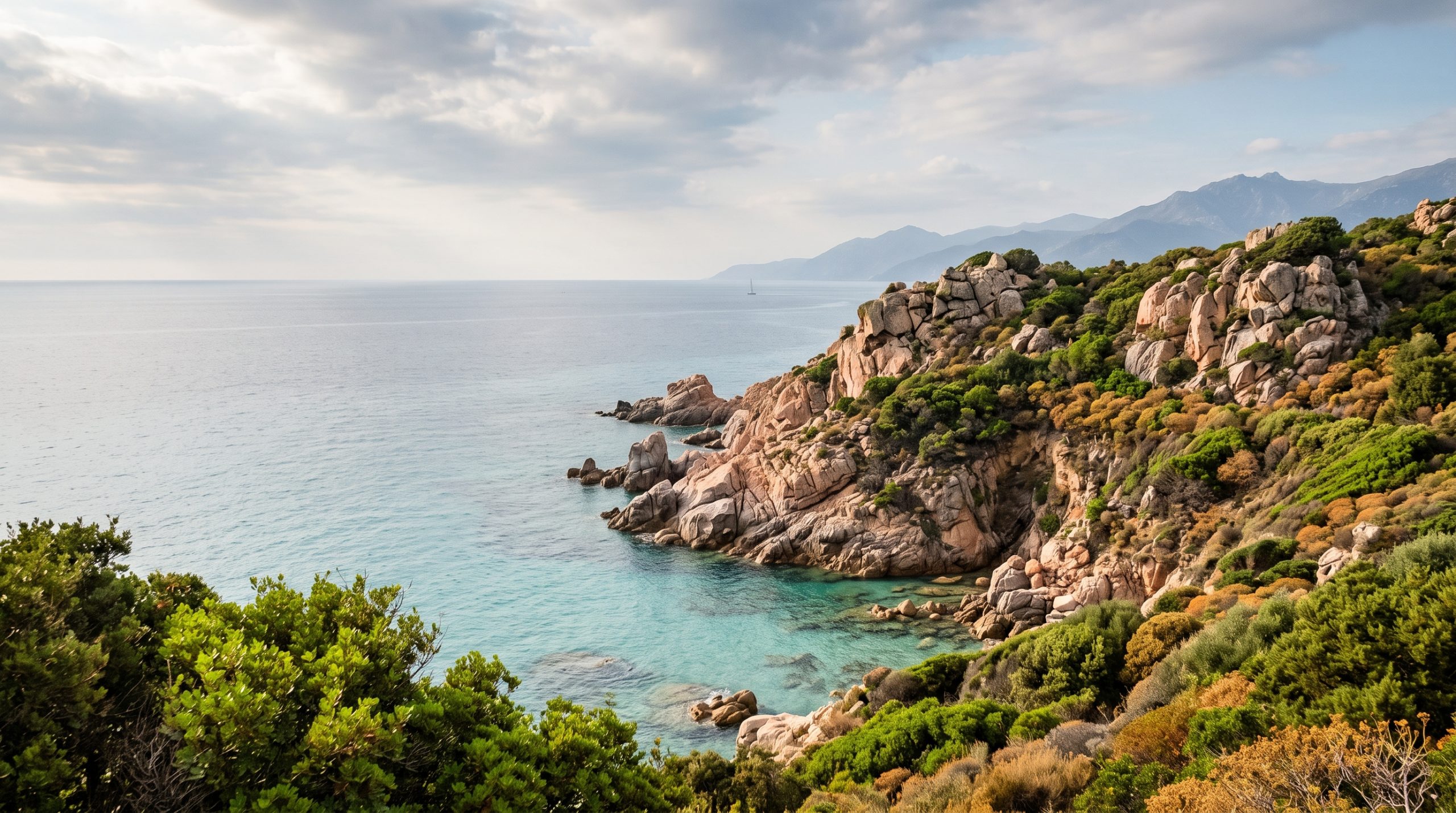
Sardinia’s year does not split neatly into summer and winter. It splits into the months when the island’s best coves are rationed and the months when they are not. Cala Goloritzé, at the south end of the Golfo di Orosei under a 148-metre limestone needle, takes reservations from April to October, holds 250 people at a time and currently charges seven euros a head including the guarded parking. Bookings only open 72 hours ahead.
The light swings just as hard. In Cagliari the earliest sunrise of the year falls in mid-June at about 5:54 am, the latest sunset on June 27 at 8:55 pm, and the longest day runs 14 hours 59 minutes. By December 7 the sun has gone at 5:01 pm and the shortest day is down to 9 hours 27 minutes. Those two numbers shape a wedding day here more than the temperature ever will.
This is the year as we actually plan it: the fortnight we reach for first, the two months we would move if your date is still open, what the light does in between, and how we build a strong day in the months that fight you. If you are earlier in the process, our guide to planning an elopement covers the fundamentals underneath all of this.
The Sardinian fortnight we would take first
The second half of September. The sea is still holding its late-summer warmth after an August peak near 25°C at Alghero, the visitor caps on the famous coves are lapsing, the autumn rain has not arrived, and the day still runs close to twelve hours with a long, low evening. Late May is the strong alternative.
Sardinia month by month, with the numbers
Figures below come from long-term averages at Cagliari in the south, Alghero on the west coast and Olbia in the northeast, plus the published access rules for the coves couples ask about most. Read the light column first. It is the one that changes your timeline.
| Month | Conditions | Light | Crowds | Our verdict |
|---|---|---|---|---|
| January | Cagliari’s coldest month, averaging around 10°C | Just under 10 hours of daylight | Coast effectively empty | Low sun all day, short plan |
| February | Sea at its yearly floor near 14°C; Alghero highs around 14°C | Day climbing past 10.5 hours | Empty | Clear, cold, sharp |
| March | Sea still near 14°C; rain easing off the winter peak | Clocks jump forward on the last Sunday | Very low | Greenest interior of the year |
| April | Rain well down from November levels | About 13 hours, sunset near 8 pm | Building slowly | Goloritzé bookings open |
| May | Warm land, cold-ish water | Over 14 hours by month’s end | Light until half term | Our second choice, especially late |
| June | Dry and hot; sea warming fast | Longest day, 14 hours 59 minutes | Caps switch on across the coast | Early June is excellent |
| July | Driest month: Cagliari sees 2.4 mm across two rainy days | Olbia averages 12.1 sunshine hours a day | Heavy everywhere | Sunrise or nothing |
| August | Olbia highs near 30°C, nights holding at 21°C | Sunset back before 8:30 pm | Peak of the year | Workable, but we would move it |
| September | Warm sea, first cooler nights | Around 12 hours at the equinox | Falls away sharply after the 15th | The month we book |
| October | Rain returning; sea still swimmable | About 11 hours mid-month | Quiet, and quieter after the 15th | Beautiful and slightly risky |
| November | Wettest month: 94 mm over 13 rainy days at Alghero | Barely 10 hours | None | The month we would move |
| December | Mild days, cold mornings inland | Sunset at 5:01 pm on December 7 | None | Short, quiet, all low light |
Notice how narrow the difference is between the months either side of the peak. Mid-June and mid-September sit at opposite ends of the season and both give you a long usable day, an open coast and settled weather, while the eight weeks between them give you heat and company.
The booking calendar that decides where you can stand
Sardinia has quietly become one of the most tightly managed coastlines in the Mediterranean, and for elopements that is good news. Caps mean the cove you chose eight months ago looks in October the way it looked in the photograph you fell for. It also means the day has to be built around a ticket.
- Cala Goloritzé, Baunei. Reservation required April to October, 250 people at a time, currently seven euros per person with parking included, released 72 hours before entry. The approach from Su Porteddu on the Golgo plateau is about 3.6 km with roughly 513 metres of descent and climb, and takes most people around an hour and a half each way.
- La Pelosa, Stintino. Capped at 1,500 visitors a day through the summer window from mid-May to mid-October, with a booking that currently costs three euros fifty per person.
- Cala Mariolu. 700 people at a time between 15 June and 15 September.
- Cala Brandinchi. 1,447 a day between 1 June and 30 September.
Those dates are why we care so much about the calendar rather than the season. A ceremony at Cala Mariolu on 16 September is a different experience from the same ceremony on 14 September, and nothing about the weather has changed. We hold the first entry slot of the morning wherever the system allows it, put the vows in before the day-boats arrive from Cala Gonone, and keep the middle of the day for driving, eating and the parts of the story that do not need an empty beach.
Permit research and logistics guidance are part of every experience we run, along with the destination and location design, the timeline and the backup planning. The government, venue and landowner fees themselves are paid by you. Guest numbers do not change our fee, but they absolutely change what is bookable: a cove with a hard cap and a boat with twelve seats will shape your invitation list more than any budget line. Our destination guides go deeper on the regions if you are still choosing between the granite north and the Ogliastra coast.
When August or November fights the day, and what we choose instead
August is the month couples ask for most, and the month we most often suggest moving, on the merits of the place rather than anything else. Olbia sits at highs near 30°C with nights that stay around 21°C. Roughly three quarters of Sardinia’s annual arrivals land between June and September, and August is the middle of that. Every cap is active, every ferry is full, and the two hours of good evening light are shared with a great many people who have driven a long way for them.
Move it two to five weeks later and you keep almost everything you wanted. The second half of September holds the sea temperature, drops the crowd and hands you a warmer, longer evening angle. If the date has to stay in high summer, the first ten days of June do the same job from the other side, with the longest days of the year and the water still cool enough to be bracing.
November is the other one. It is the wettest month across the island: 94 mm spread over 13 rainy days at Alghero, 83 mm across 15 days at Olbia, and barely ten hours of daylight to work with. The first half of October keeps the same soft light with a fraction of the rain and the Stintino booking window still running to the 15th. Late March is the other swap, when the interior is green in a way the postcards never show and the whole island feels like it belongs to whoever bothered to come.
If your date is fixed, say so early and we will build for it rather than around it. August dates start before dawn on the east coast, take the middle of the day off entirely, and finish at a west-facing headland where the sun is still up past eight. November dates get a movable ceremony hour, a shortlist of sheltered valleys inland, and a plan that assumes we will use a two-hour break in the weather rather than a whole clear day. Both of those work. They just need the decision made in the planning, not on the morning.
Two golden hours in June, forty minutes in December
The gap between the longest and shortest day here is 5 hours 31 minutes. In July, Olbia averages 12.1 hours of sunshine a day; in December that figure is 3.9. Those are not small adjustments to a timeline. They are different jobs.
In June and July the sun is high and hard from mid-morning to late afternoon, and the day has two ends rather than one middle. A 5:54 am sunrise on the east coast means leaving the hotel around 4:45, which is a real ask, and it buys you a cove with nobody in it and light coming straight off the water. The evening runs generously: sunset near 8:55 pm at the solstice, with usable colour for a good while after. That is the version of Sardinia where you can take an hour over the vows and still walk somewhere else afterwards.
From mid-September the sun sits lower and the warm hour genuinely lasts an hour instead of twenty minutes. Sunset around 7:30 pm in mid-September puts the ceremony at a civilised hour and still leaves time to drive to a second location. Geography matters as much as the calendar: the Golfo di Orosei and the east coast get the sunrise straight out of the sea, while Capo Caccia, Bosa and the Sinis peninsula on the west coast take the sunset. Two locations, opposite coasts, one day, if the driving is planned honestly.
Winter is the one that rewards a second camera most. On a December day the sun clears the horizon late, stays low the whole time and is gone at five, so the strongest forty minutes of the day happen once and do not repeat. That is the argument for the Expedition, where a dedicated photographer and a dedicated filmmaker work the same minutes instead of taking turns with them. You can see how the coast reads on both in our published elopement stories and films. Highlights reach you five days after the day itself, and the full gallery or film three weeks later.
If you already have a month in mind, or a fixed anniversary that lands somewhere awkward, tell us what it is and we will tell you honestly what that week looks like on the ground. Send Us a Message and we will reply with a first read within a day.
How we build the Sardinia weather backup before you arrive
Sardinian rain does not behave like a wet week at home. Cagliari averages about 448 mm a year and July delivers 2.4 mm of it across two rainy days. Even the wet months arrive in bursts: heavy for an hour, then bright, then heavy again. A day with 8 mm forecast is very often a day with four excellent dry windows in it, which is why we plan windows rather than hours.
Wind matters more than rain. The maestrale comes out of the northwest and it can hold for two or three days at a stretch, which flattens the exposed western headlands and leaves the eastern coves calm on exactly the same afternoon. So we choose locations in pairs, matched by aspect, close enough to swap between without losing the timeline. A northwest blow means we work the sheltered side; a southerly means the reverse. Aerials are planned the same way, on a legal window and a wind limit confirmed before the film is built around them.
All of that is written down before anyone flies: the destination and location design, a timeline built around real travel time rather than optimistic map estimates, permit research, and named weather alternatives with the trigger for each one. What changes between our experiences is whether one of us or two of us is with you for the day, and that is set out plainly on our pricing page.
Common questions
Is the sea still warm enough to swim in late September in Sardinia?
Yes. The water peaks around 25°C at Alghero in August and holds usefully warm well past the equinox, with September and October both counted among the island’s good swimming months. Sea temperature lags air temperature by weeks, which is exactly why late September works so well.
Do we need to book Cala Goloritzé in advance for our ceremony?
Yes, from April to October. Entry is capped at 250 people at a time, currently costs seven euros per person including parking, and the booking window opens 72 hours before your visit. That short window is one of the things we handle, along with the walking timeline for a 3.6 km approach with around 513 metres of climb.
We can only travel in August. Can we still get a quiet ceremony?
You can, and it is mostly a question of hours rather than places. An August day that starts before 6 am on the east coast gives you an empty cove and the best light of the day, and the afternoon can be spent inland where the caps and the coaches are irrelevant. We build the whole timeline around that early start.
How early is sunrise in Sardinia in June?
Around 5:54 am at the earliest, in mid-June, with first colour on the water well before that. Sunset reaches 8:55 pm on June 27, so a June day gives you 14 hours 59 minutes of daylight and two entirely separate golden hours to use.
Is a winter elopement in Sardinia actually worth it?
For the right couple, yes. January averages around 10°C in Cagliari, the coast is yours alone, and the sun stays low all day so nothing is ever harsh. The constraint is length: with sunset at 5:01 pm in early December, the day is compact and everything has to be within a short drive.
How far ahead should we be planning a Sardinian date?
Further than most people expect, because the good weeks are narrow and the paperwork is not fast. Our Sardinia calendar currently covers 2027, 2028 and 2029, and the useful order is destination first, month second, exact date third, once you know which coves and which light you are actually after.
Choose the fortnight by coast, water and access
If your calendar is open, take the second half of September and stop deliberating. If it is not, tell us the window you have and we will tell you what it really offers, which coves are capped that week, what the light does at that latitude on that date, and where the sheltered alternative sits. The Sardinia planning stays in one written thread, at whatever pace suits you, and the first reply and brochure land within 24 hours of your message. Start Your Story.