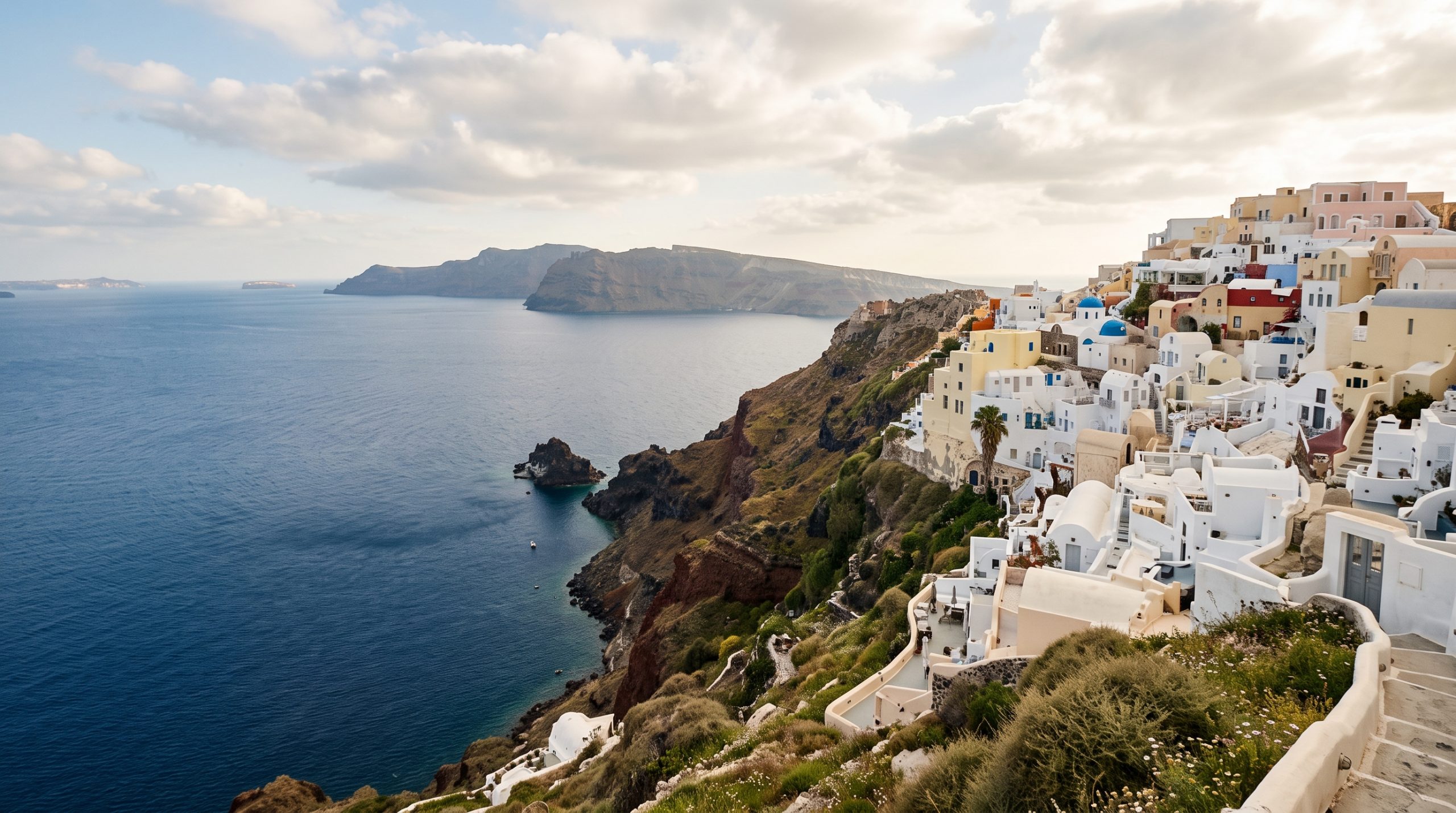
Mid-December, the sun goes down over the caldera at 17:05. Mid-June, it goes down at 20:38. Three and a half hours of difference on the same rim, and that gap decides almost everything about a day here: when you eat, when you say your vows, and whether the lane above Ammoudi is a corridor of shoulders or very nearly your own.
Most month-by-month guides to this island are really about swimming. This one is about light, wind, and how many people are standing between you and the view. We work Santorini in both halves of the year, and our position is straightforward. There is one outstanding fortnight, one runner-up that is very close behind it, and a winter that photographs far better than its reputation, so long as nobody is counting on being warm on a boat.
Below are the numbers we plan from: sunset to the minute for every month, rainfall, the north wind that arrives each summer, and the cruise arrival schedule Greece now publishes itself.
The May fortnight we would take before the rest
The last two weeks of May. Sunset sits at 20:19 mid-month and stretches past 20:30 by the 31st, highs run near 22°C, and May averages only 14mm of rain across three days. The summer north wind has not settled in yet, and peak cruise season has not started either.
Month by month, with the hour the sun actually sets
Sunset times are calculated for the middle of each month at the caldera. Everything else is the long-term average for the island, not a forecast. Read the sunset column first, because it sets your ceremony hour, your dinner and your drive.
| Month | Sunset, mid-month | Conditions | Crowds | Our verdict |
|---|---|---|---|---|
| January | 17:27 | 114mm of rain across 11 days, highs near 14°C | Rim almost empty | Superb light between fronts |
| February | 17:59 | 81mm across 10 days, highs still near 14°C | Villages half closed | Better odds than January |
| March | 18:26 | Drying out, noon sun up to 51 degrees | First coaches late month | Underrated, keep plans loose |
| April | 19:53 | Warming, occasional wet spell | Season opens, sites on summer hours | Good, pack a jacket |
| May | 20:19 | Highs 22°C, 14mm across three days, sea 19.2°C | Busy, not yet peak | First choice, second half |
| June | 20:38 | Highs 26°C, 4mm of rain, UV index peaks at 10 | Heavy from mid-month | Long evenings, early starts |
| July | 20:37 | Highs 28°C, 1mm of rain, north wind at strength | Peak | Works at both ends of the day |
| August | 20:10 | Highs 28°C, sea at its warmest 25°C | Peak, cap of 8,000 cruise passengers a day | Hardest month, we would move it |
| September | 19:26 | Highs 25°C, one rain day on average | Thins out after the first week | Runner-up, second week on |
| October | 18:43 | Mild, clocks go back the last Sunday | Falling away quickly | Excellent to mid-month |
| November | 17:10 | 10 hours 14 minutes of daylight | Gone | Quiet, short, needs a backup |
| December | 17:05 | 102mm across 12 days, 4 hours of sunshine a day | None | For winter-minded couples only |
Greece publishes the clearest crowd calendar on the island without meaning to. The cruise passenger fee at Santorini is currently 20 euros a head in the peak summer months, the highest rate in the country alongside Mykonos, and it steps down to 12 euros in October, April and May, then to a few euros through the winter. That tiering is not a coincidence, it is the shape of the season. Since 2027 the island has also capped cruise arrivals at 8,000 passengers a day, and a port rule now sends up to 70 percent of each ship’s passengers ashore at Ormos Firon below Fira, with no more than 30 percent through Athinios. In practice that concentrates the middle of the day around Fira’s cable car, which is exactly where we are not. Our destination guides cover the same reasoning for other islands.
Latest sunset, the October clock change, and the sea catching up
Four windows on this island are narrow enough to be worth building a date around, and none of them move much from year to year.
- The latest sunset of the year falls on 28 June, at 20:41. The earliest sunrise is two weeks earlier, on 13 June, at 06:00. They never coincide, so a late-June day gives you the longest possible evening rather than the longest possible day.
- The last Sunday in October takes an hour out of the evening overnight. In 2028 the clocks go back on 25 October: Saturday’s sunset is 18:31, Sunday’s is 17:30. A couple who booked a 19:00 ceremony for the fourth week of October and a 19:00 ceremony for the fifth are booking two completely different days.
- The sea takes until June to warm up. It averages 19.2°C in May and 22.8°C in June, reaching 25°C in August. If getting into the water matters to you, that single figure moves your month more than the air temperature does.
- State sites are free on the first Sunday of every month, plus third Sundays from November to March. Those mornings are the busiest of the winter at Akrotiri, so we put ancient ground on a different day.
If your date is still open, our notes on how an elopement is actually built cover the order we work in.
The Santorini months we would move away from, and the windows we prefer
August. Highs of 28°C are manageable, but August pairs them with the strongest north wind of the year and the fullest island of the year, and the two compound. The alternative is 15 to 20 days later: the second week of September holds highs of 25°C, averages a single rain day, and the crowd thins noticeably once the first week is over. Sunset is 44 minutes earlier than in August, which mostly means dinner is earlier too.
Deep winter, if what you actually want is a long caldera evening. December gives 4 hours of sunshine a day and 102mm of rain across 12 days, and the sun is gone by 17:05. The alternative is late March into April, when daylight has climbed back over 12 hours, the rain has largely finished, and the archaeological sites return to their summer timetable on 1 April while the island is still quiet.
None of that is a reason to abandon a date you already care about. Plenty of couples arrive in August because that is when the people they love can travel, and August works when it is built properly: sunrise at 06:36 on the south coast while the wind is still asleep, a long flat middle to the day spent out of the sun, then vows in the last hour before a 20:10 sunset somewhere that is not Oia’s main lane. January works too, on completely different logic, and we would rather build the month you have than talk you out of it.
What the light does: 77 degrees overhead in June, 30 in December
At solar noon in mid-June the sun stands 76.9 degrees above the horizon. Shadows go straight down, the whitewash turns into a reflector, and there is no honest way to make midday look like evening. In mid-December it reaches 30.3 degrees and stays there. That single number is why a winter day here is workable from breakfast to dusk while a June day is worked at both ends and nowhere in the middle.
The direction changes as much as the height. In June the sun sets at about 300 degrees, west-northwest, dropping over open water beyond Thirassia. In December it sets at about 241 degrees, southwest, going down the length of the caldera toward the Akrotiri headland. That is a swing of roughly 60 degrees across the year, so the same viewpoint gives you a different picture behind the same two people depending on the month, and a west-facing terrace that is perfect in February is aimed at the wrong part of the sky in July.
The warm window is shorter than most couples expect, and it is not shortest in summer. Counting from the moment the sun drops to ten degrees, we get about 60 minutes in mid-June, 53 minutes in mid-September, and 65 minutes in mid-December, because a low winter sun descends at a shallower angle. After the sun is down, the usable afterglow runs close to half an hour in every month of the year. You can see what those different windows look like in the finished work in our elopement stories and films, which is the fastest way to tell a May evening from a January one. Highlights reach you five days after the day itself, and the full gallery or film three weeks later.
Winter access: shorter gates, free Sundays, thinner travel days
The summer timetable for the island’s museums and archaeological sites runs from 1 April to 31 October. Akrotiri, the Bronze Age town under its shelter roof, opens daily to 20:00 in summer and closes at 15:30 through the winter, and entry is 20 euros in either season, since the old reduced winter fee no longer exists. Ancient Thera, up on Mesa Vouno, is 10 euros and keeps a much thinner winter timetable, and in the deep winter months we arrange access through the Ephorate of Antiquities of the Cyclades rather than assume a gate will be open. Neither site is a ceremony venue, but both are the kind of hour that makes a two-day plan feel like a place rather than a viewpoint.
Winter travel days carry more slack in our timelines than summer ones, because there are fewer sailings and fewer flights to fall back on if a connection shifts. That costs nothing to build in months ahead.
If you have a month in mind and want to know what it really gives you, Send Us a Message with the dates you are weighing up and we will tell you what the light does on each of them.
A north wind sends us to the south coast
The meltemi is a dry northerly that blows across the Aegean through the summer. It can start in June and run into September, it peaks in July and August, it typically sits at force 5 to 6 and occasionally stronger, and a spell can last several days rather than an afternoon. It also has a daily rhythm: it builds through the day and eases in the evening.
All of that is planning information rather than bad news. The caldera rim from Oia down to Imerovigli faces the wind head on, while the south coast around Vlychada and Perivolos sits in its lee, and the island is small enough that the sheltered side is a short drive rather than a different plan. So a windy forecast moves the day rather than cancelling it: coast in the morning while it is calm, shelter in the middle, vows in the last hour before sunset when the wind is dropping. Long dresses read beautifully in force 5 and short veils do not, which is worth knowing before the fitting rather than after. Aerials run on a permit and a time window, so we confirm both before we plan any part of the film around a drone.
This is where two people on the ground stops being a luxury and starts being arithmetic. In the second week of September the sun goes from ten degrees above the horizon to gone in 53 minutes, and if the wind has pushed the vows into the back half of that window, a single camera operator spends it choosing between a still frame and a moving one. On the Expedition a dedicated photographer and a dedicated filmmaker work the same 53 minutes at once, on the same rim, with audio running on the vows. With eight of us there is always a second camera on the ground and a colleague in reserve, which matters most in the months when the window is narrowest.
Common questions
Is August too hot and windy to elope in Santorini?
No, but it is the month that needs the most structure. Highs sit near 28°C, the north wind is at its strongest, and cruise arrivals run at the daily cap. We start at the 06:36 sunrise, keep the middle of the day sheltered, and place the ceremony in the hour before a 20:10 sunset well away from the busiest villages.
What time should a caldera sunset ceremony start?
Roughly an hour before sunset, which means about 19:40 in mid-June, 18:25 in mid-September and 16:05 in mid-December. That puts the vows inside the 53 to 65 minute low-sun window and leaves the half hour of afterglow afterward for the quiet frames, when almost everyone else has walked away.
Can you elope in Santorini in December or January?
Yes, and it looks like nowhere else. The sun never climbs above about 32 degrees in January, so the whole day is usable, the rim is empty, and sunset lands at a civilised 17:27. The trade is real rain: 114mm across 11 days in January, so the plan includes cave interiors and covered terraces chosen in advance, not improvised on the morning.
How often does rain move a Santorini elopement date?
Between June and September the island averages one rain day a month, so almost never. From November to February it averages 10 to 12 rain days a month, which is when a written alternative earns its place. We do not move the date, we move the hour and the location, both of which are decided before anyone lands.
Will cruise ship crowds end up in our photographs?
Not if we plan around them. Cruise arrivals are capped at 8,000 passengers a day, most come ashore below Fira, and most are back aboard before sunset. Our timeline puts you on the rim early or late, and on the coastline they never reach in between.
Is the sea warm enough to get into in May?
It averages 19.2°C, which is bracing rather than inviting. If you want water as part of the day, June at 22.8°C is the first comfortable month and August at 25°C is the warmest. In May we would use the coast for its light and its black sand instead, and keep your feet dry.
How far ahead do couples book late May and September dates?
Well ahead. We are currently taking bookings for 2027, 2028 and 2029, and the shoulder-season weeks are the ones couples ask about first. A date is held once the contract is signed and the 30 percent retainer is paid, and planning starts from there.
Choosing the date before you book the flights
The most useful thing you can send us is not a fixed date. It is what you want the day to feel like: an empty rim and a fire, or a long warm evening and dinner outside at 21:00. From that we can tell you which fortnight delivers it. A full day with one photographer or one filmmaker starts at $4,900, a full day with a dedicated photographer and filmmaker working together starts at $7,900, and the multi-day Odyssey is quoted from what you want to see, all of it set out on our pricing page.
The whole planning process stays written and easy to revisit, so you can read it twice and answer when it suits you. Tell us the months you are weighing, and whether the sea, the quiet or the light matters most, and we will come back with the shape of a day on each of them. Check Your Date and we will reply within 24 hours.