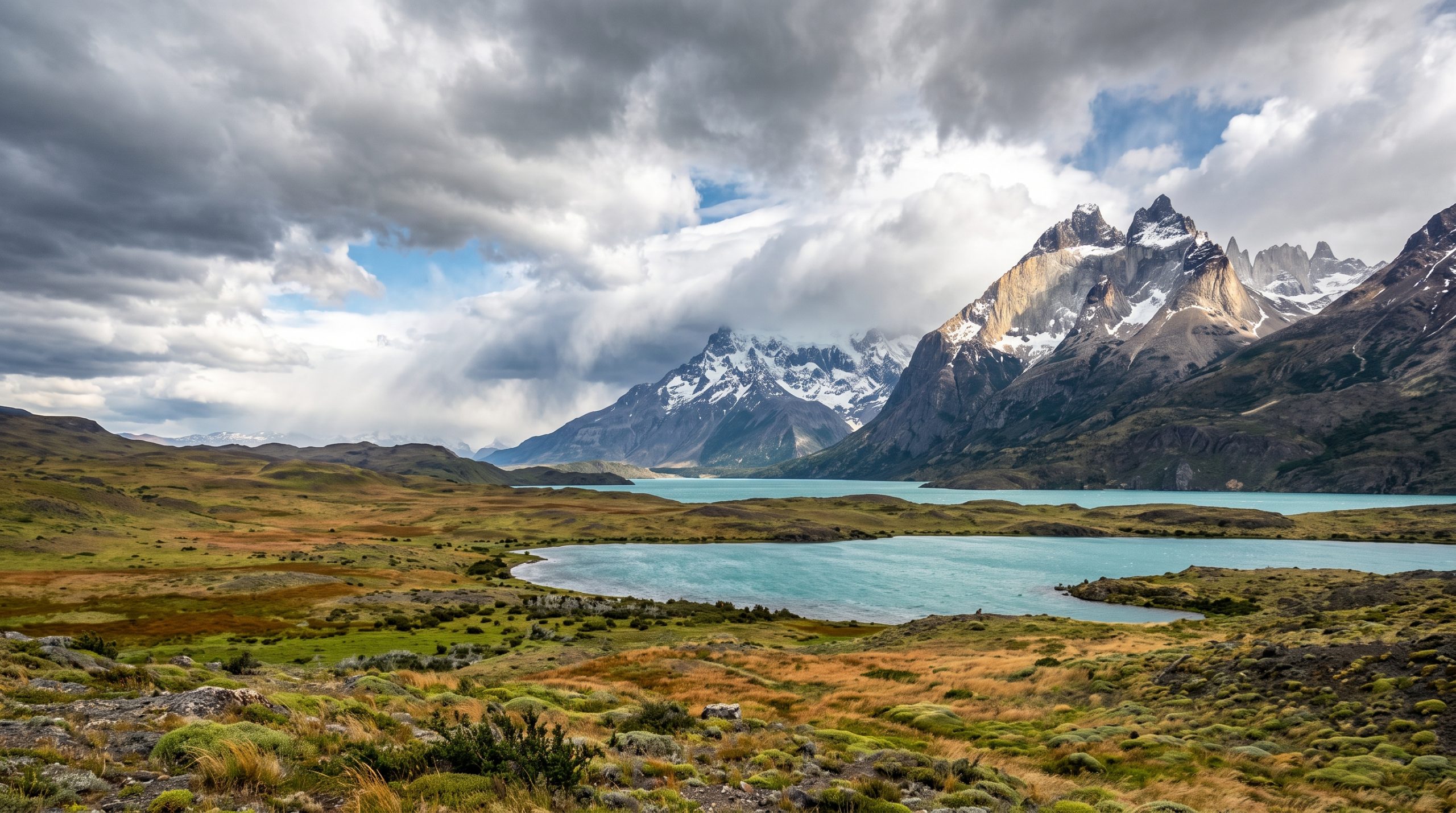
On the longest day of the year in Puerto Natales, the sun comes up at 5:27 in the morning and does not set until after ten at night. Sixteen hours and forty-five minutes of daylight, and the latest sunset of the whole year lands on December 29. Six months later the same town gets under eight hours, with the sun rising close to ten in the morning and gone again before six.
Almost every decision about a Patagonian elopement sits somewhere between those two numbers. Most planning guides will tell you December to February, and they are not wrong about the temperature. February is the warmest month in Torres del Paine, with daytime highs around 11°C. Those same weeks are also the windiest, the busiest, and the ones where the midday sun climbs past 50 degrees and flattens the granite.
We plan and shoot elopements across both sides of the border, from the Cuernos to the Fitz Roy valleys, and the month we would put first is not the one most couples arrive with. Here is the southern calendar as we actually work it, with the light, the wind and the gate dates that decide what a day can hold.
The Patagonia fortnight we would choose first
The last week of March through mid-April. Puerto Natales still gets around ten and a half hours of daylight, the lenga forests turn copper, the summer wind has eased, and the February crowds have gone. Torres del Paine’s full circuit stays open until March 31, so access is still complete.
Twelve months across Torres del Paine and El Chalten
Daylight figures below are for Puerto Natales at 51.7 degrees south, taken at mid-month. El Chalten, two degrees further north, loses about twenty-five minutes of midsummer daylight and gains about twenty minutes at the June solstice.
| Month | Conditions | Daylight | Crowds | Our verdict |
|---|---|---|---|---|
| January | Warm, dry spells, hard wind | 16h10, sunset 10:04pm | Peak | Long light, short patience |
| February | Warmest month, highs near 11°C | 14h27, sunset 9:18pm | Peak | Book early or skip |
| March | Wind drops, first colour | 12h36, sunset 8:18pm | Thinning fast | Excellent from mid-month |
| April | Cool, still, lenga at full colour | 10h34, sunset 7:07pm | Quiet | Our first choice |
| May | Cold, moody, low sun all day | 8h50, sunset 6:11pm | Empty | Beautiful and demanding |
| June | Snow on the low ground | 7h49, sunset 5:45pm | Empty | Better spent elsewhere |
| July | Coldest, highs near 2°C | 8h11, sunset 6:01pm | Empty | Better spent elsewhere |
| August | Clear cold snaps, snow-line low | 9h40, sunset 6:45pm | Very quiet | Good for snow-country film |
| September | Thaw, first refugios open | 11h36, sunset 7:34pm | Very quiet | Underrated, unpredictable |
| October | Spring green, wind building | 13h35, sunset 8:23pm | Light | Strong shoulder option |
| November | Dry, gusts averaging 60 km/h | 15h30, sunset 9:20pm | Building | Best of the long-light months |
| December | Long days, high midday sun | 16h37, sunset 10:04pm | Heavy | Great evenings, hard middays |
Four windows that only stay open a few weeks
Patagonia rewards couples who plan around a date rather than a season. These four windows change the whole shape of a day.
Lenga colour, roughly the last week of March to late April. The southern beech forests here are deciduous. Lenga, Nothofagus pumilio, and its low cousin ñire turn yellow, then orange, then a deep red as the days shorten, and NASA’s Earth Observatory has tracked the change across Torres del Paine and Tierra del Fuego from orbit. The peak moves by a week or two each year with how early the cold arrives. Book the middle of April and you are inside the window in most years; book the first week and you catch it turning, which frames just as well.
The latest sunsets, December 13 to December 29. The earliest sunrise falls on December 13 and the latest sunset on December 29, so the final fortnight of December is the widest working day of the year. A ceremony at nine in the evening still has an hour of warm light behind it.
The full circuit season, November 1 to March 31. Torres del Paine’s complete loop opens and closes on fixed dates, and the back side of the massif is off limits outside them. If your plan involves the far side of the range rather than the front country, those five months are the only ones on the table.
The spring green, mid-October to mid-November. Short, vivid, and the least photographed of the four. The grass on the pampa comes up bright, the guanacos are calving, and the peaks still carry winter snow. It is also when the wind starts to build in earnest, which is a planning problem rather than a reason to avoid it.
June and July, and the swap we would suggest
These are the two months where southern Patagonia gives you the least to work with. Puerto Natales drops to under eight hours of daylight around the June solstice, high ground is under snow, the front-country trails that make a full day possible are limited, and daytime highs in July sit around 2°C. You can absolutely have a ceremony in the snow, and we have built days that lean into it. But you will be working a short window in weather that sets its own terms.
If your date is fixed in the southern winter, the honest move is to shift the map rather than the calendar. June and July are high summer in the northern hemisphere, and the same appetite for wild ground is far better served in the weeks we spend in Iceland, the Lofoten islands and the Dolomites. If Patagonia specifically is the pull and the date can move, September gives you eleven and a half hours of light with snow still on the peaks, and it is the most under-booked month in the whole calendar.
If neither can move, tell us that in your first message. August is the strongest of the cold months, with clear high-pressure snaps, a low snow line and nearly ten hours of daylight by mid-month, and we would build the whole day around a single ninety-minute block of light rather than pretending it is April. Our destination elopement guides cover which regions carry which months.
What the sun actually does at 51 degrees south
This is the part that changes the photographs, and almost nobody writes about it.
In late December, the midday sun in Torres del Paine climbs to nearly 62 degrees above the horizon. That is high, contrasty light, and it is why so many summer images of the Cuernos look grey and hard. The compensation is enormous: the sun does not drop more than about fifteen degrees below the horizon at the solstice, so true night never really arrives, and the warm hours run from roughly eight in the evening until well after ten, then start again before six. A December day gives you two long, generous edges and a difficult middle.
Mid-April is the inverse. The sun never climbs above about 29 degrees all day. There is no harsh middle to work around, the light rakes across the terraces from the moment it clears the ridge, and a ceremony at four in the afternoon has the same quality that a December ceremony has to wait until nine to find. Ten and a half hours of usable light beats sixteen hours with a hole in the centre of it, every time. You can see how both look in our published elopement stories and films, which are grouped by place and season.
Winter goes further again. Around the June solstice the sun tops out near 15 degrees, which means the entire day is technically golden hour. It is just a short one, and it is often behind cloud.
Season decides how we staff a day, too. In April the warm light comes in one continuous run rather than two, and it does not wait. That is the case for a photographer and a filmmaker working the same moment at once instead of taking turns, which is what our two-person coverage is built for. In December the evening is long enough that a single camera can move through it slowly. We will tell you which shape your month calls for, and what that means on our coverage and pricing page.
Gate dates, refugio openings and the shoulder-season shuffle
Access in Patagonia is not a smooth curve. It steps.
Torres del Paine runs a two-tier entrance fee that switches on November 1 and back on April 1, and the same dates govern the full circuit. Refugios and campsites inside the park do not all open together: the ones near the eastern entrance typically open in the second half of September, the central lakeside properties around October 1, and the ones deepest in the valley wait until November. Those dates shift a little each year, so we confirm them against the operators before we build a timeline around a specific overnight.
Across the border, Los Glaciares National Park is open all year, but the southern sector gate that serves Perito Moreno keeps summer hours from September 1 to April 30, opening at 8am and closing at 6pm, then switches to a 9am to 4pm window from May through August. That four-hour difference is the single biggest constraint on a winter day on the Argentine side, and it is why a June ceremony there has to be booked around the gate rather than the light. El Chalten is a different case again: the town is open year-round, but the trekking valleys north of it are realistically in play from November to April.
None of this needs to be your homework. Permit research and logistics guidance sit inside every experience we run, and the sequence of who to ask and in what order is set out in our guide to planning an elopement.
Wind direction picks the location, not the postcard
Ordinary wind in Torres del Paine sits around 20 km/h. Gusts reach 110 km/h, and in November the gusting averages near 60 km/h. Those are design inputs rather than obstacles, and wind is the single most useful thing to plan around in this part of the world.
Here is what we actually do. Every timeline we write for Patagonia carries two or three alternative locations chosen by wind direction, not by preference. A westerly pins you off the big lake shores and sends the ceremony into the lee of the moraine or into forest, where the lenga takes the edge off and the sound stays clean enough to record vows. A northerly opens the eastern viewpoints. We name these before anyone flies, with drive times between them, so the morning decision is a decision and not a scramble.
The ceremony hour moves too. In a shoulder-season plan we hold a primary hour and a fallback four hours later, because a Patagonian front frequently passes through in half a day. Rain here rarely settles in for the whole day the way it does in the tropics. It arrives, it hammers, and then the sky tears open and the light that follows is the best you will get all week. Some of the strongest frames we have made in the south came forty minutes after a squall.
If your date is already locked, send it over and we will tell you honestly what that week tends to do in the south and how we would shape a day around it. Check Your Date
Common questions
How windy is Patagonia in November, really?
Gusts average around 60 km/h in November and the park’s peak gusts reach 110 km/h. In practice that means an exposed lakeshore ceremony is unlikely to work at midday, and a sheltered one twenty minutes away will. November is dry and the light runs to 9:20pm, so we build the ceremony into a lee and take the exposed viewpoints in the evening when the wind usually eases.
When do the autumn colours peak in Torres del Paine?
Roughly the last week of March through late April, with mid-April the safest single bet. The lenga and ñire forests turn yellow, then orange, then red. The peak shifts by a week or two each year depending on when the first hard cold arrives, so we would not build a date around a single weekend of colour.
Can we elope in Patagonia in winter?
Yes, and August is the month we would pick for it. Snow reaches low, high-pressure days can be brilliantly clear, and mid-August still gives close to ten hours of daylight. The day is built around one strong block of light rather than a long timeline, and everything happens on ground that is reliably reachable.
What time would our ceremony actually be in December?
Late. In the last fortnight of December the sun sets after ten at night in Puerto Natales, so we would usually place the ceremony somewhere between seven and nine in the evening and let the light do the work afterwards. Dinner ends up close to midnight, which most couples enjoy more than they expect.
Is one day enough for a Patagonia elopement?
One full day works well if you stay inside a single valley system. If you want both sides of the border, or Torres del Paine and the Fitz Roy valleys in one trip, you need multiple days simply because the driving between them eats a day on its own. Our multi-day Odyssey exists for exactly that.
Should we choose the Chilean side or the Argentine side?
Torres del Paine gives you more variety within a short radius: lakes, pampa, forest and the granite towers within an hour’s drive. El Chalten gives you sharper peaks and a walkable town, with trailheads starting at the edge of it. For a single-day elopement we lean Chilean side. For anything longer, we would use both.
What happens if the weather turns on our date?
We move, and we already know where to. Alternatives are chosen by wind direction and written into the timeline before anyone lands, and the ceremony hour can shift within the day. Fronts here move through quickly, so waiting out a squall is often the plan rather than the fallback.
Choosing the southern fortnight around wind and daylight
Pick April if you want colour, stillness and low sun all day. Pick November if you want long evenings and green ground and you are willing to plan around the wind. Pick August if you want snow and solitude and you understand the day will be short and sharp. All three make strong films and strong galleries, and they make very different ones.
We are currently taking elopement bookings for 2027 through 2029, and southern Patagonia’s good weeks go early because there are not many of them. Everything we do runs in writing, start to finish, so send us the dates you are holding and what you actually want the day to feel like, and you will have a reply and an initial brochure back within 24 hours. Tell Us Your Story