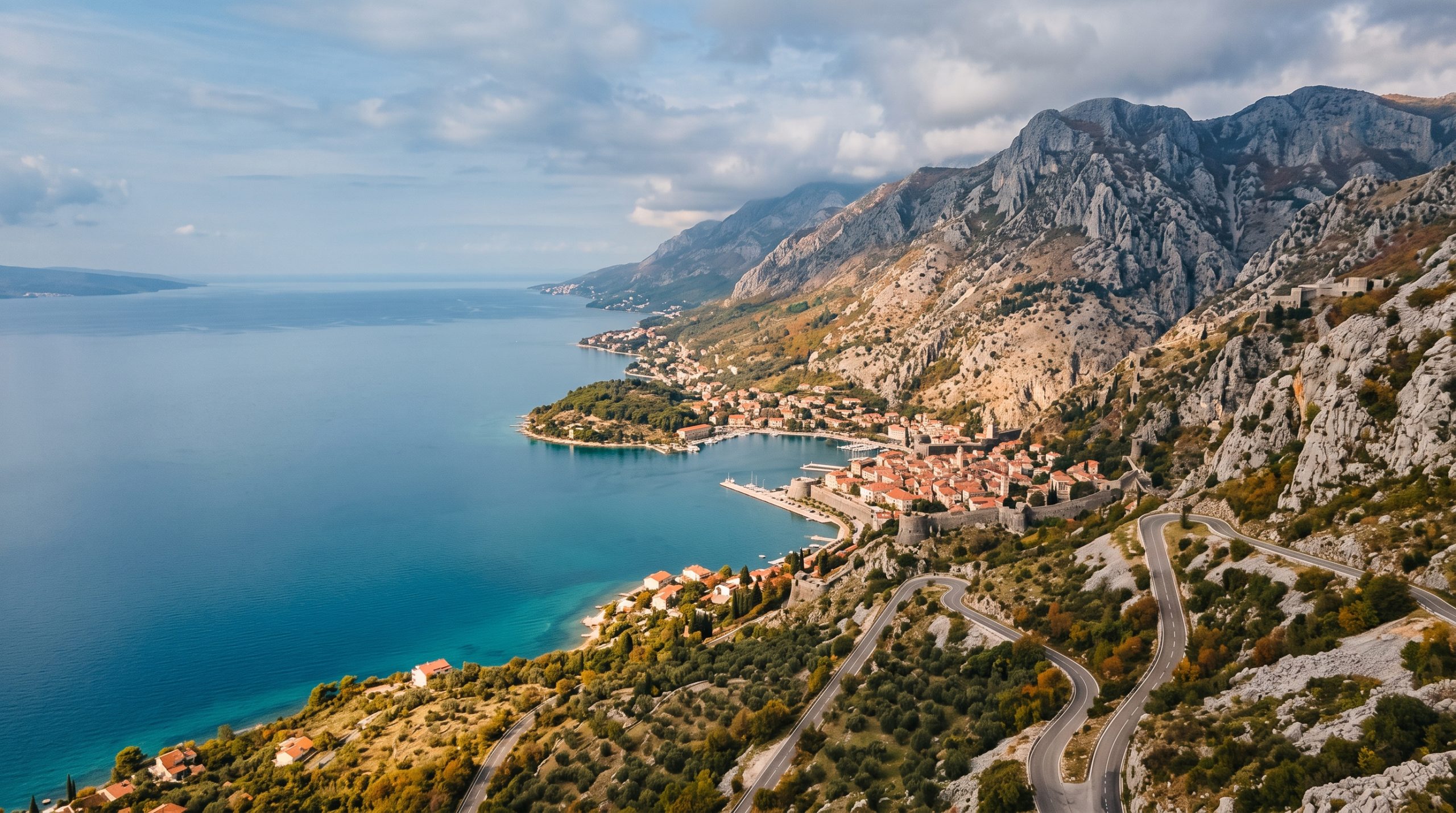
In Kotor the sun goes down twice. There is the time in the almanac, 6:04 p.m. in the middle of October, and there is the moment the ridge behind the old town lifts the last light off the water, which comes a good while earlier. Most planning happens around the first number. Ours happens around the second.
That gap is most of what season means in Montenegro. The country is small enough to reach the Durmitor plateau from the bay inside a morning, and steep enough that a single afternoon can be 28°C on the coast and jacket weather at Sedlo, the 1,907 m pass above Žabljak. Which of those places is open to you, and how many warm hours it hands over, is a question about the month.
What follows is the year in numbers: sunset times and daylight length for the bay, when the water is warm, when the cruise ships fill the old town and when they stop coming, which roads are still under snow, and what we actually do when it rains. Kotor collects well over 2,000 mm of rain a year, so that last part is not filler.
Late September into mid-October, and why we book it first
Late September through the second week of October is the strongest window in Montenegro. The sea still holds its August warmth, mid-September gives about twelve and a half hours of daylight, cruise volume is falling away, and every mountain road is still open. If you want one month named, take the back half of September.
Month by month in the bay and the high country
Sunset and daylight figures below are for Kotor around the fifteenth of each month on the local clock. They move fast at either end of summer: the bay gains more than an hour of daylight between mid-March and mid-April, and loses a similar hour between mid-October and mid-November.
| Month | Conditions in the bay | Sunset and daylight, mid-month | Crowds | Our verdict |
|---|---|---|---|---|
| January | Highs near 10°C, snow sitting on Lovćen | 4:37 p.m., 9h25 | Residents only | Sea level, three good hours |
| February | 2°C to 10°C, hard clear days between fronts | 5:17 p.m., 10h35 | Residents only | Underrated for bay and Skadar |
| March | Hillsides greening, unsettled | 5:51 p.m., 11h55 | Light | Good light, mountains still shut |
| April | Warming, showery, blossom low down | 7:26 p.m., 13h20 | Building | Low country only |
| May | Warm days, flowers on the high pastures | 7:59 p.m., 14h35 | Busy from mid-month | Our spring pick, mid-May |
| June | Warm and mostly settled, longest days | 8:24 p.m., 15h15 | Heavy | Excellent if you start early |
| July | Hottest month, around seven rainy days | 8:20 p.m., 15h00 | Peak | Sunrise vows or high country |
| August | Highs to 28°C, sea near 25°C | 7:47 p.m., 13h55 | Peak, hotels near capacity | Works at 6 a.m., not at noon |
| September | Warm water, softer air, clear evenings | 6:56 p.m., 12h30 | Thinning after the first week | Best all-round month |
| October | Color in the north, big rain arrives late | 6:04 p.m., 11h05 | Quiet by mid-month | First three weeks, very strong |
| November | Wettest month, rain on about 14 days | 4:23 p.m., 9h50 | Empty | We would move you |
| December | Highs about 9°C, shortest days of the year | 4:13 p.m., 9h05 | Empty | Short, moody, sea level |
Four dates that move every year
The turn in the north runs downhill. Color arrives first on the Durmitor plateau around Žabljak, the highest town in the Balkans, then works down into the Tara canyon and the old beech forest at Biogradska Gora over the following two or three weeks. We hold early October for the plateau and keep a lower alternative in the plan, because the whole sequence can run a week either side of where it sat last year.
Snow leaves the passes later than the coast suggests. Sedlo, the highest paved pass in the country at 1,907 m, sits under snow all winter and stays closed until late spring, when the drifts are cleared enough to let cars through. The 49.7 km road from Žabljak to Plužine is narrow with unlit tunnels even in August. A May date in the north gets you Black Lake and the meadows, not the pass, and that is a fine day as long as nobody planned on the pass.
Sea warmth builds late and leaves slowly. The water off Budva is warmest in August at around 25°C, and it gives that heat up gradually through the autumn, which is why a swim after the vows is still realistic in early October and is a brave decision in May.
The cruise calendar is the one nobody checks. Kotor is the third busiest cruise call in the Adriatic after Venice and Dubrovnik, with roughly 500 ships booked into the port across a season. They are alongside early and gone by evening, so the old town has two entirely different populations depending on the hour. From late autumn to early spring the ships stop and the stone streets are just streets.
The Montenegro months we would avoid first
November is the one we argue about most. It is the wettest month in the bay, with rain falling on roughly 14 days, daylight is down to 9h50 by mid-month, and the high roads are unreliable. The move is small: the first three weeks of October give you the same emptiness and the same autumn color with an extra 75 minutes of daylight and a much better chance of a dry afternoon.
Mid-July to mid-August is the other one. The heat is real, the old town is at its fullest, and occupancy around Tivat runs 85 to 90 percent in the peak weeks. Early June solves it with 15 hours of light and water that is already swimmable, and the last week of September solves it better still.
Mid-March looks tempting on paper. Sunset is already at 5:51 p.m., the hillsides are green, nobody is there. What you do not get is the mountains, which are still closed, or settled weather. Mid-May keeps the quiet, adds nearly three hours of daylight and opens the high country.
If your date is already fixed in one of those weeks, none of this applies to you and we would rather solve it than sigh about it. A mid-August day starts at the 5:51 a.m. sunrise with vows on the water at half past six, while the first ships are still coming up the bay, then moves to Lovćen or the plateau for the afternoon where the air is ten degrees kinder. A November day gets built inside its 9h50 window with locations twenty minutes apart and no driving after dark. Send us the date you are holding and we will tell you honestly what that week gives, or which fortnight would give more. Our guide to planning an elopement covers the shape of the day itself.
What the light does between December and June
The swing here is bigger than most couples expect. The longest day in Kotor carries 15h17 of daylight; the shortest carries 9h03. That is 6h13 of difference, and it changes the entire shape of a day rather than just its length.
Midsummer gives you a long, generous tail. The latest sunset of the year falls on 27 June at 8:27 p.m., and sunset itself takes about 39 minutes at this latitude, so a ceremony at half past seven still has warm light behind it and then a slow blue half hour on the water. December works the opposite way. The sun sits only about 24 degrees above the horizon at midday, which means the whole short day is low, raking, forgiving light with no harsh noon to plan around, and it ends quickly once the ridge takes it.
Geography matters as much as the calendar. Kotor sits directly beneath its eastern wall, so morning reaches the waterfront long after the official sunrise, while Perast and the two islands offshore pick up first light noticeably sooner. In June we can put vows at 7:30 p.m. and still have an hour of light to work in afterwards. In December the same hour of light means vows at half past two. You can see what each end of the year looks like in our elopement stories and films, which is the fastest way to decide if you want the long June gold or the low December grey.
Tell us the month you are circling and we will send back what the light does that specific week: Check Your Date.
Sedlo, Krstac and the ferry: what is open when
The north stays reachable in winter, just differently. Žabljak sits high enough to run a ski season, so a January day at Black Lake is a snow day rather than a closed door, while Sedlo above it is out of the question until spring. Lovćen is the one that catches people: the Krstac serpentine up from Kotor and the road in from Cetinje both take snow and ice in midwinter, so we build January and February days at sea level and treat a clear run up to the mausoleum ridge at 1,657 m as a bonus rather than a plan. The park charges a small entrance fee per person at the gate all year.
The Kamenari to Lepetane ferry across the narrows runs year round and takes minutes, which saves the long loop around the inner bay and is worth building into any timeline that crosses from Tivat to Perast. On arrivals, Podgorica flies through the winter while the Tivat schedule thins outside summer, and coming in through Dubrovnik adds a border crossing to your transfer. Our destination guides go further into the regions.
Paperwork has a season too. Civil marriage runs through the municipal registry office of the town you marry in, with documents from home translated and legalized, and some of those papers have a short validity window. We sequence them against your month rather than the month you signed, and we do the permit research and the landowner conversations for the locations themselves. The permit fees are paid by you; the finding out is ours.
The rain plan, written before anyone lands
Nobody sells weather honestly by promising it. November brings rain on about 14 days and even July averages around seven, so the plan has to assume some of it. What matters is that the alternatives are chosen by wind direction before anyone gets on a plane. When the jugo comes up from the southeast it brings grey and swell, and we work the sheltered inner bay at Risan, Perast and the Verige narrows. When the bora drops in from the northeast it scrubs the air clear and puts a hard chop on the open water, which is the day to be high on Lovćen with visibility for fifty miles. When a front parks on the Adriatic entirely, the Skadar side or the north often sits outside it.
The hour moves; the day does not. Every timeline we write has two location sets, a ceremony hour that can slide by a few hours, and the drive between them costed in real minutes rather than optimistic ones.
Season is also the honest argument for two of us working at once. A December day in the bay gives perhaps three genuinely good hours, and a photographer and a filmmaker covering the same fifteen minutes together is the only way that hour becomes both a gallery and a film. In June, with 15h15 of daylight, there is room to work slowly and one person can carry the day. We are eight, so there is always a second camera on the ground and a colleague in reserve; the shapes of coverage and what each one includes are set out on our experiences and pricing page. Highlights reach you five days after the date, and the full gallery or film three weeks after that.
Common questions
Is October too wet to elope in Montenegro?
The first three weeks are not. The wet peak is November, when rain falls on roughly 14 days in the bay, and October’s serious rain usually arrives at the very end of the month. Mid-October also still carries 11h05 of daylight, which is over an hour more than mid-November.
Can we get up to Durmitor and Black Lake in April?
Black Lake and the meadows around Žabljak, usually yes. Sedlo, the 1,907 m pass, no: it stays snowbound until late spring. We plan April days in the north on lower ground and around water, and we keep the bay as the alternative if the plateau is still white.
What time do the cruise ships clear out of Kotor?
Most are alongside in the early morning and gone by evening, and roughly 500 of them are booked into the port across a season. That is why we put vows either before the first tender or after the last one, and it is the single biggest difference between a crowded morning and an empty one.
Will the sea be warm enough to swim in after the ceremony in early October?
Usually, yes. The water off Budva peaks near 25°C in August and lets go of that warmth slowly, so early October is still comfortable for most people. May is the opposite trap: warm air, cold water.
We can only travel in August. Can that still work?
It can, and we have a specific shape for it. Sunrise in mid-August is 5:51 a.m., so vows go on the water around half past six with the bay to yourselves, breakfast follows, and the afternoon moves up to Lovćen or the plateau where it is meaningfully cooler. Tell us your dates and we will build the day backwards from that sunrise.
How far ahead do people book a September or October date?
We currently have dates open across 2027, 2028 and 2029, and the last week of September through mid-October is the stretch we are asked for most. A date is held once the contract is signed and the 30 percent retainer is paid, and planning starts from there.
Picking your date, 2027 to 2029
If you take one thing from all of this, take the back half of September: warm water, twelve and a half hours of light, open roads, and the ships thinning out. If your month is fixed elsewhere, that is a design problem rather than a compromise, and we have shapes for every month in the table above.
Everything with us happens in writing, at whatever hour suits you. Send the month you are thinking about and anything you already know about the day you want, and you will have our reply and first brochure within 24 hours, with an honest read on what that week in Montenegro actually does. Tell Us Your Story