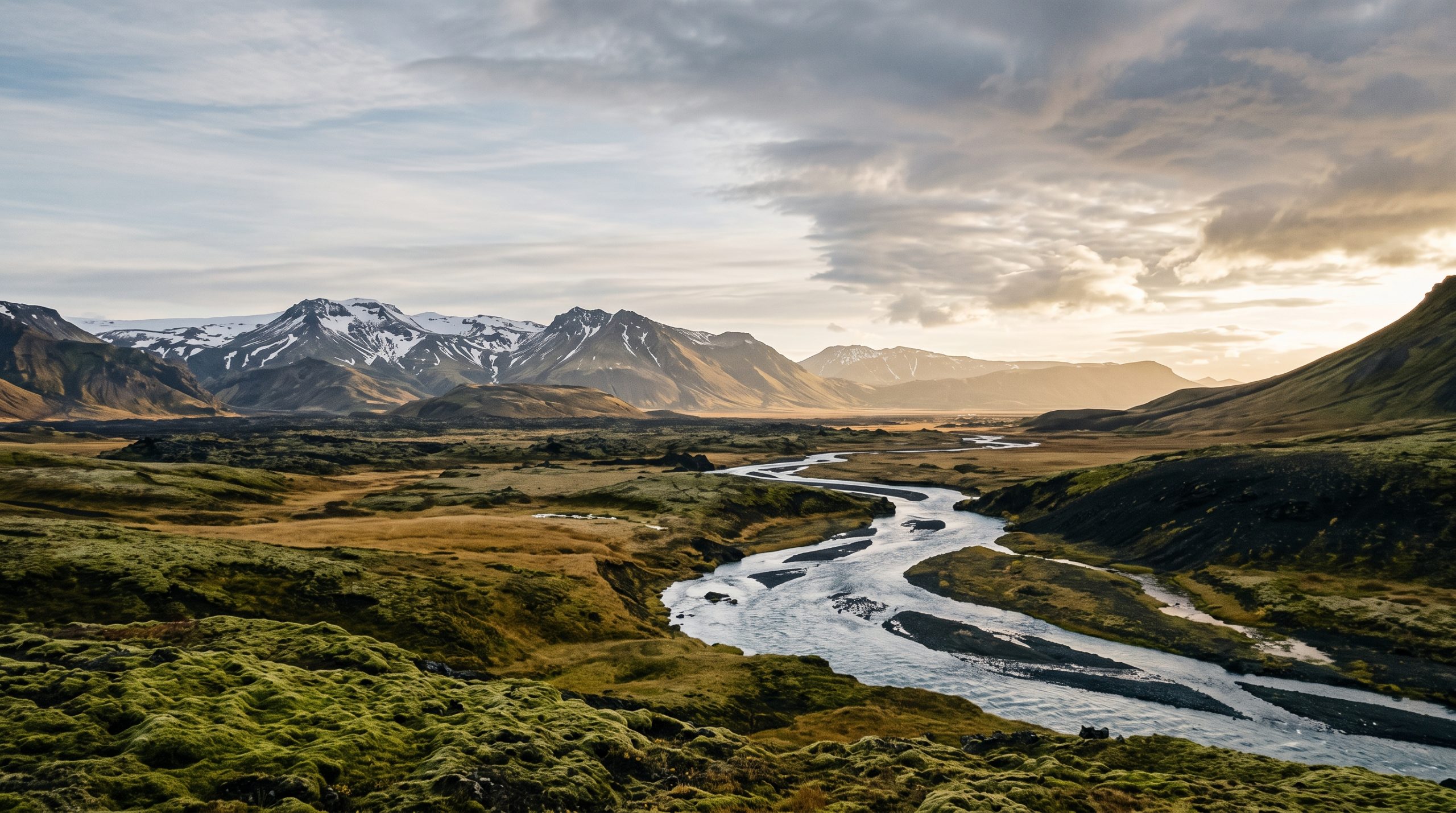
Iceland’s year is really one number moving. In mid-December, Reykjavik gets four hours and twenty minutes of daylight. In mid-June it gets twenty-one. Almost everything else about eloping here follows from that curve, including how many locations fit into one day and what hour a ceremony can sit at.
The second number matters more, and almost nobody publishes it. At 64 degrees north the midday sun runs from roughly 2 degrees above the horizon at the winter solstice to 49 degrees at the summer solstice. For 62 days between late November and late January, the noon sun over Reykjavik never climbs past 6 degrees. The day is short, and all of it is the low, raking light most places get for forty minutes at dusk.
What follows is the year as we plan it: daylight and sunrise times month by month, the windows that open and close on a two-week hinge, the months we would move a couple off and where we would move them to, and the weather plan we write before anyone flies.
The twenty days we book first
September 1 to 20 is the strongest elopement window in Iceland. Reykjavik still holds 13 to 14 hours of daylight, sunrise sits near 6:20 and sunset near 20:30, true darkness has just returned for aurora, autumn colour is turning across the interior, and the highland roads have not yet shut for winter.
The year in one table: hours, ground, verdict
Daylight figures are for Reykjavik on the 15th of each month. Iceland stays on GMT all year, so these times hold from year to year within a minute or two. Average temperatures in the capital run from about 0.5 C (33 F) in January to around 12 C (54 F) in July.
| Month | Daylight, mid-month | Sunrise to sunset | Ground and access | Crowds | Our verdict |
|---|---|---|---|---|---|
| January | 5h 20m | 10:57 to 16:16 | Ice caves running, highlands closed, snow on the south coast | Lowest of the year | Five hours, all of it gold |
| February | 8h 30m | 09:27 to 17:57 | Ice caves running, most ring road sites reachable | Still quiet | Winter’s best trade |
| March | 11h 35m | 07:50 to 19:25 | Snow retreating, ice caves into their last weeks | Building slowly | Dark nights plus a real day |
| April | 15h | 05:59 to 20:57 | Highlands closed, ground bare between snow and green | Moderate | The in-between month |
| May | 18h 20m | 04:15 to 22:32 | Green returning, highland roads still shut, puffins arriving | Rising fast | Long days, few people |
| June | 21h | 02:57 to 23:58 | Lupine at peak, highland roads opening mid to late month | High | Book the first half |
| July | 19h 50m | 03:38 to 23:29 | Everything open, warmest ground and warmest water | Peak of the year | Open access, shared views |
| August | 16h 30m | 05:16 to 21:49 | Highlands open, real night back from mid-month | High, easing late | Late August is underrated |
| September | 13h 10m | 06:48 to 19:59 | Autumn colour, highland roads on borrowed time | Falling away | Our first choice |
| October | 10h | 08:15 to 18:12 | Highlands closing, ice caves not yet in season | Low | First half only |
| November | 6h 35m | 09:54 to 16:31 | Ice cave season opens, coastal ground often clear of snow | Low | Long night, short gold |
| December | 4h 20m | 11:15 to 15:30 | Ice caves running, one workable block of light | Moderate near the holidays | Four hours, no waste |
Windows that open and close on a two-week hinge
Several of the things couples come here for are not seasons. They are short openings that shift a little each year, worth building a date around rather than hoping to catch.
Midnight sun. Reykjavik holds twenty or more hours of daylight from about June 1 to July 13. On June 21 the sun rises just before 3:00 and sets just after midnight, and the sky never goes fully dark. Bright nights run roughly six weeks either side of the solstice, so a 22:30 ceremony is normal in that stretch.
Lupine. The Nootka lupine that turns whole hillsides violet was introduced last century to hold thin soil together. Peak colour runs mid-June to mid-July, and the south coast flowers a week or two ahead of higher inland ground. A date in late July usually means fields going over.
Real darkness returning. This is the one that catches people out. Astronomical night disappears over Reykjavik around April 11 and does not return until roughly September 3, with usable deep twilight back about two weeks earlier in mid-August. Aurora season runs September to April, the darkest nights fall between November and January, and dark hours pair most dependably with settled weather in late September to October and again from late February into March.
Ice caves. Natural glacier caves under Vatnajokull are a November to March proposition, visited with a guide, and the season is set by sustained cold rather than by a calendar. The man-made tunnel inside Langjokull is open year round, which is a different look entirely and worth knowing if your date sits outside winter.
Puffins. The cliff colonies fill from late April into May and empty through early August. June and July are the certainty.
If one of these has to be in your film, tell us which when you first write in, because it decides the date before it decides anything else. Our destination guides go deeper on where each of them sits on the map.
April, and the back half of October
Two stretches of the Icelandic year give you less than the months either side of them, and we would rather say so than take the booking and hope.
April is the honest gap. Mid-month gives 15 hours of daylight, which sounds generous, but astronomical night has gone, so aurora is off the table from around April 11. The highlands are still under snow. The ground sits between states, last winter’s cover pulled back and this summer’s green not yet in, so wide frames read brown and flat in a way they never do in March or June. For dark skies with a workable day, mid-March gives you 11 and a half hours of light and a full night on top of it. For green, mid-June is only eight weeks later.
The back half of October and the first days of November sit in a similar squeeze. Daylight drops from 10 hours in early October to under 7 by mid-November, the highland network has closed, and natural ice caves are not yet dependable. Two weeks earlier, in mid-September, you get 12 and a half hours and autumn colour at its best. Or wait for February: 8 and a half hours, ice caves running properly, aurora nights that start at a reasonable hour.
None of that makes a fixed April date a problem. It means we plan it differently. April days get built on low ground and water: waterfalls at full meltwater, river mouths, black sand at low tide, moss returning on the lava. The ceremony goes in the last ninety minutes before sunset, when the sun drops under 6 degrees and the coastline goes warm at once. Send us the week you hold and we will tell you what it offers, not what the month is known for.
What the sun does at 64 degrees north
Latitude changes photography more than weather does. Because the sun tracks so low and so slowly, the good light is not one hour long. In September the window between sunrise and 6 degrees of altitude runs a little over an hour, and the evening does the same coming down. In mid-June it stretches to almost two hours, though the trade is a midday sun 49 degrees up, which is hard light and not what anyone pictures when they imagine an Icelandic summer.
Midwinter inverts the problem. From November 22 to January 22 the noon sun never passes 6 degrees, so there is no harsh hour to avoid. Everything between 11:15 and 15:30 in December is the light you would normally wait all day for. There is simply very little of it, moving fast, in a country where the next location is forty minutes away.
That is where having a photographer and a filmmaker working at once stops being a preference and becomes arithmetic. A four-hour December day cannot be shot twice. When one of us holds the vows in stills while the other runs audio and motion on the same moment, nothing is repeated for a second camera and the hour stays yours. A long June evening is the opposite luxury: three hours of usable gold, room to walk further and let a ridge line come to you. Both shapes are visible in finished work across our stories and films.
One more thing nobody expects. Around both equinoxes the day length shifts by about six and a half minutes every twenty-four hours, so a ten-day trip in late September moves more than an hour between arrival and departure. The timeline gets built against your date, not the month.
Highland roads, guides and the seasonal locks
Access, not weather, usually decides whether a location is possible on a date. The interior runs on Vegagerdin, the Icelandic Road and Coastal Administration. Mountain roads do not open on fixed dates. Each is inspected and released individually, with snowpack the biggest factor and wet ground a common cause of a late opening. Vegagerdin publishes a highlands map through spring and early summer showing which routes are through, keeps conditions current on road.is, and staffs its watch line, 1777, around the clock. In practice the network comes open across the second half of June and into early July, easier routes first, and closes again from late September into October.
So a highland ceremony is a July or August plan, occasionally a very late June one, and never a May one. Coastal and lowland Iceland stays reachable all year, which is why almost every winter elopement we plan lives on the south coast, the Reykjanes peninsula, or Snaefellsnes.
Two other locks matter. Natural ice caves are guided-only and only exist from November to March. Glacier terrain means a qualified guide in every month, summer included, which shapes the timeline more than the paperwork does, because it pins a fixed start time onto a day you would otherwise run on light alone. Our guide to planning an elopement covers how those fixed points get sequenced.
How we build the Iceland fallback before you arrive
Iceland’s south side takes more than 1,300 millimetres of precipitation a year, about 51 inches, and genuinely calm, clear spells are rare in any season. Planning around good weather is not a strategy here. Planning around wind direction is.
Every timeline carries named alternatives rather than a vague fallback, chosen by where the wind is coming from rather than by how close they are. A northerly puts us on the south-facing side of a headland. A southerly moves the coastal hour into a river valley or a lava field with height behind it. Ceremony hours are written to move by two or three hours inside the same day, because a front here usually passes rather than settles. Aerials run on a permit and a time window, so we confirm both in advance and plan the film to work with or without them.
None of it is improvised on the morning. The alternatives, the moveable hour and the drive times are in your timeline before you fly, which is why the plan holds when a road opens late or a guide moves a start time. What that planning covers, and the two shapes of coverage it sits inside, are set out on our pricing page.
If you have a month in mind, or a fixed week you cannot move, that is the useful thing to send us. Check Your Date and we will tell you what the light and the access do that week.
Common questions
What is the single best month to elope in Iceland?
September, and specifically the first three weeks. You get 13 to 14 hours of daylight, sunrise around 6:20 rather than 3:00, aurora nights back from about September 3, autumn colour, and highland roads still open. Late August is the close second, with three more hours of daylight and slightly more company.
Can we actually see the northern lights on our elopement day?
Between September and April, yes, and nobody can promise it for one named night. Aurora needs darkness, solar activity and a gap in the cloud at the same time. Over a single night the odds are ordinary. Over four or five nights they get good, which is why we build the aurora attempt as a separate late outing rather than pinning it to the ceremony. When it stays away, those hours still give you deep blue twilight over snow.
Is December worth it with only four hours of daylight?
It is, for the right couple. Mid-December gives you four hours and twenty minutes between 11:15 and 15:30, and because the noon sun never rises above about 3 degrees, all of it looks like sunset. We plan two locations rather than five, keep drives under forty minutes, and put the ceremony mid-block. Ice caves are running, and night starts early enough that aurora fits the same day.
When do the highland roads open, and can we get married up there in June?
Mountain roads are released individually by Vegagerdin after inspection, mostly across the second half of June and into early July, with snowpack deciding the exact date. Early June is not a highland plan. If your date is in June and the interior matters to you, we build on lowland and coastal ground and look inland only for the last days of the month.
How early do we have to get up in June?
Less early than you would think. In mid-June the sun rises at 2:57 and sets at 23:58, with the best light at both ends. Most of our June couples sleep normally, start in the late afternoon, and use the 21:00 to 01:00 stretch for the strongest hours. If you would rather have a 3:00 start on an empty coastline, say so and we will build the day the other way around.
Will rain ruin the day?
No, and we plan as though it is coming. The south side takes over 1,300 millimetres a year, so a dry day is luck, not a plan. Rain here moves through in bands, so a ceremony hour that can slide by two or three hours matters far more than an umbrella. Some of our strongest work happens twenty minutes after a squall clears.
How far ahead do couples book an Iceland date?
We are currently taking 2027, 2028 and 2029 dates. September and the first half of June are the two windows couples ask for most, since both are narrow rather than long. Send your date whenever you have it, even loosely held, and we will tell you what is open.
Start with the date; we will build the light around it
Iceland does not have a bad month. It has twelve months that each want a different day built around them, and the useful part starts with which one draws you and what you want to be doing at the best hour of it. We keep the planning in one written thread, so you can read and reply in your own time, and our first reply and brochure reach you within a day.
Tell us the week, or the month, or just the year. Tell Us Your Story and we will come back with what that date offers, where it puts you, and how we would shape the hours.