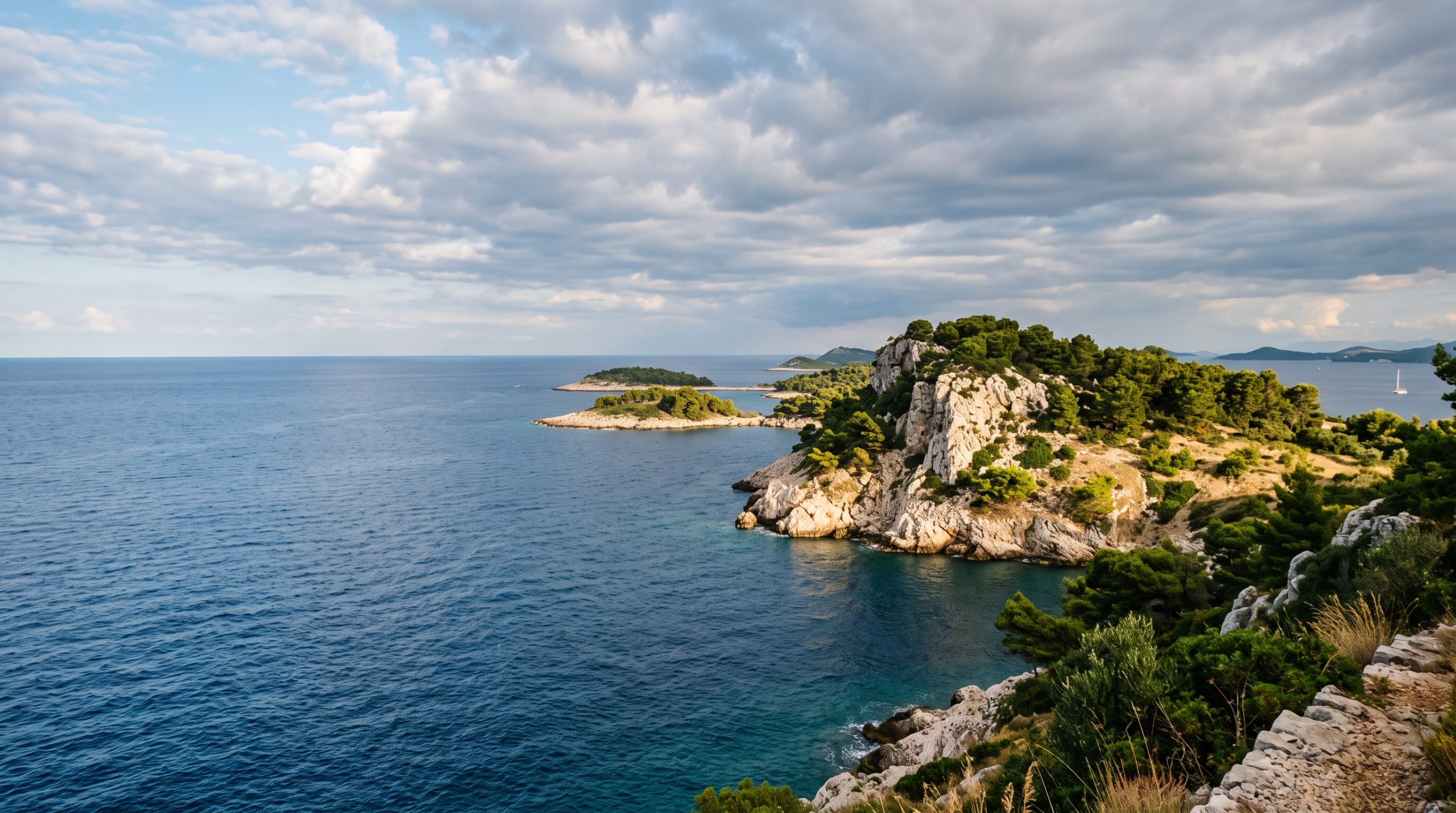
Dubrovnik’s longest day runs 15 hours and 22 minutes. Its shortest runs 9 hours and 5 minutes. That gap of just over six hours is the most useful number on this page, because it decides everything downstream: what hour a ceremony can sit, how long the warm light lasts afterward, whether the evening ends with a swim or with a jacket at four in the afternoon.
Croatia is not one climate. The Adriatic coast is Mediterranean and mild, while Plitvice sits inland and high and behaves like a different country in January. Almost every couple who writes to us wants the coast, so the figures below are anchored on Dubrovnik, with notes for the islands, Split and Istria where they pull away from it.
We have worked here in the third week of June, when the sun stays up until half past eight and the old town is still warm at eleven at night. We have also worked here in the first week of November, when the best hour of the entire day happened at nine in the morning on a beach with nobody else on it. Both days were good. They needed completely different plans.
The Adriatic ten-day window we would choose first
Take the last ten days of September. The sea is still warm from summer, sunset lands near 6:40pm, and the crowd that filled the Adriatic through August has gone. You get a long working day, low evening light on the stone, and coastline you can have almost to yourselves.
Twelve months on the Adriatic, coast first
Sunset times below are for the middle of each month in Dubrovnik. Split runs a few minutes later and Istria later again, which matters more than you would think once a ceremony, a drive and an evening on the water have to fit into one day.
| Month | Conditions and sea | Sunset, mid-month | Crowds | Our verdict |
|---|---|---|---|---|
| January | Average high around 11C, sea near its annual low of 14C | 4:39pm | Empty | Old town walls to yourselves |
| February | Cold wind days, then extraordinary clarity behind them | 5:19pm | Empty | Underrated if you stay flexible |
| March | Hillsides green, water still cold | 5:54pm | Quiet | Strong light, no swimming |
| April | Warming fast, showers that pass in an hour | 7:29pm | Filling slowly | Best month inland |
| May | Reliable and green, sea still bracing | 8:03pm | Busy and growing | Our second choice |
| June | Hot by noon, latest sunset of the year on June 27 | 8:27pm | Peak begins | Finest evenings, hardest middays |
| July | Driest month: about 35 mm across 7 rainy days | 8:24pm | Full | Sunrise work or nothing |
| August | Average high 28C, sun out 81 percent of daylight | 7:50pm | Fullest of the year | Start at 5:54am |
| September | Warm sea, softer air, thunder possible late | 6:58pm | Collapses after week one | Book this one |
| October | Mild, first sustained rain, vineyards turning | 6:06pm | Quiet by mid-month | Excellent for Istria |
| November | Wettest month, rain on around 13 days | 4:25pm | Gone | Short day, enormous skies |
| December | 125 hours of sunshine all month, sea back to 14C | 4:15pm | Gone | Ceremony by 2:30pm |
Two patterns run through that table. The light peaks six weeks before the heat does, and the crowd does not taper at the end of summer so much as fall off a shelf. Plan against both and the year opens up.
The narrow windows worth planning around
Croatia has no bloom week or ice season that makes or breaks a date. It has three windows that barely move, which makes them unusually easy to plan against.
The long-evening window is the tightest and the most rigid. Sunset holds past 8pm from around the middle of May to the end of July, peaks at 8:31pm on June 27, and the earliest sunrise of the year falls on June 15 at 5:09am. Those dates are astronomy. They do not shift by a single day between 2027 and 2029, so a couple who wants vows finishing at nine in the evening with light still in the sky has a genuine six-week slot and no negotiation available.
The warm-water window drifts later than people expect. The Adriatic sits at a mean of about 14C in January and about 26C in July, and it gives that heat back slowly, so the last week of September is far closer to the July figure than to anything wintry. That is the whole argument for autumn over spring here. May looks better on a hillside and September feels better in the water.
The third window is the crowd. In August 2027 Croatia recorded 4.96 million visitors and 31.1 million overnight stays nationally, according to the Croatian National Tourist Board. By the last week of September the coast is a different place, and by mid-October the island paths belong to whoever bothers to walk them. That drop happens over roughly two weeks, and it shifts by a week or so each year depending on how long the warm weather holds.
August and November, and what we suggest instead
August is the month we push back on hardest. The famous coastal viewpoints are flat and busy at exactly the hour most people arrive at them, the stone throws glare back at you from ten in the morning until six at night, and the water between the islands is full of day boats. None of that is a secret, and none of it rules the month out. August is simply a sunrise month rather than an all-day month.
If your date is fixed in August, here is what we actually do. Mid-August sunrise in Dubrovnik is 5:54am, so we start before it, take the headlands and the water while the light is still sideways, and are finished with the hardest locations before the first tour buses unload. The ceremony moves to the last ninety minutes before a 7:50pm sunset. The middle of the day becomes lunch, shade and a boat, not a working block. Handled that way, August is a strong month with a strange shape.
November is the other one. It is the wettest month of the year in Dubrovnik, with rain on around 13 days, and the mid-month day is down to 9 hours and 47 minutes with sunset at 4:25pm. If you have flexibility, mid-October gives you nearly all the emptiness with two more hours of daylight and a fraction of the rain. If November is the month you want, we go inland and upward, where low cloud sitting in the Plitvice valleys does more for a film than a blue sky ever does, and we build the day around a 9am start.
Either way, the move is the same: tell us the date you are actually working with, and we will tell you honestly which coastline and which hour make that date work. We would rather reshape a difficult month than talk anyone into a different one.
The 71-degree sun and the 24-degree sun
Latitude decides more about your photographs than season does, and Dubrovnik sits at roughly 42.6 degrees north. At solar noon on the June solstice the sun stands about 71 degrees above the horizon, which is close enough to overhead that white limestone becomes a mirror and faces fall into shadow under their own brows. On the December solstice the sun never climbs past about 24 degrees. Every hour of that short day is raking, directional and warm.
What that means in practice: June and July give you three usable hours in the evening and about two after dawn, with a long dead zone in between. December gives you a day that is entirely usable and entirely too short, running from a 7:10am sunrise to a 4:15pm sunset, with the earliest sunset of the whole year falling on December 9. April and October are the balanced months, when the sun tops out low enough to keep faces modeled but the day still runs past eleven hours.
This is also where having a photographer and a filmmaker on the same team stops being a nice idea and starts being structural. In late June you have room to work slowly, shoot the vows, then rebuild a moment for the film twenty minutes later while the light is still good. In December the warm window is under an hour and nothing can be repeated, so both cameras have to be on the same moment at the same time, with the same brief, briefed by the same person. You can see how that reads across a finished gallery and film in the stories we have published from days like these. Photography, film and planning arrive as one booking rather than three, and what that covers is set out on our pricing page.
Gate times, ticket seasons and the last Sunday in October
Croatia’s access calendar is more rigid than its weather calendar, and it catches people out.
Plitvice Lakes changes gear four times a year. From November through March the park runs 8am to 4pm, which in practice means you are inside for sunrise and out well before dusk. April and May open at 7am and close at 7pm, June through August run 7am to 8pm, and September and October return to 7am to 7pm. The winter timetable takes over on the last Sunday in October, the same weekend the clocks change, so an elopement planned for the final days of October and one planned for the first days of November are two different logistical problems. Tickets are timed, sold by the park’s own webshop with a one-hour arrival window at Entrance 1 or Entrance 2, and priced by season: currently around 10 euros in winter, about 23.50 euros in the shoulder months, and roughly 40 euros at the summer peak, with the panoramic train and the electric boat included.
On the coast, the constraint is wind and boats. Dubrovnik sees frequent cold wind between October and April, which is why we plan shoulder-season island days around the leeward side of whichever island we are on, and around the boat timetable before the light. Out of season, the boat decides the day. And the legal side has its own clock: the Croatian Ministry of Foreign Affairs asks couples to contact the registry office in the district where they intend to marry at least three months before the date. That lead time sits comfortably inside our planning, but it does rule out a genuinely spontaneous February. Our guide to planning an elopement covers the paperwork sequence in full, and the country pages in our destination guides go deeper on specific coastlines.
If you already have a month in mind and want to know what it will actually give you, Check Your Date and we will come back with the sunrise, the sunset and an honest read on the crowd.
The wet-morning plan we write before you land
Nobody sells weather, and we do not try. What we sell is a plan that does not depend on it.
Every timeline we build carries a second version chosen by wind direction rather than by preference. If the wind is out of the northeast, the exposed western headlands stop working and the sheltered eastern bays start working, usually within a twenty-minute drive. If a front is crossing at midday, the ceremony hour moves and the rest of the day stays where it is. Rain on Dalmatian limestone is also not the problem a forecast app makes it look. Wet stone goes deep gold under a low sun, the old town empties, and the frames you get in the hour after rain are frequently the strongest of the day.
The arithmetic helps too. Even in November, 13 rainy days leaves 17 dry ones, and Adriatic weather tends to arrive and leave inside a few hours rather than settling in for a week. That is why we plan movement rather than shelter. Two locations on different sides of a ridge, a ceremony hour that can slide by three hours in either direction, and a decision sent to you in writing the evening before rather than taken in a car park in the rain.
Common questions
Is May or September better for eloping in Croatia?
September, for the water and the quiet. May gives you greener hillsides and a sea still sitting well below its 26C July peak, plus a shoulder season the tourist board reports is growing faster than the summer. Late September gives you warm water, a 6:40pm sunset and a coast that has emptied out.
How far in advance do we need to contact a Croatian registry office?
The Croatian Ministry of Foreign Affairs asks couples to get in touch with the registry office in the district where the marriage will take place at least three months before the intended date. Civil ceremonies are conducted by a registrar. We handle the research and the sequencing; the official fees themselves are paid by you.
Will the sea still be warm enough to swim in late September or October?
Late September, comfortably. The Adriatic runs from a mean of about 14C in January to about 26C in July and cools slowly through autumn, so late September water is much closer to the summer figure than the winter one. By late October it is a short, bright, memorable swim rather than a lingering one.
Can we elope at Plitvice Lakes in winter?
Yes, and it is one of the most distinctive days in the country. The park runs 8am to 4pm from November through March and the ticket drops to around 10 euros, so the day is compact and the boardwalks are quiet. Some upper routes run on a reduced circuit in deep winter, which we confirm and design around before anything is fixed.
What happens if it rains on the day we have chosen?
We move the hours, not the date. Your timeline is written with wind-direction alternatives already in it, and we send you the decision in writing the evening before, so you wake up knowing the shape of the day. Passing Adriatic fronts usually clear within a few hours, and the light behind them is exceptional.
Is August genuinely a bad month to elope in Croatia?
It is a demanding month, not a bad one. August 2027 brought 4.96 million visitors to Croatia, so the answer is to work at the edges: start before the 5:54am sunrise, take the coastline early, and put the ceremony in the last ninety minutes before sunset. Plenty of our favorite Adriatic mornings have been in August.
How late can we hold an outdoor ceremony in December?
Aim to finish by around 2:30pm. Dubrovnik’s earliest sunset of the year is 4:15pm on December 9, and the warm light runs for roughly the hour before it, so a ceremony that ends mid-afternoon puts your portraits and the film’s closing sequence exactly where the light is best.
Start with the month, then choose the coast
Most couples arrive with a place in mind and work outward. Croatia rewards the opposite. Choose the month first and the coastline selects itself: September and October for the southern islands and the walled towns, April and May for Istria and the interior, midwinter for the empty stone streets of a Dubrovnik nobody photographs. Our current availability runs across 2027, 2028 and 2029, which is enough runway to pick your ten days rather than settle for whatever is left.
Everything from here happens in writing, at whatever pace suits you. Send us your dates and the shape of the day you have in your head, and you will have a reply and an initial brochure within 24 hours. Tell Us Your Story.