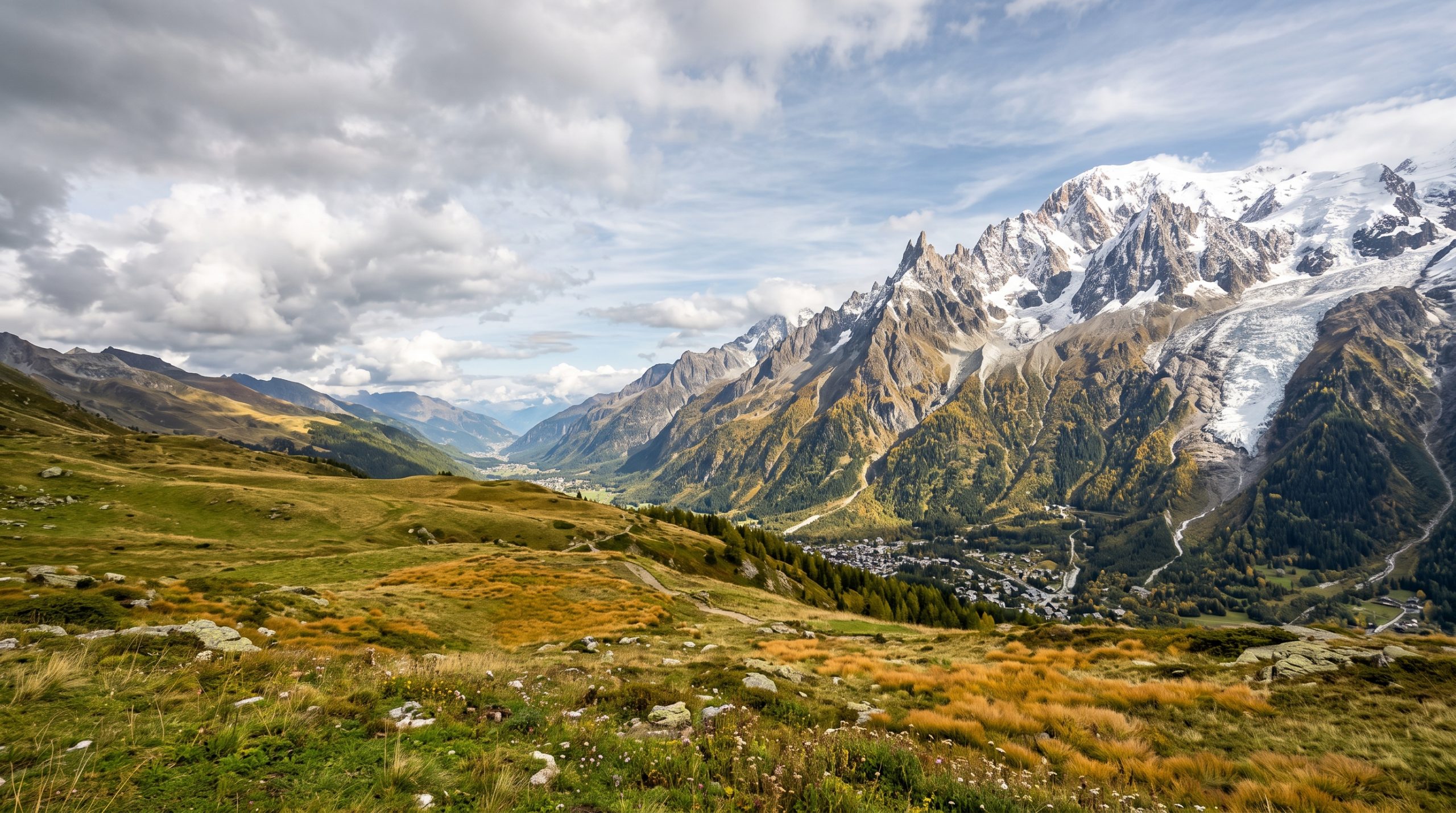
The Aiguille du Midi is named after noon. Stand in front of the church in Chamonix and the sun crosses that summit at midday, which tells you almost everything about light in this valley. The town sits at 1,035 metres with walls rising 2,800 metres above it, so the sun arrives late, leaves early, and spends the winter tracking behind the biggest thing in the frame.
That geometry, plus a lift calendar that opens and closes on fixed dates, is what actually decides when to elope here. Not the average temperature. In the first half of July the sun is up in the valley at 5:56 and the first cable car does not leave until 6:10, so the pink light on the high faces has already come and gone before anyone can reach the summit. In late December the first cabin leaves at 8:10 and sunrise is 8:11, which means a winter couple can be standing at 3,842 metres inside the first hour of light.
Below is what each month gives you, what is running, and the fortnight we would take over all the others.
The two weeks we book first
The first two weeks of September. The Aiguille du Midi, the Montenvers train, Brévent and Flégère are all still turning, the massif reopens to drones on 1 September, the summer crowd has gone home, and close to thirteen hours of daylight give you both ends of the day without a 3am alarm.
Chamonix month by month, and what is actually running
Daylight figures are for the middle of each month unless a solstice or equinox is named. Lift dates shift by a few days each year but the pattern is remarkably stable, and we confirm the published calendar for your date before we build the timeline.
| Month | Conditions | Light | Crowds | Our verdict |
|---|---|---|---|---|
| January | Coldest weeks, whole ski domain running | 9h 01m, sunrise 8:10, sunset 17:12 | Full lifts, empty trails | Best deep-winter look |
| February | Most reliable snow base of the year | Past 11 hours by the 28th | Peak, European school holidays | Take the last week |
| March | Snow high, valley thawing | 12h 06m at the equinox | Thinning after mid-month | Our winter pick |
| April | Spring snow above 2,000m, brown valley floor | 14h 14m by the 30th | Quiet | High ground only |
| May | Ski lifts finished, summer lifts not open | Long days, steep midday sun | Very quiet | We would move your date |
| June | Meadows out low, high lakes still under ice | 15h 48m at the solstice | Building, marathon weekend late | Strong from the 20th |
| July | Warm mornings, afternoon build-up | Sunrise 5:56, sunset 21:21 | Full valley | Only with an early start |
| August | Warmest and most settled, thunder late | 13h 25m by the 31st | Peak, plus UTMB week | Gorgeous, shared |
| September | Settled spells, cold nights, first high snow | 13h 03m on the 7th | Falls away after week one | The one we book |
| October | Driest-leaning month, larch gold | 11h 01m, sunset 18:49 | Very quiet | Second best window |
| November | Aiguille du Midi in annual maintenance | 9h 31m and falling | Empty, much of it closed | Valley-floor days |
| December | Wettest month, around 168mm; domain opens around the 20th | 8h 42m at the solstice, earliest sunset 16:49 | Christmas week busy | Snow-sure after the 20th |
Four windows that move by a fortnight each year
Some of what people come here for is not a month, it is a window, and the window moves.
- The ice cave at the Mer de Glace runs from the start of June to the start of November. Outside those dates the largest glacier in France is still there, but the cut ice and the gallery are not.
- The long-light fortnight sits either side of the June solstice, when the latest sunset lands at 9:29pm. A ceremony at 8pm is comfortable, unhurried and still golden.
- Larch gold arrives on the Vallorcine and Argentière slopes in October. We plan colour days for the middle of the month and keep the following week loose, because a warm September pushes it later and an early cold snap pulls it forward.
- The high-lake thaw. The tourist office lists the Lac Blanc path from Col des Montets as a mid-June to end-October route, snow permitting, and it describes the lake itself as often snow-covered. If you want water rather than ice in the reflection, you want August or September, not June.
None of these are promises. Larch colour, a clear summit and still water are probabilities, and we plan for the version of the day where they do not arrive as well as the version where they do. Our destination guides go further into how each of those days is built.
The between-seasons weeks, and where we move you instead
Two stretches of the Chamonix year are genuinely thin, and both are thin for the same reason: the machinery is off.
The first is November. The Aiguille du Midi closes at the start of the month for its annual maintenance and does not reopen until a few days before Christmas. The Montenvers train takes its own two-week break, the ice cave shuts at the start of the month, and the ski domain does not open until around 20 December. The high summer trails have snow on them but not enough to be beautiful. If you are choosing freely, take the middle of October instead, or the second half of January once the base is in.
The second is the gap between the last ski lift in early May and the first summer lift in June. The Grands Montets typically runs to the first weekend of May, then Bellevue reopens in the first week of June, Brévent and Planpraz around the 13th, Flégère around the 20th. In between you have a valley of brown grass and grey snow patches, and the Montenvers train takes a short annual closure in the middle of May as well. Mid-June is transformed. Late March, with snow still high and 12 hours of daylight, is transformed too.
If your date is already fixed in one of those weeks, say so and we will build for it rather than around it. November on the valley floor is quiet, moody and completely photographable: the Arve running high and grey, the larch forest at the Bois du Bouchet, the stone and timber of Argentière church with fresh snow on the Drus above it. A day like that is not second best. It is a different film.
What the sun actually does here across the year
At the June solstice the midday sun stands 67 degrees above the horizon. At the December solstice it reaches 21 degrees and sits behind the massif for much of its arc. That single difference reshapes everything about how a day here is shot.
In high summer the usable light is at the ends. From late June the sun is up before 5:45 and down after 9:20, which sounds generous until you notice that everything between 10am and 6pm is hard, flat and overhead on snow and pale rock. So a July day starts on the west side of the valley, in the Aiguilles Rouges, where the first light lands on the faces opposite. The summit terrace at 3,842 metres is a mid-morning place in July, not a dawn one, because the first cabin cannot beat the sun.
From mid-September the sun stops climbing so high, the warm hours stretch to nearly two at each end, and side light comes across the glaciers instead of down onto them. This is the reason we push so hard for early autumn. It is also when the valley reads best on film: cold air, long shadows, and a horizon line that holds detail rather than blowing out. You can see how that light behaves in our published galleries and films.
Winter inverts the whole shape. In late December the valley floor loses direct sun in the early afternoon while the Aiguille du Midi is still bright, so the summit becomes the warm-light location and the town becomes the soft, shaded one. There is one good window, and it is short. That is exactly where two people working at once earns its place: on the Expedition a dedicated photographer and a dedicated filmmaker cover the same eight minutes of low sun from different distances, instead of one person choosing between stills and motion while the light goes. Both one-day options and the multi-day Odyssey are set out on our pricing page, and team flights and accommodation are included wherever we travel.
Lifts, trails and the aerial calendar
Access, not weather, is what most often forces a plan to change here. These are the dates that matter, and they repeat closely enough year to year to plan around.
- Summer lifts open in stages through June: Bellevue in the first week, Planpraz and the Brévent cable car around the 13th, Flégère around the 20th, Prarion daily from the end of the month.
- Autumn closes them just as fast: Brévent, Flégère and Bellevue finish in the middle of September, Planpraz and Charamillon around the 20th, the Mont-Blanc Tramway at the end of the month. A late-September plan built on Flégère does not work.
- The Aiguille du Midi is the exception and runs to the start of November, then closes for maintenance until shortly before Christmas. Its first departure moves through the year: 6:10am at the height of summer, 7:10am in mid-June and late August, 8:10am from late September and all winter.
- The Montenvers train serves the Mer de Glace nearly year round with short maintenance breaks in May and November. The round trip is ticketed per person and currently sits around 39.50 euros.
- Aerials are a calendar question. Drones are not flown over the Mont Blanc massif itself through July and August, and the Aiguilles Rouges nature reserve is a no-overflight zone all year. Plan a film that depends on aerial footage for September or October, or let us design it from the ground.
The reserve has other rules worth knowing before you fall in love with a location: no dogs, and swimming is prohibited at Lac Blanc and the Lacs des Chéserys under a prefectoral decree. We handle permit research and the paperwork trail as part of planning, and the fees themselves are paid by you.
Send us the dates you are weighing up and we will tell you what is open, what the light does that week, and which side of the valley we would start on. Check Your Date.
The plan for the day the mountain disappears
Chamonix collects roughly 1,684mm of precipitation a year. December is the wettest month at around 168mm and October the driest-leaning of the ones we recommend, near 119mm. Cloud sitting on the valley is not an unlucky outcome here, it is a normal Tuesday, and a plan that assumes clear skies is not a plan.
So we build every Chamonix day in three layers by altitude. A valley option at around 1,035 metres in forest and river ground, which works in almost anything. A mid-mountain option between 1,900 and 2,300 metres for a cloud base sitting higher than the town. And a summit option at 3,842 metres for the days when the inversion puts you above a white sea with Mont Blanc clean behind it. The morning call is which layer the sky allows, and we make it the evening before and again at first light.
The ceremony hour moves with it. Nothing about a symbolic ceremony in the mountains is fixed to a clock, so if the cloud is due to lift at 4pm, that is when you say your vows. Because the legal marriage happens at home, your date is chosen on light and snow rather than on a paperwork window, which is one of the real freedoms of eloping here. Our guide to planning an elopement covers how that sequence works.
Common questions
When does Chamonix get quiet again after summer?
Within days of the first week of September. European schools go back, the valley empties, and the weather often settles into its most reliable spell of the year. Brévent and Flégère still run until the middle of the month, so you get low crowds with full access.
Can we legally get married in Chamonix as Americans?
French law requires at least one partner to have lived continuously in the commune for 30 days before a civil marriage there, which rules it out for most visiting couples. Nearly everyone marries legally at home and holds their real ceremony in the mountains. It also means no waiting period dictates your date.
Is there still snow in Chamonix in June?
Above roughly 2,200 metres, yes, and the high lakes can still be frozen or ringed with snow into early summer. The valley floor is green, the meadows are out, and the contrast between the two is one of the best things June gives you.
How busy is Chamonix in late August?
Very. The UTMB trail races take over the town and the surrounding paths for a week at the end of the month, and accommodation is scarce well in advance. The two weeks straight after are the calmest of the whole summer.
Can we get drone footage over Mont Blanc in July?
Not over the massif itself. Drones are kept out of that airspace through July and August, and the Aiguilles Rouges reserve is closed to overflight all year. From September the massif reopens, which is one more reason early autumn is our first choice for film.
How short is a December day in Chamonix?
Eight hours and 42 minutes at the solstice, with the earliest sunset at 4:49pm on 10 December. The valley floor loses direct sun earlier still. It is enough for a beautiful day, but it needs a tight timeline and it rewards two cameras working at once.
Is November worth it if that is the only week we have?
Yes, with the plan built around the valley rather than the summits. The Aiguille du Midi is in maintenance and the ski lifts have not opened, so we work the Arve, the forest at the Bois du Bouchet and the hamlets, and let the first snow on the high faces be the backdrop.
What happens if it is raining on our elopement day?
We shift altitude, or we shift the hour, or both. Three locations are chosen before anyone lands, sorted by cloud base and wind, and the ceremony time is deliberately movable. Highlights reach you five days after the day itself either way.
Picking your fortnight for 2027 or 2028
We are booking 2027, 2028 and 2029 now, and September fills earliest for exactly the reasons above. If you have a fixed date, we will tell you honestly what that week in Chamonix does with light and access, and how we would shape the day around it. If the date is open, we will name the fortnight we would choose and explain why.
We keep the whole process in writing, at whatever pace suits you, starting with the form on our contact page and a reply with our brochure inside 24 hours. Tell us the month you keep coming back to and we will take it from there. Tell Us Your Story.